The Unexpected Detection (Image Credits: Cdn.mos.cms.futurecdn.net)
Astronomers have stumbled upon a perplexing cosmic entity billions of light-years from Earth, challenging existing models of black holes and stellar phenomena.
The Unexpected Detection
Researchers first spotted the object through advanced telescopes scanning distant galaxies. This detection occurred as part of routine observations aimed at mapping the early universe. The anomaly stood out immediately due to its unusual energy emissions and gravitational effects. Teams from multiple observatories confirmed the findings over several months of follow-up studies. What began as a faint signal quickly revealed a structure unlike any previously cataloged.
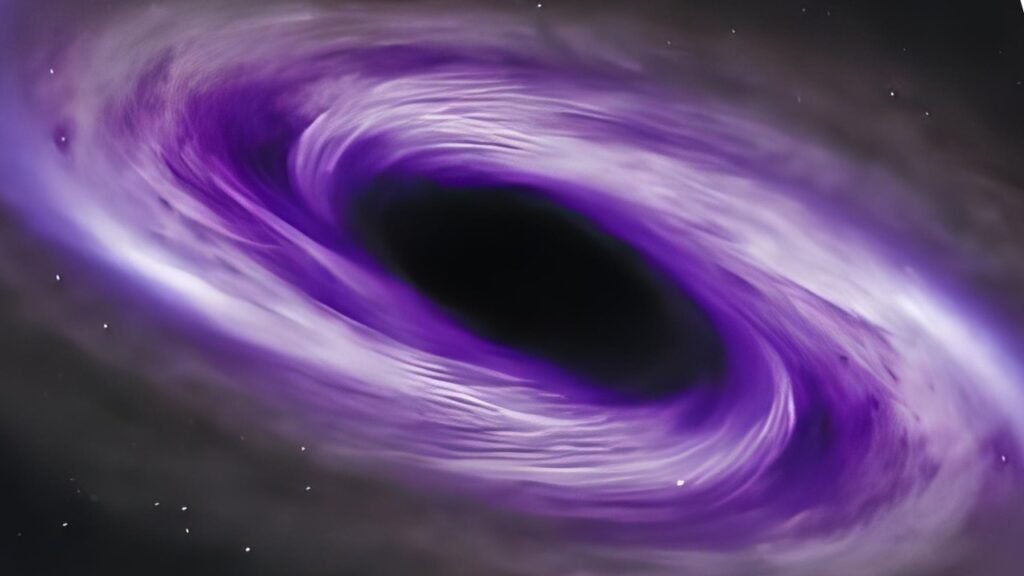
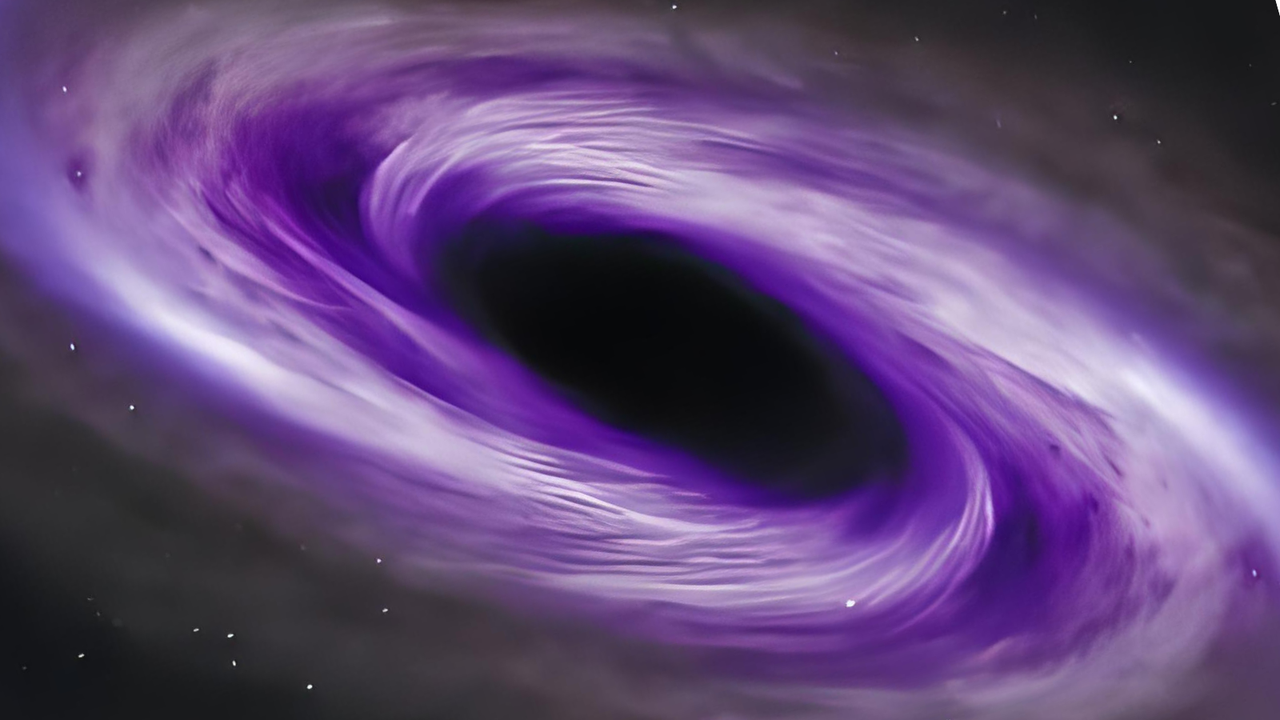
The object’s position, approximately 11 billion light-years away, places it in an era when the universe was still young and turbulent. Such remoteness complicates direct imaging, yet the data painted a clear picture of disruption in its vicinity. Scientists noted how surrounding gas and stars appeared influenced by an immense, unseen force. This force, they determined, stemmed from a central black hole exerting profound pull.
Unpacking the Disruptor’s Traits
At the heart of this entity lies a black hole estimated to hold the mass of one million suns. This supermassive core devours nearby material, creating waves of radiation that ripple outward. Unlike typical active galactic nuclei, this disruptor exhibits erratic behavior, flaring unpredictably and altering the paths of interstellar clouds. Its overall mass aligns closely with that of the black hole itself, suggesting minimal surrounding accretion disk or host galaxy remnants.
Gravitational lensing further highlighted its presence, bending light from background sources into distorted arcs. This effect provided crucial measurements of its density and influence radius. The disruptor’s emissions span multiple wavelengths, from radio to X-rays, indicating high-energy processes at play. Yet, its isolation in intergalactic space raises questions about its formation and evolution.
Theories Behind the Black Hole Heart
Experts propose several hypotheses to explain this object’s origins. One theory suggests it formed from the merger of primordial black holes in the dense early universe. Another posits a stripped-down intermediate-mass black hole that grew through repeated stellar captures. A third idea involves a wandering black hole ejected from its original galaxy via dynamical interactions.
- Primordial merger: Rapid coalescence in the cosmic dawn could account for its size without a visible host.
- Stellar stripping: Surrounding stars fueled its growth, leaving a compact, disruptive remnant.
- Galactic ejection: Violent events in a parent galaxy propelled it into the void, where it now roams freely.
- Dark matter influence: Invisible halos might stabilize its structure, defying standard collapse models.
- Exotic accretion: Unusual feeding mechanisms could sustain its activity without a traditional disk.
Each scenario carries implications for how black holes seed galaxy formation. Current simulations struggle to replicate the observed stability, prompting revisions to theoretical frameworks.
Implications for Astrophysics
This discovery could redefine categories of celestial bodies. If confirmed as a novel type, the disruptor might bridge gaps between stellar-mass and supermassive black holes. It highlights the role of such objects in shaping cosmic web structures. Future surveys may uncover more of these roamers, altering our view of intergalactic dynamics.
Observations continue with instruments like the James Webb Space Telescope, seeking finer details on its composition. Collaborative efforts among global teams accelerate data analysis. The findings, detailed in recent reports from Space.com, underscore the universe’s capacity for surprises. As puzzles like this persist, they drive innovation in detection technologies.
Key Takeaways
- The object, 11 billion light-years distant, features a black hole core equivalent to one million solar masses.
- Its disruptive effects on surroundings suggest a unique evolutionary path, possibly isolated from typical galactic environments.
- This enigma may herald a new class of cosmic entities, prompting deeper probes into black hole diversity.
In the vast expanse of space, entities like this million-sun disruptor remind us that the cosmos holds secrets yet to be decoded. As astronomers push boundaries, such revelations could unlock fundamental truths about our universe’s architecture. What mysteries in the stars captivate you most? Share your thoughts in the comments below.