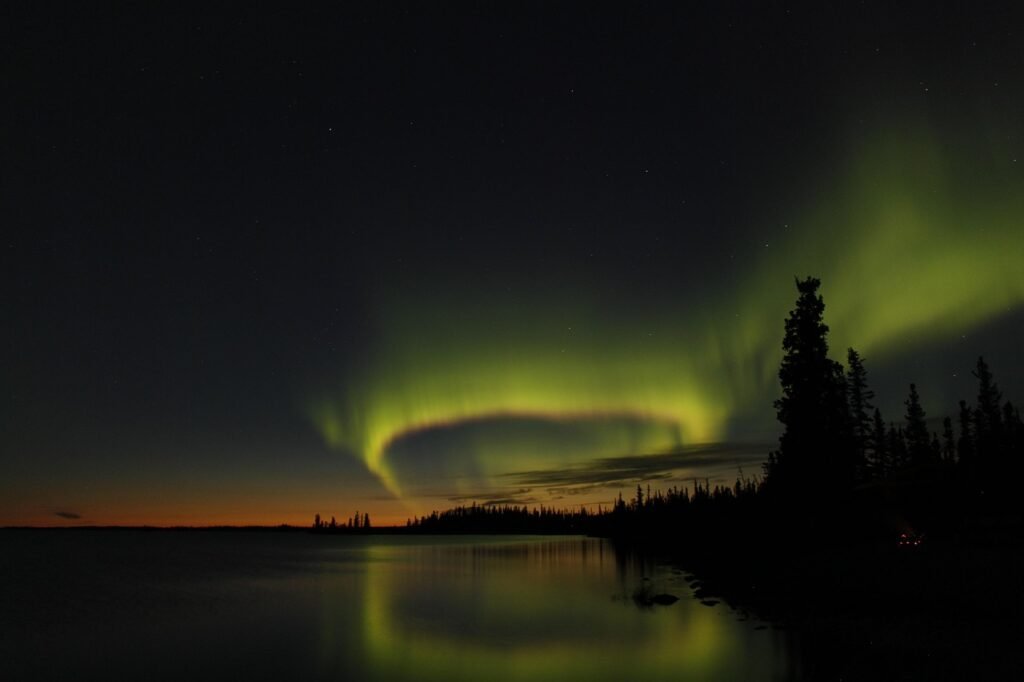

The Solar Surge Behind the Lights (Image Credits: Pixabay)
On January 10, 2026, a surge of solar activity transformed night skies in high-latitude regions into a mesmerizing spectacle of dancing lights.
The Solar Surge Behind the Lights
A moderate geomagnetic storm, rated G2 by space weather experts, swept through Earth’s magnetic field late on January 10. This event stemmed from a coronal mass ejection (CME) that erupted from the Sun days earlier, combined with streams of fast-moving solar wind from a coronal hole. The interaction compressed Earth’s magnetosphere, channeling charged particles toward the poles and exciting atmospheric gases to produce vivid auroral glows.
Charged particles from the Sun’s corona, heated to millions of degrees, formed plasma that escaped the star’s gravity. Satellites like DSCOVR and ACE detected the incoming disturbances about 90 minutes before impact, allowing forecasters to issue timely warnings. The storm’s intensity peaked during nighttime hours in many regions, creating conditions ripe for widespread aurora sightings. Observers reported greens and reds dominating the displays, with occasional purples adding to the ethereal beauty.
Visibility Reaches Unexpected Southern Latitudes
The auroras extended beyond their usual polar confines, appearing as far south as parts of the northern United States and southern Europe. In North America, sightings stretched from Alaska through Canada and into states like Washington, Montana, and Minnesota. European viewers in Scandinavia and the United Kingdom captured the lights streaking across dark horizons.
Forecasters from the NOAA Space Weather Prediction Center had predicted G1 to G2 storm levels, which aligned with reports of visible auroras even under partially moonlit skies. The 49% waning moon provided just enough darkness for clear views in many areas. Social media buzzed with photos from amateur astronomers, highlighting the event’s global reach. High-latitude communities, accustomed to such displays, still marveled at the storm’s potency.
Effects on Technology and Daily Life
While the auroras captivated skywatchers, the geomagnetic storm carried potential disruptions to satellite operations, GPS signals, and high-frequency radio communications. Power grids in vulnerable areas monitored for induced currents, though no major outages occurred. The event underscored the interconnectedness of solar activity and modern infrastructure.
Amateur radio operators noted brief signal fades, particularly on Earth’s nightside. Satellite drag increased slightly for low-Earth orbit craft, prompting minor adjustments. Overall, the impacts remained minor, allowing the focus to stay on the natural phenomenon’s allure. Scientists used the opportunity to gather data on magnetospheric responses, aiding future predictions.
Forecasts Point to Continued Solar Drama
With the Sun in an active phase of its 11-year cycle, more geomagnetic activity loomed for mid-January. Upcoming coronal holes and possible CMEs could spark additional storms, potentially extending aurora visibility. Forecasters urged vigilance for G1-level events through January 11 and beyond.
Tools like the OVATION model from NOAA provided real-time oval projections, showing the auroral ring’s expansion during the peak. Viewers in northern latitudes prepared for intermittent displays, while southern observers hoped for clear nights. The event highlighted the Sun’s dynamic influence on our planet.
- Monitor space weather alerts from reliable sources like NOAA’s Space Weather Prediction Center.
- Seek dark-sky locations away from city lights for optimal viewing.
- Use apps or websites for live aurora forecasts to time your observations.
- Protect eyes from bright screens to preserve night vision.
- Share sightings responsibly to avoid light pollution in sensitive areas.
Key Takeaways
- A G2 geomagnetic storm on January 10 fueled auroras visible worldwide at high latitudes.
- Caused by CMEs and solar wind, the event had minimal tech disruptions.
- Expect more activity in January, with tips for safe, enjoyable viewing.
As solar storms remind us of the cosmos’s raw power, this auroral show served as a brilliant preview of the year’s celestial highlights. What aurora experiences have you had lately? Share in the comments below.