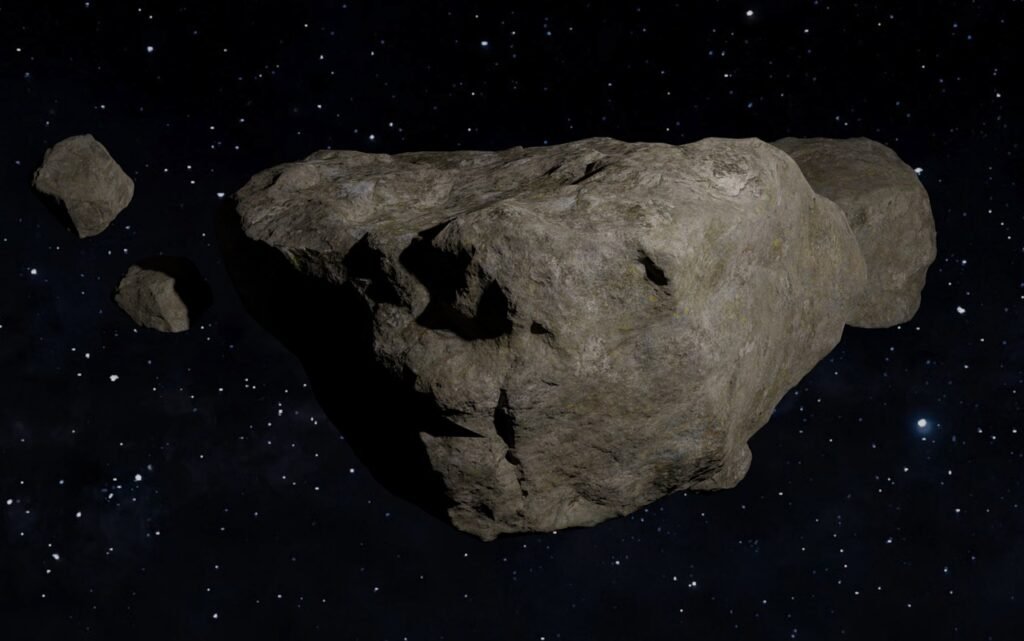

Astounding Discovery from Early Observations (Image Credits: Pixabay)
In the vast expanse of the main asteroid belt, astronomers have identified a celestial oddity that defies expectations for objects of its scale.
Astounding Discovery from Early Observations
The Vera C. Rubin Observatory captured data on asteroid 2025 MN45 during its initial testing phase in April and May 2025. This 710-meter-wide rock emerged from a dataset that included over 2,000 previously unknown asteroids. Researchers analyzed the preliminary release from June 2025 and quickly recognized its extraordinary rotation speed. The asteroid completes a full turn every 1.88 minutes, a rate that outpaces any similar-sized body observed before. This find highlights the observatory’s potential to uncover hidden dynamics in our solar system. Previously, the fastest rotations belonged to much smaller asteroids, often mere meters across.
Such rapid spinning raises questions about the asteroid’s composition. Scientists believe internal forces must counteract the centrifugal pull that could otherwise tear it apart. The discovery came amid routine scans, yet it promises to reshape understandings of asteroid physics. Observers noted the object’s path between Mars and Jupiter, confirming its place in the main belt.
Why This Rotation Matters for Asteroid Science
Asteroids typically rotate over hours, influenced by collisions or gravitational tugs from nearby planets. Yet 2025 MN45’s 1.88-minute period marks it as a superfast rotator among large bodies. For objects exceeding 500 meters, this speed sets a new benchmark, surpassing prior records by a significant margin. The Vera C. Rubin Observatory’s advanced camera detected subtle brightness variations that revealed this motion. These fluctuations occur as the asteroid’s irregular shape reflects sunlight unevenly during each spin.
This phenomenon suggests 2025 MN45 possesses unusual tensile strength, possibly from a rubble-pile structure reinforced by cohesion. Traditional models predicted that asteroids this size would disintegrate at such velocities due to rotational stress. The find implies a class of exceptionally durable space rocks may exist, formed through ancient high-energy events. Further study could inform models of solar system formation and evolution.
Implications for Solar System Exploration
The rapid rotation of 2025 MN45 underscores the diversity within the asteroid belt. While smaller asteroids can spin in seconds without issue, larger ones face greater challenges from their mass. This discovery hints at processes that allow some to maintain integrity under extreme conditions. Astronomers now anticipate more such rotators as the observatory continues operations. The initial seven nights of data alone yielded thousands of candidates, many awaiting detailed analysis.
Understanding these dynamics aids planetary defense efforts. Fast-spinning asteroids might behave unpredictably if perturbed toward Earth. The object’s stability offers clues for mining potential, as cohesive materials could simplify extraction. International teams plan follow-up observations to measure its exact dimensions and surface features.
Key Takeaways from the 2025 MN45 Discovery
- 2025 MN45 rotates every 1.88 minutes, the fastest known for asteroids over 500 meters in diameter.
- Discovered by the Vera C. Rubin Observatory, it resides in the main asteroid belt.
- The find suggests stronger-than-expected internal structures in large asteroids.
As telescopes like the Vera C. Rubin Observatory peer deeper into the cosmos, revelations such as 2025 MN45 remind us of the solar system’s untapped mysteries. This asteroid’s relentless spin not only rewrites records but also invites speculation on the forces shaping our cosmic neighborhood. What other surprises lurk among the belt’s billions of rocks? Share your thoughts in the comments below.