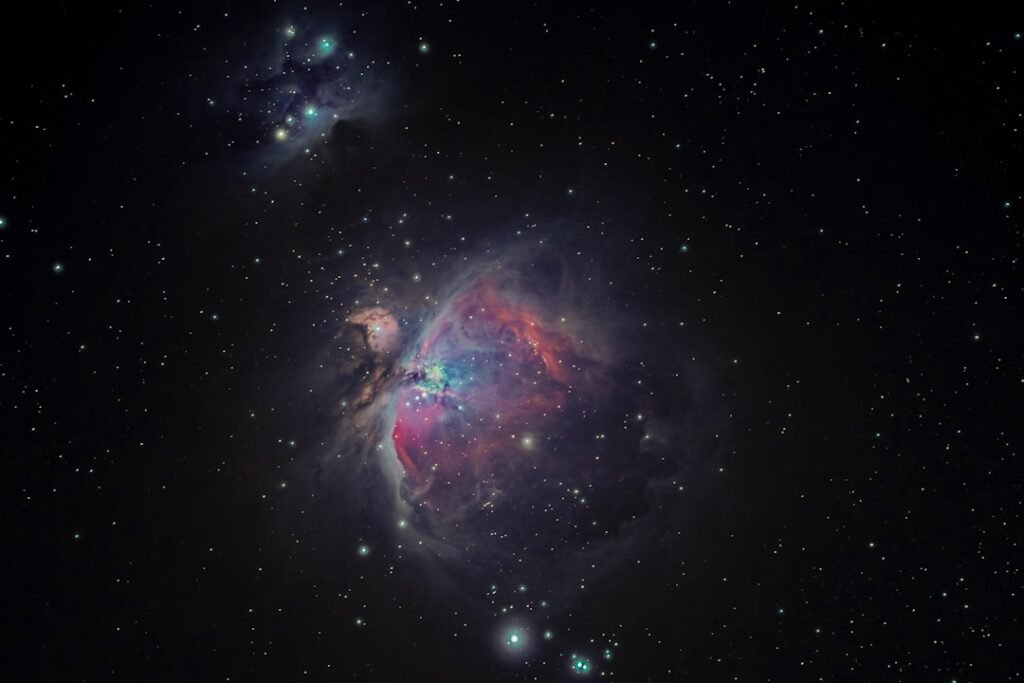

Unexpected Discoveries in the Cosmic Dawn (Image Credits: Unsplash)
Astronomers have uncovered a puzzling class of objects from the universe’s infancy that masquerade as individual stars but reveal themselves as miniature galaxies upon closer inspection.
Unexpected Discoveries in the Cosmic Dawn
Researchers using the James Webb Space Telescope stumbled upon these enigmatic sources during a survey of the early universe. What initially appeared as bright, point-like stars turned out to possess the complex spectral signatures typical of galaxies. This finding, led by a team from the University of Missouri, highlights the telescope’s ability to pierce through the veil of time and distance.
The objects, observed from a period roughly 12 billion years ago, challenge long-held assumptions about how the first galaxies formed. Traditional models predicted that early cosmic structures would be diffuse and irregular, gradually coalescing over eons. Instead, these compact entities suggest a more rapid and organized assembly process in the universe’s formative stages.
Unraveling the Spectral Secrets
When analyzed in detail, the light from these sources displayed emission lines and absorption features that pointed to gaseous disks and star-forming regions, hallmarks of galactic activity. Haojing Yan, an astrophysicist at the University of Missouri’s College of Arts and Science, and his colleagues noted that the sources’ brightness mimicked that of single stars, fooling initial observations. Deeper spectroscopic data, however, exposed their true nature as dense clusters of stars enveloped in interstellar material.
This duality – star-like in appearance yet galactic in behavior – stems from their extreme compactness. Spanning distances far smaller than modern galaxies, these early formations pack the mass of thousands of suns into volumes comparable to solar systems. Such density implies intense gravitational interactions that accelerated structure formation beyond what simulations had anticipated.
Implications for Cosmic Evolution Theories
The detection prompts a reevaluation of the timeline for galaxy formation. Standard cosmological frameworks, built on data from previous telescopes, envisioned a slow buildup from primordial gas clouds into sprawling galaxies. These findings indicate that some structures achieved maturity much sooner, possibly through mergers of smaller protogalaxies or enhanced starburst episodes.
Astronomers now question whether dark matter halos played a larger role in funneling gas and igniting star formation at unprecedented rates. The James Webb Space Telescope’s infrared sensitivity proved crucial here, allowing observations of light stretched by the universe’s expansion from those distant epochs. As more data pours in, scientists anticipate refinements to models that better align with this accelerated cosmic history.
Key Characteristics of These Anomalous Objects
To catalog their properties, the research team compiled observations from multiple JWST fields. The sources exhibited redshifts corresponding to the universe’s youth, confirming their ancient origins. Their spectra showed elevated levels of heavy elements, suggesting multiple generations of stars had already cycled through supernovae explosions.
- Appearance: Resolve as point sources in imaging, resembling isolated stars.
- Spectral profile: Broad emission lines indicative of ionized gas in galactic environments.
- Size and mass: Compact cores with masses up to 10^9 solar masses, far exceeding typical stars.
- Redshift range: z ≈ 6-8, placing them 800 million to 1 billion years after the Big Bang.
- Star formation rate: Elevated, supporting rapid evolution into mature systems.
Future Observations and Broader Impact
Follow-up studies with JWST aim to map the distribution of these objects across the sky, potentially revealing clusters or filaments that influenced early galaxy networks. Enhanced resolution could differentiate between true compact galaxies and other phenomena, such as quasars or star clusters. This work underscores the telescope’s role in transforming our view of the cosmos, from a static timeline to a dynamic, surprise-filled narrative.
Ultimately, these star-like galaxies serve as a reminder that the early universe held more complexities than previously imagined. They push astronomers to integrate new physics, perhaps involving modified gravity or exotic particle interactions, into evolving theories.
Key Takeaways
- JWST’s observations reveal compact galaxies mimicking stars, dated to 12 billion years ago.
- These findings accelerate timelines for cosmic structure formation.
- Spectral analysis confirms galactic traits despite point-like visuals.
In reshaping our grasp of cosmic evolution, these discoveries invite ongoing exploration into the universe’s hidden beginnings. What aspects of the early cosmos intrigue you most? Share your thoughts in the comments.