
The Serendipitous Detection (Image Credits: Unsplash)
Astronomers have identified a cosmic anomaly that defies traditional models of how galaxies emerge from the universe’s primordial chaos.
The Serendipitous Detection
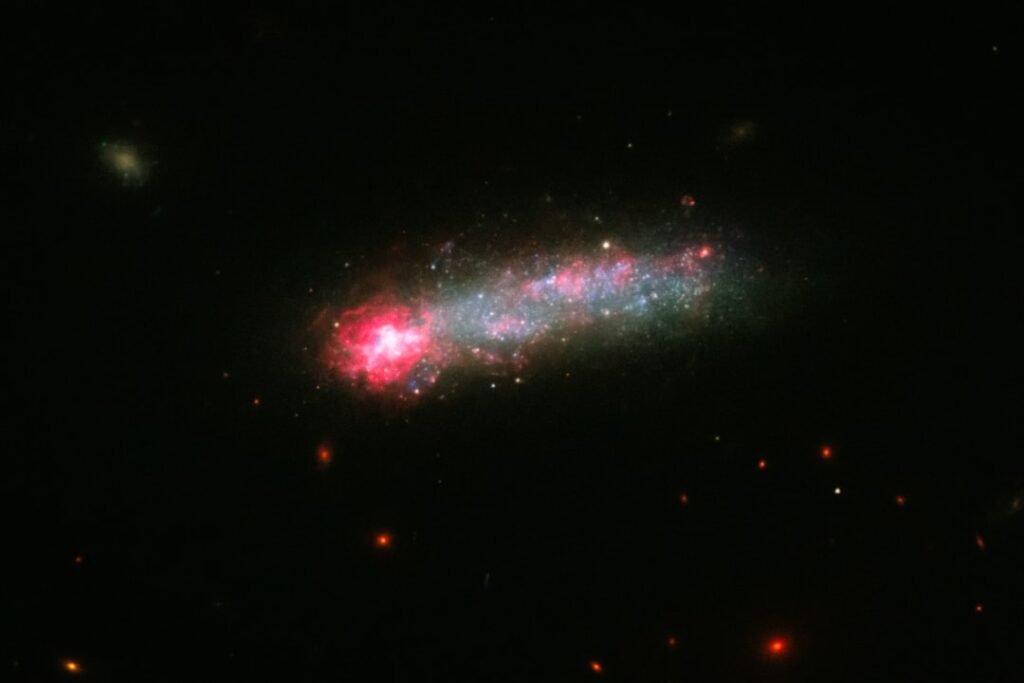
Researchers first spotted Cloud-9 in 2023 through observations with China’s Five-Hundred-Meter Aperture Spherical Radio Telescope, which revealed a vast sphere of hydrogen gas spanning nearly 5,000 light-years. Located about 14 million light-years from Earth near the galaxy Messier 94, this enigmatic structure initially puzzled scientists as a potential dwarf galaxy lacking any visible stars. Follow-up studies using the National Radio Astronomy Observatory’s Very Large Array confirmed the presence of roughly one million solar masses of neutral hydrogen, yet no stellar signatures emerged. The breakthrough came when NASA’s Hubble Space Telescope turned its gaze toward the object, providing the deep imaging needed to rule out faint or ancient stars.
Team members analyzed the Hubble data meticulously, concluding that Cloud-9 harbors no more than 3,000 solar masses in stars – a ratio overwhelmingly favoring gas over light. This scarcity set it apart from known dwarf galaxies, which typically host sparse but detectable stellar populations. The discovery, presented at the 247th meeting of the American Astronomical Society in Phoenix, marked the first confirmed example of a “failed galaxy,” a term now entering astrophysical lexicon.
Unpacking the Composition
At its core, Cloud-9 consists of a diffuse cloud of hydrogen gas bound by an estimated five billion solar masses of dark matter, invisible scaffolding that prevents the structure from dissipating into the void. Unlike typical galaxies, where gas collapses to ignite star formation, this object remains inert, a pristine snapshot of early cosmic conditions. Ground-based radio telescopes mapped the gas distribution, showing a spherical halo that aligns with simulations of primordial dark matter clumps from the universe’s infancy.
Hubble’s ultraviolet and optical observations further solidified the starless nature, detecting no traces of young, hot stars or the dim glow of red giants. This purity offers a rare laboratory for studying dark matter’s influence without the complicating light of stars. Scientists noted that the object’s proximity – relatively close on cosmic scales – enabled detailed scrutiny that might elude more distant relics.
Implications for Cosmic Evolution
Cloud-9 challenges prevailing theories by illustrating a pathway where galaxy formation stalls before stars can form, possibly due to insufficient gas density or external feedback from nearby massive galaxies. In the early universe, dark matter halos gathered gas, but in this case, the process halted, leaving a “relic” that echoes the Big Bang’s aftermath. Such objects could explain discrepancies in models of dwarf galaxy populations, suggesting that many potential galaxies never ignited their stellar engines.
The find bolsters understanding of dark matter’s role in structure formation, as the invisible mass here maintains gravitational equilibrium without luminous counterparts. Researchers from the Space Telescope Science Institute emphasized how Cloud-9 provides a “window into the dark universe,” free from stellar interference. This perspective shifts focus toward gas-rich, star-poor systems that may dot the cosmos more frequently than previously thought.
Key Characteristics of Cloud-9
To highlight its distinct profile, astronomers compiled the following traits based on multi-wavelength data:
- Distance: Approximately 14 million light-years from Earth.
- Size: About 5,000 light-years across, comparable to a small dwarf galaxy.
- Gas Content: One million solar masses of neutral hydrogen.
- Dark Matter: Five billion solar masses, dominating the mass budget.
- Stellar Mass: Less than 3,000 solar masses, effectively starless.
- Discovery Telescopes: FAST (initial), VLA (radio mapping), Hubble (optical confirmation).
These attributes position Cloud-9 as a benchmark for future surveys seeking similar “failed” structures.
Key Takeaways
- Cloud-9 represents the first observed “failed galaxy,” offering insights into stalled cosmic assembly.
- Its dark matter dominance underscores the material’s pivotal role in binding cosmic gas without star formation.
- Proximity and clarity make it ideal for probing early universe physics and refining galaxy evolution models.
As telescopes like the James Webb Space Telescope peer deeper into the cosmos, discoveries like Cloud-9 promise to reshape our narrative of the universe’s buildup from darkness to light. This starless sentinel reminds us that not every cosmic gathering culminates in a blaze of stars, revealing the subtle forces at play in the grand design. What mysteries might similar relics unveil next? Share your thoughts in the comments.