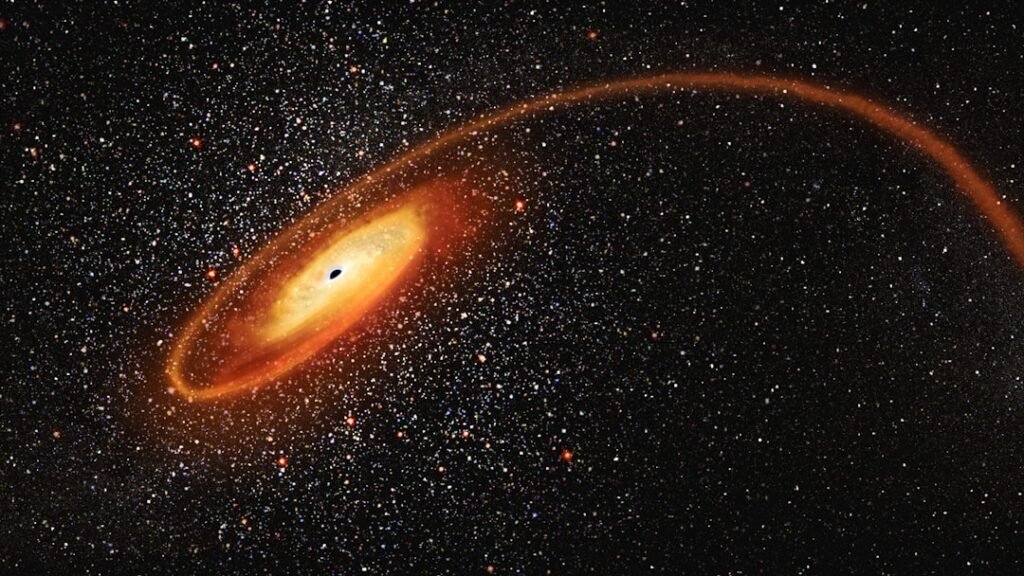

The Enigma of Little Red Dots (Image Credits: Unsplash)
In the vast expanse of the early universe, faint crimson specks observed by advanced telescopes challenge long-held views on cosmic evolution.
The Enigma of Little Red Dots
Astronomers have long puzzled over the origins of supermassive black holes that dominated the sky mere hundreds of millions of years after the Big Bang. Recent observations from the James Webb Space Telescope revealed compact, reddish objects dubbed “little red dots,” appearing in the universe’s infancy. These entities, detected in deep-space surveys, span just a few hundred light-years and glow with unusual intensity. Their discovery, dating back to surveys conducted around 2024, sparked debates about whether they represent fledgling black holes or something entirely different.
Experts initially suspected these dots harbored supermassive black holes actively feeding on surrounding gas. However, their small size and rapid evolution raised questions. Simulations suggested that traditional formation models, involving gradual growth from stellar remnants, could not account for their presence so early. This led researchers to explore alternative pathways, blending observation with computational modeling to test various scenarios.
Challenging Conventional Black Hole Birth Theories
Standard models posit that black holes form from the collapse of massive stars or through mergers of smaller ones. In the early universe, population III stars – enormous, metal-poor giants – likely seeded the first black holes upon their explosive deaths. Yet, these processes demanded time, potentially billions of years, to build the million-solar-mass behemoths seen in ancient quasars. The little red dots, emerging just 600 million to 1.6 billion years post-Big Bang, appeared too soon for such gradual assembly.
Primordial black holes, hypothetical relics from the universe’s first moments, offered another explanation. Formed directly from density fluctuations in the inflationary era, they could have grown rapidly by accreting primordial gas. Still, evidence remained elusive until recent James Webb data highlighted anomalies, like a 50-million-solar-mass object in galaxy Abell 2744-QSO1, dated to 700 million years after the Big Bang. This find prompted a reevaluation, suggesting direct collapse of massive gas clouds as a viable mechanism.
Gigantic Stars as Cosmic Forerunners
At the 247th American Astronomical Society meeting in Phoenix, Devesh Nandal from the Center for Astrophysics at Harvard and Smithsonian presented a compelling alternative. He proposed that little red dots might consist of gigantic, short-lived stars rather than black holes. These hypothetical stars, far larger than any known today, could have formed from pristine gas in the early cosmos, burning brightly before collapsing into seeds for supermassive black holes. Nandal’s team analyzed spectral data, noting emission lines consistent with stellar activity over black hole accretion signatures.
This hypothesis simplifies the puzzle by bypassing the need for exotic primordial origins. Instead, it aligns with known stellar physics, where instability in massive stars leads to direct collapse. Computer models supported this view, showing how such stars could evolve in isolation, free from the metallicity constraints of later epochs. If confirmed, this shifts focus from immediate black hole formation to a stellar intermediary phase.
Implications for Cosmic History
Understanding early black hole formation reshapes narratives of galaxy evolution. Supermassive black holes anchor galactic centers, influencing star formation and structure. If little red dots prove to be stellar precursors, it implies faster black hole seeding, accelerating the growth of the first quasars. Ongoing James Webb observations, including those of “fuzzy dark matter” collapses, continue to test these ideas, with simulations predicting observable differences in light patterns.
Recent studies, such as one exploring catastrophic collapses of dark matter solitons, add layers to the debate. They suggest environments where stars or black holes emerge from dense, early halos. As data accumulates, astronomers anticipate clearer distinctions, potentially resolving whether these dots birthed black holes before stars fully populated the universe.
- Traditional stellar collapse: Relies on massive stars dying and merging over time.
- Direct gas cloud collapse: Bypasses stars, forming black holes from pristine material.
- Gigantic star hypothesis: Short-lived giants as intermediaries, collapsing rapidly.
- Primordial seeds: Formed in the Big Bang’s aftermath, growing via accretion.
- Dark matter influences: Exotic scenarios involving fuzzy dark matter halos.
Key Takeaways
- Little red dots from James Webb challenge timelines for supermassive black hole growth.
- Gigantic stars offer a simpler path, aligning with observed spectra and models.
- Future surveys may confirm if black holes preceded or followed the first stellar generations.
The quest to decode early black holes underscores the universe’s rapid transformation from chaos to structure. As new evidence emerges, it invites us to ponder the delicate balance of cosmic forces. What do you think sparked these ancient giants? Share your thoughts in the comments.