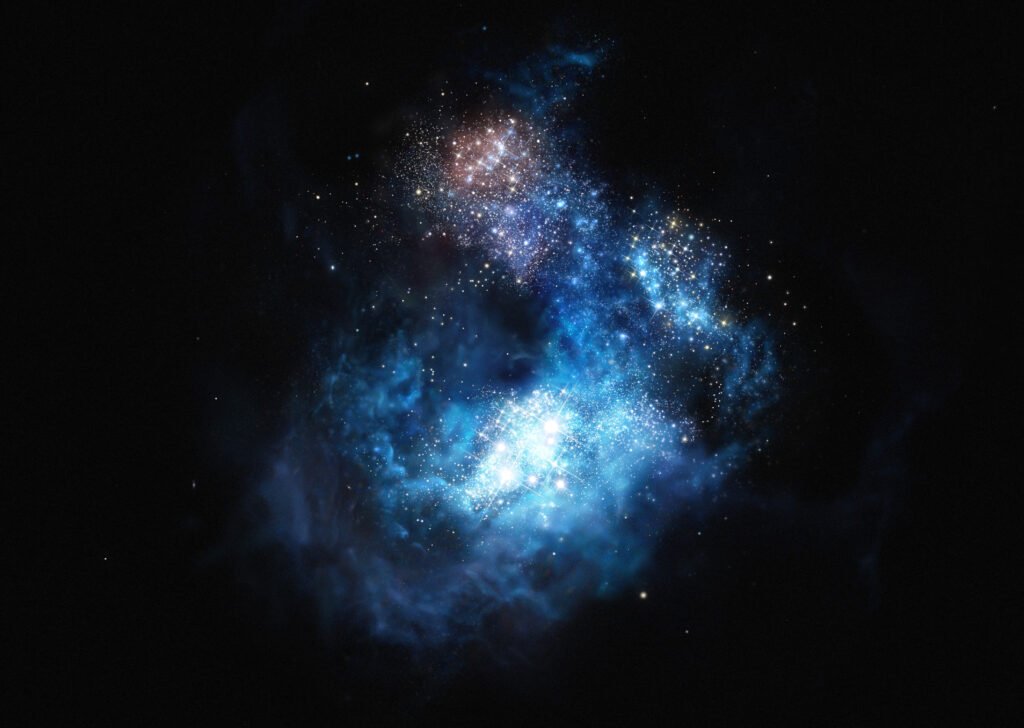
The Hubble Space Telescope has revealed a remarkable new class of cosmic object — a starless, gas-rich cloud bound by dark matter that may be a relic from the early universe, offering astronomers a rare glimpse into galaxy formation processes that occurred billions of years ago. This object, nicknamed Cloud-9, challenges traditional ideas about how galaxies form and provides a fresh window into the mysterious realm of dark matter and cosmic evolution.
Unlike typical celestial discoveries that spotlight bright stars or glowing nebulae, Cloud-9 is notable precisely because it contains no stars at all, making it a failed galaxy — a primordial gas cloud that never ignited the stellar fusion process yet has survived to the present day. Its unique characteristics have astronomers buzzing about what it could reveal about the unseen universe.
A Cloud Without Stars Changes the Game
Cloud-9 was identified as a neutral hydrogen-rich object that remains astonishingly star-free, even under Hubble’s sensitive observations, confirming its identity as a novel object class. Astronomers call such structures Reionization-Limited H I Clouds (RELHICs), because their conditions prevented the gas from collapsing to form stars during the Epoch of Reionization and beyond.
Observations suggest Cloud-9 is relatively compact and spherical compared with other known hydrogen clouds, making it stand out among the cosmic landscape. Its discovery aligns with theoretical predictions that such objects should exist as fossil building blocks of early galaxy assembly, offering a missing piece in the puzzle of how early matter clustered under the influence of dark matter.
What Holds It Together
Despite lacking stars, Cloud-9 is far from empty. Analyses indicate that the cloud contains neutral hydrogen gas with a mass around one million times that of the Sun, but its overall gravitational structure suggests a dominant dark matter halo roughly five billion times the Sun’s mass. In other words, most of the mass keeping the gas clumped together isn’t visible matter at all but the elusive dark matter that makes up most of the universe’s mass.
Dark matter does not emit, absorb or reflect light, so its presence is inferred through gravitational effects. Cloud-9’s stability despite lacking stars, which would normally contribute gravitational pull, strongly points to dark matter as a key binding agent, giving scientists a rare laboratory for studying dark matter’s role in small, starless systems.
A Failed Galaxy or Something Else?
Astronomers describe Cloud-9 as a “failed galaxy” not in a critical sense, but as a structure that never reached the threshold for star formation. If Cloud-9 were much more massive — perhaps more than several billion solar masses of gas — its gravity might have triggered star birth, turning it into a normal galaxy. Too small, and its gas would have evaporated into intergalactic space. Cloud-9 exists in a narrow intermediate range that allows it to persist as is.
Its proximity to the spiral galaxy Messier 94 suggests it may have influenced or interacted with its larger neighbor’s environment, though exactly how remains a topic for future study. Detecting such delicate interactions helps astronomers test models of cosmic structure formation that extend beyond star-hosting galaxies.
Why This Matters for Cosmology
Cloud-9’s existence supports long-standing theoretical predictions that the early universe was dotted with dark matter-dominated gas clouds that never lit up with stars. These relics can serve as fossils of cosmic dawn, illuminating how matter clumped together under gravity before or during the universe’s first bouts of star formation. This, in turn, informs models of large-scale structure evolution across billions of years.
Because dark matter plays such a central role in the formation and growth of cosmic structures, objects like Cloud-9 are valuable not just as curiosities but as direct probes of dark matter physics — a field still rife with unanswered questions about how this invisible mass shapes the universe.
What Comes Next for Cloud-9 and Beyond
Astronomers hope future surveys with next-generation telescopes, including radio observatories and space-based instruments, will uncover additional RELHICs and similar starless systems. The rarity of such objects means each new detection could significantly refine our understanding of early cosmic environments and the conditions that lead to star formation — or prevent it.
By building a fuller census of these relic clouds, scientists aim to test theories of galaxy formation thresholds, dark matter distribution and the influence of environment on cosmic evolution, bridging observations across epochs from the early universe to the present.
A Window Into the Dark Universe
The discovery of Cloud-9 is more than a quirky footnote in astronomical catalogues — it represents a paradigm shift in how we view the universe’s early building blocks. By confirming that starless, dark-matter-dominated clouds exist, Hubble has helped validate theoretical predictions and opened a new avenue for studying the unseen components of cosmic history.
While bright galaxies and blazing stars rightly capture the public imagination, the universe’s subtler structures may hold equally profound secrets. Cloud-9 reminds us that looking beyond the light — into dark matter and the faintest gas clouds — could be key to unraveling the universe’s deepest mysteries. As telescopes and surveys grow ever more sensitive, we may soon uncover many more of these relics, turning what once seemed theoretical into a thriving frontier of discovery.