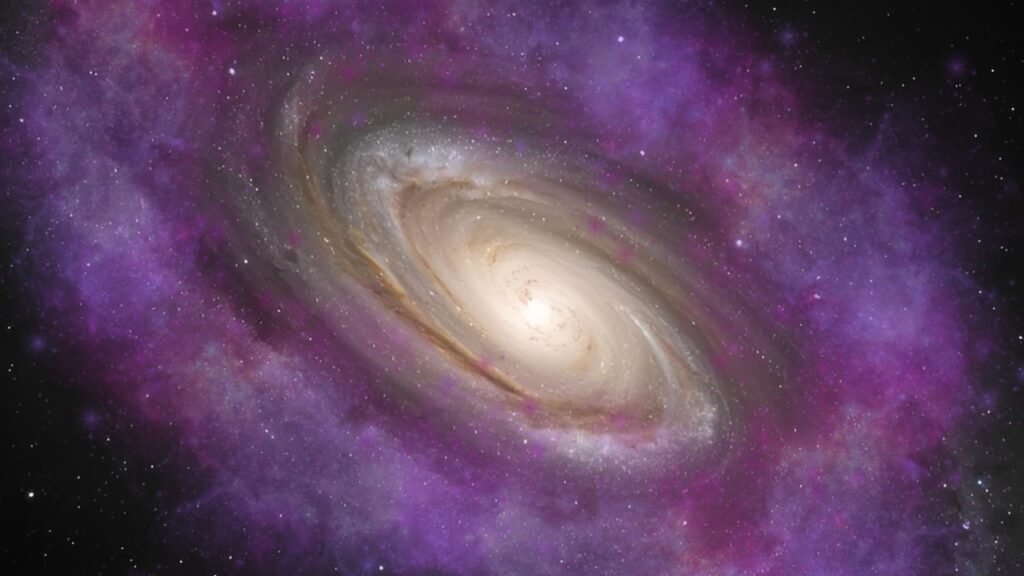
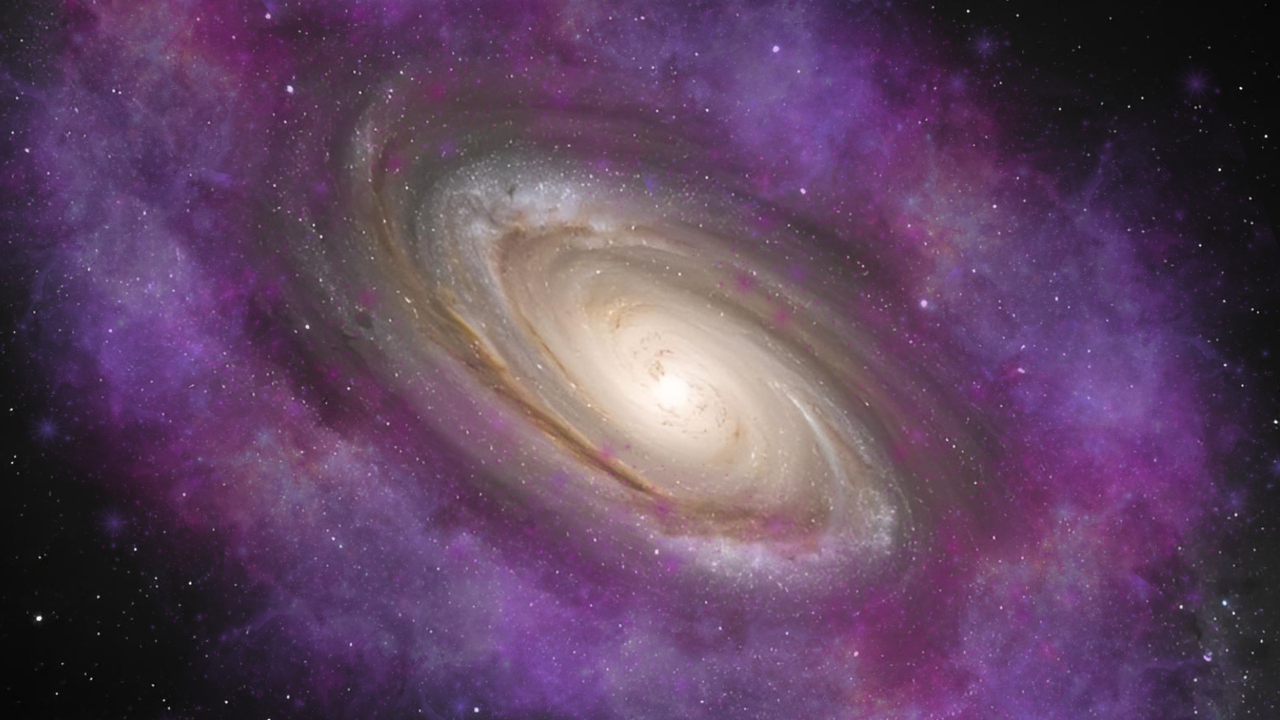
Unveiling the Invisible Force (Image Credits: Cdn.mos.cms.futurecdn.net)
Astronomers have long puzzled over the invisible forces shaping the universe, and recent findings suggest dark matter might connect with the most elusive particles known.
Unveiling the Invisible Force
Dark matter constitutes about 85 percent of the universe’s mass, yet it evades direct detection. Scientists inferred its existence decades ago through gravitational effects on visible matter, such as the rotation speeds of galaxies. This unseen substance holds cosmic structures together, preventing them from flying apart under their own momentum.
Traditional models portrayed dark matter as completely inert, interacting only via gravity. However, anomalies in cosmic observations hinted at more complex behavior. Researchers now explore whether this mysterious entity engages with other fundamental particles, potentially rewriting our understanding of the cosmos.
The latest analysis draws from multiple experiments, revealing subtle discrepancies that challenge long-held assumptions. These hints emerged from data on particle behaviors in high-energy environments, prompting a reevaluation of dark matter’s role.
Ghost Particles in the Void
Neutrinos, often dubbed ghost particles, zip through space with minimal interaction. Produced in abundance by stars, supernovae, and even the Big Bang, they pass through ordinary matter almost unnoticed. Detectors the size of buildings capture only a handful, underscoring their ethereal nature.
These particles come in three flavors – electron, muon, and tau – and oscillate between types as they travel. Such properties make them ideal probes for extreme conditions, like the hearts of black holes or the early universe. Yet, their weak coupling to other forces has kept many secrets hidden.
Recent studies pooled results from neutrino observatories worldwide. The combined data showed patterns inconsistent with the standard model, suggesting external influences at play. This could mark the first glimpse of neutrinos mingling with the dark sector.
Hints of an Unexpected Interaction
A collaborative effort examined neutrino fluxes from cosmic sources, spotting irregularities that align with dark matter distributions. In galaxy clusters, where dark matter concentrations peak, neutrino signals appeared slightly altered. Such patterns imply a feeble but real exchange between the two.
Experts caution that these signals remain tentative, requiring further verification. Still, the alignment across datasets strengthens the case. If confirmed, dark matter would no longer stand alone, isolated from the particle zoo.
Simulations incorporating this interaction reproduced observed cosmic structures more accurately. For instance, they better explained the clustering of galaxies without invoking ad hoc adjustments. This development excites theorists, as it bridges gaps between particle physics and cosmology.
Shaking the Foundations of Physics
The standard model of cosmology, built on cold dark matter and general relativity, faces scrutiny. An interaction with neutrinos could alter predictions for the universe’s expansion and large-scale structure. It might even resolve tensions in measurements of the Hubble constant, the rate at which space stretches.
Beyond theory, practical implications abound. Enhanced understanding could guide next-generation detectors, like upgraded versions of IceCube or future space-based telescopes. These tools aim to capture direct evidence of the interplay.
- Neutrino observatories detect trillions of particles daily, but only a fraction interact meaningfully.
- Dark matter’s gravitational pull warps light from distant quasars, offering indirect maps of its presence.
- Combined analyses from experiments like Super-Kamiokande and NOvA provide the statistical power needed for subtle signals.
- Future missions, such as the Euclid satellite, will map dark matter halos with unprecedented detail.
- Interactions could influence neutrino masses, tying into ongoing quests for their exact values.
Key Takeaways
- Dark matter-neutrino links hint at new physics beyond the standard model.
- Observations from galaxy clusters show aligned anomalies in particle data.
- Confirmation would revolutionize cosmology and particle detection strategies.
As astronomers peer deeper into the cosmic web, the prospect of dark matter conversing with neutrino ghosts promises to illuminate the universe’s hidden architecture. This potential breakthrough invites us to question the boundaries of known physics. What implications do you see for future space exploration? Share your thoughts in the comments.