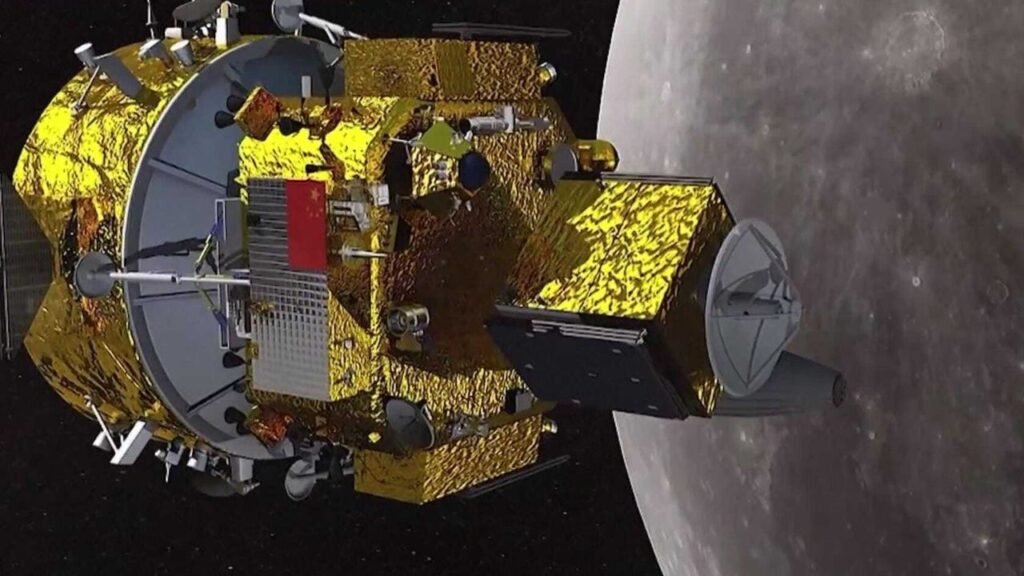

A Leap in Lunar Exploration (Image Credits: Cdn.mos.cms.futurecdn.net)
China’s ambitious lunar program advances with the upcoming Chang’e 7 mission, scheduled for launch later this year to probe the moon’s south pole for signs of water ice.
A Leap in Lunar Exploration
The Chang’e 7 mission marks a pivotal moment in China’s efforts to expand human presence beyond Earth. Engineers and scientists have finalized preparations for this complex endeavor, which builds on previous successes like the sample-return flights of Chang’e 5 and 6. The spacecraft will journey to one of the moon’s most intriguing regions, where shadowed craters hold the promise of frozen resources essential for future missions.
Unlike earlier probes that focused on the lunar near side or far side basins, this operation targets the challenging terrain near the south pole. Teams at the China National Space Administration coordinated extensive testing to ensure reliability in the harsh lunar environment. The mission’s timeline aligns with global space activities, including private sector attempts at lunar landings throughout 2026.
Key Components of the Mission
At the heart of Chang’e 7 lies a suite of interconnected vehicles designed for comprehensive data collection. The orbiter will circle the moon, relaying signals and mapping the surface from above. Once in position, it will deploy the lander, which serves as the primary platform for surface operations in the selected crater rim.
A rover will navigate the rugged landscape, equipped with tools to analyze soil and subsurface features. The standout element is a mini-hopping probe, a compact robot capable of short leaps to access hard-to-reach spots. These components will collaborate to photograph one another and share findings, extending the mission’s reach beyond a single landing site. Overall, more than a dozen instruments from Chinese and international partners will contribute to the payload.
Focusing on Shackleton Crater
Shackleton crater emerges as the prime landing target due to its unique conditions at the lunar south pole. This ancient formation, with its permanently shadowed interior, offers ideal spots for water ice preservation, shielded from solar heat. Previous orbital observations suggested volatile deposits here, prompting this focused investigation.
The lander and rover will drill and scan for ice signatures, while the hopper explores adjacent depressions. Terrain analysis will map slopes and illumination patterns to aid safe navigation. Such data could confirm the extent of accessible resources, vital for sustaining long-term outposts. The site’s proximity to illuminated areas also supports solar power generation for the vehicles.
Innovations Driving Water Detection
Chang’e 7 introduces advanced technologies tailored for resource scouting. The hopping probe, for instance, uses propellant for multiple jumps, allowing it to sample diverse microenvironments after initial landing. Ground-penetrating radar and spectrometers on the rover will detect hydrogen signals indicative of water ice beneath the regolith.
These tools build on lessons from prior missions, enhancing precision in low-gravity conditions. The orbiter’s high-resolution cameras will provide context for surface readings, identifying potential ice-rich zones. International collaborations have integrated specialized sensors to measure temperature and composition variations.
- Orbital mapping for site selection and communication relay.
- Lander-based drilling up to several meters deep.
- Rover mobility across uneven terrain with autonomous pathfinding.
- Hopper for targeted sampling in shadowed areas.
- Spectrometers to identify water vapor or ice traces.
Implications for Future Lunar Ambitions
Success in detecting water could transform plans for a lunar research station, targeted for the 2030s. Water ice serves multiple purposes, from drinking supplies to fuel production via electrolysis. China’s program emphasizes self-reliance, yet it opens doors for multinational partnerships in deep-space exploration.
This mission aligns with the fourth phase of the Chinese Lunar Exploration Program, following orbiters, landers, and sample returns. It complements global efforts, including NASA’s Artemis initiatives, by filling gaps in polar data. As 2026 unfolds, updates from the mission control in Beijing will highlight progress toward sustainable moon presence.
Key Takeaways
- Chang’e 7 launches in August 2026, focusing on water ice confirmation at the south pole.
- Multi-vehicle setup enables broad coverage of Shackleton crater and nearby sites.
- Findings could support lunar bases by identifying usable resources.
The Chang’e 7 mission underscores the accelerating pace of lunar discovery, potentially unlocking resources that make the moon a viable stepping stone for deeper space travel. What aspects of this exploration excite you most? Share your thoughts in the comments below.