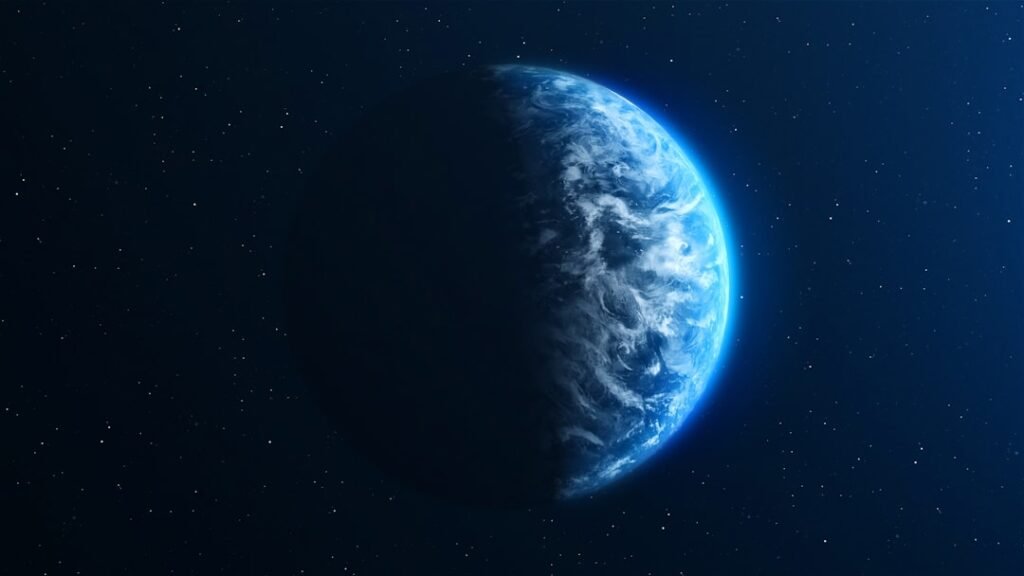
Astronomers have achieved a milestone in planetary science by measuring both the mass and distance of a rogue planet — a world drifting alone through the Milky Way without orbiting any star. Using a rare combination of ground-based observatories and the Gaia space telescope, researchers were able to overcome a long-standing challenge in detecting such objects, capturing data that reveals this elusive planet’s true nature.
This breakthrough not only sheds light on how such “free-floating” planets form and wander unbound across space, but also paves the way for future studies of what could be billions of unseen worlds hidden in the galaxy’s depths. By turning fleeting flickers of light into hard measurements, scientists are finally beginning to tell the stories of planets that don’t belong to any star.
A First for Rogue Planet Measurement
Astronomers have long suspected that rogue planets — planetary-mass objects not gravitationally bound to any star — drift through the galaxy, but actually measuring one has been nearly impossible. Typical observations using gravitational microlensing can indicate that a planet passed in front of a distant star, but without knowing the distance, researchers faced a mass-distance degeneracy that kept estimates uncertain.
In this case, the microlensing event labeled KMT-2024-BLG-0792/OGLE-2024-BLG-0516 was observed by Earth-based telescopes and the European Gaia spacecraft simultaneously. The timing difference between the two vantage points allowed scientists to calculate the microlensing parallax and break the degeneracy, yielding both the planet’s mass and its distance from Earth for the first time.
Saturn-Sized and Stranger Than Expected
From the combined observations, researchers concluded that the rogue planet has a mass roughly 22 percent that of Jupiter — about the size of Saturn — and lies approximately 3,000 parsecs (just under 10,000 light-years) away in our Milky Way galaxy. This precise measurement marks a significant improvement over earlier detections that could only infer a planet’s presence indirectly.
Spectral data also indicated that the background star used to detect the planet was a red giant, providing a stable reference point for the light-bending signals needed to derive the planet’s properties. These results confirm that this wandering world is truly planetary in nature, rather than a small brown dwarf (a “failed star”) or other compact object.
How It Was Spotted
This rare breakthrough depended on microlensing, a phenomenon predicted by Einstein’s theory of general relativity where a massive object bends and magnifies the light of a star behind it. Typically, microlensing alerts astronomers that something passed in front of a star, but without distance information, many detections leave scientists guessing about the object’s true character.
Thanks to Gaia’s position far from Earth and its repeated observations of the event, scientists were able to detect tiny differences in the light curve from two locations. This “stereoscopic” effect gave precise information about how the light was distorted, allowing researchers to break the long-standing measurement roadblock and label this drifting world definitively.
Clues to Planetary Origins
The characteristics of this planet reinforce the idea that many rogue planets likely formed in protoplanetary disks around stars and were later ejected due to gravitational interactions with other planets or nearby stars. Previous statistical studies suggested that free-floating planets tend to have masses lower than Jupiter’s, fitting with models of dynamical ejection from young systems.
Because this Saturn-class world fits into that pattern, researchers hypothesize it may have begun its life in a star system before being cast adrift by gravitational chaos — a fate common in young stellar nurseries where planets and stars interact in tight, dynamic configurations.
What This Means for Astronomy
By finally measuring both distance and mass of a rogue planet, scientists have opened a new chapter in understanding the population of unbound worlds in our galaxy. These free-floating planets have long been suspected to be plentiful — perhaps even outnumbering stars — but concrete data has been scarce.
Upcoming missions like NASA’s Nancy Grace Roman Space Telescope and China’s Earth 2.0 satellite are expected to dramatically increase the detection rate of microlensing events, potentially revealing hundreds or thousands of such lone planets and leading to a richer picture of galactic planetary demographics.
From Cosmic Ghosts to Real Worlds
The measurement of this rogue planet’s mass and distance is a profound leap forward in exoplanet science. It transforms these once-invisible wanderers from theoretical curiosities into measurable celestial objects, making the unseen ordinary and the extraordinary tangible.
Yet this achievement also reminds us how much remains hidden in our own galaxy: billions of planets may roam unseen, their existence inferred only by fleeting blips of starlight. Rather than merely cataloging more planets, future research should aim to understand how these cosmic nomads shape the evolution of planetary systems and what they tell us about the dynamic processes that sculpt the universe. A rogue planet is no longer just a ghost in the cosmic machine — it’s a measurable piece of the galactic puzzle we’re only beginning to assemble.