
Unveiling the Elusive Nature of Lensed Waves (Image Credits: Upload.wikimedia.org)
Gravitational waves, those subtle ripples in spacetime predicted by Einstein over a century ago, continue to reveal the universe’s most violent secrets, and now artificial intelligence promises to sharpen our view of these cosmic messengers even further.
Unveiling the Elusive Nature of Lensed Waves
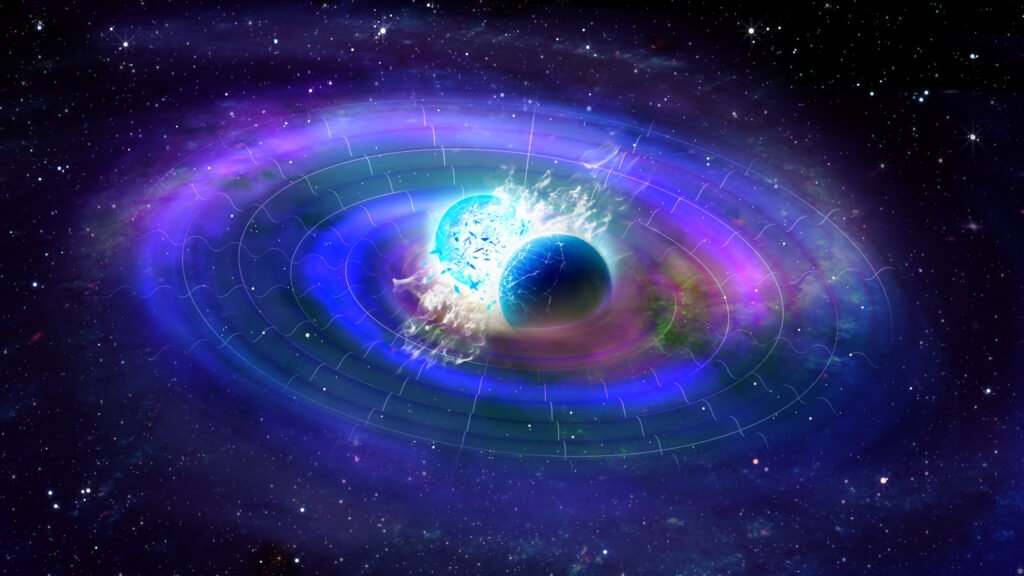
Gravitational lensing occurs when massive objects like galaxies or black holes bend the fabric of spacetime, distorting the path of gravitational waves much like a lens warps light. These lensed waves carry unique signatures that can illuminate distant cosmic events, but identifying them amid noisy data has long challenged astronomers. Traditional detection methods often struggle with the faint, multiplied signals produced by lensing, leading to missed opportunities for groundbreaking discoveries.
Researchers faced this hurdle head-on by developing specialized tools to sift through vast datasets from observatories like LIGO and future space-based instruments. The complexity arises because lensed waves can appear as multiple arrivals or distorted waveforms, mimicking glitches or unrelated noise. This breakthrough addresses that directly, offering a pathway to confirm rare events that probe the early universe.
Without advanced processing, such signals risk being overlooked, limiting our understanding of phenomena like supermassive black hole mergers. The innovation lies in automating this sifting process, transforming raw data into actionable insights.
The Rise of the Novel AI Network
A team of scientists introduced a cutting-edge artificial intelligence framework designed specifically for gravitational wave analysis, achieving an impressive 98% accuracy in detecting lensed signals. This network builds on deep learning techniques, including advanced recurrent models, to process waveforms in real time. It outperforms conventional algorithms by learning intricate patterns that indicate lensing effects, such as time delays between wave arrivals.
The development stemmed from collaborative efforts in computational physics, where experts trained the AI on simulated datasets mimicking real cosmic scenarios. By incorporating elements like extended long short-term memory units, the system captures both short-term fluctuations and long-range dependencies in the data. This approach not only boosts detection rates but also reduces false positives to under 1%, a critical factor for reliable scientific conclusions.
Early tests demonstrated the network’s robustness across various noise levels, proving its potential for deployment in operational observatories. Such precision marks a shift from manual analysis to automated, scalable solutions.
Mechanisms Behind the High-Accuracy Detection
At its core, the AI network employs a frequency-domain extraction method to isolate lensing features, converting time-based signals into spectral patterns for easier identification. This technique allows the model to flag anomalies with a true positive rate exceeding 98%, while maintaining low computational demands suitable for future detectors. Key to its success is the integration of machine learning architectures that adapt to the unique distortions caused by gravitational lensing.
During training, the system analyzed thousands of simulated lensed events, refining its ability to distinguish them from standard gravitational waves. Researchers optimized the model to handle millihertz-band signals, relevant for upcoming space missions like LISA. The result is a tool that processes data streams efficiently, enabling near-instantaneous alerts for potential discoveries.
Comparisons with existing pipelines showed marked improvements, particularly in sensitivity to weakly lensed waves from distant sources.
Transforming Cosmology and Future Observations
This AI advancement paves the way for enhanced data analysis from next-generation space-based gravitational wave detectors, which will generate terabytes of information daily. By accelerating the identification of lensed waves, scientists can better map the distribution of dark matter and trace the evolution of the universe’s large-scale structure. These insights could refine models of cosmic expansion and even test general relativity under extreme conditions.
In practical terms, the network supports multi-messenger astronomy, where gravitational waves pair with electromagnetic signals for a fuller picture of events like neutron star collisions. For cosmology, lensed detections offer a novel probe into hidden realms, such as the role of intermediate-mass black holes in galaxy formation. The technology’s scalability ensures it will integrate seamlessly with planned observatories, democratizing access to high-precision analysis.
Broader applications extend to fundamental physics, potentially revealing deviations from predicted waveforms that hint at new particles or forces.
| Aspect | Traditional Methods | AI Network |
|---|---|---|
| Accuracy | ~70-80% | 98% |
| False Positive Rate | 5-10% | <1% |
| Processing Speed | Hours to days | Real-time |
Key Takeaways
- The AI network achieves 98% accuracy by leveraging deep learning for pattern recognition in lensed waveforms.
- It reduces false alarms, ensuring reliable data for cosmological studies.
- Future integrations with space detectors like LISA will unlock deeper universe insights.
As this AI-driven tool reshapes gravitational wave astronomy, it underscores the power of interdisciplinary innovation to decode the cosmos’s deepest mysteries – what untapped secrets might the next lensed signal reveal? Share your thoughts in the comments below.