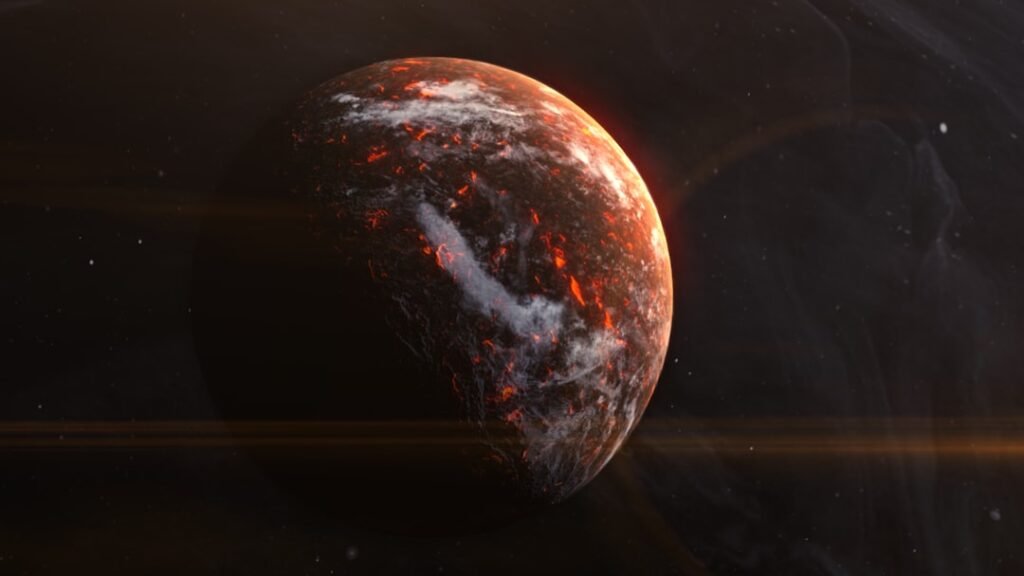

A Shocking Find in the Heat of a Lava Ocean (Image Credits: Unsplash)
Astronomers using NASA’s James Webb Space Telescope have uncovered compelling evidence of a substantial atmosphere enveloping the scorching exoplanet TOI-561 b, challenging long-held assumptions about rocky worlds in extreme environments.
A Shocking Find in the Heat of a Lava Ocean
Researchers announced the detection of a dense atmospheric layer around TOI-561 b, a super-Earth that orbits perilously close to its host star. This planet, located 560 light-years away in the constellation Cetus, experiences surface temperatures exceeding 3,000 degrees Fahrenheit, turning its rocky exterior into a vast magma ocean. Despite such brutal conditions, observations indicate the world retains a thick blanket of gases, defying expectations that intense stellar radiation would strip away any air.
The discovery emerged from infrared data collected by the Webb telescope, which revealed signatures of water vapor and other volatiles in the atmosphere. Scientists had previously viewed ultra-hot rocky exoplanets like TOI-561 b as barren, airless rocks. Yet this finding suggests ongoing processes replenish the atmosphere, possibly through volcanic outgassing from the molten surface below.
Profiling the Enigmatic TOI-561 b
TOI-561 b ranks as a super-Earth, with a mass roughly twice that of our planet and a diameter about 50 percent larger. It completes an orbit around its star every 10.5 hours, placing it 40 times closer to the star than Mercury is to the Sun. This proximity bathes the planet in relentless radiation, heating its dayside to lava-like extremes while the nightside might cool just enough for some atmospheric circulation.
The exoplanet formed billions of years ago, making it one of the oldest known in its class. Early models predicted that such ancient, irradiated worlds would lose their atmospheres over time. However, the presence of a reflective, gas-rich envelope hints at resilience, with potential compositions including carbon dioxide, sulfur dioxide, or even silicates vaporized from the magma.
- Mass: Approximately 2 Earth masses
- Orbital period: 10.5 hours
- Surface temperature: Over 3,000°F on the dayside
- Distance from Earth: 560 light-years
- Atmospheric indicators: Water vapor and reflective properties
Challenging Theories of Planetary Atmospheres
This breakthrough prompts a reevaluation of how small, rocky planets endure in hostile stellar neighborhoods. Prior studies of similar exoplanets, like 55 Cancri e, hinted at tenuous atmospheres, but TOI-561 b provides the strongest case yet for a stable, thick one on a lava-covered world. The implications extend to understanding atmospheric retention on other super-Earths, which make up a significant portion of detected exoplanets.
Astronomers now speculate that internal heat from the planet’s core could drive continuous volcanic activity, injecting fresh gases into the air. This cycle might sustain the atmosphere against erosion by stellar winds. For the broader field, the find underscores the diversity of exoplanetary systems and the potential for habitable zones beyond traditional definitions.
The Role of the James Webb Space Telescope
NASA’s James Webb Space Telescope enabled this detection through its advanced infrared instruments, which peer through cosmic dust to analyze light passing through exoplanet atmospheres. Launched in 2021, the observatory has revolutionized exoplanet studies by capturing subtle spectral features invisible to earlier telescopes. In this case, Webb’s data showed the planet’s light dimming in specific wavelengths, consistent with atmospheric absorption.
The observations built on initial discoveries from NASA’s Transiting Exoplanet Survey Satellite, which identified TOI-561 b in 2020. Follow-up with Webb confirmed the atmospheric presence, marking a milestone in the mission’s early years. For more details on the findings, see the NASA announcement.
Key Takeaways
- TOI-561 b hosts a thick atmosphere despite extreme heat, suggesting dynamic replenishment from its magma ocean.
- The discovery highlights JWST’s power in probing distant exoplanets and reshaping models of atmospheric evolution.
- This could reveal more about the prevalence of atmospheres on super-Earths, influencing future searches for life-bearing worlds.
As this lava planet defies the odds, it opens doors to deeper questions about the building blocks of other worlds. What secrets might more observations uncover about atmospheres in the cosmos? Share your thoughts in the comments below.