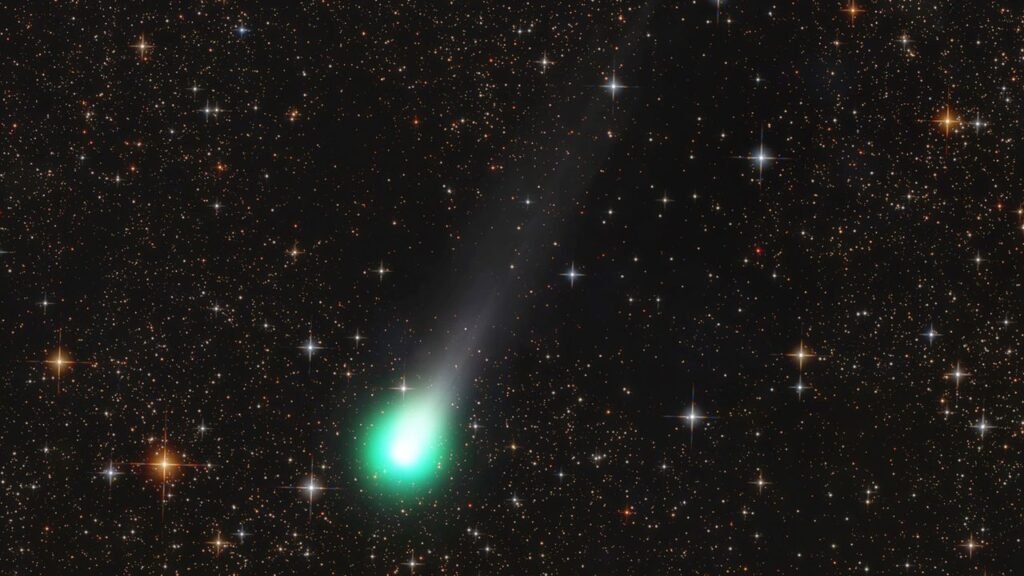

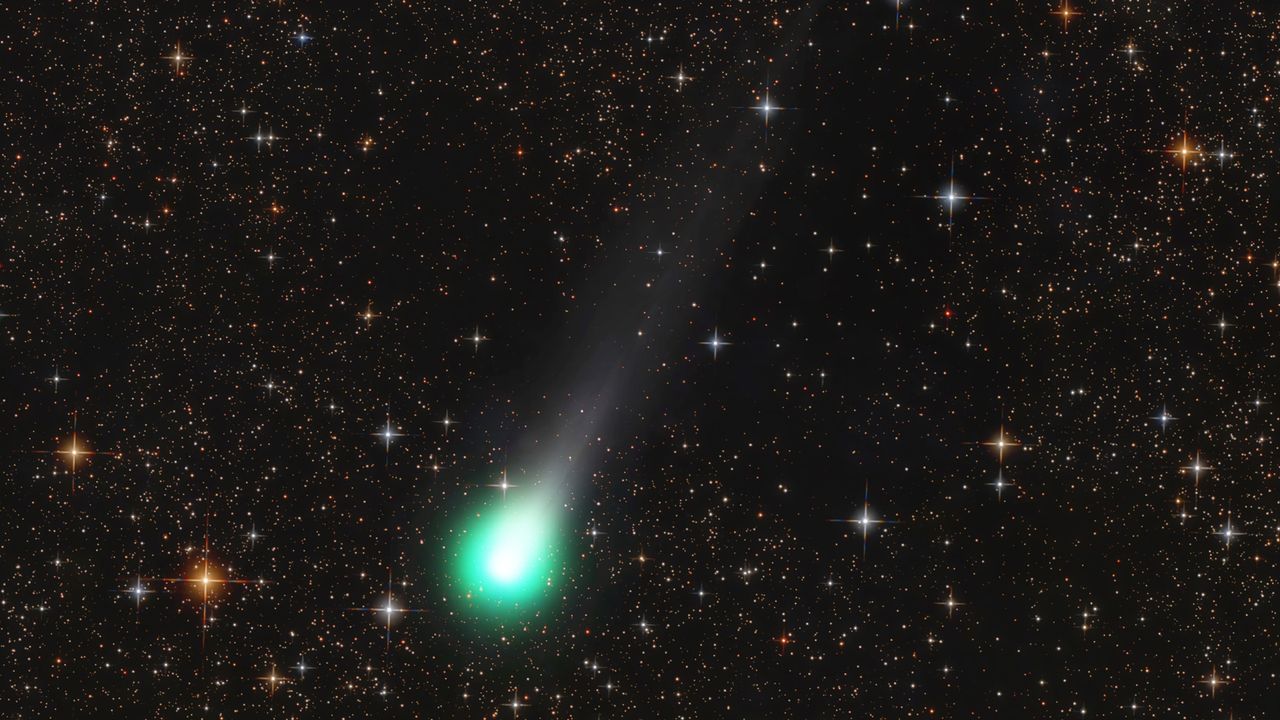
Unearthing a Celestial Wanderer (Image Credits: Cdn.mos.cms.futurecdn.net)
Astronomers worldwide have turned their attention to Comet C/2025 R3, a celestial visitor that promises to deliver one of the year’s most anticipated astronomical events.
Unearthing a Celestial Wanderer
The discovery of Comet C/2025 R3 by the Pan-STARRS telescope in Hawaii marked an exciting find in the summer of 2025. This long-period comet, originating from the distant Oort Cloud, follows an elliptical orbit that brings it back to the inner solar system only once every several thousand years. Scientists quickly noted its trajectory, which positions it for a close solar encounter in April 2026. That perihelion approach, just 0.3 astronomical units from the Sun, could trigger dramatic changes in the comet’s appearance. Early observations revealed a nucleus about 1 kilometer in diameter, surrounded by a faint coma of gas and dust. As it hurtles inward, the increasing solar heat will likely intensify these features, potentially transforming a modest visitor into a spectacular sight.
Predictions from observatories suggest the comet’s brightness could surge as it nears the Sun. While initial estimates placed its peak magnitude around 8 – requiring binoculars for viewing – recent models indicate a possible reach to magnitude 3, making it faintly visible without aids under dark skies. However, the comet’s fate remains uncertain; similar sun-grazers often fragment under intense radiation and tidal forces. If it holds together, C/2025 R3 could emerge as a highlight for stargazers in 2026.
Forecasting Brightness and Behavior
Comet C/2025 R3’s journey will unfold over several months, with key phases building anticipation. It enters the inner solar system in late 2025, gradually brightening as sunlight energizes its ices into vapor. By March 2026, observers in the Southern Hemisphere may spot it low in the evening sky, initially as a fuzzy patch through telescopes. The critical moment arrives in April, when the comet swings around the Sun, potentially developing a prominent tail stretching millions of kilometers. Post-perihelion, it heads northward, offering Northern Hemisphere viewers a chance in May and June, though fading rapidly.
Experts emphasize the variability inherent in comets. Historical precedents, like Comet ISON in 2013, show how close solar passes can lead to disintegration, while survivors like Comet Lovejoy in 2011 produce stunning displays. For C/2025 R3, monitoring continues through ground-based and space telescopes to track any outbursts or structural changes. If dust production ramps up, the comet might develop multiple tails – one of dust curving in the solar wind, another of ions pointing radially outward. Such features could make it a standout object, visible primarily from southern latitudes during its brightest phase.
Why This Comet Captures Imagination
Designating a comet as “great” hinges on more than brightness; it must captivate public interest with naked-eye visibility and striking visuals. Past great comets, such as Hale-Bopp in 1997, lingered for weeks and sported expansive tails that rivaled the Milky Way in splendor. C/2025 R3 shares traits with these icons: its non-periodic orbit suggests a pristine composition, unmarred by prior solar visits. This freshness could yield vigorous outgassing, creating a coma wide enough to span the field of view in small instruments. Astronomers hope it avoids the pitfalls that doomed other prospects, positioning 2026 as a banner year for comet watching.
The broader context of 2026’s celestial calendar adds to the excitement. With other comets like 24P/Schaumasse appearing earlier in the year, C/2025 R3 stands out for its potential scale. Social media buzz from enthusiasts already highlights its promise, with posts noting rapid brightening trends in similar objects. Yet, caution prevails; comets defy predictions, reminding observers of nature’s unpredictability.
Tips for Spotting the Comet
Preparing to view C/2025 R3 requires planning, especially for those in light-polluted areas. Start by selecting dark-sky sites away from city glow, using apps or star charts to locate it near constellations like Hydra in the south. Binoculars of 7×50 magnification or larger will prove essential for early detection, revealing the coma as a hazy glow. As it brightens, look for the tail extending westward after sunset. Weather and moonlight will influence success, so check forecasts for clear April nights.
- Monitor updates from observatories like the International Comet Quarterly for real-time brightness reports.
- Use a star-tracking mount if employing a telescope to follow its motion against the stars.
- Join local astronomy clubs for group viewings, enhancing the experience with shared expertise.
- Photograph the comet with long exposures to capture faint details invisible to the eye.
- Avoid urban areas; rural horizons offer the best low-elevation views in the southern sky.
In summary, Comet C/2025 R3 PanSTARRS holds the potential to define 2026’s astronomical narrative, blending scientific intrigue with visual wonder – if it endures its solar trial. As the year progresses, skywatchers everywhere should mark their calendars for this fleeting spectacle. What are your plans to catch this cosmic traveler? Share your thoughts in the comments below.
Key Takeaways
- C/2025 R3 reaches perihelion in April 2026, potentially brightening to naked-eye visibility.
- Southern Hemisphere observers gain the prime viewing window, with Northern access post-perihelion.
- Uncertainty surrounds its survival, but success could yield a memorable tail and coma display.
For more details, see the analysis at Space.com.