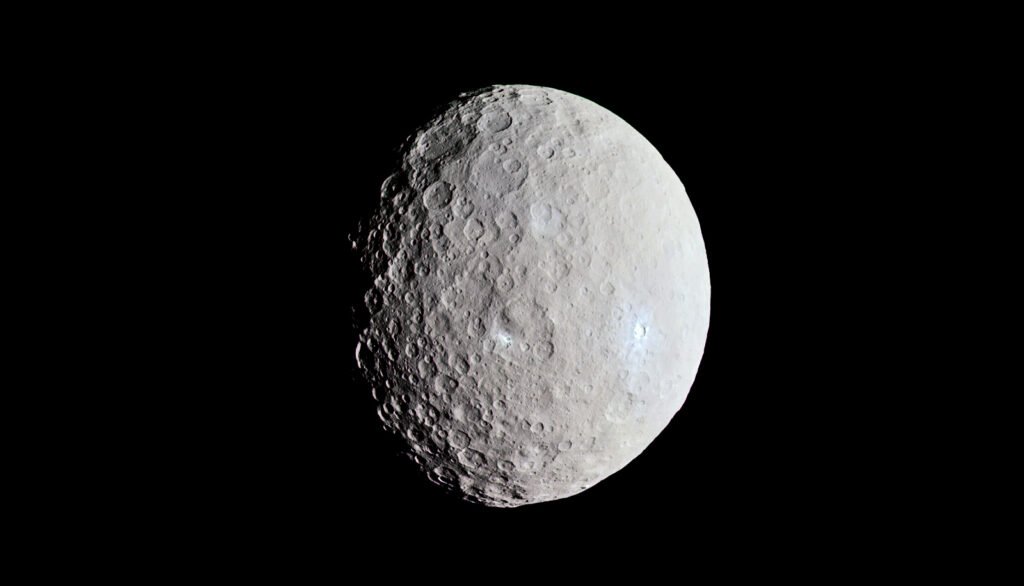

A Starlit Surprise in the New Year (Image Credits: Upload.wikimedia.org)
On a crisp night in early 1801, astronomer Giuseppe Piazzi gazed through his telescope in Palermo, Italy, and spotted an unfamiliar wanderer among the stars.
A Starlit Surprise in the New Year
Picture this: the calendar had just flipped to January 1, and the world was still adjusting to the 19th century. Giuseppe Piazzi, director of the Palermo Astronomical Observatory, was methodically charting the constellation of Taurus when a faint object caught his eye. It moved against the fixed backdrop of stars, defying expectations. At first, Piazzi suspected a comet, but no tail appeared. His observations over the following weeks confirmed something extraordinary – a new celestial body orbiting between Mars and Jupiter.
This discovery marked a pivotal moment in astronomy. Piazzi named it Ceres, after the Roman goddess of agriculture, honoring Sicily’s fertile heritage. News spread quickly across Europe, igniting debates among scholars. The object challenged the prevailing Titius-Bode law, which predicted a planet in that orbital gap. Ceres’ identification as the first of its kind opened a new chapter in our exploration of the solar system.
Evolving Status: Asteroid, Planet, and Beyond
Initially hailed as the “missing planet,” Ceres held that title briefly. Its size – about 590 miles in diameter – seemed substantial enough to warrant planetary status. However, within a few years, more similar bodies emerged, prompting astronomers to reclassify it. By 1852, over 100 such objects had been found, leading to the term “asteroid” for these minor planets.
The 20th century brought further refinements. In 2006, the International Astronomical Union redefined planetary criteria, demoting Pluto and elevating Ceres to dwarf planet status alongside it. This category recognizes bodies that orbit the Sun, are massive enough to assume hydrostatic equilibrium, but have not cleared their orbital neighborhoods. Ceres remains the largest asteroid and the only dwarf planet in the inner solar system, comprising about a third of the asteroid belt’s total mass.
Dawn’s Revelations: A Close Encounter
Centuries after its discovery, human ingenuity brought Ceres into sharper focus. NASA’s Dawn spacecraft, launched in 2007, arrived at the dwarf planet in 2015 after first visiting the asteroid Vesta. This mission provided the first detailed images and data, revealing a rugged surface dotted with craters, bright spots, and mysterious pyramids. Scientists detected water ice and salts, suggesting Ceres formed in a wetter environment billions of years ago.
The findings extended beyond visuals. Dawn’s instruments measured Ceres’ weak gravity and composition, indicating a rocky core overlaid with ice. Organic molecules hinted at prebiotic chemistry, fueling speculation about its role in delivering water to Earth. After completing its primary objectives, Dawn orbited until 2018, when mission control lost contact. These insights continue to inform models of solar system formation.
Why Ceres Matters in Modern Astronomy
Today, Ceres stands as a time capsule from the solar system’s infancy. Its location in the main asteroid belt offers clues about the chaotic early dynamics that shaped the planets. Unlike the icy outer dwarf planets, Ceres’ inner position highlights the diversity of primordial materials. Ongoing analysis of Dawn’s data reveals seasonal changes and possible cryovolcanism, where subsurface oceans might vent materials.
Astronomers also eye Ceres for practical reasons. Its resources – water and volatiles – could support future space missions. As the largest accessible body beyond Mars, it represents a stepping stone for deep-space exploration. Recent studies emphasize its significance in understanding planet-building processes, bridging the gap between rocky asteroids and terrestrial worlds.
- Ceres’ diameter measures roughly 590 miles, about one-quarter that of Earth’s Moon.
- It orbits the Sun every 4.6 years, at an average distance of 2.8 astronomical units.
- The dwarf planet lacks a moon, unlike many larger bodies.
- Bright spots on its surface, like those in Occator Crater, contain sodium carbonate from subsurface brines.
- Ceres’ density suggests a mix of rock and ice, with possible liquid layers beneath.
Key Takeaways
- Ceres’ discovery sparked the asteroid era, expanding our view of the solar system.
- From planet to dwarf, its classification reflects evolving scientific understanding.
- Dawn’s visit uncovered water and organics, hinting at ancient habitability.
As we mark 225 years since Piazzi’s observation, Ceres reminds us of the universe’s ongoing mysteries. This unassuming dwarf planet continues to challenge and inspire, urging astronomers to probe deeper into the cosmos. What aspects of Ceres intrigue you most? Share your thoughts in the comments below.