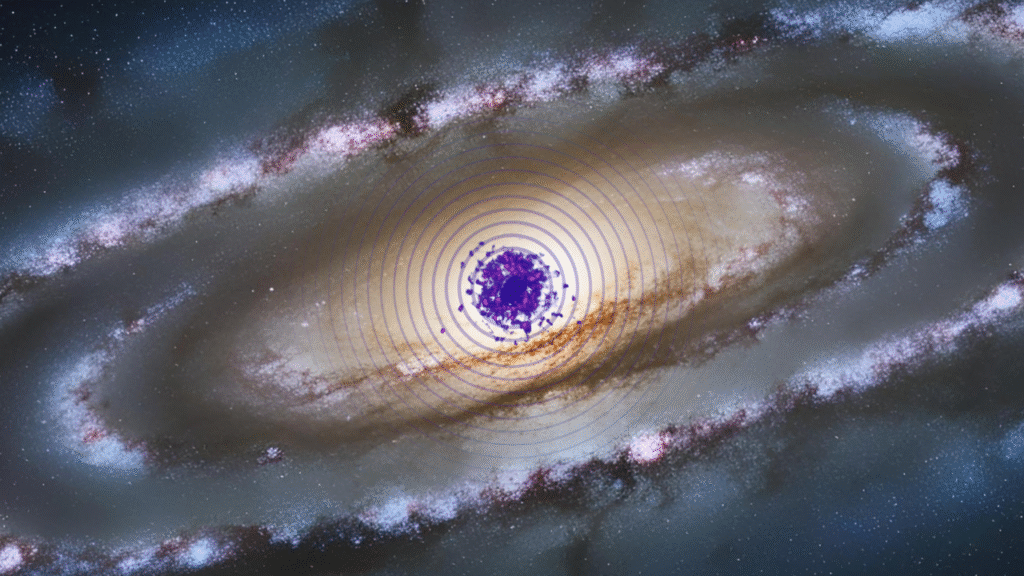

The Enigma of Baryonic Matter (Image Credits: Cdn.mos.cms.futurecdn.net)
Astronomers have long puzzled over the whereabouts of the universe’s ordinary building blocks, revealing that much of this matter drifts far from the familiar glow of stars and galaxies.
The Enigma of Baryonic Matter
Scientists faced a longstanding riddle in cosmology: the Big Bang theory predicted a certain amount of normal matter, yet observations showed far less concentrated in visible structures. This discrepancy left researchers searching for the bulk of baryonic matter, the protons, neutrons, and electrons that form atoms. For years, telescopes captured only a fraction of it locked in stars, planets, and interstellar dust. The rest seemed to vanish into the vast emptiness of space. Recent studies, however, have begun to map this hidden reservoir with unprecedented clarity.
Diffuse gas clouds, stretched across intergalactic voids, emerged as prime suspects. These tenuous filaments, often too faint for traditional optics, hold the majority of ordinary matter. Astronomers estimated that up to 90 percent of baryonic matter resides here, far from the dense clusters we associate with cosmic life. This discovery reshaped views on the universe’s architecture, highlighting how much remains unseen.
Breakthrough Techniques in the Search
In June 2025, a team employed innovative radio astronomy methods to conduct a comprehensive survey of normal matter distribution. They targeted fast radio bursts – intense, millisecond-long signals from distant cosmic events – as natural probes. By measuring how these bursts distorted through intervening gas, researchers quantified the density of baryons along vast sightlines. This approach completed what many called a full census of ordinary matter, confirming its prevalence in the cosmic web.
The technique proved remarkably sensitive, detecting wispy plasma that scatters light minimally. Previous efforts relied on X-ray emissions or absorption lines, but those missed the hottest, most diffuse components. Now, with data from multiple observatories, scientists traced matter filaments linking galaxy clusters. This not only accounted for the “missing” baryons but also refined models of large-scale structure formation.
Mapping the Universe’s Composition
Normal matter constitutes just a sliver of the cosmos, dwarfed by invisible forces. Dark energy drives the universe’s accelerating expansion, while dark matter provides the gravitational scaffolding for galaxies. Within the realm of ordinary matter, distribution varies dramatically, with most evading compact forms. Astronomers now understand that stars and galaxies capture only about half of available baryons, leaving the rest in expansive, low-density regions.
To illustrate the breakdown:
- Dark energy: Approximately 68 percent, fueling cosmic acceleration.
- Dark matter: Around 27 percent, invisible yet essential for structure.
- Normal (baryonic) matter: Roughly 5 percent, including atoms in gas, stars, and planets.
- Within normal matter, diffuse intergalactic gas dominates at over 50 percent of the total baryonic content.
- Stars and galaxies account for less than 10 percent of baryons.
These proportions, drawn from missions like Planck, underscore the universe’s sparse nature.
Implications for Cosmic Evolution
Understanding normal matter’s spread influences theories on galaxy formation and the early universe. Filaments of gas likely seeded the first stars, feeding black holes and shaping clusters over billions of years. This diffuse matter also absorbs and re-emits radiation, affecting how light travels across space. Future surveys could reveal interactions between baryons and dark matter, potentially explaining galaxy rotation curves.
Challenges persist, as detecting the warm-hot intergalactic medium requires ever-more precise instruments. Upcoming telescopes, like those scanning in ultraviolet and radio wavelengths, promise deeper insights. Such advancements could bridge gaps between theory and observation, illuminating the universe’s hidden skeleton.
Key Takeaways
- Most normal matter exists as diffuse gas in intergalactic space, not in luminous objects.
- Radio techniques using fast bursts have enabled a near-complete baryon census.
- This discovery affirms the Big Bang’s predictions and refines our cosmic inventory.
As astronomers peel back the veil on ordinary matter’s domain, the universe reveals itself as a tapestry of unseen threads binding the visible few. This perspective invites a broader appreciation for the cosmos’s subtlety. What aspects of this hidden matter intrigue you most? Share your thoughts in the comments.