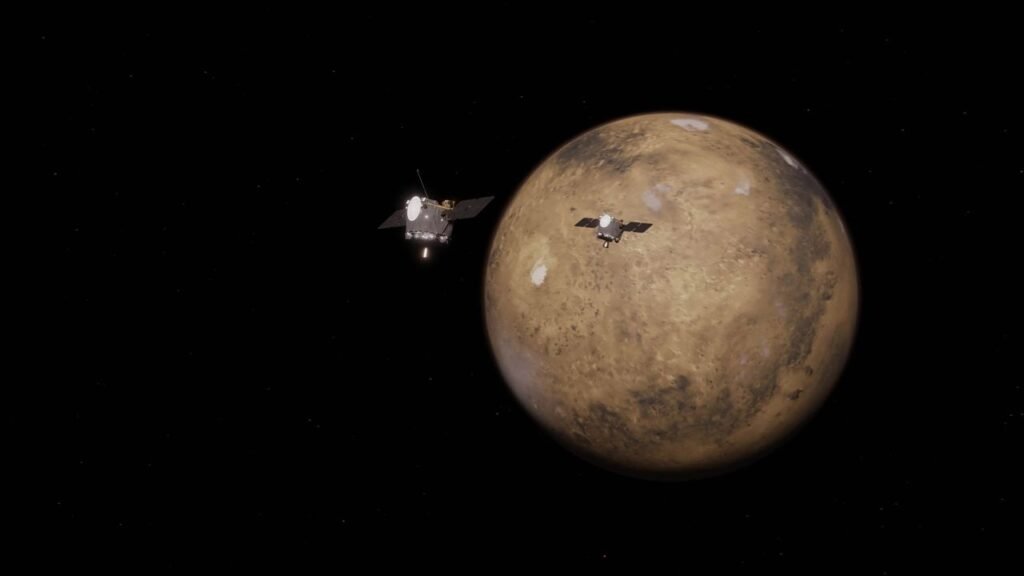
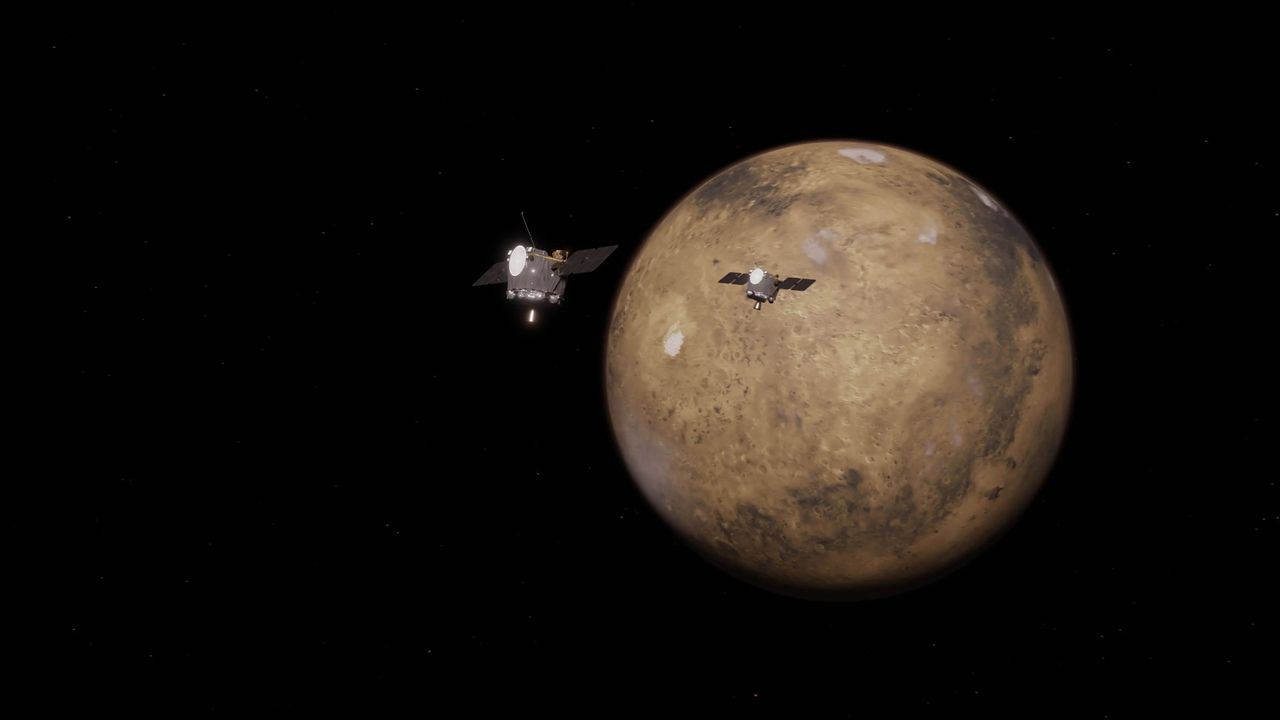
A Mission Unlike Any Other (Image Credits: Cdn.mos.cms.futurecdn.net)
NASA’s latest venture into Martian science highlights a shift toward more accessible space exploration, where innovation meets fiscal restraint in the quest to understand the Red Planet’s atmosphere.
A Mission Unlike Any Other
The ESCAPADE mission, short for Escape and Plasma Acceleration and Dynamics Explorers, marked a departure from traditional planetary probes when it launched aboard a Blue Origin rocket in November 2025. Twin small satellites, each weighing just 150 pounds, embarked on a circuitous path to Mars after enduring years of delays and technical hurdles. This approach broke the conventional mold of large, expensive spacecraft, opting instead for compact designs that prioritize speed and affordability.
Engineers at NASA designed these probes to orbit Mars and measure how solar wind interacts with the planet’s weak magnetic field. The mission’s simplicity allowed for a rapid development cycle, but it also introduced uncertainties that larger projects typically mitigate through extensive testing. Despite the challenges, the launch represented a milestone in demonstrating that vital science could reach Mars without multimillion-dollar price tags.
Strategies Behind the Savings
NASA turned to commercial partnerships to slash costs on ESCAPADE, leveraging rideshare opportunities and off-the-shelf components rather than custom-built hardware. This model reduced the budget to a fraction of flagship missions like the Perseverance rover, which exceeded $2 billion. By focusing on essential instruments – such as magnetometers and particle detectors – the team streamlined operations and avoided the bloat of redundant systems.
Similar tactics appear in other low-cost initiatives, where agencies collaborate with private firms for launches and manufacturing. These efforts enable more frequent missions, spreading scientific inquiries across multiple targets instead of concentrating resources on one. However, the reliance on unproven technologies demands careful calibration to ensure data integrity upon arrival.
Unlocking New Scientific Insights
Once in orbit, ESCAPADE’s probes will provide real-time data on plasma dynamics around Mars, offering clues about atmospheric loss over time. This information could refine models of how planets like Earth maintain their protective bubbles against solar radiation. Scientists anticipate breakthroughs in understanding space weather effects, which influence satellite operations and future human outposts.
The mission’s dual-satellite setup allows for simultaneous measurements from different angles, enhancing the reliability of findings despite the pared-down payload. Early projections suggest these observations will complement data from prior Mars explorers, filling gaps in knowledge about the planet’s interaction with the sun. Such targeted studies exemplify how modest investments can yield outsized returns in planetary science.
The Inevitable Trade-Offs
Lower budgets inherently amplify risks, as seen in ESCAPADE’s history of setbacks, including launch postponements due to integration issues. Missions like this forgo extensive backups, meaning a single failure could compromise the entire effort. Limited funding also curtails the number of scientific instruments, potentially overlooking secondary phenomena that costlier probes might capture.
Yet, these compromises foster creativity, pushing teams to optimize every element. For instance, the spacecraft’s minimalistic design reduces launch mass, enabling cheaper rides to space. Experts weigh these factors carefully, recognizing that while success rates may dip, the volume of missions could accelerate overall progress in astronomy and space research.
To illustrate the balance, consider the following key aspects of low-cost missions:
- Reduced development time: From concept to launch in under five years, versus a decade for traditional projects.
- Commercial integration: Partnerships lower expenses by up to 70% through shared infrastructure.
- Focused objectives: Emphasis on core science goals avoids mission creep and resource dilution.
- Higher failure tolerance: Acceptance of partial successes to enable broader experimentation.
- Scalability: Potential for fleets of small probes to cover diverse targets efficiently.
Key Takeaways
- Affordable missions like ESCAPADE expand access to space science without prohibitive costs.
- Risks include technical glitches and limited data scope, but rewards lie in frequent discoveries.
- The future favors hybrid models blending public innovation with private efficiency.
As ESCAPADE hurtles toward Mars, it underscores a pivotal question for space agencies: Can the pursuit of affordability sustain groundbreaking research without sacrificing too much? This mission’s outcome may guide the next era of exploration, proving that bold risks often pave the way for enduring knowledge. What do you think about the shift to low-cost space ventures? Tell us in the comments.