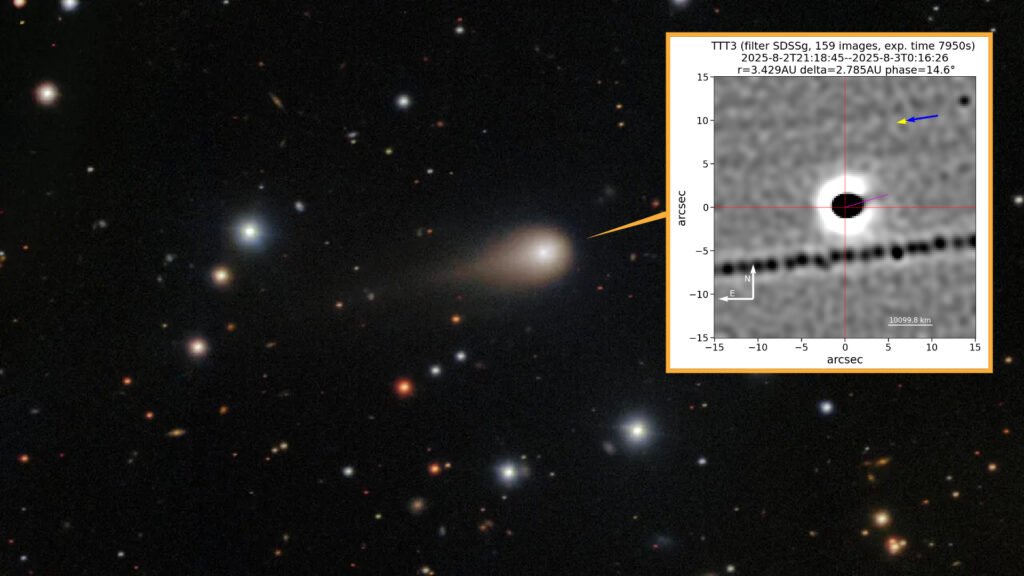
Astronomers are peering deeper than ever before into the behavior of interstellar comet 3I/ATLAS, a rare visitor from beyond our solar system, and the latest images suggest it’s behaving in ways that are both familiar and strikingly unexpected. As it approaches and then recedes from the Sun on its hyperbolic path, 3I/ATLAS has been observed erupting jets of ice and gas—akin to “ice volcanoes” (cryovolcanism)—that spew material into space, offering a unique natural laboratory for studying how icy bodies react to intense solar heating.
This eruption of volatile material not only helps scientists understand the physical processes occurring on an interstellar comet’s surface, but also provides clues about the composition and history of an object that formed around another star. Being only the third confirmed interstellar object and the largest yet studied, 3I/ATLAS continues to surprise astronomers with its activity as it travels through our cosmic neighborhood.
A Visitor From Another Star System
Comet 3I/ATLAS (C/2025 N1) was first spotted on July 1, 2025 by the ATLAS survey telescope in Chile, and soon confirmed to be an interstellar traveler due to its hyperbolic trajectory, meaning it is passing through our solar system once and then leaving forever.
Unlike most solar system comets, which form around our Sun and orbit it repeatedly, 3I/ATLAS came from far beyond—likely from the outer reaches of another star system—and is moving at speeds over 130,000 miles per hour as it travels through our neighborhood.
Ice Volcanoes: Eruptions on a Comet
New astronomical imagery shows that 3I/ATLAS isn’t just sublimating ice in the usual cometary fashion; it’s erupting jets of icy material from its surface that resemble cryovolcanic outbursts. These jets can act like miniature “ice volcanoes,” blasting gas and dust into space as the Sun’s heat penetrates volatile-rich regions of the nucleus.
Unlike typical comet tails that mainly stream away from the Sun due to solar wind pressure, these vigorous bursts appear to come from localized vents on the comet’s surface, suggesting internal pockets of volatile ice (like CO₂ or water ice) are rapidly transitioning to gas and driving the eruptions.
What the Jets Reveal About Composition
Studies using infrared spectroscopy from instruments like the James Webb Space Telescope (JWST) indicate that 3I/ATLAS has a coma dominated by carbon dioxide (CO₂)—far richer in CO₂ relative to water than typical solar system comets.
This composition supports the idea that the comet’s ice volcanoes may be driven by sublimation of highly volatile ices uncommon or less abundant in many familiar comets. The presence of such material suggests that 3I/ATLAS formed in a drastically different environment, offering a valuable comparison point for planetary scientists.
A Tale Told in Light and Motion
As 3I/ATLAS neared the Sun in late 2025, its activity spiked, making it one of the brightest interstellar comets observed and enabling astronomers to track both its jets and its unusual “anti-tail”—a feature that appears to point toward the Sun due to geometric and particle effects.
The comet’s internal rotation and evolving outgassing may also cause wobbling jets, where the direction of expelled material shifts over time—a behavior that hints at complex interactions between the comet’s spin, ice distribution, and solar heating.
A Window Into Interstellar Chemistry
Because 3I/ATLAS originates outside our solar system, its material composition potentially reflects conditions in a distant stellar nursery. Studies suggest it may be older than the Sun and our entire solar system, perhaps by billions of years, carrying in its ice and dust a chemical record of its formation environment.
Tracking how its ice volcanoes behave under solar influence gives researchers clues about volatile storage, internal heat transfer, and surface evolution in comets birthed around other stars—insights that would be impossible without an interstellar visitor to observe up close.
What Happens Next
After making its closest approach to the Sun around late October 2025 and its nearest pass to Earth in December 2025, 3I/ATLAS is now accelerating back out of our solar system, continuing its long, solitary journey through the galaxy.
Astronomers will continue to monitor it as long as it remains visible, using every available telescope to capture late-stage activity and changes in its outgassing patterns, extracting as much information as possible before it fades into the cosmic distance.
The eruptive behavior of interstellar comet 3I/ATLAS—especially its ice volcanoes—has turned what might have been another passing visitor into one of the most informative celestial objects of 2025. Far from being a static chunk of ice and rock, this comet illustrates how dynamic and richly textured interstellar bodies can be once heat from a star activates their volatile stores. The fact that 3I/ATLAS’s jets and composition differ so markedly from typical comets broadens our understanding of how these objects form, evolve, and preserve ancient galactic materials. As telescopes chase its fading light, the science gleaned will deepen our appreciation of the diversity of solar system neighbors and shed light on the physical processes that shape icy wanderers born around other suns. This unexpected cosmic display proves that even well-studied phenomena like comets can still surprise us—and that the universe always has more to teach those who look closely.