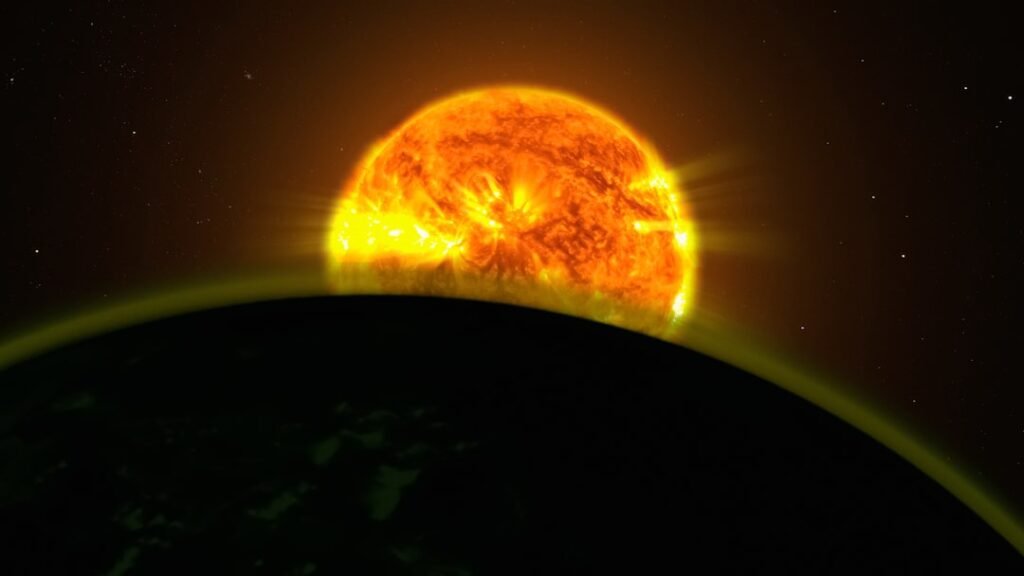


What Defines Perihelion? (Image Credits: Unsplash)
As the new year unfolds, Earth prepares for its annual closest encounter with the sun, a celestial milestone that highlights the subtle dynamics of our planet’s orbit.
What Defines Perihelion?
Perihelion marks the moment when Earth swings to its nearest position relative to the sun in its elliptical journey around the star. This event occurs every year, but the exact date shifts slightly due to the complexities of orbital mechanics. In 2026, astronomers pinpoint the occurrence for January 3 at approximately 17:15 UTC, placing our planet about 147 million kilometers from the sun.
The term derives from Greek roots meaning “around the sun,” emphasizing the orbital nature of this phenomenon. Unlike a perfect circle, Earth’s path forms an ellipse, with the sun positioned not at the center but at one focus. This geometry ensures that perihelion alternates with aphelion, the farthest point, which falls in early July. Observers have noted this pattern for centuries, using it to refine calculations of solar distances and planetary motion.
The Elliptical Orbit in Action
Earth’s orbit maintains an eccentricity of about 0.0167, a value that keeps the distance variation relatively minor at around 5 million kilometers between closest and farthest points. During perihelion, the planet travels faster along its path, covering ground at roughly 30.3 kilometers per second compared to 29.3 kilometers per second at aphelion. This acceleration stems from the stronger gravitational pull at closer range, a principle first detailed by Johannes Kepler in the 17th century.
Though the sun appears marginally larger during this time – by about 3 percent – the difference proves imperceptible to the naked eye. Telescopes or precise measurements reveal the subtle shift, but everyday skywatchers rarely notice. The event underscores the precision of astronomical predictions, with modern tools confirming the 2026 timing well in advance.
Perihelion’s Role in Earth’s Seasons
Many assume perihelion drives winter’s chill in the Northern Hemisphere, yet the true architect of seasons remains Earth’s 23.5-degree axial tilt. This orientation directs sunlight more directly toward the Southern Hemisphere during January, explaining warmer summers there despite the overall proximity to the sun. Northern winters persist because of reduced daylight and angled solar rays, unaffected by the orbital closeness.
Historical records show that perihelion’s timing has varied over millennia due to precession, the slow wobble of Earth’s axis. Currently, it aligns with Northern Hemisphere winter, but in about 13,000 years, this will reverse. For 2026, the coincidence amplifies Southern Hemisphere sunlight intensity slightly, potentially influencing weather patterns in subtle ways.
Key Facts About the 2026 Event
Astronomers anticipate clear visibility of the sun’s position, though direct observation requires caution. The date falls shortly after the new year, inviting global interest in celestial events. Supporting data from observatories worldwide confirms the distance and speed metrics.
- Distance from sun: Approximately 147 million kilometers.
- Orbital speed: Peaks at 30.3 km/s.
- Sun’s apparent size: Increases by 3% compared to July.
- Global impact: Minimal on daily temperatures, dominated by tilt.
- Historical note: Last similar alignment with a full moon occurred in 1912.
Key Takeaways
- Perihelion highlights Earth’s elliptical orbit, not circular perfection.
- Seasons arise from axial tilt, overriding distance effects.
- 2026’s event offers a timely reminder of our dynamic solar relationship.
Earth’s perihelion serves as a poignant reminder of the intricate balance sustaining life on our planet, where vast cosmic forces yield to the steady rhythm of seasons. As January 3 approaches, consider how this quiet orbital dance shapes our world year after year. What celestial events intrigue you most? Share your thoughts in the comments.