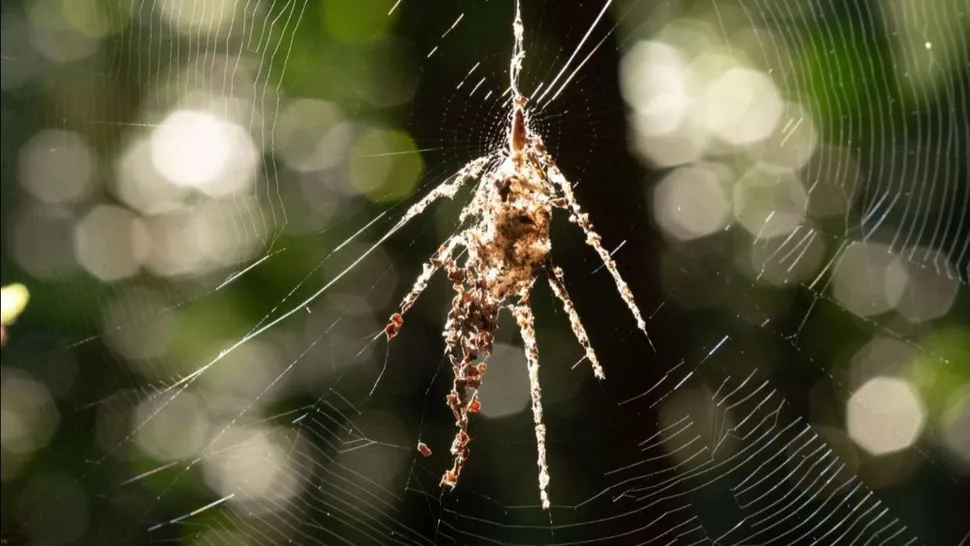
Scientists have uncovered a startling new example of animal ingenuity: tiny spiders in Peru and the Philippines that build giant “puppet” decoys out of body parts from prey insects. These incredible constructions—some larger than the spiders themselves—appear to be aimed at fooling predators, competitors, or perhaps even prey, illustrating the surprising complexity of spider behavior and evolution. This discovery adds a fascinating dimension to how researchers understand animal tool use and camouflage in the wild.
Found independently on separate continents, these spiders belong to different species yet share a behavioral strategy that’s both startling and brilliant: by arranging legs, exoskeleton fragments, and silk into lifelike figures, the spiders may reduce predation risk or manipulate ecological interactions around their webs. The research expands our knowledge of how even small, often overlooked creatures can evolve sophisticated survival techniques in response to ecological pressures.
Discovered Across Oceans: Peru and the Philippines
Naturalists first encountered these massive puppet-like figures during forest and jungle surveys in Peru and the Philippines, where the spiders’ webs were found threaded with large constructions made from dismembered insect parts. Each decoy can be many times larger than the spider itself and often bears a vaguely humanoid or insect-like form.
Scientists were initially puzzled by the structures, which seemed too elaborate to be accidental debris. Closer observation revealed that the spiders were actively assembling and maintaining the decoys, indicating intentional construction rather than random accumulation of leftovers from recent meals.
What Are These Decoys Made Of?
The spiders use a combination of disarticulated prey exoskeletons (legs, body fragments), silk, and debris to create their giant constructs. These materials are arranged with surprising precision, sometimes suspended above or below the spider’s web in a way that mimics the shape or silhouette of a larger organism.
In some observed cases, the spiders repositioned individual components when they shifted the orientation of their webs, suggesting that the decoys are not static but are refined and adjusted over time as part of the spider’s ongoing behavior.
Why Spiders Build Giant Figures
Researchers propose several hypotheses for why these spiders construct such remarkable decoys. One leading idea is that the puppet figures serve as deterrents to predators, making the web site look occupied by a larger creature that might intimidate would-be threats. Alternatively, the decoys might attract prey by mimicking the silhouette of another organism, drawing in insects curious about the shape.
Another theory suggests the decoys could play a role in intraspecific signaling, helping spiders communicate territory occupancy or avoid fights with rivals. However, behavioral experiments are still needed to test these ideas and determine the specific ecological advantages these constructions provide.
Spider Intelligence or Instinct?
The active manipulation of exoskeletal fragments into coherent forms raises intriguing questions about cognition versus instinctual behavior in spiders. While spiders are not typically regarded as intelligent in the way mammals or birds are, this behavior suggests a complex interaction between environmental feedback and evolved behavior patterns.
Scientists caution against anthropomorphizing the behavior; the spiders likely rely on evolutionary instinctual algorithms encoded in their genes to produce the decoys, even if the outcome appears intentional to human observers. Nonetheless, the sophistication of the constructions challenges assumptions about cognitive limitations in arachnids.
Broader Implications for Ecology and Evolution
These spider decoys provide a vivid example of how natural selection can produce surprising survival innovations, especially in ecosystems where predator-prey dynamics are intense. Studying such behavior helps scientists understand not only how species adapt to threats and opportunities but also how ecosystem complexity fuels behavioral diversity.
Moreover, the phenomenon prompts researchers to reexamine other odd or unexplained constructions in nature to determine whether similar behaviors have been overlooked in other crustaceans, insects, or arachnid groups.
The discovery of giant puppet-like decoys crafted by tiny spiders is a game-changing insight into the ingenuity of the natural world. It reminds us that remarkable solutions to life’s challenges can emerge in the most unexpected places and from the smallest of brains. While caution is needed to avoid overstating spider cognition, these behaviors undeniably reflect sophisticated evolutionary adaptation shaped by ecological pressures. As scientists continue to explore Earth’s biodiversity, such revelations encourage a broader appreciation for the complex subtleties of animal life—especially among creatures we often overlook.