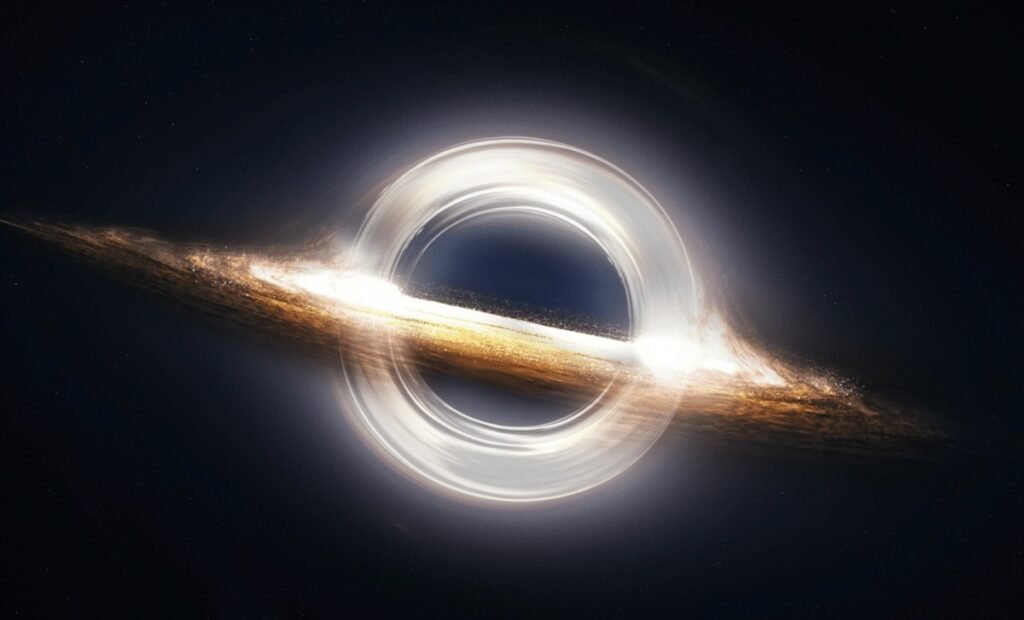

The Roots of a Cosmic Enigma (Image Credits: Dailygalaxy.com)
Physicists have long pondered the enigmatic boundaries of our universe, and a once-fringe idea – that it might reside within the event horizon of a colossal black hole – has resurfaced amid fresh theoretical insights.
The Roots of a Cosmic Enigma
The concept that our observable universe could be the interior of a black hole traces back to mid-20th-century explorations in general relativity. Early proponents suggested that the immense gravitational collapse forming black holes might not end in singularity but could spawn entirely new spacetimes. This notion challenged the prevailing view of black holes as inescapable voids, proposing instead that they act as gateways to other realms.
Over decades, the idea gained sporadic attention through mathematical models linking black hole interiors to expanding universes. Researchers drew parallels between the Big Bang’s initial conditions and the dynamics near a black hole’s horizon. Though dismissed by many as speculative, these early frameworks laid groundwork for later refinements, emphasizing quantum effects and multiverse possibilities.
Black Holes as Universe Factories
In this revived theory, supermassive black holes in a parent universe could serve as cosmic incubators. Matter falling beyond the event horizon undergoes extreme torsion, potentially inverting spacetime to create a “baby universe” on the other side. Such a process aligns with observations of our universe’s rapid early expansion, mirroring the rebound from a black hole’s collapse.
Proponents argue that the uniformity of the cosmic microwave background supports this model, as it resembles the smoothed-out remnants of infalling material. Quantum mechanics enters the picture here, suggesting that entanglement across horizons could explain dark energy’s repulsive force driving our universe’s acceleration. This perspective transforms black holes from destroyers into creators, reshaping our understanding of cosmic evolution.
Recent Advances Fueling the Revival
Breakthroughs in gravitational wave detection and black hole imaging have reignited interest in 2025. Observations from telescopes like the James Webb Space Telescope revealed unexpectedly mature structures in the early universe, prompting theorists to revisit black hole cosmology. Simulations incorporating Einstein’s equations alongside quantum field theory now better replicate these anomalies, bolstering the inside-a-black-hole hypothesis.
Physicists have proposed that our universe’s apparent flatness and lack of observable boundaries stem from being embedded within a larger black hole structure. These models predict subtle signatures in cosmic rays or gravitational lensing that upcoming missions could detect. While not yet proven, the theory offers a unified explanation for phenomena like the universe’s accelerating expansion without invoking exotic new particles.
Implications for the Fate of Reality
If validated, this idea would redefine humanity’s place in the cosmos, suggesting an infinite chain of black hole-spawned universes. It implies that every black hole in our sky might harbor its own thriving reality, challenging the finality of death by gravity. Yet, it also raises profound questions about observability – trapped within such a structure, we might never glimpse the parent universe.
Cosmologists caution that testing remains daunting, requiring indirect evidence from particle accelerators or space-based observatories. The theory dovetails with ongoing debates over the multiverse, where black holes proliferate realities endlessly. As research progresses, it invites a reevaluation of foundational principles in astrophysics.
- Black holes may not destroy information but recycle it into new universes.
- Our Big Bang could represent the “bounce” from a collapsing parent cosmos.
- Quantum torsion effects might explain dark matter’s elusive nature.
- Event horizons act as one-way membranes, isolating child universes.
- Predictions include unique patterns in cosmic microwave background fluctuations.
Key Takeaways
- The theory links black hole formation to universe creation via spacetime inversion.
- Recent simulations match early universe observations, lending credibility.
- It offers a natural resolution to the horizon problem in standard cosmology.
This bold hypothesis not only expands the frontiers of theoretical physics but also underscores the universe’s profound interconnectedness. As we peer deeper into the cosmos, such ideas remind us that reality’s deepest secrets may lie just beyond the gravitational veil – what mysteries await discovery next? Share your thoughts in the comments below.