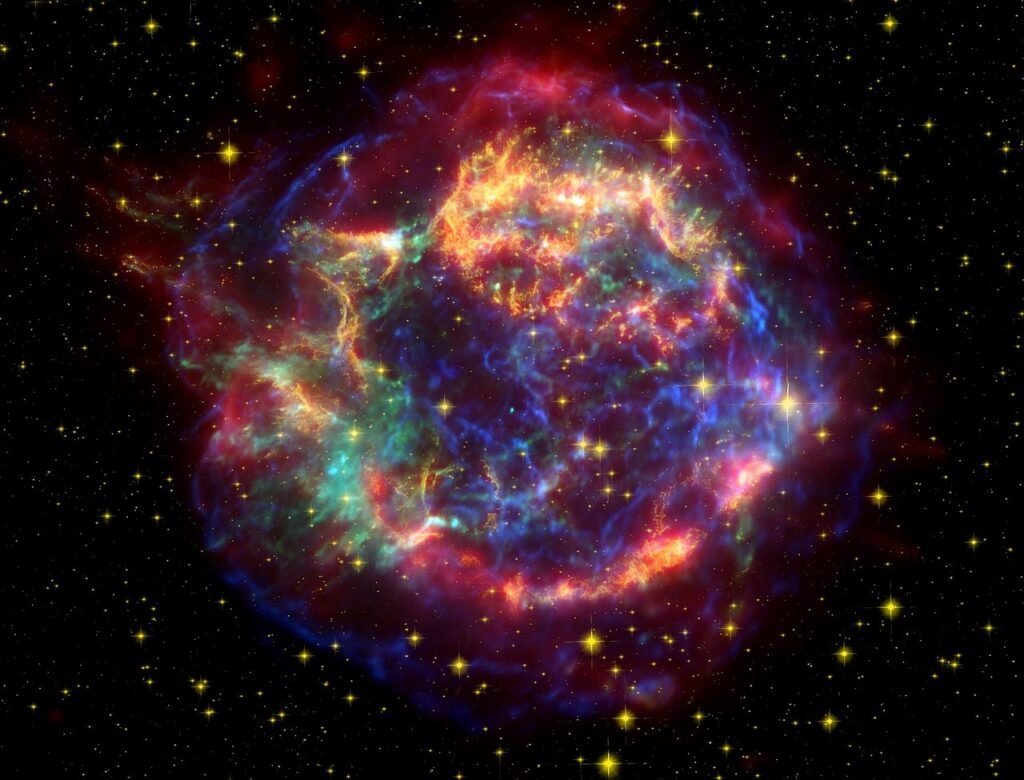
Astronomers are buzzing over an unprecedented cosmic firework display that blended two of space’s most powerful explosions into one. On August 18, 2025, scientists detected a celestial event that initially resembled a kilonova—an explosion caused by the merger of two neutron stars—only to watch it brighten again like a supernova, challenging existing theories of stellar death. This rare occurrence, dubbed AT2025ulz, could represent the first observed “superkilonova,” a hybrid event that combines both phenomena in sequence, opening a new chapter in astrophysics and the study of extreme cosmic explosions.
What makes this discovery so intriguing is not just its rarity, but what it suggests about the life cycles of massive stars and the dynamics of stellar remnants. Detected simultaneously through gravitational waves and electromagnetic telescopes, the event offered scientists an opportunity to witness a double explosion from the same source—a scenario only theorized until now. While further observations are needed to confirm that AT2025ulz is indeed the first superkilonova, this potential breakthrough could help refine models of how some of the universe’s most energetic processes unfold.
A Tale of Two Explosions
The initial detection of AT2025ulz came from the Laser Interferometer Gravitational-Wave Observatory (LIGO) and its partner Virgo in Italy, which sensed ripples in space-time indicative of a neutron star merger. Such mergers are known to produce kilonovae, bright flashes of light resulting from the fusion of heavy elements like gold and platinum.
Shortly after, optical telescopes like the Zwicky Transient Facility observed a faint red glow at the same location, consistent with past kilonova signals such as the famous 2017 event known as GW170817. But unlike typical kilonovae, the signal didn’t fade as expected. Instead, it re-brightened in blue wavelengths—a signature more akin to a supernova.
What Is a Superkilonova?
A superkilonova is a theoretical hybrid event that begins with the death of a massive star in a supernova explosion, followed closely by the merger of the newly formed neutron stars, producing a kilonova. Such a sequence would create a complex light curve with characteristics of both explosion types—first heavy element-rich, red-shifted light, then brighter, blue-shifted emission.
In the case of AT2025ulz, astrophysicists propose that the progenitor was a rapidly rotating massive star that collapsed into two neutron stars in quick succession. These then spiraled inward and merged, creating the second explosion. While this model matches the unusual observations, researchers caution that additional superkilonova candidates would be needed to fully validate the concept.
Gravitational Waves and Light: A Coordinated Discovery
What makes AT2025ulz particularly valuable is the multimessenger approach—using both gravitational wave detectors and traditional telescopes to study the same event. Gravitational waves revealed the merger’s timing and dynamics, while telescopes captured the evolving light emissions, allowing scientists to piece together a detailed timeline of the explosions.
This coordinated detection underscores how far observational astronomy has advanced since the first gravitational waves were recorded in 2015. Combined data give researchers a richer picture of the physics behind stellar collisions and explosions, revealing subtle nuances that either method alone might miss.
The Role of Neutron Stars
Neutron stars—the incredibly dense remnants left behind after a massive star dies—play a central role in both kilonovae and this potential superkilonova. In AT2025ulz, some of these neutron stars may have unusually low mass, a puzzling observation that hints at novel formation pathways, such as stellar fission or rapid accretion of material immediately after the initial explosion.
Such oddballs in the neutron star population expand astronomers’ understanding of how these exotic objects originate and interact, and how they contribute to the cosmic distribution of heavy elements.
Why This Matters
If confirmed, AT2025ulz will be more than a singular oddity—it will stand as the first observational evidence of a superkilonova, linking two explosive stellar processes in one astronomical event. This would reshape theories about how certain massive stars end their lives and how neutron star systems evolve immediately after their birth.
Moreover, such hybrid explosions may help explain some enigmatic transient events in the night sky that defy traditional classification, offering a fresh lens through which to interpret future gravitational wave and light signals.
The potential discovery of a superkilonova marks a thrilling crossroads in astrophysics—where theory and observation finally converge to illuminate a previously invisible corner of stellar evolution. AT2025ulz challenges the neat categories of supernova and kilonova, suggesting that nature’s fireworks can be even more intricate than textbooks describe. While a single event doesn’t prove a new class of explosion, the evidence is compelling and demands deeper exploration. Future sky surveys and gravitational wave observatories will likely uncover more of these cosmic hybrids, not only confirming their existence but also enriching our understanding of the universe’s most violent and beautiful phenomena. Until then, AT2025ulz stands as a cosmic invitation—to expect the unexpected among the stars.