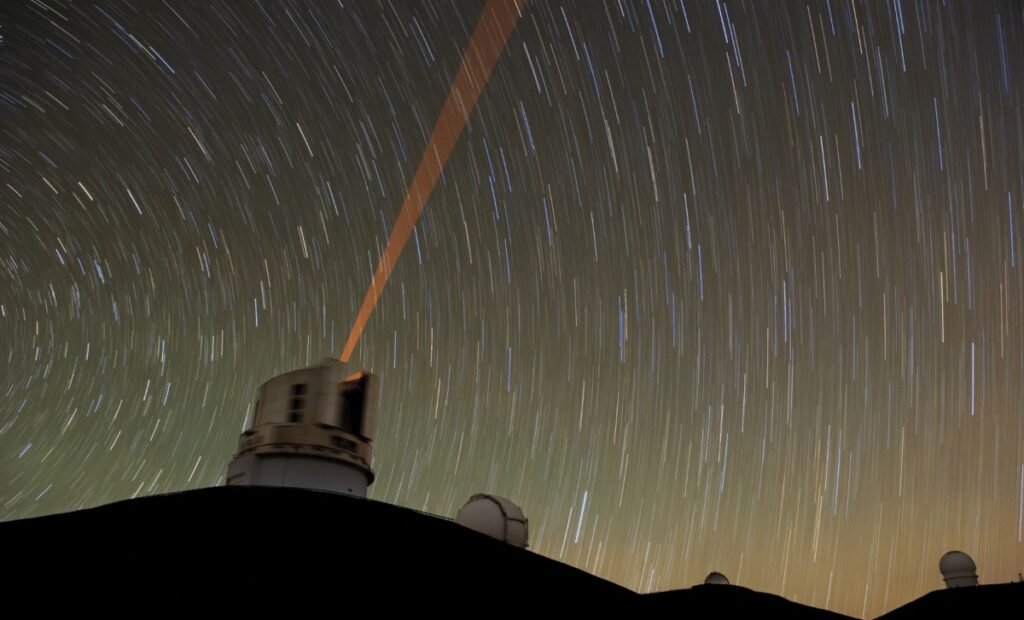

The Dawn of Interstellar Messaging (Image Credits: Dailygalaxy.com)
Humanity’s electromagnetic chatter has quietly expanded into the void of space for more than a century, forming an invisible sphere of signals that marks our presence among the stars.
The Dawn of Interstellar Messaging
In 1906, Reginald Fessenden achieved a milestone when he transmitted the first audio signal across the Atlantic, including violin music and a Bible reading that echoed into the ether. This event marked the beginning of what scientists now call Earth’s radio bubble, a growing shell of radio waves carrying fragments of human culture outward at the speed of light. Early experiments like these laid the foundation for widespread broadcasting, from radio stations to television signals, all inadvertently beaming our story into the galaxy.
By the mid-20th century, powerful transmitters amplified this outreach. Military radars and commercial broadcasts joined the fray, creating a denser wave of emissions. Though these signals dispersed in all directions, they formed a spherical wavefront centered on Earth, expanding relentlessly since those initial transmissions. Today, this bubble encapsulates a volume where echoes of old newsreels and speeches persist, undiminished in speed but fading in strength.
Measuring the Bubble’s Expansion
As of late 2025, the leading edge of our earliest radio signals has traveled approximately 119 light-years from Earth, creating a bubble with a diameter of about 238 light-years. This distance reflects the time elapsed since Fessenden’s broadcast, with light-speed propagation ensuring steady growth year by year. Within the Milky Way, which spans roughly 100,000 light-years, this footprint remains minuscule, akin to a whisper in a vast auditorium.
Astronomers visualize this expansion through models that account for the galaxy’s structure. The signals pass through interstellar dust and gas, but their core propagation remains unimpeded. Recent studies, including those from the SETI Institute, emphasize that while the bubble’s size is impressive on human scales, it covers only a fraction of the nearest star systems. For context, Proxima Centauri, our closest stellar neighbor at 4.2 light-years, lies well within this zone, potentially intercepting signals from the 1920s onward.
Factors Limiting Detectability
Despite the bubble’s growth, detecting these signals from afar proves challenging due to the inverse square law, which causes intensity to drop sharply with distance. Early AM radio waves, for instance, might remain audible up to 100 light-years away under ideal conditions, but television signals weaken to near-undetectable levels beyond a few light-years. Solar interference and atmospheric absorption further muted initial broadcasts, limiting their effective range.
Several elements influence how far these waves can be discerned:
- Signal Power: Stronger pulses, like those from planetary radars, travel farther than faint commercial broadcasts.
- Frequency Bands: Lower frequencies penetrate space better but face more galactic noise.
- Interstellar Medium: Dust scatters some wavelengths, though radio waves generally evade heavy absorption.
- Receiver Sensitivity: Advanced alien technology could pick up traces that human telescopes miss today.
- Time Delay: Signals arrive with a lag equal to their travel distance, complicating real-time analysis.
These constraints mean that while the bubble exists, its contents grow fainter, blending into cosmic background radiation over vast distances.
Implications for Extraterrestrial Contact
The radio bubble raises intriguing questions for the search for extraterrestrial intelligence, or SETI. If advanced civilizations exist within 100 light-years, they might have already glimpsed our 20th-century emissions, from swing music to Apollo mission chatter. However, the signals’ dilution suggests that only nearby, highly sensitive observers could decode them meaningfully.
Efforts to listen for reciprocal signals continue, with projects like the Allen Telescope Array scanning for artificial radio sources. This outbound bubble serves as a passive beacon, but intentional messages, such as the 1974 Arecibo transmission aimed at a distant star cluster, push our reach further. As technology evolves, humanity might amplify future broadcasts, extending the bubble’s legible frontier and inviting cosmic dialogue.
Key Takeaways
- Earth’s radio bubble spans about 238 light-years in diameter, a tiny speck in the 100,000-light-year Milky Way.
- Signals weaken rapidly due to distance, making detection beyond a few light-years improbable without advanced tech.
- Our broadcasts carry cultural snapshots, potentially the first hint of human existence to any listening stars.
In an immense universe, Earth’s radio bubble stands as a testament to our technological infancy, a fragile thread connecting us to the unknown. As it expands, it prompts reflection on our place among potential cosmic neighbors – what messages would we want them to hear next? Share your thoughts in the comments below.