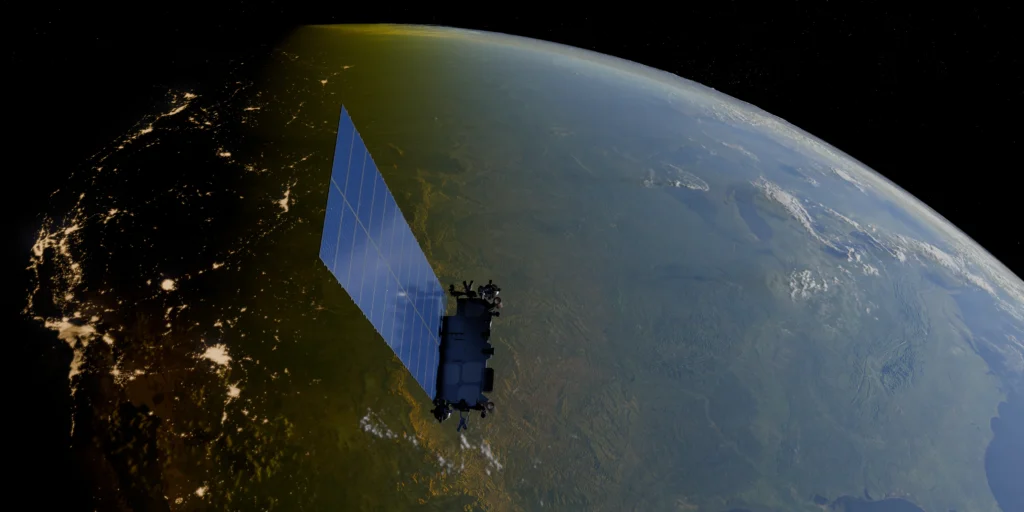
Strange Starlink Satellite Signals Raise Alarms (Image credits: Wikimedia Commons)
Scientists and satellite observers are grappling with an unexpected issue involving a special class of SpaceX satellites known as Starshield, part of a U.S. government program tied to national security. Amateur astronomer Scott Tilley discovered that roughly 170 Starshield satellites are broadcasting unusual signals in a radio band normally reserved for uplink communications—a frequency used by NASA and other space agencies to send commands and data to spacecraft rather than receive them. These signals resemble low-speed links similar to 3G cellular connections, yet their presence in the 2025–2110 MHz band could interfere with established space communication standards and operations.
This discovery comes amid broader concerns about the increasingly crowded low-Earth orbit (LEO), where the number of operational satellites has ballooned from around 900 in 2019 to nearly 10,000 today. As satellite constellations expand, so too do potential conflicts over frequency use and interference, raising questions about regulatory oversight and the safe coordination of space assets.
Satellite Signals Where They Don’t Belong
Starshield is a classified military subset of the broader Starlink internet constellation, designed to support secure communications for government missions. However, the accidental emission in uplink bands was uncovered only because a hobbyist meticulously scanned frequencies while tracking satellites overhead. The transmissions from these spacecraft show up in a portion of the spectrum typically allocated for uplinks, suggesting either a regulatory oversight or an intentional but unreported use of radio bands that could overlap with other critical space services.
Under international telecommunications rules, uplink frequencies are protected to prevent interference with spacecraft command and control—so signals appearing there, regardless of origin, are cause for concern. If such emissions go unchecked, they could disrupt other operators’ ability to send commands or receive data from their own satellites.
Why Frequencies Matter in Space
Radio frequencies are the lifeblood of satellite operations. Spacecraft rely on carefully allocated bands to carry out navigation, Earth observation, scientific measurement, and communications tasks. When unexpected signals appear in a band reserved for uplinks, it can introduce noise or confusion that degrades performance or, in extreme cases, blocks critical messages between ground stations and orbiting assets.
The fact that these Starshield transmissions resemble everyday terrestrial data links adds another layer of complexity: they are not crude interference but organized signals that could entangle with legitimate space communications if not properly managed.
The Regulatory Puzzle
It remains unclear whether SpaceX has formal authorization from the U.S. National Telecommunications and Information Administration (NTIA) or international bodies to broadcast in this band. Regulatory timestamps and approvals for satellite frequency use are often public, but the classified nature of Starshield complicates standard transparency.
International coordination is essential because satellites cross global borders, and frequency misuse by one operator can impact services worldwide. The discovery of these transmissions underscores potential gaps in how novel space systems are vetted and regulated, especially as commercial and military projects proliferate.
Interference: More Than a Buzzword
Experts warn that even well-intentioned transmissions in restricted bands could affect spacecraft belonging to other agencies or companies. If uplink frequencies become cluttered with unintended signals, ground stations might struggle to maintain stable contact with satellites, which could lead to degraded science returns or degraded mission safety.
This is not an abstract worry; disruptions to uplink bands have real consequences for Earth observation satellites, GPS services, and interplanetary missions—all of which depend on pristine communication channels to operate effectively.
What Happens Next
SpaceX and relevant government agencies have not publicly detailed whether the Starshield emissions are intentional, authorized, or subject to ongoing review. The situation highlights the growing need for close international coordination on spectrum use as space grows increasingly congested.
Astronomers, operators, and regulators alike may now push for clearer rules or enforcement mechanisms to ensure that military, commercial, and scientific satellites can coexist without harmful signal interference—a challenge that will only intensify as the orbital population continues to rise.
The surprising discovery of satellite signals in the “wrong” frequencies isn’t just a technical curiosity—it is a vivid illustration of how space infrastructure is outpacing regulation and oversight. As private companies and governments deploy ever-larger constellations, the risk of interference grows, threatening everything from everyday communications to deep-space missions. This episode should serve as a wake-up call: we urgently need transparent, enforceable, and internationally harmonized rules governing frequency use to protect the fragile ecosystem of space operations. With orbit becoming even more congested, the era of haphazard radio usage must give way to rigorous coordination or risk undermining the very systems humanity has come to rely upon.