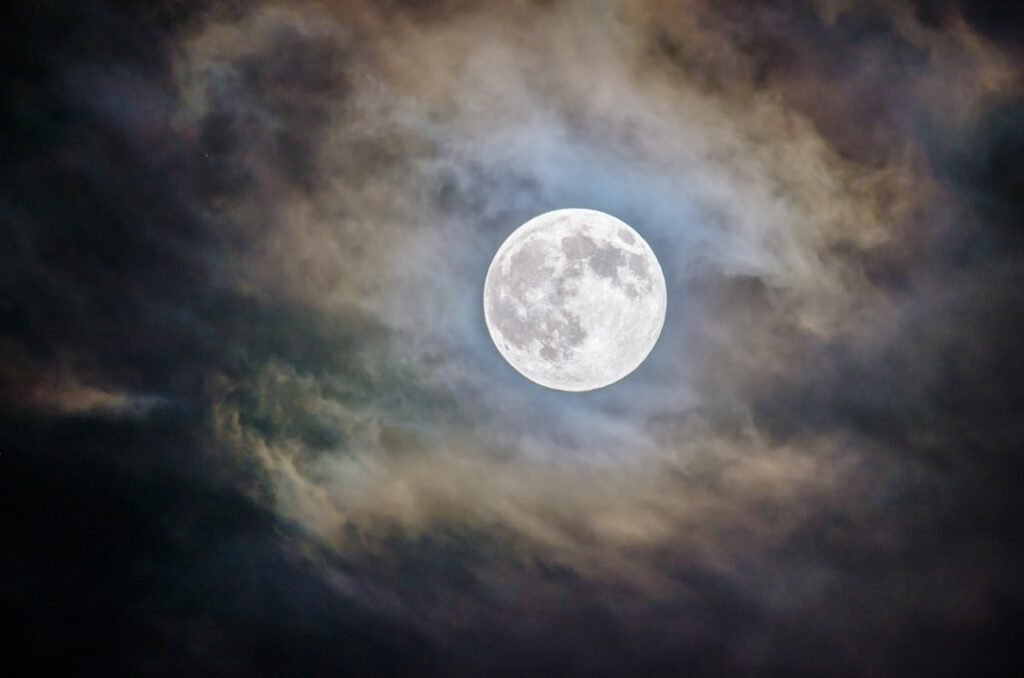

The Science Behind the Full Moon’s Glow (Image Credits: Unsplash)
Throughout 2025, skywatchers around the world witnessed a series of luminous full moons that illuminated nights with their silvery glow, marking the rhythm of the lunar cycle.
The Science Behind the Full Moon’s Glow
Earth’s moon reaches its full phase when it positions itself directly opposite the sun, with our planet in between. This alignment bathes the moon’s Earth-facing side in direct sunlight, creating the bright disk visible from the ground. Astronomers noted that this occurs roughly every 29.5 days, following the moon’s elliptical orbit around Earth.
The reflected light travels across the vacuum of space, arriving to us without the dimming effects of an atmosphere on the lunar surface. Observers often reported how the moon appeared larger near the horizon due to an optical illusion, though its actual size remained constant. This phenomenon continued to captivate scientists and enthusiasts alike in 2025, offering insights into orbital mechanics.
Full moons also influenced tides, pulling oceans with greater force during these alignments. Researchers tracked these effects precisely, using data from observatories worldwide. The event served as a reminder of the moon’s gravitational dance with Earth.
Key Dates and Times for 2025 Full Moons
Astronomy enthusiasts marked their calendars for 12 full moons in 2025, each arriving at specific universal times that varied by time zone. The year began with the Wolf Moon on January 13 at 22:27 UTC, setting a tone for the celestial year. Subsequent phases followed a predictable pattern, with the final one, the Cold Moon, occurring on December 4 at 06:15 UTC.
Here is the complete schedule of full moon peaks in 2025, listed in UTC for global reference:
- January 13: 22:27 UTC (Wolf Moon)
- February 12: 13:53 UTC (Snow Moon)
- March 14: 06:55 UTC (Worm Moon)
- April 13: 00:22 UTC (Pink Moon)
- May 12: 16:56 UTC (Flower Moon)
- June 11: 07:44 UTC (Strawberry Moon)
- July 10: 20:37 UTC (Buck Moon)
- August 9: 07:56 UTC (Sturgeon Moon)
- September 7: 18:09 UTC (Harvest Moon)
- October 7: 03:07 UTC (Hunter’s Moon)
- November 5: 13:19 UTC (Beaver Moon)
- December 4: 06:15 UTC (Cold Moon)
These timings allowed viewers in different regions to plan observations, adjusting for local daylight saving changes. For instance, the March full moon peaked just before dawn in many areas, providing a pre-sunrise spectacle.
Highlights: Supermoons and Eclipses in 2025
Two full moons in 2025 stood out as supermoons, when the moon reached perigee – its closest point to Earth – amplifying its size and brightness in the sky. The Pink Moon on April 13 and the Flower Moon on May 12 both qualified, drawing larger crowds to dark-sky sites. Observers described these events as particularly vivid, with the moon seeming to dominate the horizon.
Lunar eclipses added drama to the year’s lineup. A total lunar eclipse shadowed the Worm Moon on March 14, turning it a striking reddish hue for viewers in parts of the Americas, Europe, and Africa. Later, a partial eclipse darkened the Harvest Moon on September 7, visible across Asia, Australia, and the Pacific. These rare overlaps of full moon and eclipse paths heightened interest among amateur astronomers.
Such events underscored the moon’s dynamic role in our solar system, blending predictable cycles with occasional spectacles.
Practical Tips for Moon Gazing
To make the most of 2025’s full moons, stargazers selected locations far from city lights, where light pollution would not wash out the view. Binoculars or a small telescope enhanced details like craters and maria on the lunar surface. Many joined local astronomy clubs for guided sessions during peak times.
Weather played a crucial role; clear nights in rural areas offered the best opportunities. Apps and websites provided real-time updates on moonrise and visibility. Photographers captured these moments with long exposures, balancing the bright moon against starry backdrops.
Even urban dwellers found ways to observe, peering from rooftops or parks after sunset.
Key Takeaways from 2025’s Full Moons
- Twelve full moons lit the skies, with precise timings enabling worldwide viewing.
- Supermoons in April and May appeared brighter and larger due to orbital proximity.
- Eclipses in March and September offered rare, shadowed displays of the moon.
In reflecting on 2025’s full moons, one clear takeaway emerges: these ancient celestial rhythms continue to connect us to the cosmos, inviting wonder year after year. What was your favorite lunar moment this year? Share in the comments below.