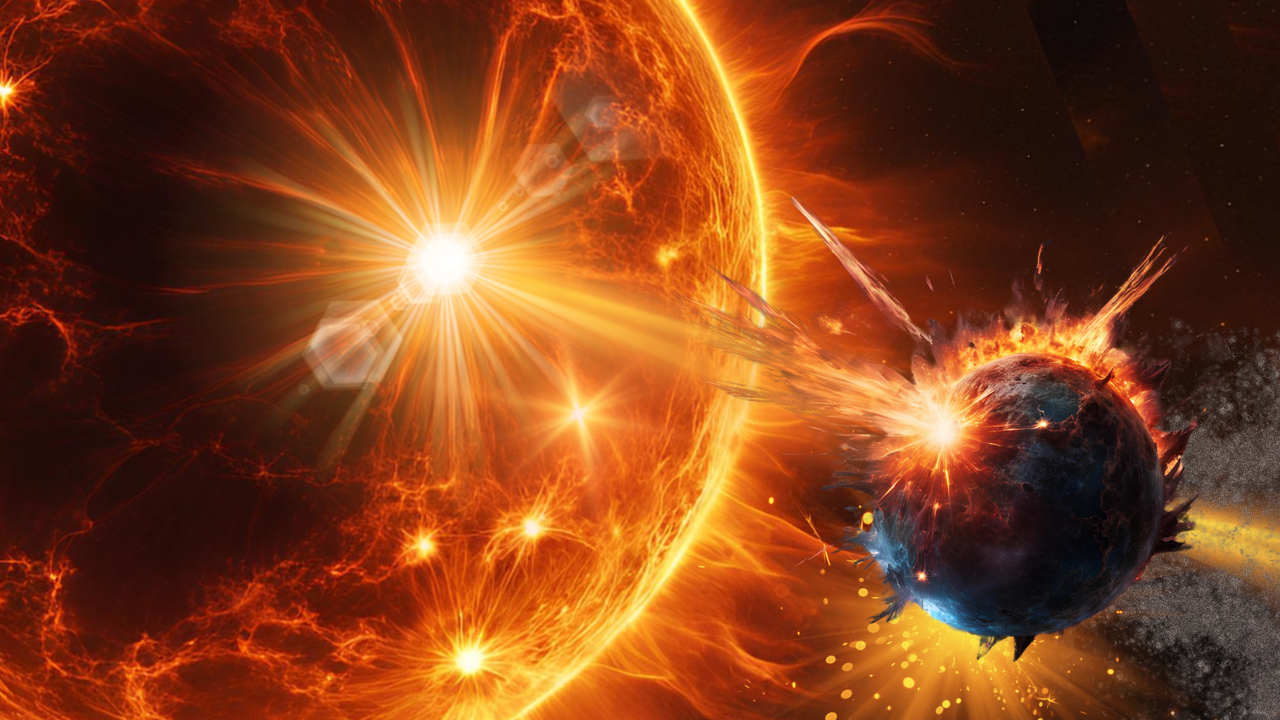
A Cosmic Feast Observed (Image Credits: Cdn.mos.cms.futurecdn.net)
Astronomers have uncovered compelling evidence from aging stars that consume their orbiting worlds, offering a stark preview of the solar system’s long-term evolution.
A Cosmic Feast Observed
Recent studies of Sun-like stars in their later stages revealed a pattern of planetary ingestion that stunned the scientific community. Researchers analyzed data from dozens of these stars and found that many showed chemical signatures indicating they had engulfed nearby planets. This phenomenon, once theorized, now stands confirmed through spectroscopic observations.
The process begins as stars exhaust their hydrogen fuel and expand into red giants. In this bloated phase, their outer layers reach out toward inner planets, pulling them into gravitational chaos. One notable case from 2023 involved a star 15,000 light-years away that astronomers caught in the act of swallowing a Jupiter-sized planet, marked by a sudden brightness flare.
These events highlight how stellar evolution disrupts planetary systems. As the star swells, orbits destabilize, and close-in worlds spiral inward. Such observations provide rare windows into processes that unfold over billions of years.
Lessons from Dying Suns
Our Sun, a middle-aged G-type star, follows a similar trajectory. In approximately 5 billion years, it will enter its red giant phase, expanding dramatically and likely vaporizing Mercury and Venus. Earth’s fate hangs in a precarious balance, depending on whether the Sun’s growth engulfs it entirely or merely scorches its surface.
Analysis of over 100 Sun-like stars demonstrated that those with close-orbiting planets often display elevated levels of rocky elements in their atmospheres, remnants of devoured worlds. This trend suggests that planetary consumption is common among evolving stars. Scientists used telescopes like the Hubble and ground-based observatories to detect these anomalies.
Yet, not all systems end the same way. Factors like planetary mass and orbital distance influence outcomes. For instance, gas giants might migrate inward and trigger engulfment, while smaller rocky planets could evaporate before contact.
Implications for Life and Exploration
These findings reshape our understanding of habitability timelines. While 5 billion years seems distant, they underscore the finite lifespan of solar systems. Earth, currently thriving, faces an inevitable transformation as solar radiation intensifies even before the red giant stage.
Astronomers now model scenarios where Earth’s orbit widens slightly due to the Sun’s mass loss, potentially sparing it from direct consumption. However, the planet would still become uninhabitable, with oceans boiling away long before. This knowledge informs long-term strategies for space exploration and the search for enduring exoplanets.
- Planetary migration accelerates during stellar expansion.
- Chemical pollution from ingested worlds alters stellar compositions.
- Observational biases favor detecting inner-planet losses.
- Future surveys aim to track more systems in real time.
- Comparative studies link red giant behaviors to white dwarf remnants.
Broader Stellar Insights
Beyond our Sun, these planet-eating events reveal patterns across the galaxy. Surveys of white dwarfs, the end stage for Sun-like stars, show polluted atmospheres in up to 50% of cases, hinting at widespread cannibalism. This data, gathered from missions like NASA’s Gaia, maps how planetary systems dismantle over cosmic timescales.
Though remote, such discoveries drive advancements in astrophysics. They refine models of stellar interiors and planetary dynamics. International teams continue monitoring candidate stars for fresh evidence.
| Star Type | Typical Fate for Inner Planets | Timeline |
|---|---|---|
| Sun-like (G-type) | Engulfment or evaporation | 5 billion years |
| Red Giants | Direct consumption | During expansion phase |
| White Dwarfs | Remnants detected in atmosphere | Post-engulfment |
Key Takeaways
- Aging stars commonly devour close planets, as seen in recent chemical analyses.
- Earth may avoid full engulfment but will become lifeless far earlier.
- These observations enhance predictions for our solar system’s endgame.
As we gaze at the stars, these revelations remind us of the universe’s relentless cycles of creation and destruction. While humanity’s story may unfold long before the Sun’s final act, contemplating Earth’s ultimate fate inspires awe and urgency in preserving our world today. What aspects of this cosmic drama intrigue you most? Share your thoughts in the comments.