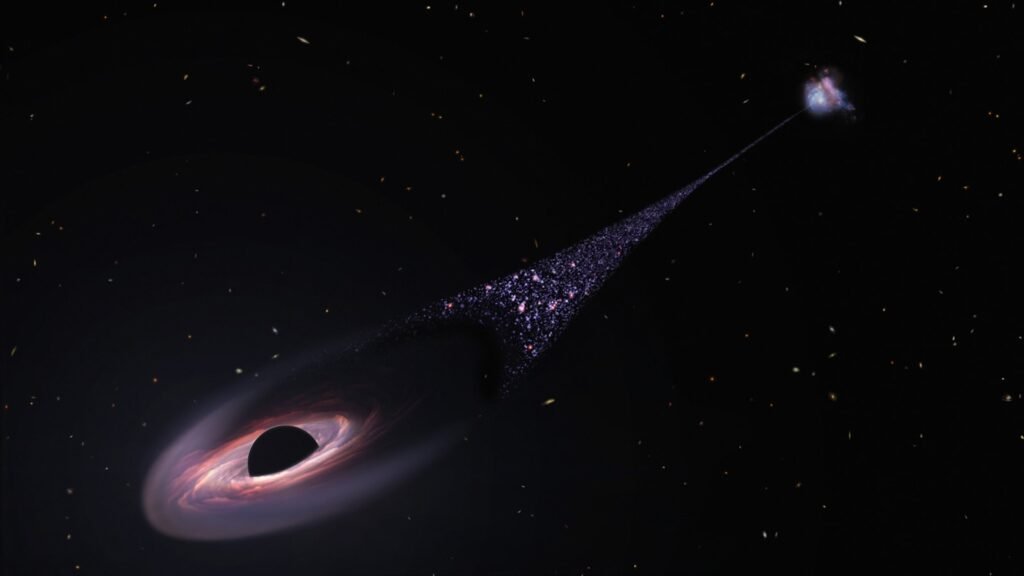

Thirteen and a bit billion years ago, before galaxies, before atoms, before even space and time as we know them, there may have been almost nothing at all – just a seething fog of quantum uncertainty. Out of that nearly featureless state, tiny random jitters in energy could have been amplified into everything: stars, planets, black holes, and the long chain of events that eventually included you reading this sentence. That idea sounds like science fiction, yet it sits at the heart of one of modern cosmology’s most successful theories. Still, the notion that randomness at the smallest scale sculpted the largest structures in the cosmos raises unsettling questions about origin, cause, and meaning. Scientists are now racing to test this picture, not just because it explains our past, but because it could reshape what we think “nothing” really means.
The Hidden Clues Written Across the Sky
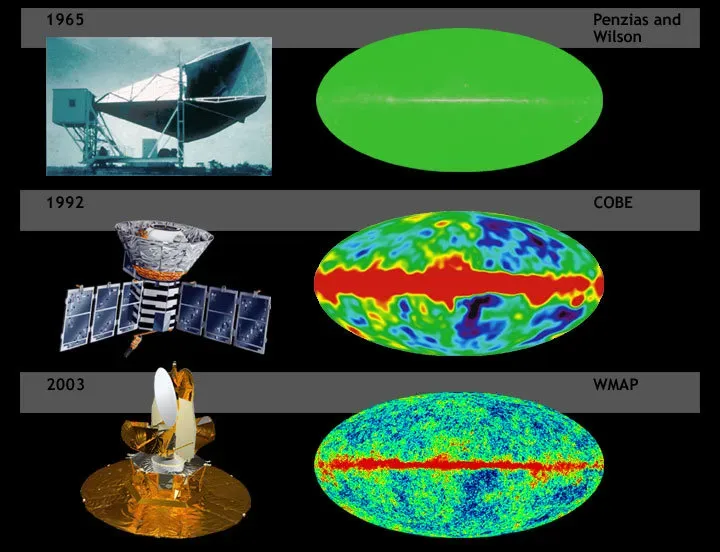
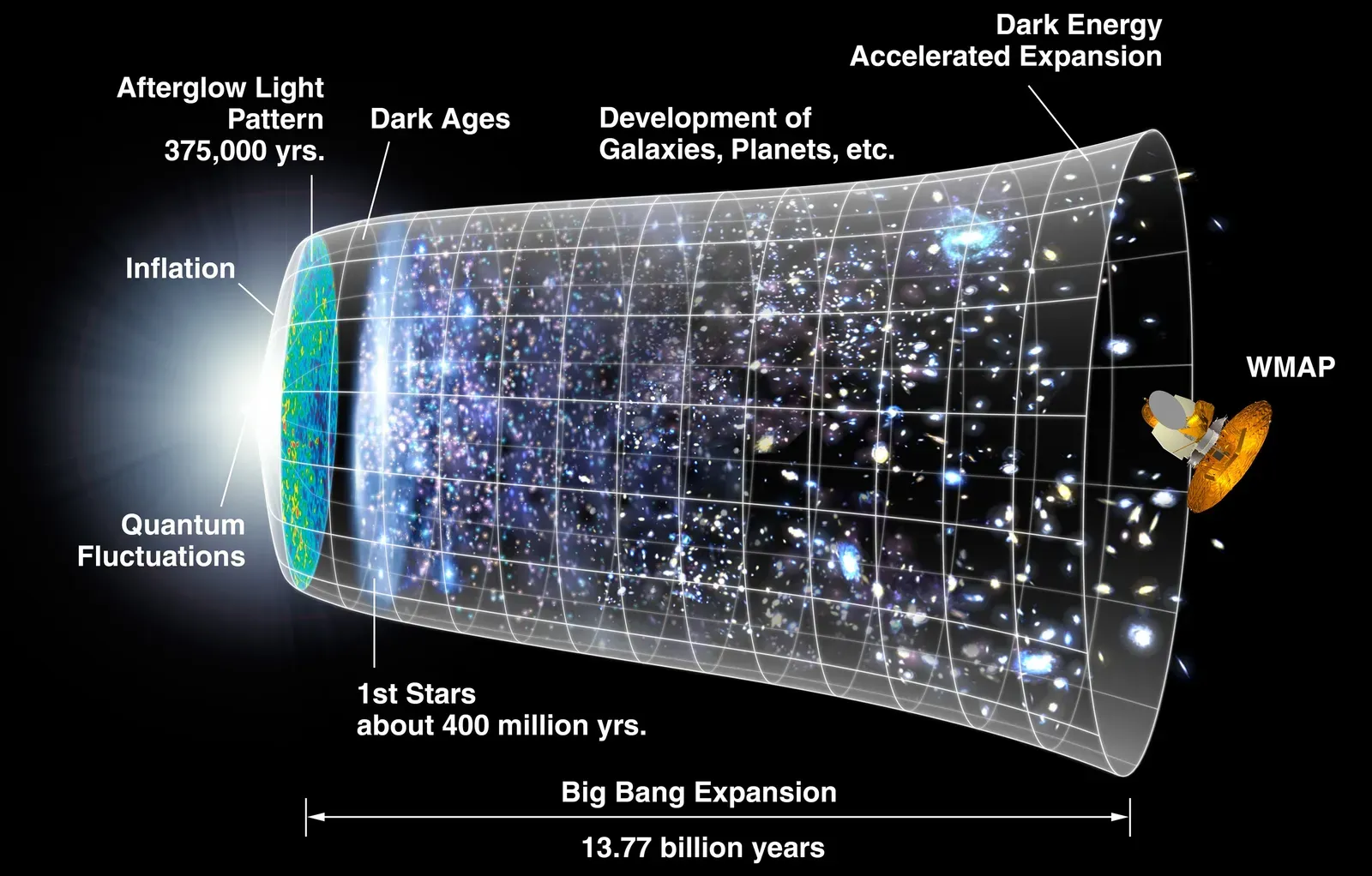
Open a cosmology textbook and you’ll see something that looks like cosmic static: a mottled map of faint microwaves left over from the Big Bang. That map, known as the cosmic microwave background, is more than a pretty pattern; it is the fossil imprint of quantum fluctuations stretched to cosmic size. The temperature variations on that sky – only differences of a few parts in one hundred thousand – trace slightly denser and slightly emptier regions in the infant universe. Those tiny imbalances are exactly what gravity later amplified into galaxies, clusters, and cosmic webs. In other words, the night sky’s grand architecture is, according to this view, frozen evidence that quantum jitters once ruled the cosmos.
What makes this so powerful is how specific the clues are. Satellite missions that mapped the cosmic microwave background found that the size and strength of those primordial ripples match what quantum theory predicts if space expanded incredibly fast in its first fraction of a second. This runaway growth phase, called cosmic inflation, acts like a photocopier for quantum fluctuations, blowing them up from subatomic scales to astronomical ones. The resulting pattern is not random noise but a particular mix of smoothness and lumpiness that can be measured and checked. Every time astronomers compare those measurements to inflation-based models, they keep finding an uncomfortable truth: the universe looks eerily like what you’d expect if it began with quantum randomness and an explosive growth spurt.
From Quantum Foam to Inflating Space
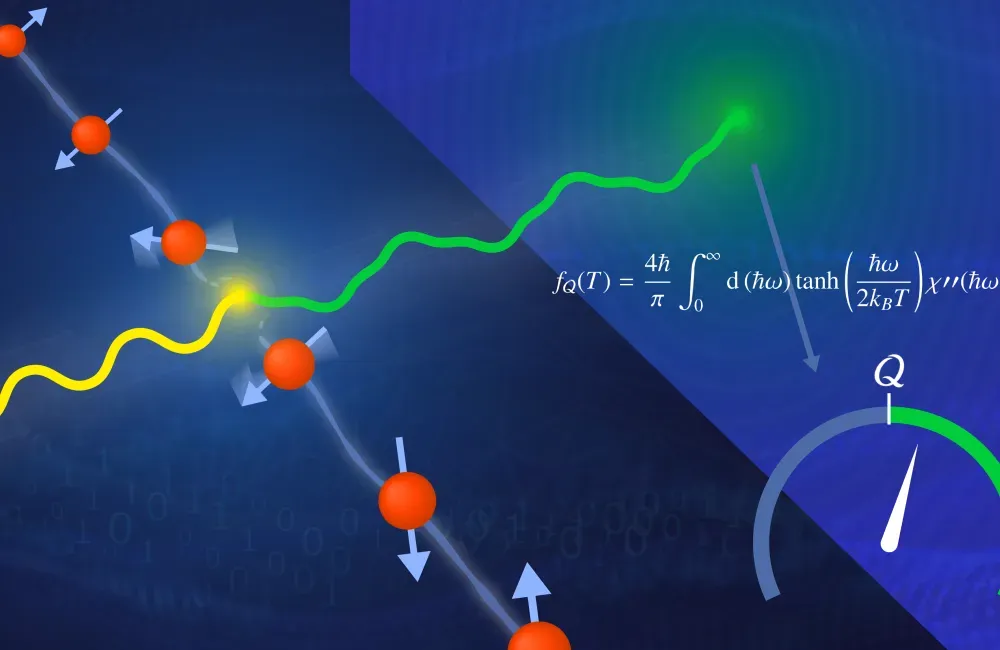
To understand how fluctuations could create a universe, you first have to accept a weird premise: even “empty” space is never truly empty. Quantum mechanics teaches that energy and particles can flicker in and out of existence for brief moments, like foam bubbling on the surface of a dark sea. Normally, these virtual particles appear and vanish so quickly that their effects are subtle, only showing up in careful lab experiments. But if the fabric of space itself is expanding violently, as in inflation, those fleeting ripples can be stretched and frozen into permanent features of the cosmos. What was once microscopic quantum noise becomes macroscopic cosmic structure.
In many inflation models, a special field – often called the inflaton – permeated the early universe, storing enormous energy. Tiny quantum fluctuations in this field slightly changed how fast different patches of space expanded. Some regions inflated a bit more, some a bit less, and those differences became the seeds of future galaxies and voids. It is a remarkably simple recipe: take a quantum field, let it fluctuate, then hit “expand” on the universe’s fastest setting. Out of this process, you naturally get a universe that is large, smooth overall, but with just enough imperfections for complexity to grow.
Quantum Cosmology: When Space-Time Itself Becomes Uncertain
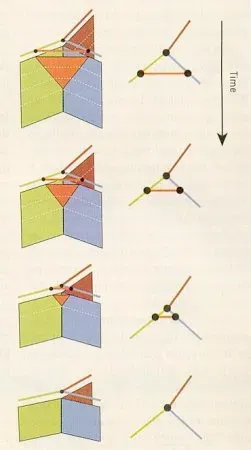
Inflation explains how fluctuations shape the universe once space and time exist, but it forces a deeper question: where did space and time come from in the first place? Here, physicists enter the strange territory of quantum cosmology, where even the geometry of the universe can exist in a fuzzy, superposed state. In this view, the early universe is not a tiny marble expanding into a larger space; instead, it is a quantum object described by a wavefunction that encodes all possible configurations of space-time. Talking about “before” that state may not make sense, because the very concept of time could emerge from the quantum rules rather than pre-exist them.
Several proposals try to describe this origin in mathematical detail, each trading philosophical comfort for predictive power. Some ideas suggest the universe “tunneled” into existence from a kind of quantum nothing, similar to how particles can pass through barriers they classically should not cross. Others imagine a timeless quantum state in which universes with different properties coexist as possibilities, with ours realized once certain conditions are met. These models are hard to test directly, but they share a striking theme: at the deepest level, the birth of the universe might not require a spark from outside physics, only the strange logic of quantum rules applied to space-time itself.
The Hidden Assumptions Behind “Something from Nothing”
When headlines claim the universe came from “nothing,” they often hide a crucial subtlety: physicists have a very technical notion of nothingness. The “vacuum” in quantum field theory is not a literal absence of everything; it is a state with the lowest possible energy that still contains fields, laws, and the capacity for fluctuations. Saying that the universe emerged from a quantum vacuum really means it emerged from a state governed by precise mathematical rules and physical constants. That is a far cry from philosophical or everyday nothingness, which implies no space, no time, no laws, and no possibility at all. The language can be misleading, making it sound as if physics has erased the need for any starting conditions.
Even inflation-based models require assumptions that are easy to gloss over. Why did the inflaton field exist, why did it have the right shape, and why did it eventually stop driving exponential expansion? Cosmologists can build elegant models that fit the data while still debating whether they have explained the initial conditions or simply pushed the mystery one step earlier. For readers, the key is to recognize that “quantum fluctuations created the universe” is more of a scientific narrative framework than a final, all-encompassing answer. It narrows the puzzle dramatically, but it does not close the book on why there is something rather than nothing at all.
Why It Matters: From Random Ripples to Human Meaning
The idea that random quantum ripples helped sculpt the universe is not just a fun party fact; it transforms how we see our place in the cosmos. Traditional origin stories, whether religious or philosophical, often rest on purposeful creation or timeless cycles, with humans playing a central or at least intended role. A quantum-fluctuation origin hints at a universe where structure and life are byproducts of underlying laws plus chance, not inevitable outcomes. That can feel unsettling, as if it erases meaning, but it can also be oddly liberating, emphasizing how improbable and precious conscious life really is. When you look up at the Milky Way, you are literally seeing randomness written in starlight and then shaped by billions of years of cosmic evolution.
Scientifically, this perspective matters because it tests the power of physics across an enormous range of scales. Any successful theory of quantum fluctuations and inflation must simultaneously describe subatomic behavior and galactic clustering, bridging realms once studied in separate silos. It pushes technology too: measuring tiny polarization patterns in the cosmic microwave background or mapping galaxies across vast swaths of sky demands exquisitely sensitive instruments and global cooperation. And culturally, the story reframes long-running questions about determinism, free will, and whether the universe is fundamentally ordered or chaotic. Accepting that our cosmic structure has its roots in quantum noise does not end those debates, but it gives them a sharper, more empirical edge.
Testing the Cosmic Dice Roll
For this grand narrative to hold, it has to survive one harsh test after another, and cosmologists have been busy trying to break it. Observatories on the ground and in space map the cosmic microwave background’s tiny temperature and polarization patterns, looking for signatures of primordial gravitational waves that inflation models predict. If those waves are confirmed with convincing clarity, it would be a strong hint that space itself underwent a violent, quantum-driven growth spurt. Astronomers also survey millions of galaxies to study how matter clumps on different scales, checking whether the pattern of large-scale structure matches what quantum-seeded inflationary models expect. So far, the broad strokes line up impressively well, even as some finer details keep theorists awake at night.
There are several concrete signals researchers are hunting for in the data and in upcoming experiments. They are searching for tiny deviations from a perfectly simple pattern in the primordial fluctuations, which could reveal the detailed behavior of the inflaton field or even the presence of additional fields. They are probing whether the distribution of matter is perfectly scale-free or subtly bent, a difference that encodes how inflation started and stopped. They are also pushing particle physics experiments to see if any known or hypothetical particles could play the role of the inflaton. The stakes are high: a single clear, contradictory finding could force scientists to rethink not only inflation but the entire story of how quantum fluctuations shaped the universe.
The Future Landscape: Quantum Origins and New Technologies
Over the next decade, the cosmos will become one of the most closely watched laboratories for quantum ideas. New generations of telescopes and satellites are being designed to measure the cosmic microwave background with unprecedented precision, teasing out polarization twists and temperature wrinkles that earlier missions could only hint at. Massive galaxy surveys will map the positions and motions of tens of millions of galaxies, turning the universe into a three-dimensional data set where models of quantum fluctuations must either succeed or fail. At the same time, theoretical physicists are working to embed inflation and quantum cosmology into something deeper, such as a quantum theory of gravity that unifies general relativity and quantum mechanics. The hope is to replace today’s patchwork of successful but incomplete ideas with a more coherent origin story.
Alongside these sky-facing efforts, advances in quantum technology on Earth are feeding back into cosmology. Quantum computers and simulators might one day model aspects of early-universe physics that are currently too complex for classical supercomputers. Quantum sensors could allow more sensitive detection of faint signals, from gravitational waves to tiny distortions in the cosmic background. The future landscape is not guaranteed to vindicate the current story; upcoming data could reveal cracks that send theorists back to the drawing board. But even that outcome would be scientifically thrilling, because it would mean the universe is stranger than our best quantum-fluctuation narratives suggest.
How You Can Stay Connected to the Quantum Universe Story
You do not need a PhD in physics to be part of this unfolding story about how quantum fluctuations may have birthed the cosmos. One simple step is to follow public results from major observatories and space missions, many of which now share images, data visualizations, and explanations written for non-specialists. Planetariums, science museums, and online lecture series increasingly highlight topics like inflation, the cosmic microwave background, and quantum cosmology, and these programs often do a better job than dense textbooks at making the ideas feel intuitive. By supporting these institutions – through visits, memberships, or donations – you help keep complex, cutting-edge science accessible to wider communities. The more people understand where current theories stand and what questions remain open, the healthier the public conversation around cosmic origins becomes.
If you want to go a step further, you can look for citizen-science projects that involve classifying galaxies, spotting gravitational lenses, or helping analyze cosmological data sets. While you will not be tweaking quantum-fluctuation equations directly, your clicks and classifications can sharpen the measurements that test those theories. You can also advocate for strong public funding of basic research, reminding policymakers that curiosity-driven science, from quantum physics to cosmology, has a long history of spinning off transformative technologies. Finally, keep asking questions – of scientists, educators, and yourself – about what it really means for the universe to arise from quantum jitters. The more we collectively push on those questions, the clearer our picture of the cosmic beginning will become.
Suhail Ahmed is a passionate digital professional and nature enthusiast with over 8 years of experience in content strategy, SEO, web development, and digital operations. Alongside his freelance journey, Suhail actively contributes to nature and wildlife platforms like Discover Wildlife, where he channels his curiosity for the planet into engaging, educational storytelling.
With a strong background in managing digital ecosystems — from ecommerce stores and WordPress websites to social media and automation — Suhail merges technical precision with creative insight. His content reflects a rare balance: SEO-friendly yet deeply human, data-informed yet emotionally resonant.
Driven by a love for discovery and storytelling, Suhail believes in using digital platforms to amplify causes that matter — especially those protecting Earth’s biodiversity and inspiring sustainable living. Whether he’s managing online projects or crafting wildlife content, his goal remains the same: to inform, inspire, and leave a positive digital footprint.