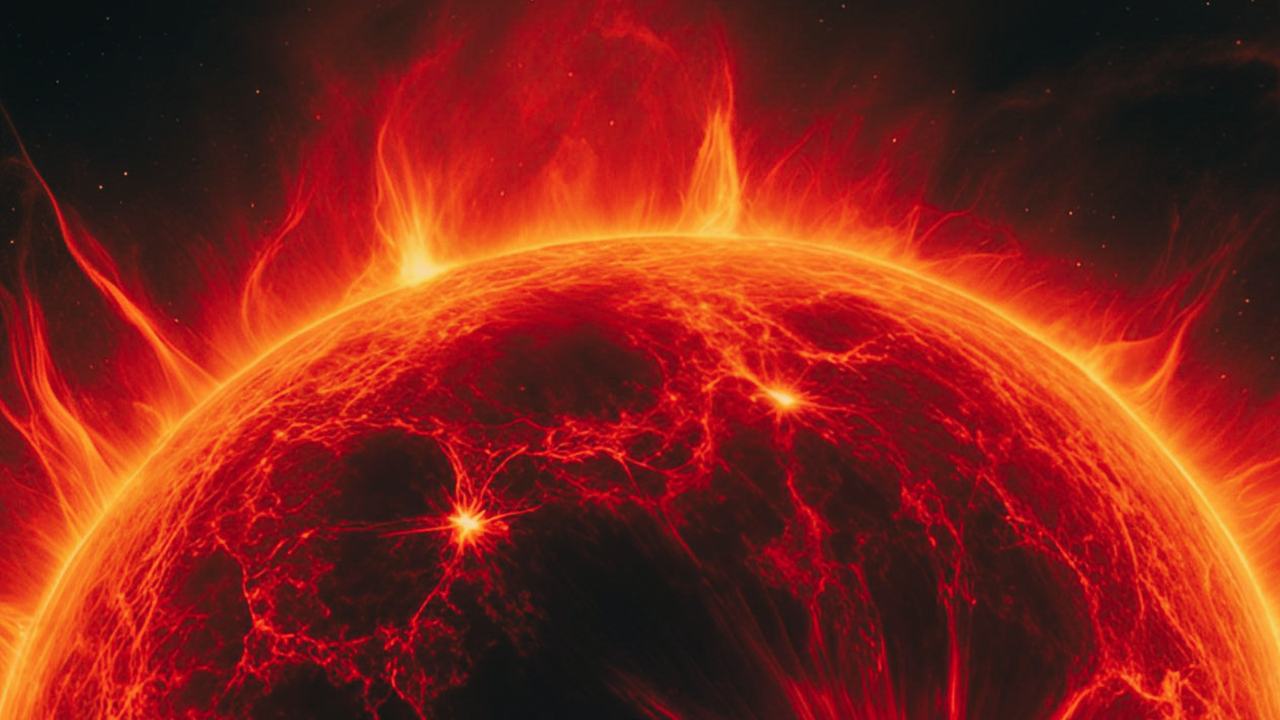
Unlocking the Secrets of Primordial Giants (Image Credits: Cdn.mos.cms.futurecdn.net)
Astronomers have announced a groundbreaking observation from the James Webb Space Telescope that points to the existence of extraordinarily large stars in the early universe, offering a glimpse into cosmic conditions shortly after the Big Bang.
Unlocking the Secrets of Primordial Giants
These so-called ‘dinosaur-like’ stars represent a pivotal find in cosmology. Researchers identified evidence of stars that could have been up to 10,000 times more massive than our Sun, formed just a few hundred million years after the universe’s birth. Such immense objects likely burned brightly but briefly, much like the colossal creatures that once dominated Earth. The detection challenges previous models of star formation in the dense, young cosmos. This breakthrough came through detailed analysis of infrared light captured by JWST.
The stars’ signatures appeared in spectra from distant galaxies, revealing chemical compositions that matched theoretical predictions for early stellar evolution. Unlike modern stars, these behemoths formed in environments rich with pristine hydrogen and helium, free from heavier elements forged in later generations. Their rapid lifecycles would have enriched the interstellar medium with vital elements, paving the way for future star and galaxy development. Scientists noted that confirming these observations requires further study, but the initial data aligns closely with simulations of the epoch known as Cosmic Dawn.
The Technology Behind the Revelation
The James Webb Space Telescope’s advanced instruments played a crucial role in peering back to the universe’s toddler years. Launched in 2021, JWST excels at observing faint, ancient light stretched by cosmic expansion into the infrared spectrum. This capability allowed the telescope to penetrate the dust and gas obscuring early stellar nurseries. Teams sifted through data from multiple observation campaigns, focusing on regions billions of light-years away.
Key to the discovery was JWST’s Near-Infrared Spectrograph, which dissected the light from these remote sources to identify unique emission lines. Previous telescopes, like Hubble, lacked the sensitivity to detect such subtle signals from the universe’s first billion years. Now, with JWST operational, astronomers can map the transition from the opaque early universe to the clearer cosmos we see today. The findings emerged from collaborative efforts involving international teams, underscoring the telescope’s role in rewriting astrophysical history.
Implications for Cosmic Evolution
This evidence reshapes our view of how the universe transitioned from a hot, uniform plasma to a structured web of galaxies. Massive stars like these would have exploded as supernovae, dispersing heavy elements essential for planet formation and life. Their presence suggests star formation occurred more vigorously and on larger scales than once thought in the primordial era. Researchers believe these giants influenced the growth of the first supermassive black holes and galaxy clusters.
One striking aspect involves the stars’ potential role in reionizing the universe, a process where ultraviolet light cleared the fog of neutral hydrogen. Without such stars, the cosmic landscape might have evolved differently, delaying the emergence of familiar structures. The discovery also prompts questions about the efficiency of gas collapse in the early universe’s low-metallicity conditions. As data accumulates, models will refine to better predict these ancient phenomena.
Characteristics of these early massive stars include:
- Extremely high mass, often exceeding 1,000 solar masses.
- Short lifespans, lasting mere millions of years.
- Formation in pristine gas clouds with minimal heavy elements.
- Intense radiation output that shaped surrounding environments.
- Supernova explosions seeding the cosmos with metals.
Key Takeaways
- JWST’s observations mark the first direct evidence of ‘dinosaur-like’ stars, confirming theories about early stellar populations.
- These stars, formed soon after the Big Bang, drove key processes like reionization and element production.
- Future missions will build on this to explore even earlier cosmic epochs.
As JWST continues to deliver revelations, this discovery highlights the telescope’s power to connect the dots of cosmic history, reminding us how fragile yet dynamic the universe’s beginnings were. What aspects of the early universe intrigue you most? Share your thoughts in the comments.