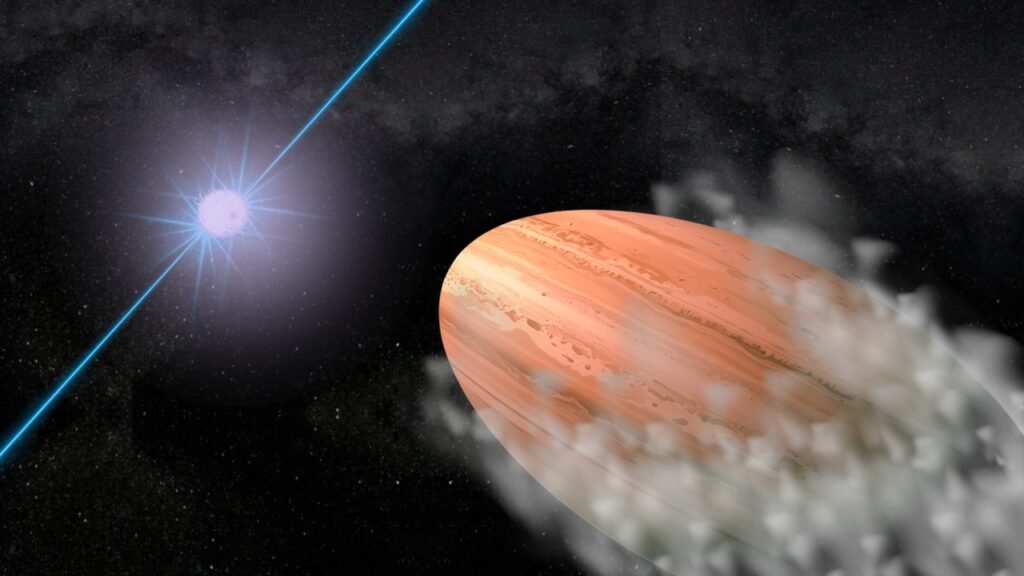


A Shape-Defying Discovery (Image Credits: Cdn.mos.cms.futurecdn.net)
Astronomers have uncovered a peculiar world far beyond our solar system, one that defies traditional notions of planetary form and composition.
A Shape-Defying Discovery
The James Webb Space Telescope recently revealed an exoplanet stretched into an unusual ellipsoid form, resembling a lemon or football, orbiting a pulsar thousands of light-years away. This object, designated PSR J2322-2650b, marks the first such detection of its kind, surprising researchers with its bizarre structure. The planet’s elongated shape results from intense gravitational forces exerted by its host star, a rapidly rotating neutron star. Such tidal distortions highlight the extreme environments possible in distant stellar systems. Team members expressed astonishment at the find, underscoring how it pushes the boundaries of known planetary physics.
Unlike the spherical planets in our solar system, this exoplanet demonstrates how proximity to a massive, compact star can warp a world’s very form. Observations confirmed the planet completes an orbit about a million miles from the pulsar, close enough for these dramatic effects. The discovery builds on earlier detections of planets around pulsars but introduces unprecedented details about their physical state. Scientists noted the planet’s mass approximates that of Jupiter, yet its appearance sets it apart entirely. This revelation invites further scrutiny into how such bodies endure their harsh surroundings.
Unusual Atmospheric Secrets
PSR J2322-2650b boasts an atmosphere dominated by helium and carbon, a composition unlike any previously observed on an exoplanet. Soot-like clouds drift through this gaseous envelope, and deeper layers may harbor condensed carbon in the form of diamonds. The planet’s core could contain these crystalline structures, formed under immense pressure and heat. Researchers described the atmosphere as exotic, challenging models of how gas giants evolve in pulsar systems. The presence of carbon-rich elements suggests unique formation processes at play.
Early analyses indicate the planet blurs the distinction between worlds and stellar remnants, given its host’s peculiarities. The pulsar itself packs the mass of the Sun into a city-sized sphere, creating conditions ripe for atmospheric oddities. Instruments aboard the Webb telescope captured infrared signatures that revealed these atmospheric traits with remarkable clarity. No similar carbon-helium mix has appeared in prior exoplanet studies, making this a landmark observation. Future spectra could uncover even more about the planet’s internal dynamics.
Implications for Planetary Formation
This finding complicates theories on how planets form and survive around neutron stars, remnants of exploded supernovae. Traditional models predict rocky or gaseous bodies in such orbits would disintegrate, yet PSR J2322-2650b persists. Its diamond potential and soot clouds point to carbon-heavy origins, possibly from the debris of the host star’s explosive past. Astronomers now question whether such worlds represent a new class of objects, intermediate between planets and brown dwarfs. The discovery prompts revisions to simulations of extreme exoplanetary environments.
Experts emphasized the planet’s orbit around a “completely bizarre” star, as one researcher put it, highlighting the need for expanded surveys. Pulsar planets were first confirmed in the 1990s, but none matched this one’s profile until now. The elongated shape alone suggests tidal locking, where one side perpetually faces the pulsar. Such stability raises questions about potential geological activity or volatile retention. Overall, the observation enriches our catalog of cosmic diversity.
The Role of Advanced Telescopes
The James Webb Space Telescope’s infrared capabilities proved essential for peering into this distant system’s veiled details. Positioned a million miles from Earth with its expansive sunshield, the observatory maintains the chill needed for precise measurements. Ground-based telescopes could not achieve the same resolution due to atmospheric interference. This detection exemplifies Webb’s prowess in exoplanet atmospheres, following earlier successes with gas giants and rocky worlds. The mission continues to deliver insights into the universe’s formative epochs.
Launched as the premier space observatory for the coming decade, Webb supports thousands of astronomers globally. Its focus spans solar system enigmas to the early universe’s structures. For PSR J2322-2650b, the telescope’s sensitivity unveiled features invisible to other instruments. Ongoing observations may refine our understanding of the planet’s evolution. The international collaboration behind Webb ensures broad access to such groundbreaking data.
Key Takeaways
- PSR J2322-2650b is a Jupiter-mass exoplanet deformed into a lemon shape by pulsar gravity.
- Its helium-carbon atmosphere features soot clouds and possible diamond formations.
- The discovery, enabled solely by JWST, redefines planetary possibilities around neutron stars.
As this lemon-shaped enigma expands our view of the cosmos, it reminds us how much remains unexplored in the realm of exoplanets. What implications might such worlds hold for the search for life in extreme conditions? Share your thoughts in the comments below.