
Somewhere out there in the dark, tiny city-sized stars spin hundreds of times a second, bending light, warping time, and firing out beams of radiation like cosmic lighthouses gone mad. Neutron stars used to be almost mythical, a theoretical solution to a physics puzzle about how massive stars die, but in the last few decades they’ve become front-line players in astrophysics. They’re not just oddities; they’re laboratories where gravity, matter, and magnetism reach limits that we can’t reproduce on Earth. And every time astronomers build a sharper telescope or a more sensitive detector, neutron stars rewrite the script. To understand the future of space science, and perhaps the fate of matter itself, you have to start with these dense, shining corpses of once-mighty suns.
The Stellar Corpses Born in Catastrophic Supernovae
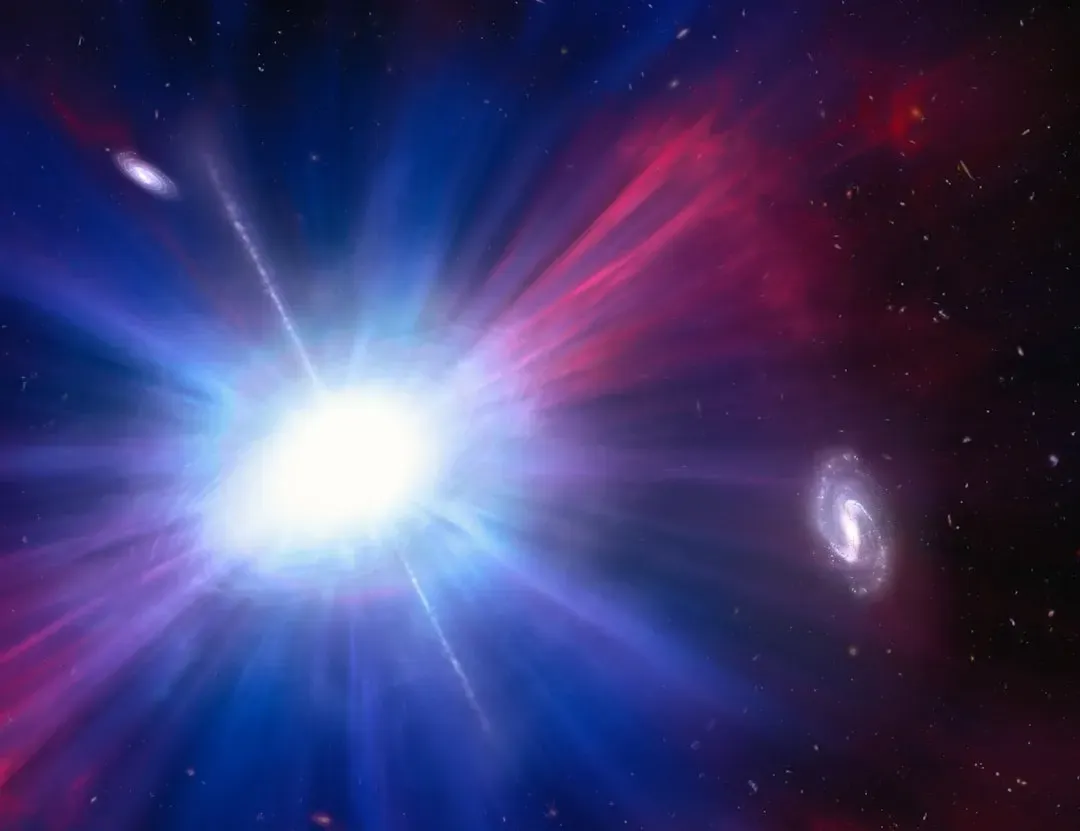
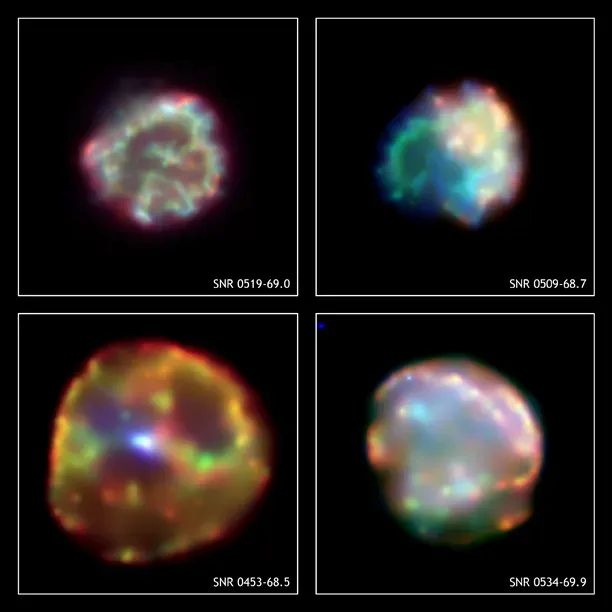
Neutron stars begin their lives in violence: the death of a massive star at least about eight times heavier than the Sun. When such a star exhausts its nuclear fuel, its core collapses in a fraction of a second, slamming protons and electrons together to form neutrons while the outer layers explode as a supernova. That outgoing blast can briefly outshine an entire galaxy, yet what remains inside is only about the size of a city. The newly formed core is so dense that a teaspoon of its material would outweigh a mountain, tipping the scales at roughly a billion tons or more.
This process is not just a dramatic ending but also a crucial reset button for galaxies, seeding space with heavy elements forged in the star’s furnace and in the explosion itself. Iron in your blood and calcium in your bones likely passed through a supernova – and sometimes through a neutron star phase or its aftermath. Astronomers study these explosions across the electromagnetic spectrum, from radio waves to gamma rays, to reconstruct the final seconds of stellar life. Each event reveals fresh details about how matter behaves when gravity starts to win the ultimate tug-of-war.
Crushing Density: Matter Packed Beyond Imagination
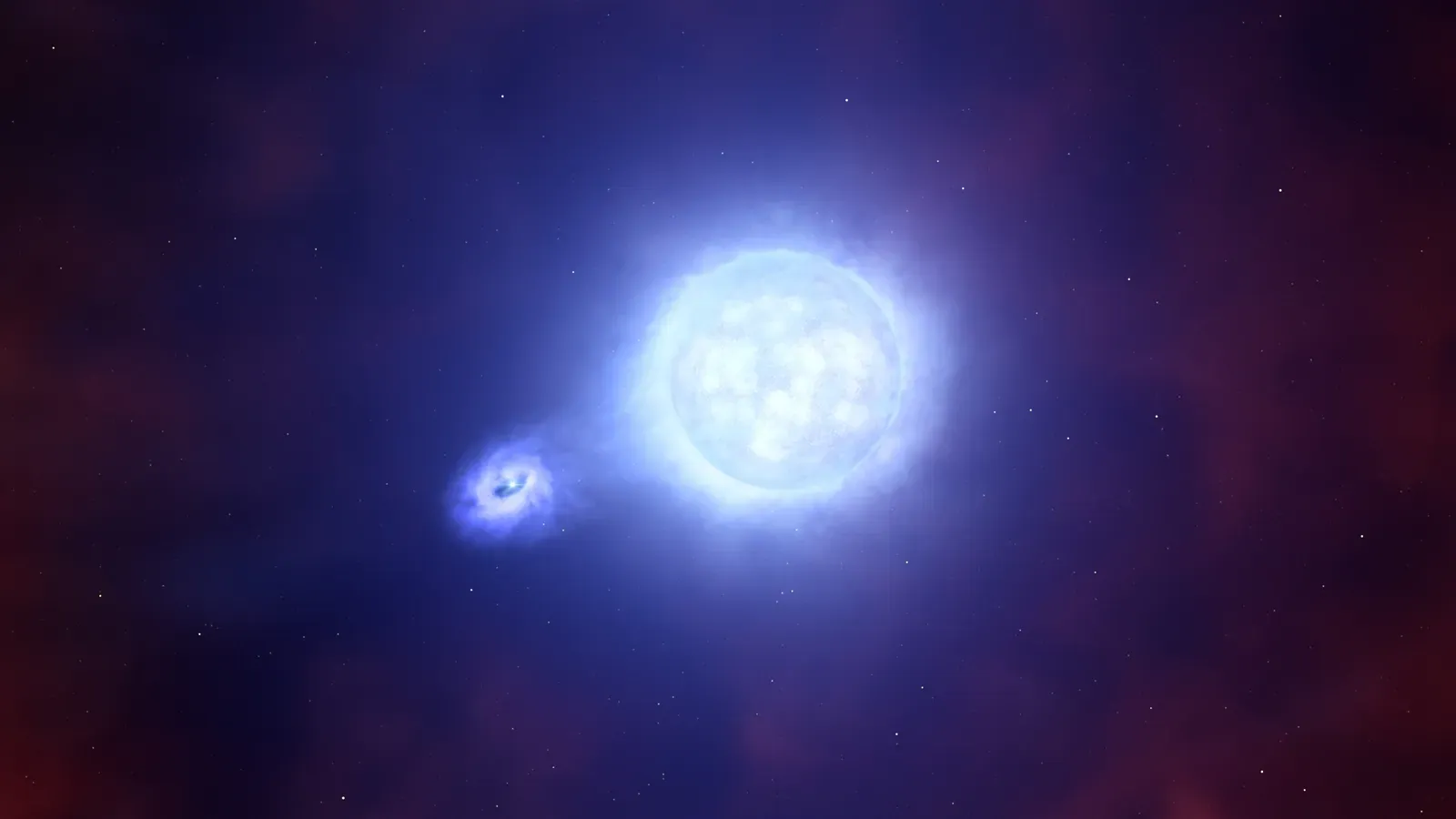
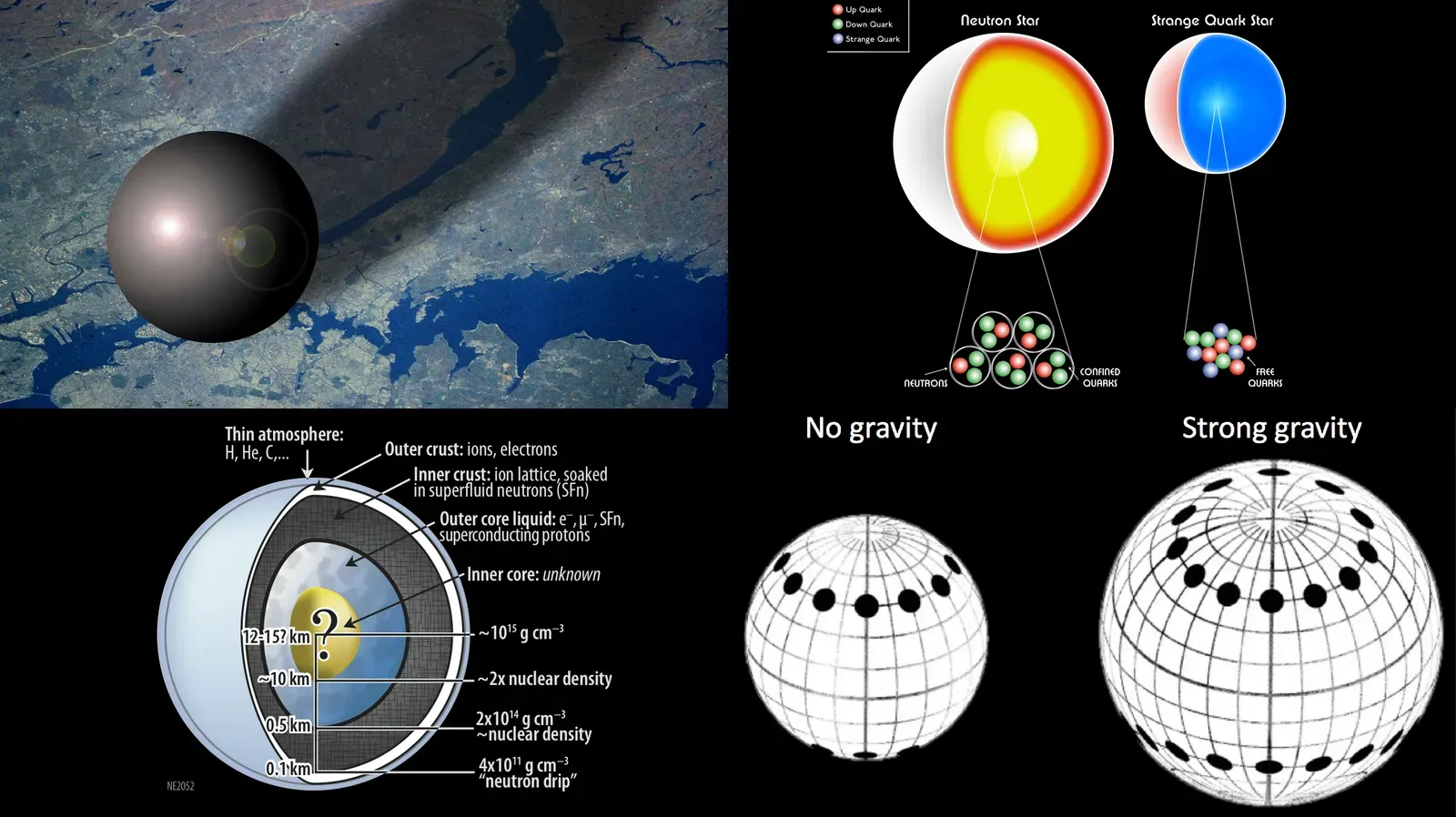
The defining fact about a neutron star is also the hardest to truly picture: its density. Take something about one to two times the mass of the Sun and cram it into a sphere only around twelve miles across, and you get a gravitational field so intense that space-time itself noticeably curves. The surface gravity is hundreds of billions of times stronger than Earth’s, enough that if you could somehow stand on a neutron star, you’d be crushed flatter than a sheet of paper in less than a heartbeat. Light leaving the surface loses energy climbing out of that gravity well, so even photons are effectively weighed down.
Inside, normal atomic structure breaks down entirely; there are no atoms, no familiar electrons in orbit, just a seething quantum fluid of neutrons with some protons and other exotic particles mixed in. Physicists compare it to squeezing an entire mountain into a single sugar cube, and even that metaphor barely does it justice. The outer crust may be a lattice of nuclei and electrons, but deeper down, nuclei melt into one another, forming nuclear pasta – phases of matter with nicknames like “spaghetti” and “lasagna” because of the bizarre shapes they take on. These extreme states give theorists a rare testbed for nuclear physics far beyond any laboratory accelerator.
Spinning Lighthouses: Pulsars and Their Precision Beams
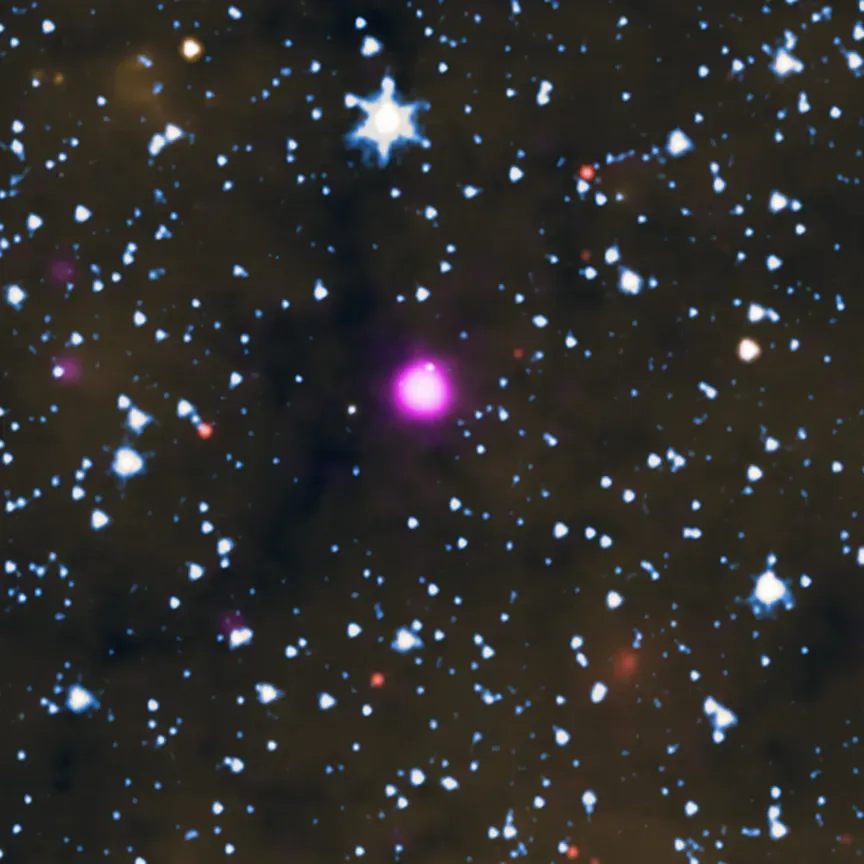
When a neutron star’s magnetic axis is misaligned with its spin axis, it becomes a pulsar, sweeping beams of radiation across space like a cosmic radar. As the star rotates, these beams flash past Earth with regularity so precise that some pulsars rival atomic clocks. Many spin dozens of times per second, and the fastest known pulsars whirl hundreds of times per second, with their entire surface moving at a significant fraction of the speed of light. Astronomers first detected these signals as mysterious, incredibly regular radio pulses in the late 1960s, briefly wondering whether they might be artificial.
Now we know pulsars form a sprawling population of timekeepers scattered across the Milky Way. Their clock-like behavior lets researchers probe everything from the interstellar medium between stars to the behavior of space-time near extremely dense objects. For instance, when a pulsar orbits another star, tiny shifts in its pulse timing can reveal gravitational effects predicted by general relativity. On a more poetic level, there’s something haunting about the idea that the heartbeat of a dead star can still echo across tens of thousands of light-years, steady and unwavering.
The Strongest Magnets in the Universe: Magnetars
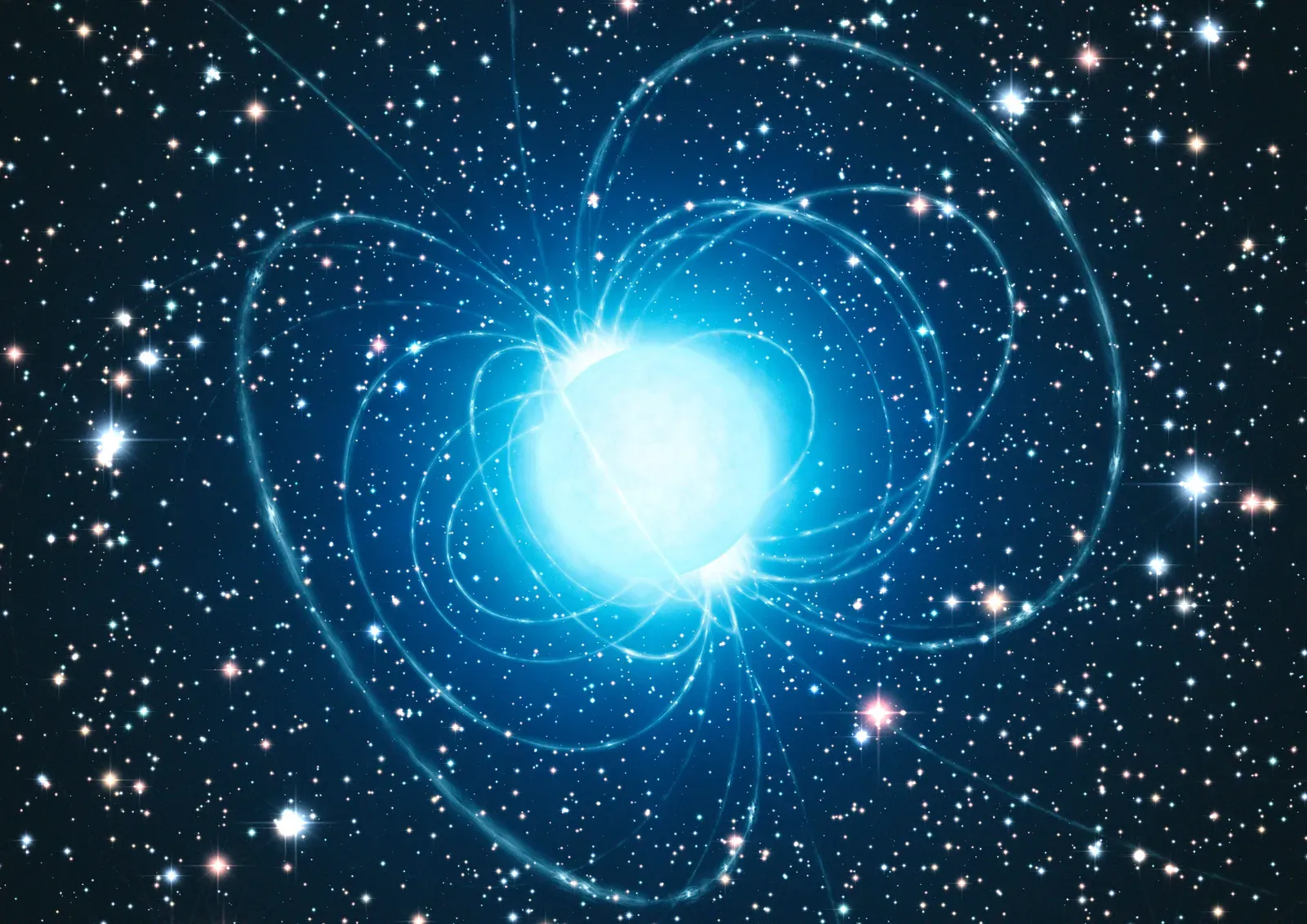
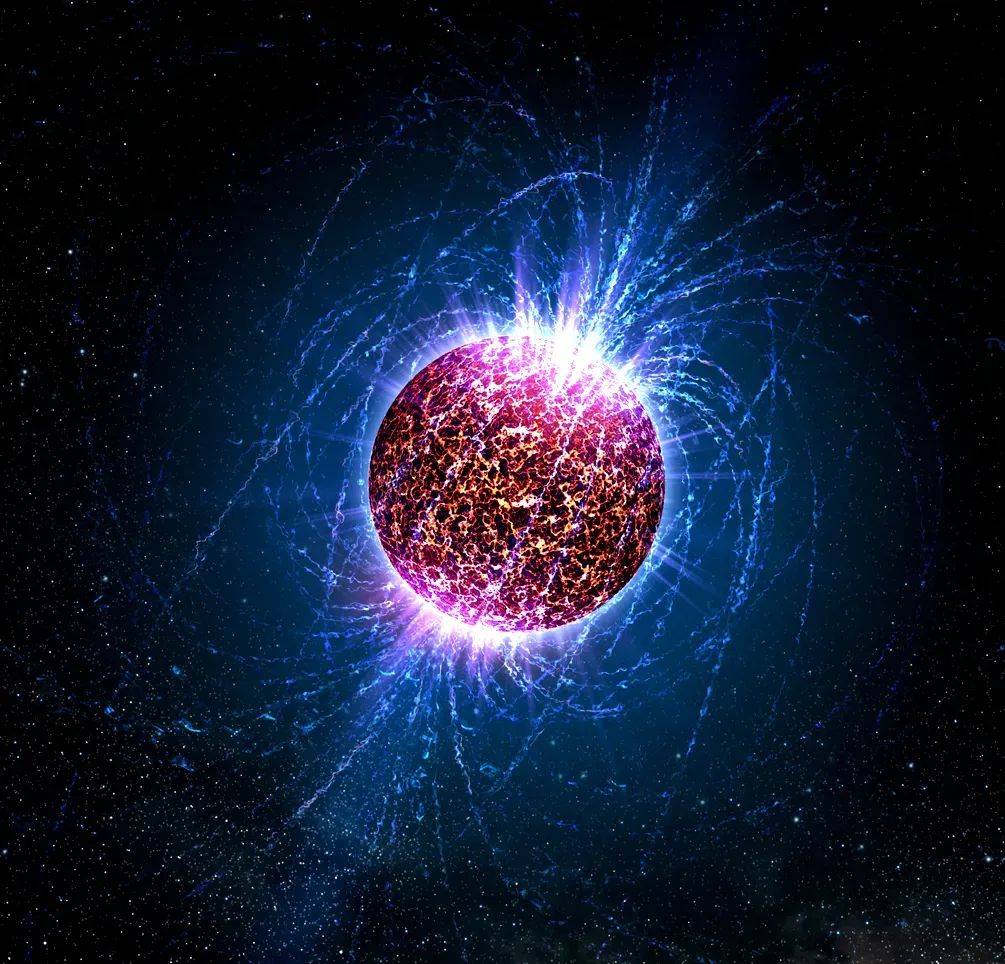
As extreme as ordinary neutron stars are, magnetars push everything to a new level. Their magnetic fields are trillions of times stronger than Earth’s, intense enough to distort atomic orbitals and tear apart matter at the subatomic level. If a magnetar sat halfway between Earth and the Moon, its field could theoretically erase every credit card and hard drive on our planet. These objects occasionally unleash sudden, powerful flares of X-rays and gamma rays when their magnetic fields twist and snap, a bit like giant cosmic earthquakes but driven by magnetism instead of tectonics.
Some of the most energetic short bursts of high-energy radiation ever observed in our galaxy have been traced back to magnetars. In a few rare events, detectors in orbit have even saturated from the intensity of the incoming signal. Astronomers suspect that at least some mysterious fast radio bursts – millisecond flashes of radio energy from distant galaxies – come from magnetars in other parts of the universe. That connection turns these bizarre stars into tools for probing otherwise invisible properties of distant galaxies and the tenuous matter between them.
Cosmic Collisions: Neutron Star Mergers and Gravitational Waves
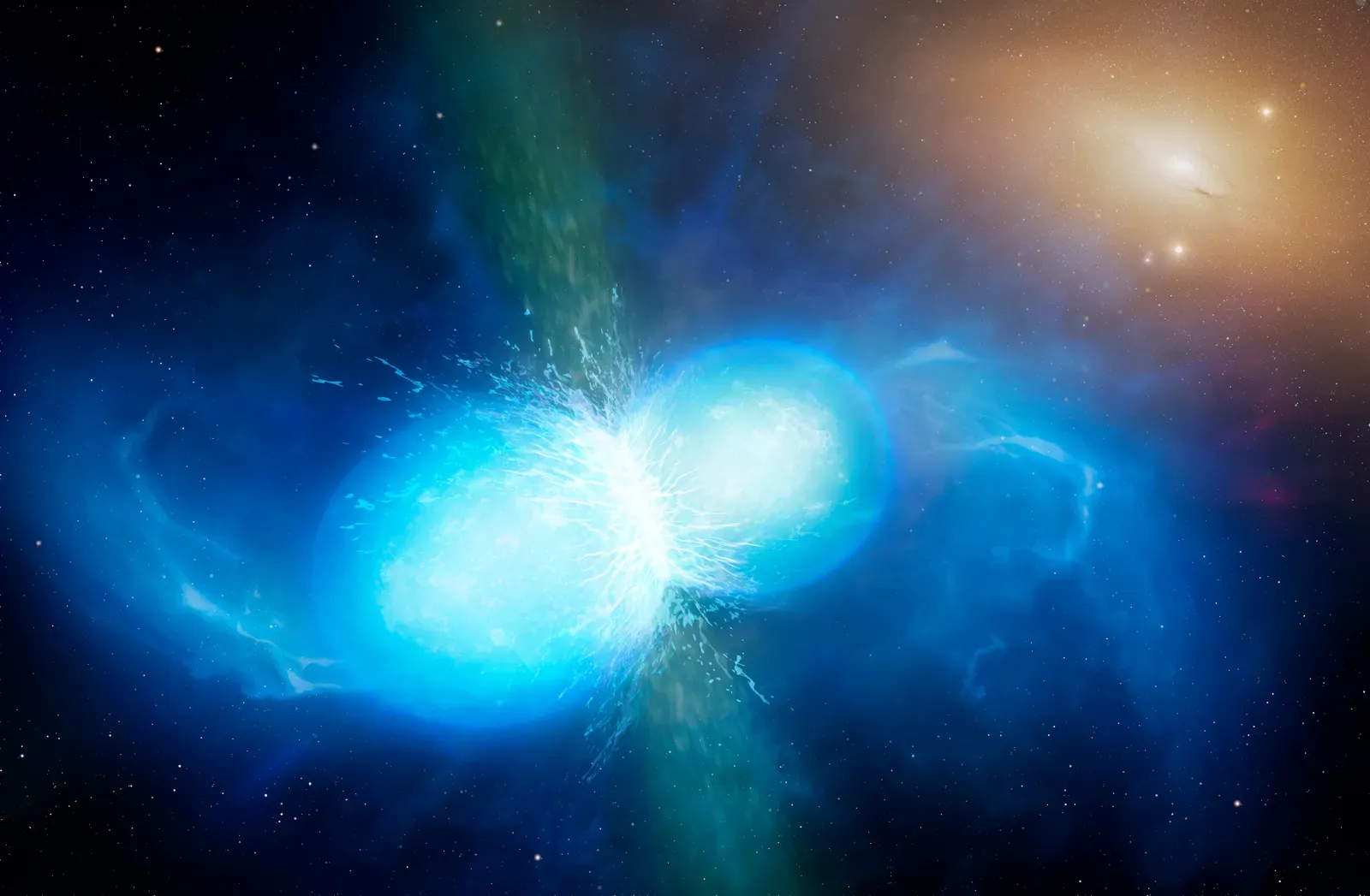
When two neutron stars orbit each other in a tight binary, they slowly spiral inward as they lose energy in the form of gravitational waves – literal ripples in the fabric of space-time. After millions or sometimes billions of years, they finally collide in an event so energetic that it can briefly emit more light than all the stars in a galaxy combined. In 2017, astronomers observed such a merger both as a gravitational-wave signal and in light across the spectrum, a watershed moment that confirmed theories about how some of the universe’s heaviest elements form. That single event helped confirm that elements like gold and platinum can be forged in these catastrophic smash-ups.
These mergers are not just fireworks; they’re precision experiments in gravity and nuclear physics. By studying the gravitational-wave signal, scientists can infer how stiff or squishy neutron star matter is under crushing pressure. And by analyzing the fading glow of the merger’s afterglow, they can estimate how much heavy material was thrown into space. This multi-messenger astronomy – combining gravitational waves and light – has turned neutron star mergers into one of the hottest frontiers in astrophysics, with observatories around the world waiting eagerly for the next big collision.
The Hidden Clues: What Neutron Stars Reveal About Fundamental Physics
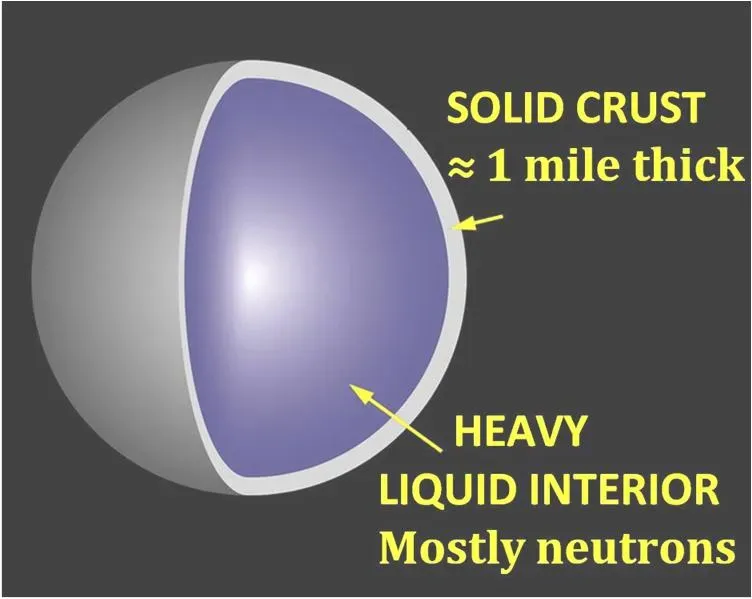
Buried inside every neutron star is a secret that keeps physicists up at night: what happens to matter when it is squeezed beyond nuclear density. We simply cannot reproduce those conditions on Earth, even with our most powerful particle accelerators. That means neutron stars act as natural laboratories, encoding in their size, mass, and spin the details of an unknown equation of state – the relationship between pressure and density in ultra-dense matter. By carefully measuring how fast they spin, how they cool, and how they deform under gravity, researchers decode hints about the building blocks of matter.
Some theories predict that deep in the core, neutrons may break down into free quarks, forming something like a “quark soup” or even more exotic states of matter. Others suggest the presence of hyperons, particles that include strange quarks, or superfluid phases that flow without resistance. Each model leaves a slightly different imprint on observables like maximum mass or the way gravitational waves look during a merger. In that sense, neutron stars sit at the intersection of astrophysics, particle physics, and relativity, tying together three major pillars of modern science in one compact, enigmatic object.
Why It Matters: From Cosmic Ecosystems to Our Gold Wedding Rings
It might be tempting to file neutron stars under “exotic trivia,” the kind of thing you learn about once and then forget, but they quietly shape the story of the universe we live in. The heavy elements they help forge in supernovae and mergers eventually become part of planets, atmospheres, and even living bodies. The gold in a wedding ring or the iodine in a thyroid pill almost certainly owes its existence to some violent neutron star-related event in the distant past. In that sense, these ultra-dense corpses of dead stars are part of the same ecosystem that produces flowers, oceans, and humans.
On a more abstract level, neutron stars give us a rare chance to test our deepest theories about reality. General relativity, quantum mechanics, and nuclear physics each do a good job in their own lanes, but they collide head-on in the interior of a neutron star. If our models are wrong, neutron stars are where the cracks will show up first. And as we refine those models, the payoff ripples outward into technologies that rely on precision timing, navigation, radiation detection, and more. Studying these stars is not just about satisfying curiosity; it is about sharpening the tools we use to understand everything else.
From Ancient Tools to Modern Science: A Brief Human Connection
Long before anyone knew neutron stars existed, people looked up at the night sky and noticed stars that suddenly brightened and faded – the historical records of supernovae in cultures from China to the Middle East are surprisingly detailed. Those bright points were the visible funerals of massive stars that may have left neutron stars behind, even if observers had no way to know it. Fast-forward to the twentieth century, and the invention of radio astronomy opened an entirely new window on the sky, one that would eventually reveal pulsars ticking like metronomes in the cosmic background. Every new technology – from X-ray satellites to gravitational-wave detectors – has added another chapter to the neutron star story.
In my own work following neutron star news, I’ve noticed how often breakthroughs arise from clever repurposing of existing tools. A telescope built to hunt black holes ends up catching a magnetar flare; a pulsar timing array designed to study interstellar gas becomes a probe of low-frequency gravitational waves. This constant re-use and re-imagining mirrors the stars themselves, which die and then continue influencing the cosmos in a different form. Our understanding of neutron stars is still young, but it’s built on a long cultural tradition of reading meaning and pattern in the night sky.
The Future Landscape: Next-Generation Telescopes and Detectors
The coming decade promises a surge of new data that will transform neutron star science. Upgraded gravitational-wave observatories are expected to detect many more neutron star mergers, giving statisticians enough events to map out patterns in how and where they occur. New X-ray missions are measuring neutron star sizes and masses with unprecedented precision, tightening the screws on competing theories of dense matter. Radio arrays are expanding pulsar catalogs, including elusive pulsars in distant or crowded regions of the galaxy that earlier surveys missed.
All of this will feed into more robust models of how neutron stars form, evolve, and die, and how often they collide. There are serious challenges ahead: separating signal from noise in enormous data streams, coordinating observations across continents, and keeping funding steady for long-term projects. Yet the payoff is huge. Better constraints on neutron star physics could refine our understanding of gravity itself and help identify whether we need to modify Einstein’s theory on the most extreme scales. Neutron stars are poised to remain at the heart of multi-messenger astronomy, acting as anchors that tie together different ways of sensing the universe.
How You Can Stay Engaged With Extreme Stars

Most of us will never sit at the controls of a radio array or help tune a gravitational-wave detector, but there are still real ways to be part of the neutron star story. Public data portals from major observatories increasingly make raw or processed observations available for anyone to explore, and citizen science platforms often host projects that involve classifying pulsar candidates or spotting unusual transients. Following mission updates from space agencies or major observatories can turn a dry news item into a personal narrative you’ve been tracking for months or years. Even something as simple as learning the constellations and understanding where supernova remnants sit on the sky can make future discoveries feel more immediate.
Supporting science journalism, education programs, and research institutions is another practical step; these are the channels that turn abstract numbers into human stories. Talking about neutron stars with friends, students, or kids – why they matter, how they link to everyday objects – helps keep curiosity alive in a world that can feel saturated with information but starved for wonder. If anything, neutron stars are a reminder that the universe still has secrets that require patience, creativity, and collaboration to uncover. The next time you see an image of a hazy supernova remnant, you might ask yourself: is there a tiny, invisible neutron star still ticking away at its heart?
Suhail Ahmed is a passionate digital professional and nature enthusiast with over 8 years of experience in content strategy, SEO, web development, and digital operations. Alongside his freelance journey, Suhail actively contributes to nature and wildlife platforms like Discover Wildlife, where he channels his curiosity for the planet into engaging, educational storytelling.
With a strong background in managing digital ecosystems — from ecommerce stores and WordPress websites to social media and automation — Suhail merges technical precision with creative insight. His content reflects a rare balance: SEO-friendly yet deeply human, data-informed yet emotionally resonant.
Driven by a love for discovery and storytelling, Suhail believes in using digital platforms to amplify causes that matter — especially those protecting Earth’s biodiversity and inspiring sustainable living. Whether he’s managing online projects or crafting wildlife content, his goal remains the same: to inform, inspire, and leave a positive digital footprint.