
Every so often, a question crashes into everyday life with the subtlety of a meteor: why does anything at all, instead of nothing? It sounds like a late‑night dorm room debate, yet it sits at the cutting edge of modern physics and cosmology, shaping billion‑dollar experiments and bold new theories. Strangely, the most powerful tools we have for attacking this mystery come from the weirdest corner of science: quantum mechanics. Quantum theory does not just describe the universe; it quietly suggests that reality itself may be born from chance, fluctuations, and information. If that sounds unsettling, it should – but it is also the very reason we are starting to ask this question in a more precise, testable way.
The Hidden Clues in a Universe That Should Not Be
Here is the first shock: by the rules of known physics, the universe looks suspiciously like it should not exist. Matter and antimatter are supposed to be created in equal amounts, annihilating each other in a flash of energy and leaving behind a smooth bath of light. Yet when we look around, we see a cosmos built from matter – galaxies, stars, planets, and people – with only traces of antimatter appearing in rare, violent events. This imbalance is one of the deepest hidden clues pointing toward a more fundamental explanation.
Quantum mechanics steps into this story not as a bit player, but as the scriptwriter of the plot twist. Tiny violations of symmetry, buried in the equations that govern particles, hint that the universe may have slightly “favored” matter in the earliest fractions of a second. Experiments with particle accelerators have caught glimpses of such asymmetries in the behavior of particles called mesons, but not yet enough to fully explain the cosmic excess of matter. That leaves us with a haunting impression: the very fact that you can read this sentence is evidence of subtle quantum irregularities inked into reality almost at the moment of the Big Bang.
From Ancient Wonder to Quantum Equations

Humans have been asking why the universe exists for as long as we have been able to look up at the night sky and wonder. Ancient cultures framed the question in myths and stories, from cosmic eggs to world‑creating deities, each narrative reflecting the needs and fears of its time. For millennia, “why” was answered with purpose and intention rather than mechanism and law. The shift to scientific thinking did not erase the question; it just transformed it into something that could, in principle, be measured, tested, and argued with data instead of doctrine.
Fast‑forward to the twentieth century and the birth of quantum mechanics, and the mystery acquired a new language. Instead of gods and giants, we now talk about wavefunctions, quantum fields, and the strange idea that empty space is not truly empty. Early pioneers of quantum theory realized that the vacuum is alive with fluctuations – pairs of particles and antiparticles that pop briefly into existence before annihilating each other. Suddenly, the idea that “nothing” might naturally give rise to “something” stopped being a philosophical metaphor and became a calculation you could write on a chalkboard.
Vacuum Fluctuations: When Nothing Refuses to Stay Empty

In classical physics, a vacuum is just… nothing: no particles, no fields, no structure. Quantum mechanics demolishes that picture by insisting that even the calmest possible state still wriggles with uncertainty. Thanks to the uncertainty principle, fields cannot sit perfectly still; they must jitter, creating fleeting particle‑antiparticle pairs that appear and vanish too quickly to be directly seen. Physicists call this restless background the quantum vacuum, and it has measurable effects, from tiny shifts in atomic energy levels to forces between metal plates in ultra‑precise experiments.
This seemingly arcane concept has staggering implications for the question of why the universe exists. If quantum fluctuations are unavoidable, then a universe may not be a one‑off miracle but something more like an extreme case of a common process. Some cosmological models suggest that a tiny fluctuation in a primordial quantum field, combined with a brief burst of rapid expansion called inflation, could blow up into a full‑fledged universe with galaxies and life. The notion that the cosmos might be a large‑scale echo of the same restless vacuum we can probe in the lab is as disorienting as it is compelling.
Quantum Creation Stories: From Big Bang to Multiverse

Cosmology has moved far beyond a simple picture of the Big Bang as an explosion in pre‑existing space. Modern theories describe the early universe as a quantum object in its own right, with space, time, and energy emerging from an initially tiny, exotic state. In some versions, the universe “tunnels” into existence from a quantum vacuum, similar to the way a particle can mysteriously appear on the other side of an energy barrier. There is no external trigger in these models; the laws themselves allow the transition, given enough time or enough underlying quantum foam.
Push these ideas further and you arrive at the multiverse, a concept that divides scientists and fascinates the public in equal measure. In certain inflationary scenarios, quantum fluctuations ensure that inflation never ends everywhere at once, spawning countless “bubble universes” with different physical properties. In another family of ideas, tied to quantum many‑worlds, every quantum event branches reality into multiple outcomes, each realized in a separate, mathematically consistent world. Whether these universes are physically real or just useful mathematical tools is hotly debated, but they force a provocative reframing of our question: perhaps the real puzzle is not “why does any universe exist,” but “why does our particular version exist with these laws, in this form?”
Why It Matters: Physics, Meaning, and the Human Stakes
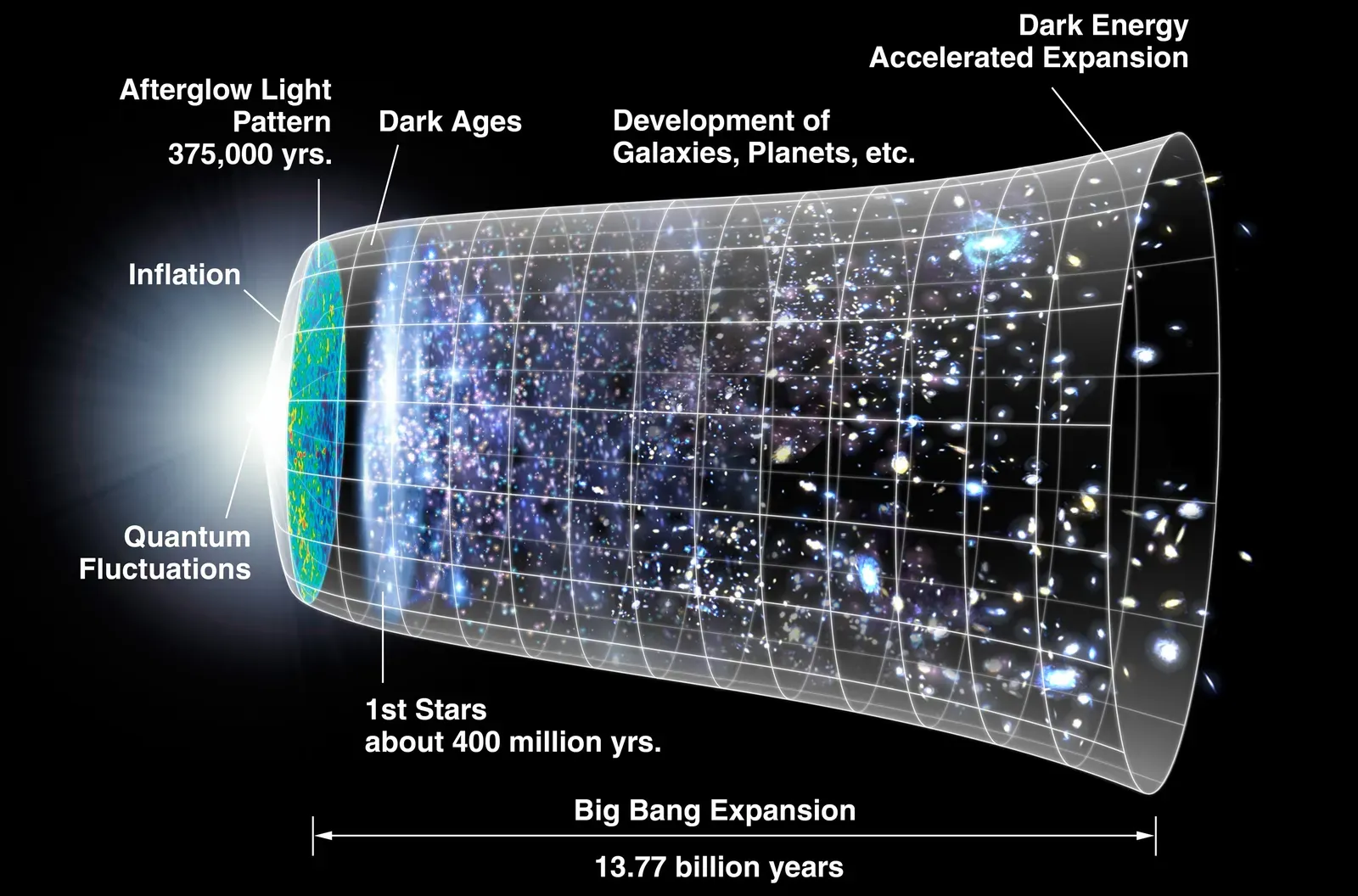
It might be tempting to file all this under “interesting but irrelevant to my everyday life,” yet that would miss the bigger picture. When science confronts the question of why the universe exists, it is really probing how deep the explanatory chain can go. We have already descended several levels, from planetary motions to gravity, from chemistry to quantum mechanics, from the glow of the night sky to the afterglow of the Big Bang. Each layer of understanding has reshaped technology, philosophy, and even politics, whether in the form of GPS satellites or nuclear power plants.
Compared to traditional explanations grounded in purpose or myth, the quantum‑cosmological story does something radical: it removes the need for a pre‑existing stage or external cause. That can feel unsettling, even offensive, if you grew up with narratives that place human beings at the center of the cosmic drama. But it also offers a kind of stark honesty about our place in the universe, one that acknowledges both our insignificance and our rare capacity to understand. Personally, I find it strangely comforting that our brains – bundles of atoms governed by those same quantum rules – can turn back and interrogate their own origins.
Clues from Colliders, Telescopes, and Cosmic Echoes

This is not purely a theoretical game played on blackboards; experiments are quietly tightening the screws on our cosmic origin stories. Particle accelerators like the Large Hadron Collider test how matter and forces behave at energies reminiscent of the early universe, searching for new particles or symmetries that might explain why matter won out over antimatter. Precision measurements of particles called neutrinos, which barely interact with normal matter, may reveal additional ways in which the universe tilted the balance toward matter. Each new anomaly or unexpected pattern adds weight to or undermines a given theory about our cosmic beginnings.
At the same time, telescopes and satellites are mapping the universe on the largest scales, reading faint imprints left by its first moments. The cosmic microwave background – the cold afterglow of the Big Bang – carries subtle fluctuations that reflect quantum noise stretched across the sky during inflation. Astronomers also track how galaxies cluster and how the universe’s expansion is accelerating under the influence of dark energy, another mysterious ingredient with quantum overtones. Put together, these observations act like a forensic report, giving us boundary conditions that any credible answer to “” must satisfy.
Comparing Old Stories and New Physics

Historically, explanations for existence have tended to stop at some unquestioned starting point: a creator, a timeless realm of forms, an eternal steady‑state universe. Traditional philosophies often trade in certainty and closure, offering a final answer that settles the matter, at least emotionally. In contrast, the quantum‑cosmological approach is almost aggressively provisional. It demands consistency with observation and logical structure, but it does not promise that the chain of explanation will ever fully terminate.
That contrast matters because it changes how we relate to knowledge and ignorance. Instead of asking which story feels most comforting, we ask which framework makes risky, specific predictions that could turn out to be wrong. Quantum cosmology has already done this by forecasting patterns in the cosmic background radiation and the distribution of galaxies, which later measurements confirmed with impressive precision. It may never offer a single, emotionally satisfying “because” in the way older stories did, but it gives us something more powerful in the long run: a way to keep pushing the frontier of understanding forward, even when the questions feel almost impossibly grand.
The Future Landscape: New Machines, New Math, New Risks

Looking ahead, answering why the universe exists will hinge on a blend of audacious experiments and radical mathematics. Next‑generation particle colliders, if built, could probe energy scales closer to those of the earliest universe, potentially revealing new forces or particles that complete the picture of matter’s dominance. Space‑based observatories are planned to map gravitational waves – the ripples in spacetime itself – which might carry direct signatures of inflation and quantum fluctuations from the universe’s birth. If those signals are detected and decoded, they could provide the most direct test yet of quantum creation scenarios.
The theoretical side is just as wild. Efforts to merge quantum mechanics with gravity into a single framework, from string‑inspired approaches to loop‑based ones and beyond, may ultimately tell us whether spacetime is fundamental or emergent from deeper quantum information. That, in turn, affects whether our question about existence is even being phrased correctly. There are risks here: enormous costs, technological hurdles, and the possibility that key predictions remain just out of experimental reach for decades. Yet the potential payoff – a coherent story of how reality bootstraps itself into being – is so extraordinary that scientists around the world continue to push forward.
What You Can Do With a Question This Big

It is easy to feel small in the face of a question as immense as why the universe exists, but there are surprisingly tangible ways to engage. Public support and informed curiosity help determine which big experiments get funded, from space telescopes to underground detectors hunting for rare particles. Even staying informed – reading about results, sharing credible science news, and resisting sensationalized misinterpretations – slowly shifts the culture toward valuing deep, long‑term inquiry over quick fixes. In classrooms and conversations, simply admitting that we do not yet know, but are actively trying to find out, models a healthier relationship with uncertainty.
If you want to lean in more directly, you can support science outreach organizations, citizen‑science projects, or local planetariums that connect people with the cosmos above them. The next generation of physicists and astronomers is growing up right now, and they are watching how seriously we treat these questions when budgets tighten and priorities collide. In a very real sense, the universe asking about itself depends on whether we choose to keep that conversation going. That choice, at least, is one place where our tiny corner of the cosmos genuinely matters.
Suhail Ahmed is a passionate digital professional and nature enthusiast with over 8 years of experience in content strategy, SEO, web development, and digital operations. Alongside his freelance journey, Suhail actively contributes to nature and wildlife platforms like Discover Wildlife, where he channels his curiosity for the planet into engaging, educational storytelling.
With a strong background in managing digital ecosystems — from ecommerce stores and WordPress websites to social media and automation — Suhail merges technical precision with creative insight. His content reflects a rare balance: SEO-friendly yet deeply human, data-informed yet emotionally resonant.
Driven by a love for discovery and storytelling, Suhail believes in using digital platforms to amplify causes that matter — especially those protecting Earth’s biodiversity and inspiring sustainable living. Whether he’s managing online projects or crafting wildlife content, his goal remains the same: to inform, inspire, and leave a positive digital footprint.