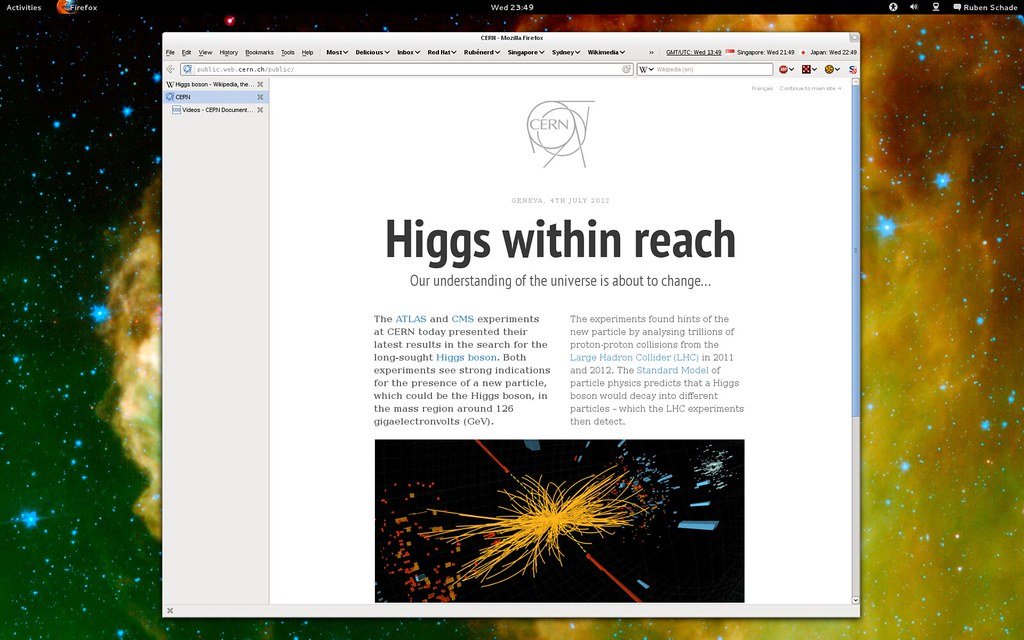

Ever wonder why physicists went to such extraordinary lengths to find a single particle? Picture this: building the world’s most complex machine, spanning miles underground across two countries, all to catch a glimpse of something that exists for less than a trillionth of a second. This isn’t science fiction; this is the real story of the Higgs boson hunt.
The discovery announced on July 4, 2012, wasn’t just another scientific milestone. It was the moment we finally understood one of the universe’s deepest mysteries. Let’s explore why this elusive particle, often called the “God particle,” matters so much to our understanding of reality itself.
It Completes the Standard Model of Particle Physics
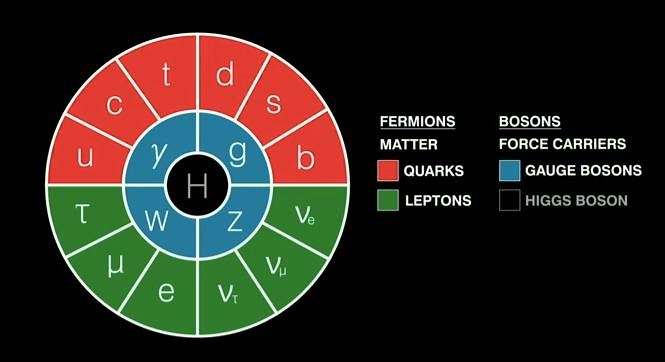
The Higgs boson was the last missing piece of the Standard Model puzzle, representing decades of theoretical predictions finally confirmed. Think of the Standard Model as the ultimate recipe book for everything that exists in our universe. For nearly forty years, physicists had this comprehensive guide to all fundamental particles and forces, but one crucial ingredient remained unverified.
The existence of the Higgs boson completes the Standard Model of particle physics. Without this final piece, our understanding of the subatomic world would have remained incomplete, like trying to bake a cake while missing the main ingredient. The LHC confirmed the existence of the Higgs field and completed the Standard Model, representing the best description we have of the subatomic world.
This completion wasn’t just academic satisfaction. It validated decades of theoretical work and confirmed that physicists were on the right track in understanding how our universe operates at its most fundamental level.
It Explains How Particles Get Their Mass
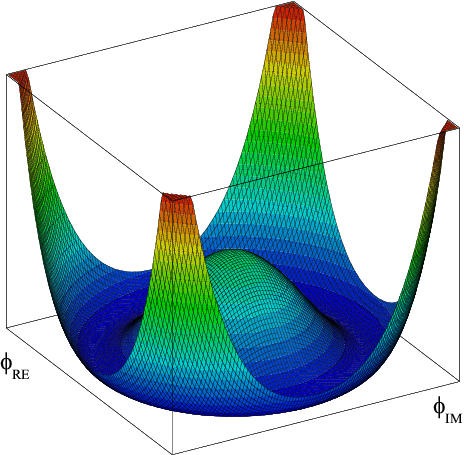
In the Standard Model, the Higgs mechanism is essential to explain how particles acquire mass, without which all bosons would be considered massless despite measurements showing W and Z bosons have large masses. Imagine trying to explain why some people walk slowly through water while others glide through effortlessly. The Higgs field works similarly, creating a kind of cosmic molasses that particles must push through.
The Higgs boson doesn’t technically give other particles mass; more precisely, it’s a quantized manifestation of a field that generates mass through its interaction with other particles. The more strongly a particle interacts with the Higgs field, the more massive it is. This elegant mechanism solved a puzzle that had stumped physicists for decades: why do some fundamental particles have mass while others, like photons, remain massless?
The discovery proved that mass isn’t just an inherent property of matter. Instead, it emerges from particles’ interactions with an invisible field that permeates all of space.
It Required the Most Sophisticated Machine Ever Built
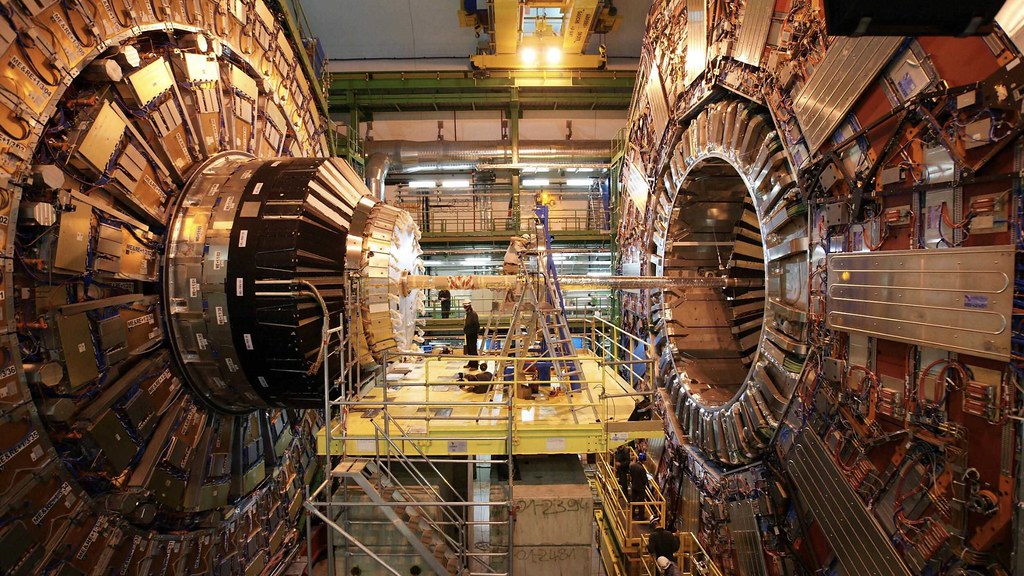
The importance of finding the Higgs boson led to a 40-year search and the construction of one of the world’s most expensive and complex experimental facilities, CERN’s Large Hadron Collider. Picture a machine so precise it can collide particles traveling at nearly the speed of light, recreating conditions that existed just moments after the Big Bang.
Finding the Higgs boson required the largest experiment and most sophisticated machine in human history, pushing both particle accelerator and detector technology to its limits with the Large Hadron Collider. The LHC spans seventeen miles across the France-Switzerland border, buried hundreds of feet underground, containing thousands of superconducting magnets cooled to temperatures colder than outer space.
This technological marvel demonstrates how important the Higgs discovery was to the scientific community. Governments and institutions invested billions of dollars and decades of effort, bringing together thousands of scientists from around the world, all for the chance to glimpse this elusive particle.
It Connects to the Mystery of Dark Matter
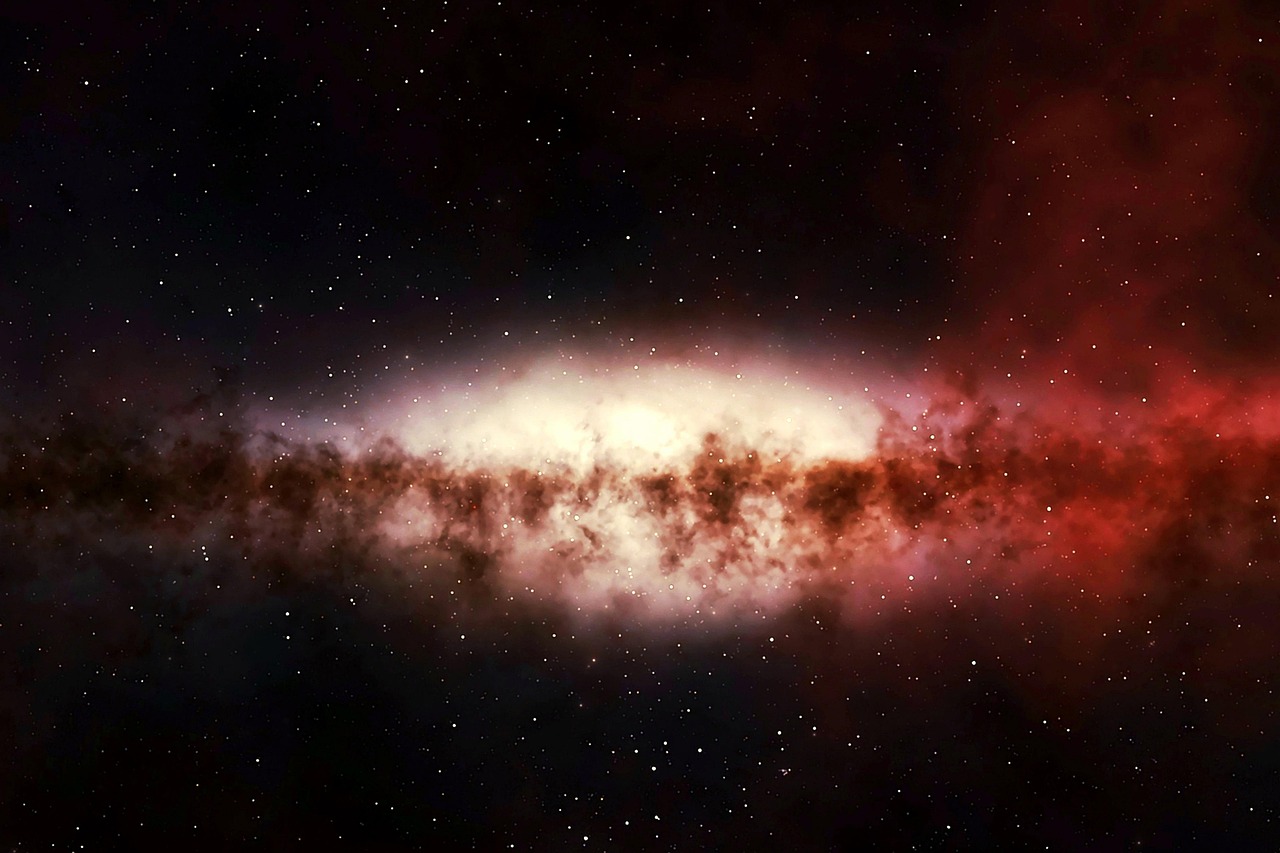
The Higgs boson may offer the key to understanding dark matter, which makes up about 27% of the universe, through Higgs-portal models that assume dark matter particles interact with normal particles through Higgs boson exchange. Think of the Higgs as a potential bridge between the visible universe we know and the invisible dark matter that surrounds us.
A simple theoretical extension of the Standard Model suggests that particles like the Higgs boson act as a “portal” between known particles and dark-matter particles, since the Higgs couples to mass and massive dark-matter particles should interact with it. Because the Higgs helps explain where mass comes from, scientists think it should interact with dark matter, potentially serving as the portal between us and this dark sector.
This connection could unlock one of cosmology’s greatest puzzles. If confirmed, it would mean the same mechanism that gives particles their mass also governs how dark matter behaves in our universe.
It Validates Einstein’s Predictions About Symmetry Breaking

The Higgs field has a unique property: it has less energy when it has a non-zero value than when it was zero, unlike every other known field, allowing it to break electroweak symmetry and show how weak force gauge bosons could have mass. Imagine a perfectly balanced pencil standing on its tip. In theory, it could stay there forever, but in reality, it will fall in some direction, breaking its perfect symmetry.
Below some extremely high temperature, the Higgs field causes spontaneous symmetry breaking during interactions, triggering the mechanism that causes bosons to have mass. This process explains how the universe evolved from its early, highly symmetric state to the complex reality we observe today.
The discovery confirmed theoretical predictions made decades earlier about how fundamental symmetries in nature could be spontaneously broken. This validation strengthened our confidence in using symmetry principles to understand the deepest laws of physics.
It Revealed Insights About the Early Universe
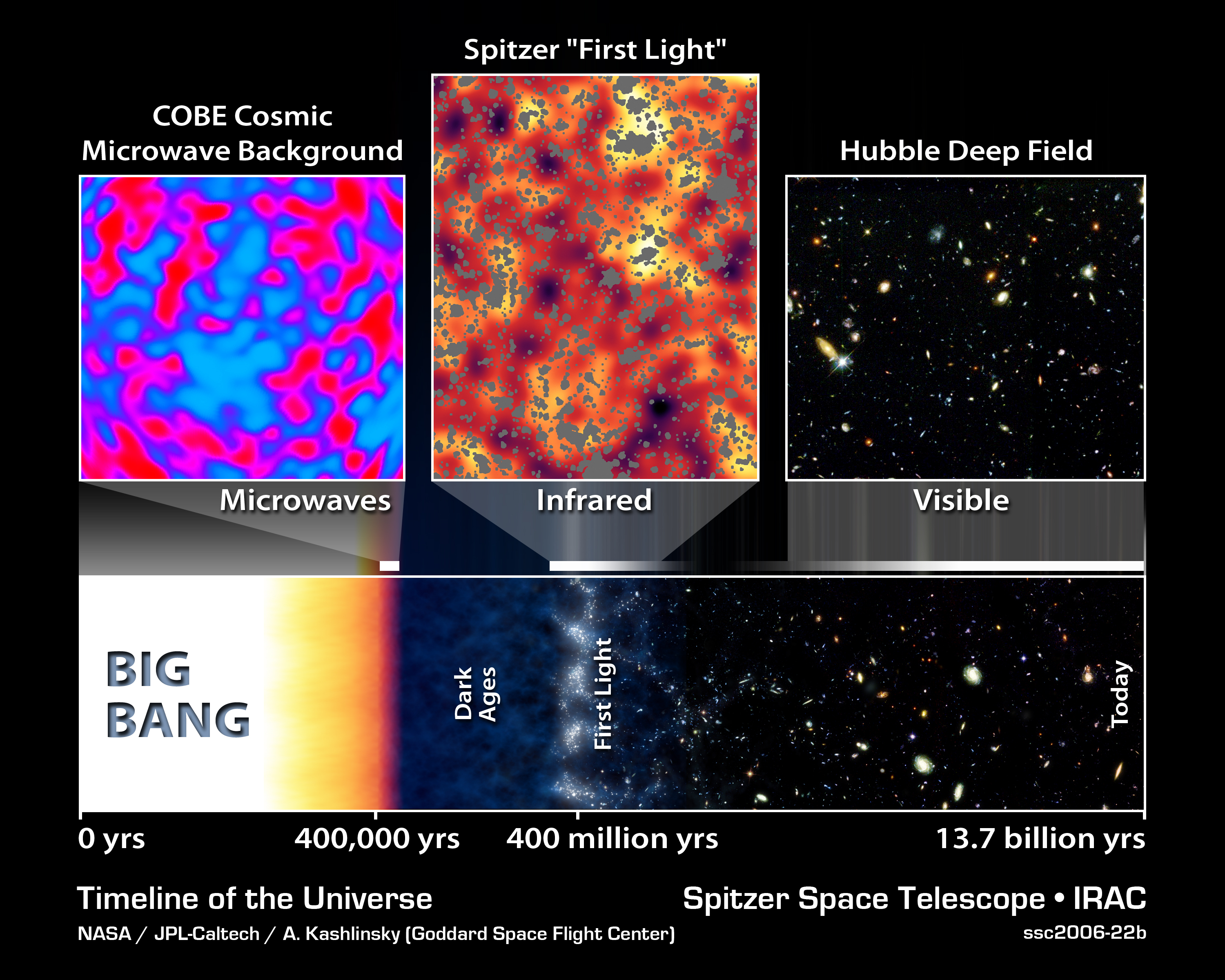
Researchers have started building a picture of how the pervasive presence of a Higgs field throughout the universe was established about a trillionth of a second after the Big Bang. Picture the universe in its infancy, when temperatures were so extreme that the very nature of matter and energy was fundamentally different from today.
The Higgs boson mass of 125 GeV places the universe’s vacuum very close to the border between stable and metastable, which may hint at deeper physics and influences ideas about dark energy, dark matter, and possible early universe phase transitions responsible for baryogenesis. This delicate balance suggests our universe exists in a remarkably special state.
The Higgs mechanism may have played a crucial role in shaping the cosmos we inhabit. Understanding this process helps explain not just how particles got their mass, but potentially why our universe has the particular properties that allow stars, planets, and life to exist.
It Opens New Frontiers in Physics Research
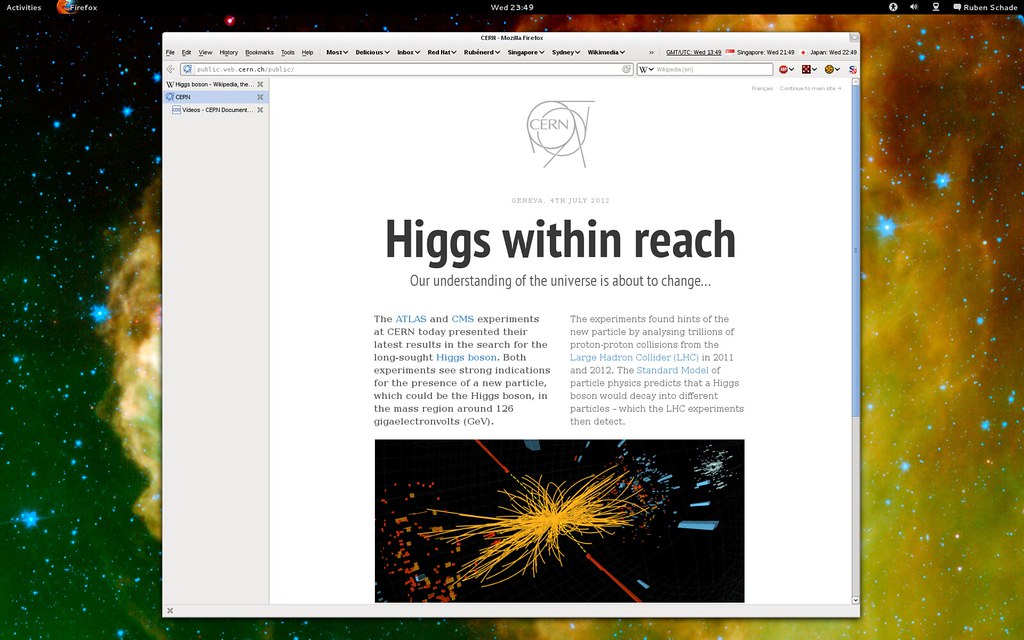
The discovery of the Higgs boson opened new windows in searching for new physics phenomena, since its properties are predicted to be different in various theoretical models, and many theories predict it plays a critical role in producing new phenomena like dark matter at the LHC. Think of the Higgs discovery as opening a door that was previously locked, revealing entirely new rooms to explore in the mansion of physics.
Scientists continue searching for threads that could unravel remaining mysteries like why there’s more matter than antimatter in the universe and the nature of dark energy and dark matter, with any small deviation in the Higgs’s expected properties potentially representing a major breakthrough. The particle serves as a powerful tool for probing beyond our current understanding.
Future experiments will study the Higgs with unprecedented precision, potentially revealing cracks in the Standard Model or signs of new physics. This could lead to revolutionary discoveries about supersymmetry, extra dimensions, or entirely unexpected phenomena.
It Demonstrates the Power of International Scientific Collaboration

The discovery represents the product of efforts by researchers, engineers, and technicians from all continents working together for a common cause, uniting theory with experimentation. Imagine coordinating the work of thousands of brilliant minds across dozens of countries, all focused on a single, seemingly impossible goal.
The discovery was a monumental milestone that marked both the end of a decades-long journey of exploration and the beginning of a new era of studies of this very special particle. The achievement was the result of years of hard work by motivated teams of postdocs, graduate students, and undergraduate students, representing an incredibly exciting time not only for the scientific community but for the world at large.
This collaboration demonstrated that when humanity unites around common goals, we can achieve seemingly impossible things. The Higgs discovery stands as proof that international cooperation in science can overcome any challenge, no matter how technically demanding or conceptually difficult.
Conclusion

The Higgs boson discovery represents far more than finding another particle in nature’s catalog. It completed our fundamental understanding of how mass emerges in the universe, validated decades of theoretical predictions, and opened entirely new research frontiers. From its connection to dark matter mysteries to its role in the early universe’s evolution, the Higgs continues revealing secrets about reality’s deepest layers.
Perhaps most remarkably, this achievement showcased humanity’s incredible capacity for understanding the cosmos through international collaboration and technological innovation. As we continue studying this remarkable particle with ever-greater precision, who knows what other profound truths about our universe we’ll uncover? What do you think the next major discovery will teach us about the nature of reality?
Jan loves Wildlife and Animals and is one of the founders of Animals Around The Globe. He holds an MSc in Finance & Economics and is a passionate PADI Open Water Diver. His favorite animals are Mountain Gorillas, Tigers, and Great White Sharks. He lived in South Africa, Germany, the USA, Ireland, Italy, China, and Australia. Before AATG, Jan worked for Google, Axel Springer, BMW and others.