
Picture this: you’re frantically debugging your latest code, cursing at your screen while coffee grows cold beside you. But have you ever wondered why we call these digital glitches “bugs” in the first place? The answer might surprise you, and it definitely involves an actual insect that became the most famous moth in technological history.
The Night That Changed Tech Language Forever
On September 9, 1947, something extraordinary happened in the basement of Harvard University’s Computation Laboratory. Grace Hopper, a pioneering computer scientist, was working late with her team on the Mark II Aiken Relay Calculator when the massive machine suddenly stopped functioning. This wasn’t unusual – early computers were temperamental beasts that broke down regularly.
What made this particular malfunction special was what they found when they opened up the machine. Stuck between the contacts of relay number 70 in Panel F was a moth, its wings spread wide, having been electrocuted by the electrical current. The tiny creature had literally caused the computer to stop working.
Hopper’s team carefully removed the moth and taped it into their logbook with the notation “First actual case of bug being found.” This moment, preserved forever in the Smithsonian Institution, gave birth to one of the most enduring terms in technology.
Grace Hopper: The Admiral Who Spoke to Machines

Grace Hopper wasn’t just any programmer – she was a force of nature who revolutionized how we think about computers. Born in 1906, she earned a PhD in mathematics from Yale University at a time when women in science were rare. During World War II, she joined the Navy and was assigned to work on the Mark I computer at Harvard.
Hopper possessed an extraordinary ability to explain complex concepts in simple terms. She once demonstrated the nanosecond by showing people a piece of wire exactly 11.8 inches long, explaining that this was how far light could travel in a nanosecond. Her practical approach to problem-solving extended to her documentation methods, including that famous moth incident.
Her meticulous record-keeping wasn’t just academic – it was revolutionary. By documenting every malfunction and its cause, she was essentially creating the first systematic approach to computer debugging, a practice that would become essential to software development.
The Mark II: A Room-Sized Calculator That Changed Everything
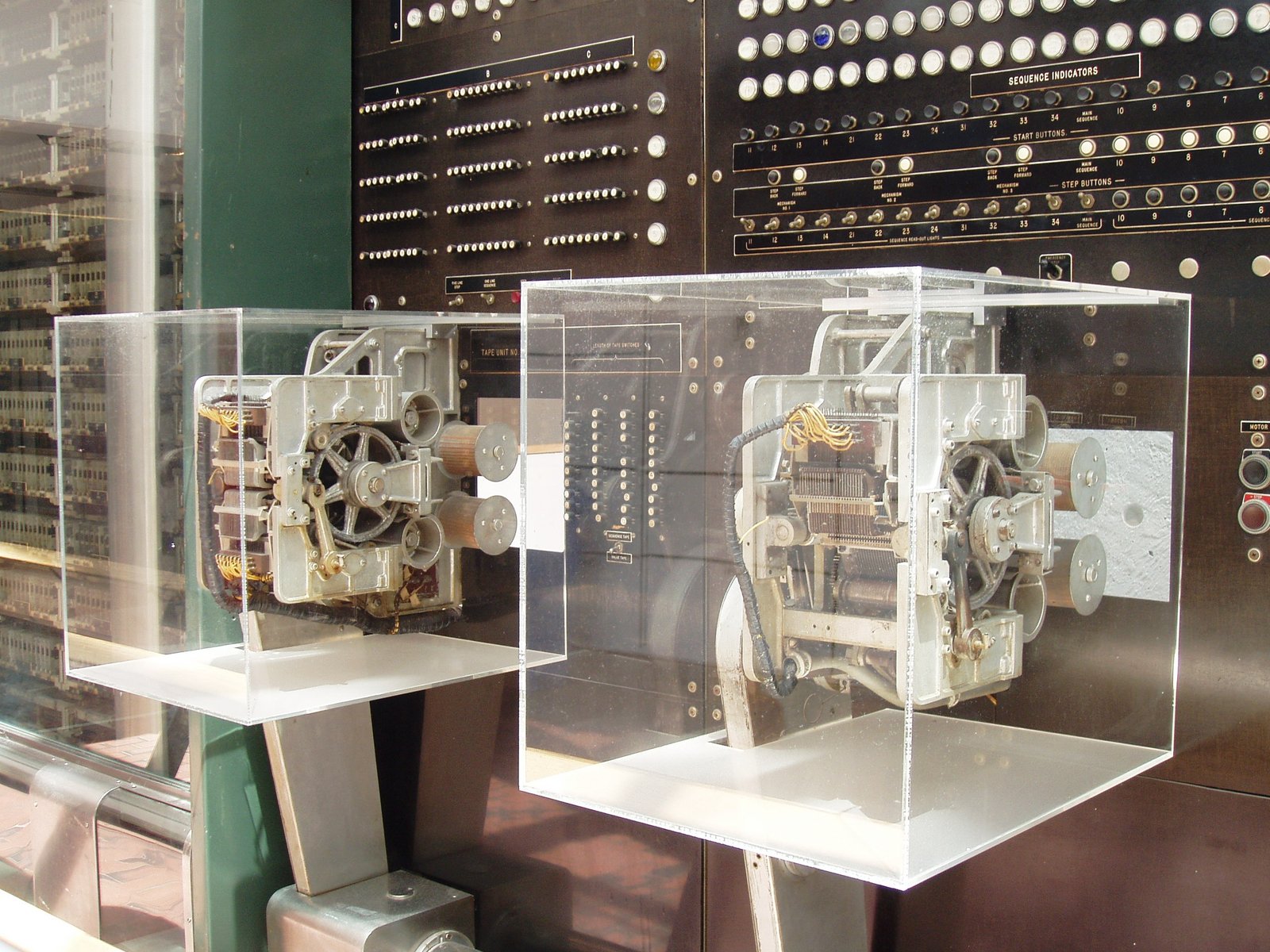
The Mark II Aiken Relay Calculator was a monster of a machine, filling an entire room with its thousands of mechanical relays, switches, and electrical components. Built as an improvement over the Mark I, it could perform calculations that would take humans hours to complete. However, its complexity made it incredibly vulnerable to the smallest disruptions.
The machine operated using electromechanical relays that clicked and clacked as they opened and closed thousands of times per second. These relays were essentially switches that could be turned on or off by electrical signals, forming the basis of the computer’s logic. When a moth flew into relay number 70, it created a short circuit that prevented the relay from functioning properly.
This wasn’t an isolated incident – insects were attracted to the warm, electrical environment of early computers. The machines generated significant heat, and the electromagnetic fields they produced seemed to draw various creatures like moths to a flame, quite literally in this case.
Why Moths Are Drawn to Technology

The relationship between moths and artificial light sources has fascinated scientists for decades. Moths use a behavior called transverse orientation, navigating by maintaining a constant angle to bright celestial objects like the moon. When they encounter artificial lights, this navigation system becomes confused, causing them to spiral toward the light source.
Early computers like the Mark II were filled with hundreds of light-producing vacuum tubes and electrical components that generated both heat and electromagnetic radiation. To a moth, these machines must have appeared like technological beacons in the darkness, irresistible and ultimately fatal.
The electromagnetic fields produced by these early computers may have also interfered with the moths’ magnetic navigation systems. Some research suggests that insects can detect magnetic fields, and the powerful electrical currents in early computers could have disrupted these natural navigation abilities, drawing them deeper into the machinery.
The Etymology of ‘Bug’ Before the Bug

Surprisingly, the term “bug” was already being used to describe mechanical and electrical problems long before Grace Hopper’s famous moth incident. Thomas Edison used the word “bug” in his private papers as early as 1878, referring to difficulties and faults in his inventions. He wrote about “bugs” in his phonograph and other electrical devices, suggesting the term was already part of engineering vernacular.
The word likely originated from the Middle English “bugge,” meaning a frightening or troublesome thing, or possibly from the Welsh “bwg,” meaning ghost or goblin. Engineers and inventors adopted it to describe mysterious, troublesome problems that seemed to appear out of nowhere, much like supernatural creatures.
Hopper’s moth incident didn’t create the term “bug,” but it did provide the first literal example of an actual bug causing a computer malfunction. This ironic coincidence helped cement the word’s place in computer terminology and gave it a concrete, memorable origin story that resonated with future generations of programmers.
Early Computer Vulnerabilities: More Than Just Moths

The Mark II and other early computers faced numerous biological threats beyond moths. Mice would occasionally nest in the warm electronic components, chewing through wires and causing short circuits. Spiders would spin webs across electrical contacts, and beetles would crawl into tiny spaces where they would die and decompose, causing corrosion.
These early machines were essentially giant electrical ecosystems that attracted all manner of creatures. The constant humming and clicking sounds they produced resembled natural environments, while the heat they generated created microclimates that many insects found irresistible. Maintenance crews had to be part electrician, part exterminator.
The vulnerability of these early computers to biological interference highlighted a fundamental challenge in technology design: how to create systems that were both functional and protected from the natural world. This led to the development of better enclosures, air filtration systems, and environmental controls that are now standard in data centers worldwide.
The Evolution of Computer Enclosures

The moth incident and similar biological intrusions led to significant improvements in computer design and housing. Early computers were often open systems with exposed components, making them vulnerable to environmental factors including insects, dust, and moisture. The need to protect these expensive machines drove innovation in enclosure design.
Engineers began developing sealed cases with filtered air systems that would allow cooling while preventing insects from entering. These early environmental controls were primitive by today’s standards but represented a crucial step toward creating stable computing environments. The lessons learned from these biological invasions directly influenced modern data center design.
By the 1960s, computer manufacturers had implemented strict environmental controls, including positive air pressure systems that would keep insects out while maintaining optimal temperature and humidity levels. These protective measures became so effective that finding actual bugs in computers became increasingly rare, though the term remained embedded in technical language.
The Mark II’s Legacy in Computing History

The Mark II represented a crucial stepping stone in the evolution of computing technology. While it wasn’t the first computer, it was among the first to be used for serious scientific and military calculations during the post-war period. Its reliability, despite occasional moth invasions, demonstrated that automated calculation was not just possible but practical.
The machine’s design influenced later computer architectures, particularly in how components were arranged and accessed for maintenance. The modular design that allowed Hopper’s team to easily locate and remove the moth became a standard feature in computer design, enabling faster troubleshooting and repair.
Most importantly, the Mark II served as a training ground for an entire generation of computer scientists. The skills and practices developed while working on this machine, including systematic debugging and meticulous documentation, became foundational principles of computer science and software engineering.
Grace Hopper’s Impact on Programming Languages

Beyond her famous moth discovery, Grace Hopper’s contributions to computing were revolutionary. She developed the first compiler, a program that could translate human-readable code into machine language. This innovation made programming accessible to a much wider audience, as programmers no longer needed to work directly with complex machine code.
Hopper also played a crucial role in developing COBOL (Common Business-Oriented Language), one of the first high-level programming languages designed for business applications. Her vision was to create programming languages that used English-like syntax, making them more intuitive for non-mathematicians to learn and use.
Her approach to problem-solving, exemplified by her careful documentation of the moth incident, influenced how programmers approach debugging and error resolution. She emphasized the importance of understanding not just what went wrong, but why it went wrong, leading to more systematic approaches to software development and maintenance.
The Science Behind Insect Attraction to Electronics

The attraction of insects to electronic devices involves several fascinating biological and physical phenomena. Many insects are naturally drawn to heat sources, as warmth indicates potential food sources or suitable environments for reproduction. Early computers generated substantial heat, making them attractive to cold-blooded creatures seeking warmth.
The electromagnetic fields produced by electrical components can also interfere with insect navigation systems. Many insects rely on the Earth’s magnetic field for orientation, and the strong electromagnetic signatures of early computers may have disrupted these natural navigation mechanisms, causing insects to become disoriented and trapped within the machinery.
Additionally, the chemical compounds used in early electronic components, including certain plastics and insulating materials, may have emitted odors that attracted insects. Some of these materials contained compounds that insects might have mistaken for pheromones or food sources, drawing them into the dangerous electrical environment.
Modern Debugging: From Moths to Algorithms

Today’s debugging process has evolved far beyond hunting for literal insects in mechanical relays. Modern software debugging involves sophisticated tools that can trace program execution, analyze memory usage, and identify logical errors in code. However, the fundamental principles established by pioneers like Grace Hopper remain unchanged: systematic investigation, careful documentation, and methodical problem-solving.
Contemporary debugging tools can automatically detect many types of errors that would have required hours of manual investigation in Hopper’s era. Integrated development environments now include debuggers that can step through code line by line, examine variable values, and identify the exact location where problems occur. These tools have made debugging faster and more precise than ever before.
Despite these technological advances, the human element of debugging remains crucial. The intuition, creativity, and systematic thinking that Grace Hopper brought to her work are still essential skills for modern programmers. The moth incident reminds us that sometimes the most complex problems have surprisingly simple causes.
Environmental Controls in Modern Data Centers

Modern data centers employ sophisticated environmental control systems that would have seemed like science fiction to Grace Hopper’s generation. These facilities maintain precise temperature and humidity levels, use advanced air filtration systems, and implement multiple layers of protection against biological intrusions. The lessons learned from early computer vulnerabilities directly influenced these protective measures.
Today’s data centers use positive air pressure systems, HEPA filters, and sealed environments to prevent insects and other contaminants from entering critical computing areas. Environmental monitoring systems continuously track conditions and alert operators to any changes that might affect equipment performance or reliability.
The evolution from moth-invaded relay computers to sterile, climate-controlled server farms represents one of the most dramatic transformations in technological infrastructure. Yet the fundamental challenge remains the same: protecting delicate electronic systems from the unpredictable forces of the natural world.
The Cultural Impact of the Bug Story

The story of Grace Hopper’s moth has become one of the most beloved anecdotes in computing history, transcending its technical origins to become a cultural touchstone. It represents the intersection of human ingenuity and natural unpredictability, reminding us that even the most sophisticated systems can be disrupted by the smallest creatures.
This story has inspired countless computer scientists and engineers, serving as a reminder that problem-solving often requires looking beyond the obvious. The moth incident demonstrates the importance of thorough investigation and the value of documenting unusual occurrences, principles that remain relevant in today’s digital age.
The tale has also become a symbol of the pioneering spirit of early computing, when engineers and scientists were literally inventing the future with limited resources and boundless creativity. It represents a time when computer science was still young enough for individual incidents to shape the language and culture of an entire field.
Other Famous Computer Malfunctions in History

The moth incident wasn’t the only time that unexpected factors caused significant computer problems. In 1962, a missing hyphen in the code for the Mariner 1 spacecraft caused the rocket to veer off course, leading to its destruction and costing NASA millions of dollars. This incident became known as the “most expensive hyphen in history.”
More recently, the Y2K bug (also known as the Millennium Bug) threatened to cause widespread computer failures when calendar systems transitioned from 1999 to 2000. While the predicted catastrophe was largely avoided through extensive preparation, the incident highlighted how seemingly minor programming decisions could have far-reaching consequences.
These historical incidents, like Hopper’s moth, demonstrate that computer problems often have surprisingly simple causes. They remind us that despite our technological sophistication, we must remain vigilant about the potential for unexpected failures and the importance of thorough testing and documentation.
The Evolution of Bug Terminology

Since Grace Hopper’s time, the terminology around computer problems has expanded far beyond the simple term “bug.” Today’s programmers distinguish between various types of errors: syntax errors, logical errors, runtime errors, and semantic errors. Each category requires different approaches to detection and resolution.
The software development community has also developed specialized terminology for different types of problems. A “feature” that’s working incorrectly might be called a “regression,” while a problem that only occurs under specific conditions might be termed a “race condition” or “edge case.” These distinctions help programmers communicate more precisely about the nature of problems they encounter.
Despite this expanded vocabulary, the simple term “bug” remains the most widely used and understood word for computer problems. Its connection to Grace Hopper’s moth gives it a historical weight and cultural significance that more technical terms lack, ensuring its continued place in the computing lexicon.
Modern Pest Control in Technology

While moths and other insects rarely cause problems in modern computers, the technology industry still faces biological threats. Server farms in certain climates must contend with aggressive insects that can damage equipment or interfere with operations. Some facilities employ specialized pest control measures designed specifically for high-tech environments.
The miniaturization of electronic components has actually made some devices more vulnerable to certain types of biological interference. Smartphones and tablets can be damaged by moisture from insects, while tiny components can be disrupted by microscopic organisms. These modern challenges require different solutions than those faced by Grace Hopper’s generation.
Some researchers are even exploring bio-inspired solutions to technical problems, studying how insects and other organisms solve complex challenges. This field, known as biomimetics, represents a fascinating reversal of the traditional relationship between biology and technology, where nature becomes the teacher rather than the disruptor.
The Enduring Legacy of a Single Moth

The moth that died in Harvard’s Mark II computer on September 9, 1947, achieved a kind of immortality that few creatures ever attain. Its preserved remains, still taped to Grace Hopper’s logbook page, represent one of the most significant artifacts in computing history. This tiny creature’s inadvertent contribution to technology continues to influence how we think about and discuss computer problems.
The incident serves as a powerful reminder of the interconnectedness of the natural and technological worlds. Even as our devices become more sophisticated and our digital environments more controlled, we remain part of a larger ecosystem where the smallest creatures can have outsized impacts on our most complex systems.
Perhaps most importantly, the moth’s story demonstrates the value of curiosity, careful observation, and thorough documentation in scientific work. Grace Hopper’s decision to preserve and document this unusual incident created a lasting legacy that continues to educate and inspire new generations of technologists. The next time you encounter a bug in your code, remember the moth that started it all – and the brilliant woman who made sure its story would never be forgotten.