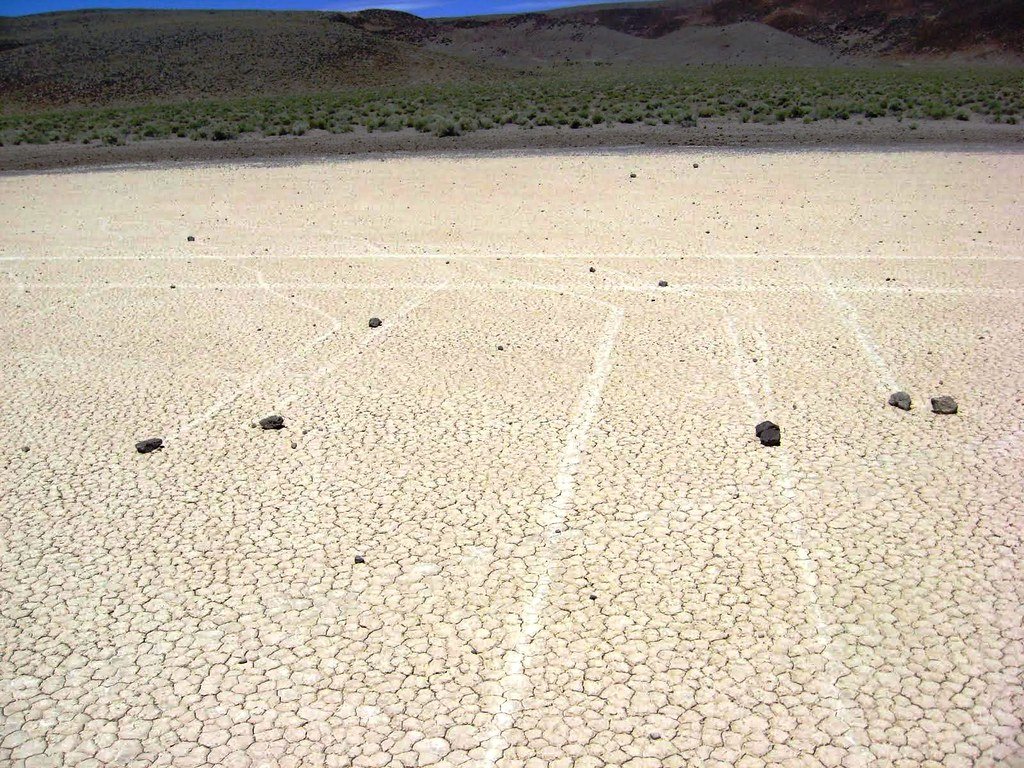
Imagine walking across a perfectly flat, barren lake bed in one of Earth’s most unforgiving places, only to discover massive boulders that have somehow traveled hundreds of yards across the desert floor, leaving perfectly straight trails behind them like ghostly signatures in the sand. This isn’t science fiction or some ancient alien mystery – it’s one of nature’s most puzzling phenomena happening right now in Death Valley’s Racetrack Playa. For decades, scientists scratched their heads trying to figure out how rocks weighing up to 700 pounds could move by themselves across this remote desert landscape, leaving behind mysterious trails that looked like someone had dragged them with invisible ropes.
The Enigmatic Landscape of Racetrack Playa
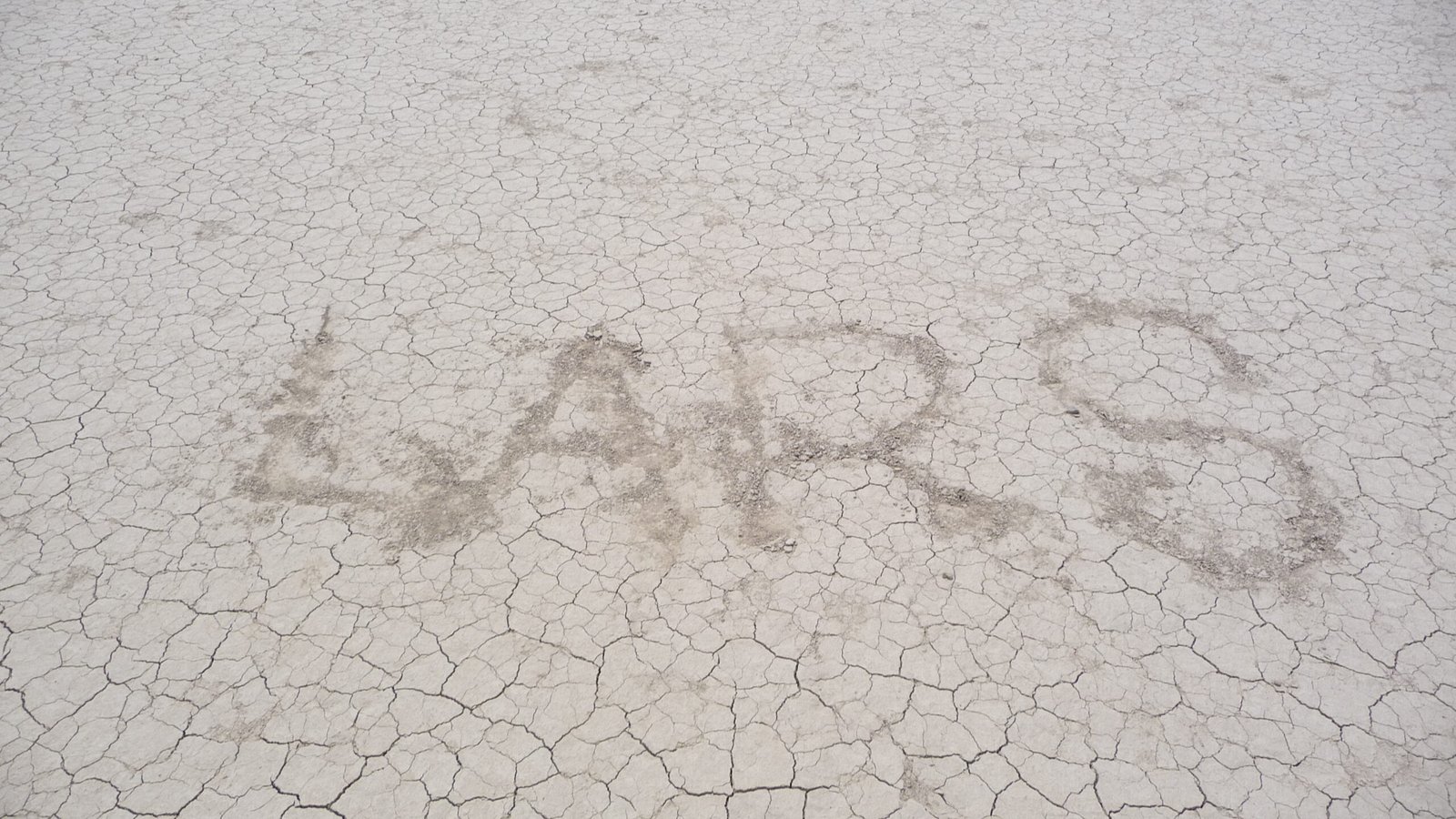
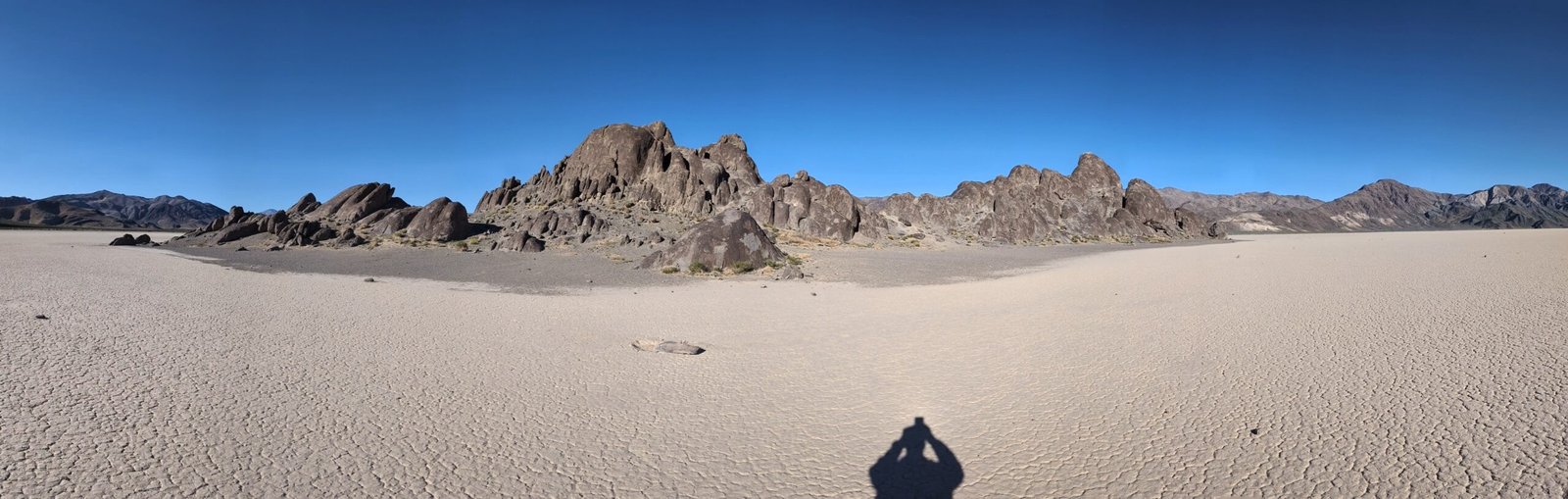
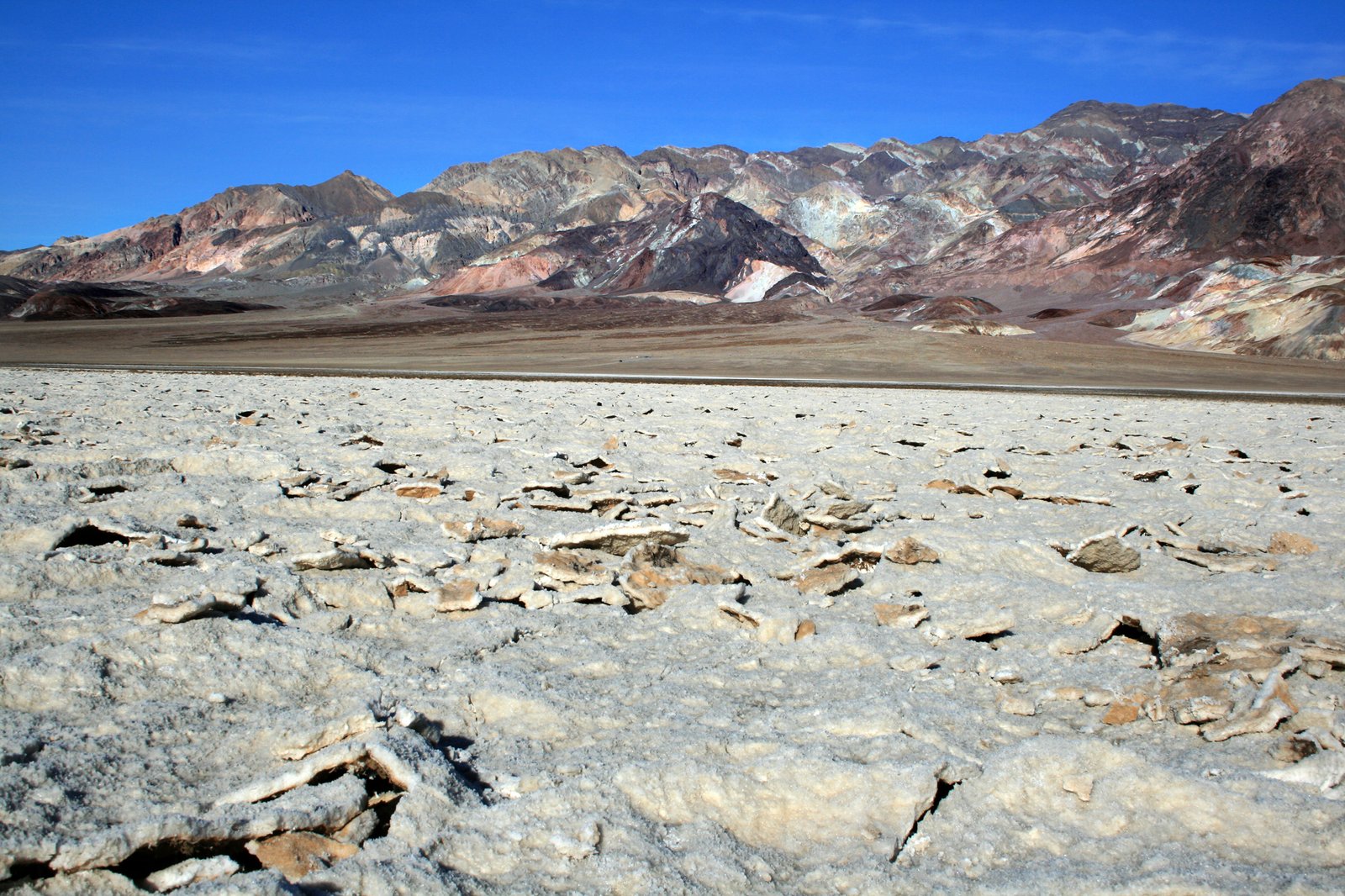
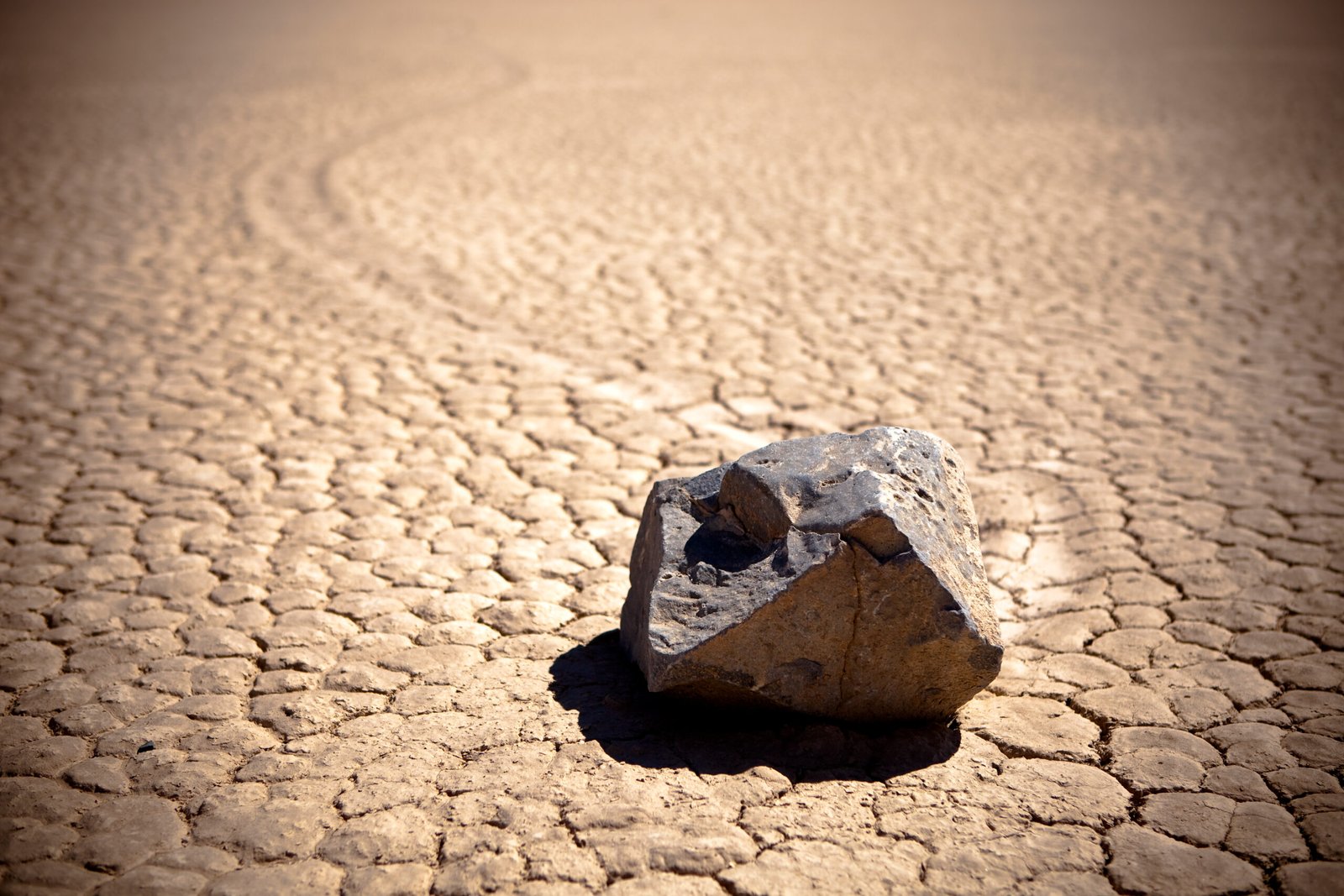
Death Valley’s Racetrack Playa stretches across nearly three miles of absolutely flat terrain, sitting 3,700 feet above sea level like a massive natural parking lot carved from ancient lake sediments. This dried lake bed represents one of the flattest places on Earth, with elevation changes of less than four inches across its entire length. The playa’s surface consists of hexagonal mud tiles that crack and separate during the scorching summer months, creating an otherworldly mosaic pattern that looks like nature’s own jigsaw puzzle. When winter rains occasionally fill this basin with a shallow layer of water, the entire landscape transforms into a temporary mirror reflecting the surrounding mountains. The combination of extreme flatness, periodic flooding, and intense temperature variations creates the perfect laboratory for one of geology’s most perplexing mysteries.
The Moving Stones That Defied Explanation
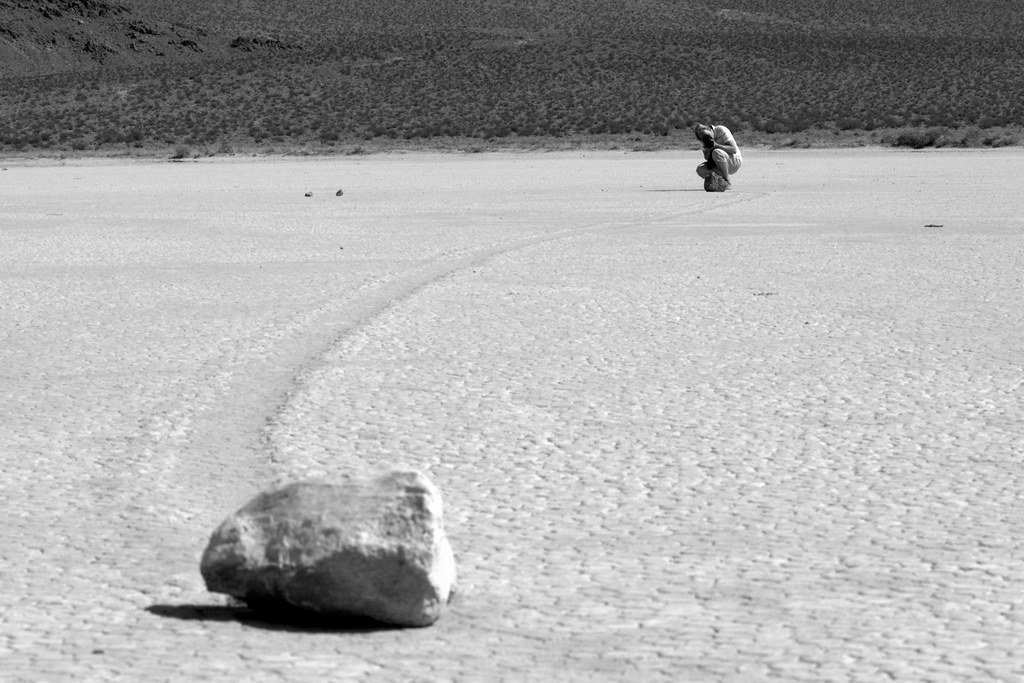
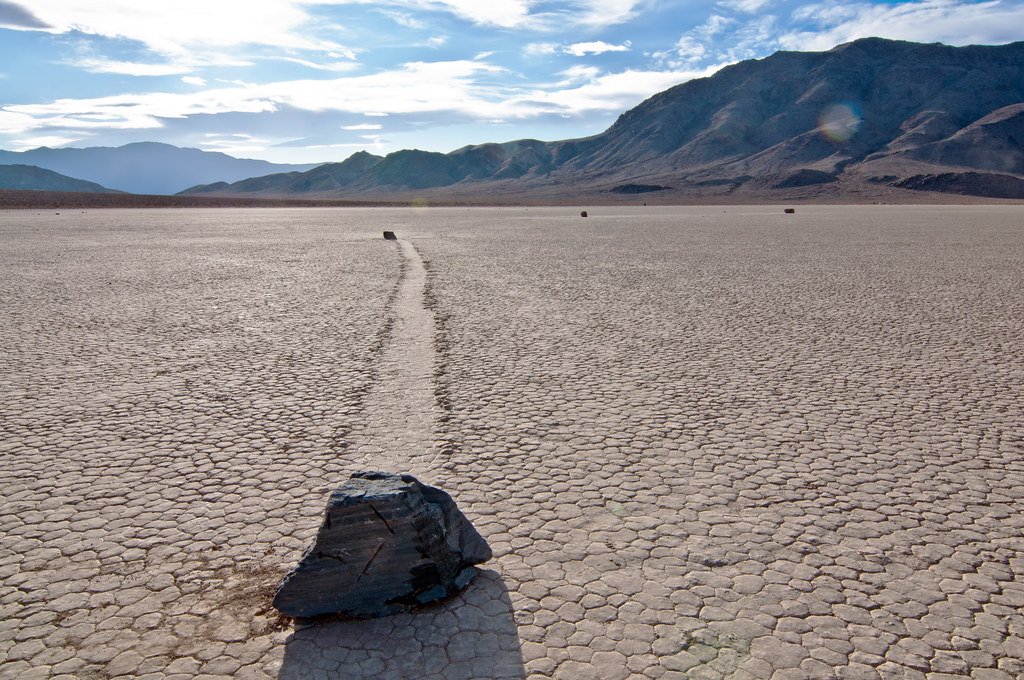
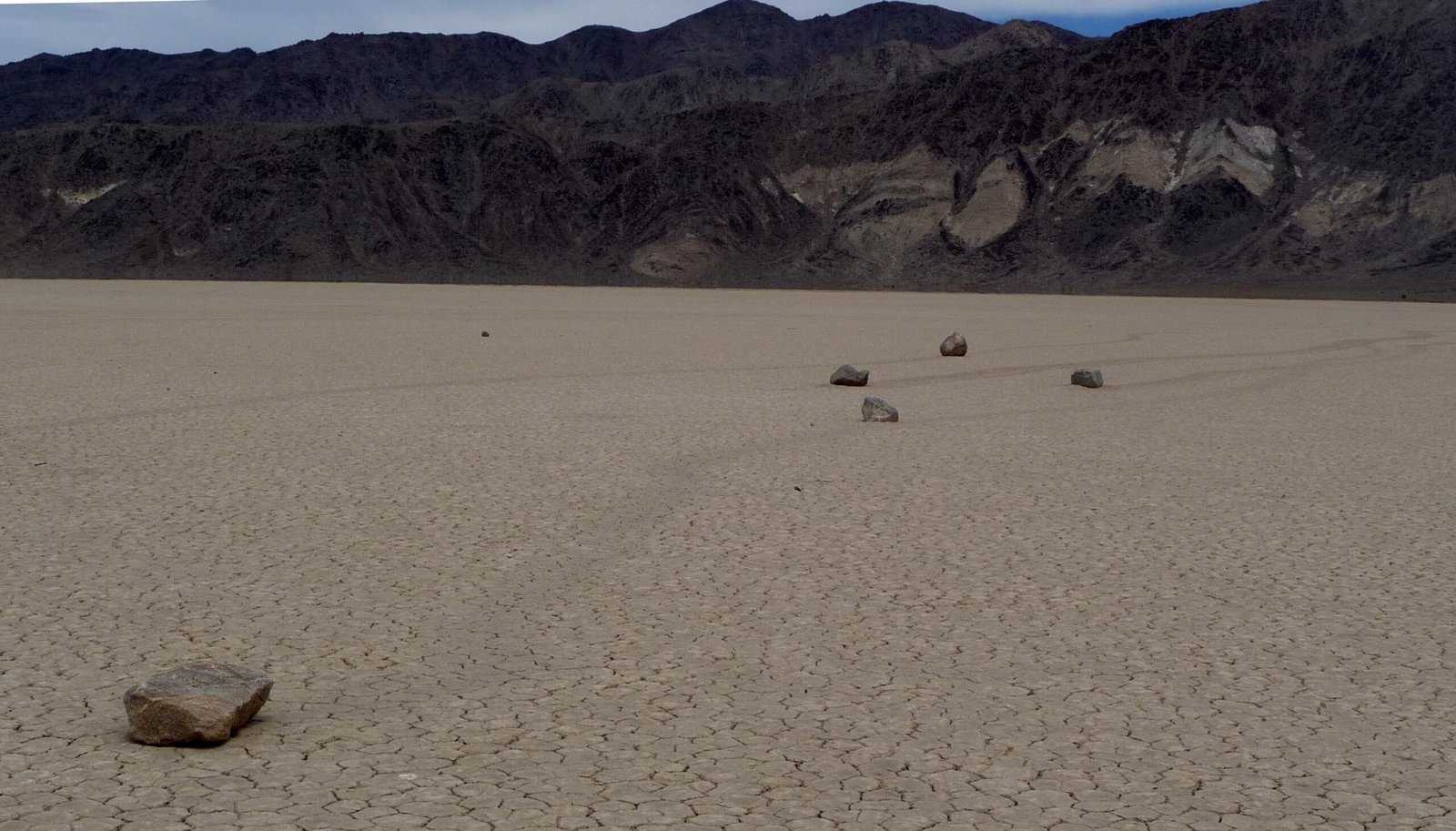
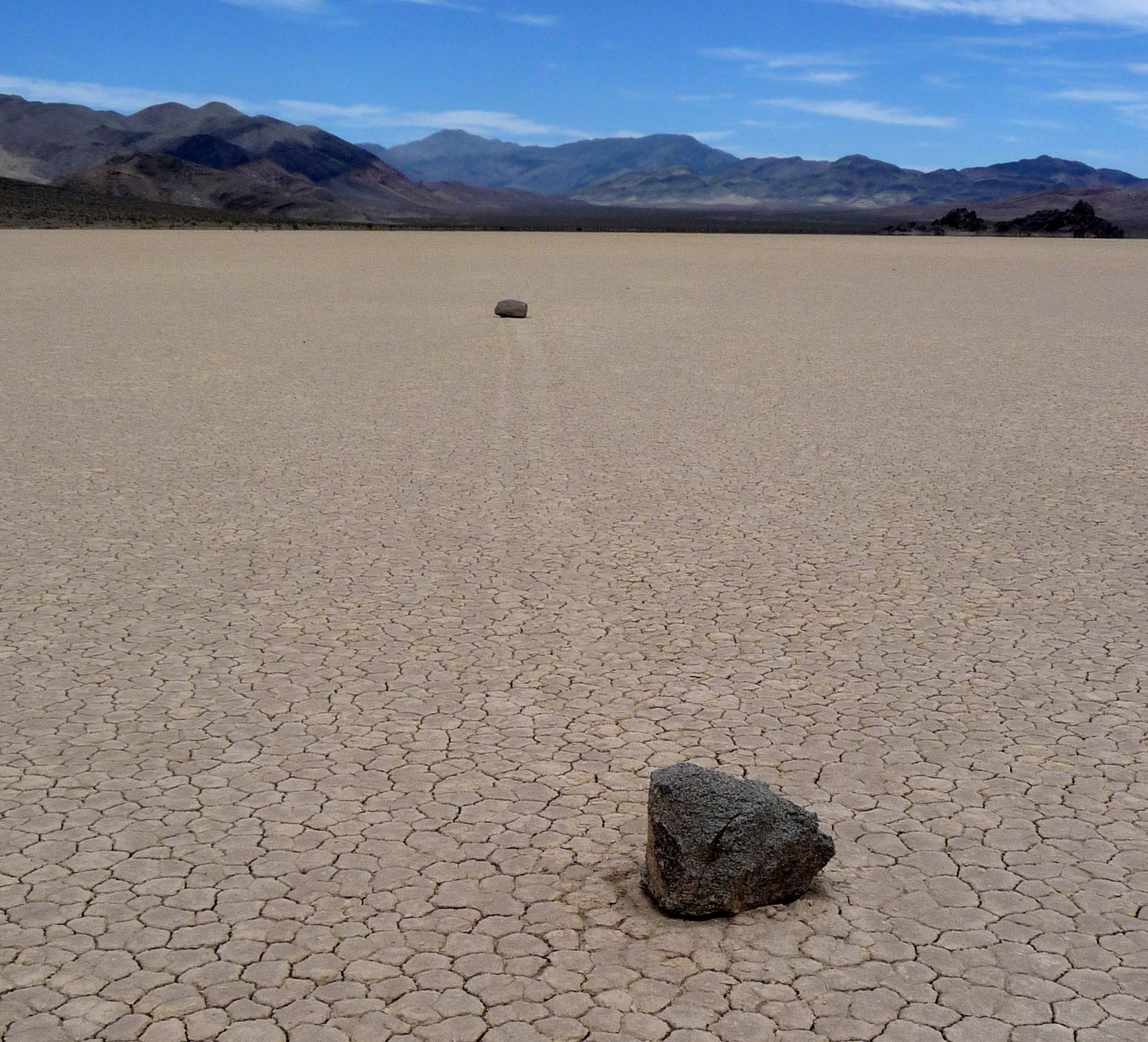
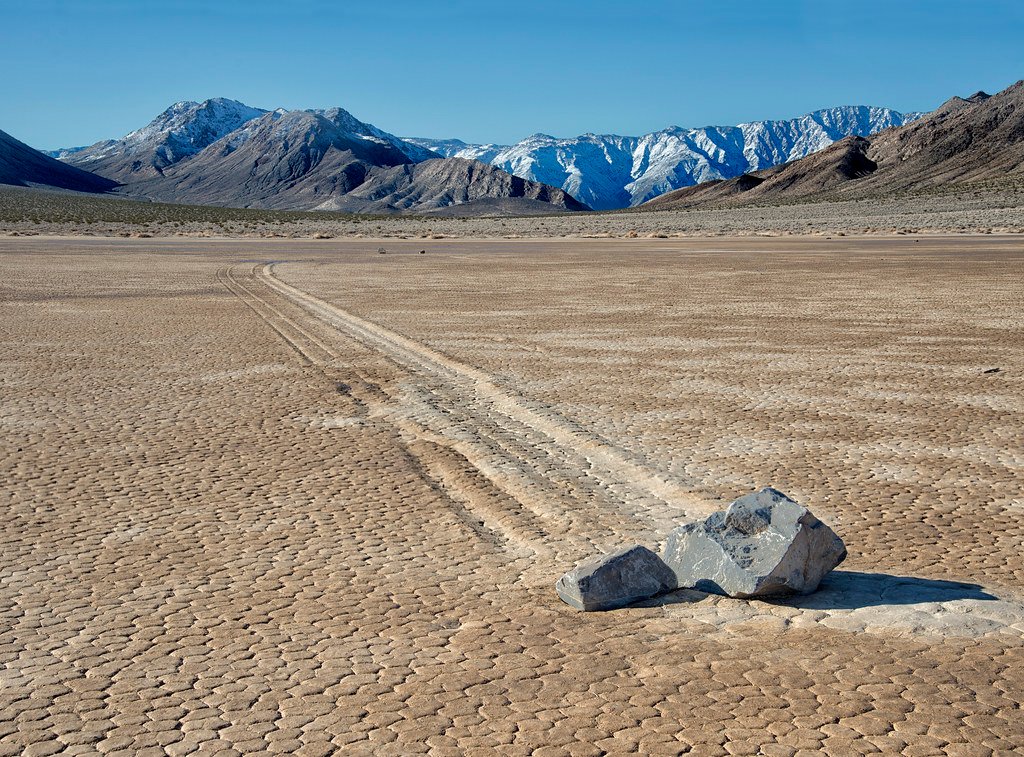
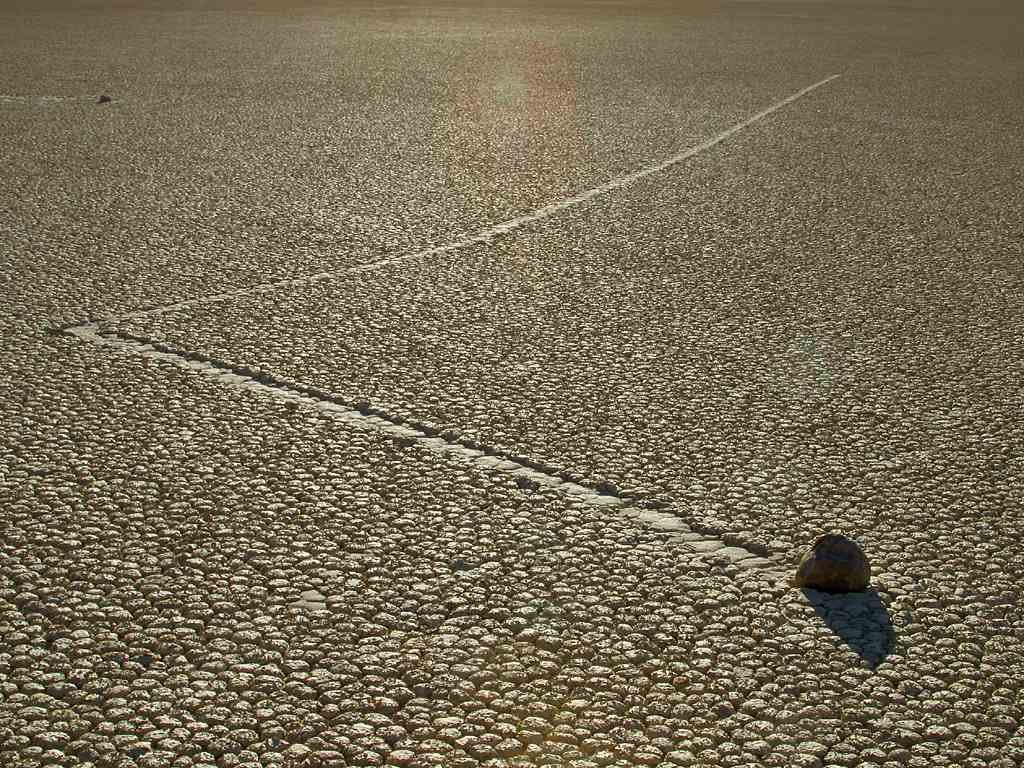
Scattered across Racetrack Playa’s surface lie dozens of boulders, some as large as refrigerators, each trailing a perfectly straight line behind it like a massive snail’s trail frozen in time. These trails can extend for hundreds of yards, creating patterns that seem too organized and deliberate to be natural phenomena. The stones themselves come from the surrounding cliffs, particularly from a formation called the Grandstand, where rockfall deposits fresh boulders onto the playa’s edge. What makes this mystery so captivating is the complete absence of any obvious force capable of moving these massive objects across the flat terrain. For over 80 years, visitors and scientists alike have stood in amazement, unable to explain how these rocks could travel such distances while leaving behind perfectly preserved tracks in the hardened mud.
Early Theories and Wild Speculation
Before scientists cracked the code, theories about the moving stones ranged from the plausible to the absolutely bizarre, reflecting humanity’s desperate need to explain the unexplainable. Some early visitors suggested that underground magnetic fields or seismic activity somehow propelled the rocks across the desert floor. Others proposed that flash floods carried the boulders, despite the obvious problem that water would need to be several feet deep to float such massive stones. The most colorful theories involved everything from alien intervention to underground gas emissions that somehow levitated the rocks. Even serious researchers initially considered possibilities like dust devils, strong winds, or underground ice formation as potential explanations, though none of these theories could adequately account for the precise, straight-line movement patterns observed in the field.
The Role of Death Valley’s Extreme Climate
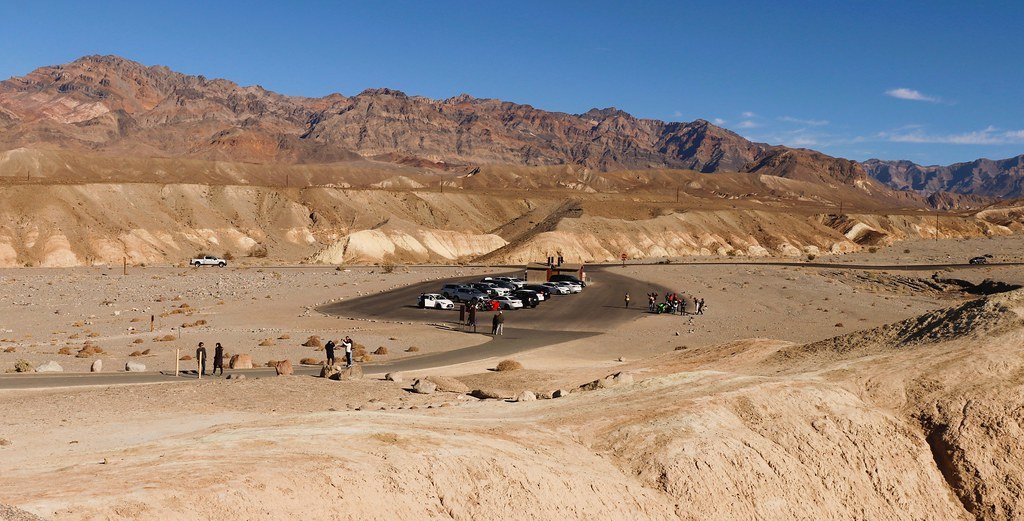
Death Valley holds the world record for the highest air temperature ever reliably recorded at 134°F, creating an environment so harsh that it seems hostile to any form of movement or change. During summer months, the playa’s surface temperature can exceed 180°F, hot enough to seriously burn human skin in seconds. These extreme temperatures cause the mud surface to crack and harden into formations resembling broken pottery, creating a surface so solid that it can support the weight of heavy vehicles. Winter brings a completely different character to the valley, with occasional rainstorms that can dump several inches of water across the playa in a matter of hours. The dramatic temperature swings between seasons, sometimes varying by more than 100 degrees, create unique conditions that exist nowhere else on Earth, setting the stage for the mysterious stone movement phenomenon.
Scientific Expeditions and Failed Attempts

For decades, teams of geologists, physicists, and curious researchers made pilgrimages to Racetrack Playa, armed with instruments and determination to solve this geological puzzle. Early expeditions in the 1940s and 1950s documented the trails and attempted to measure rock movement, but the stones seemed to move only when no one was watching. Scientists tried everything from attaching GPS devices to rocks to setting up time-lapse cameras, but the movement events occurred so infrequently and unpredictably that catching them in action proved nearly impossible. Some researchers spent months camped near the playa, waiting for the perfect conditions that might trigger stone movement, only to return home empty-handed and more confused than ever. The intermittent nature of the phenomenon, combined with the harsh environment and remote location, made systematic study incredibly challenging and frustrating for the scientific community.
The Breakthrough Discovery of 2014
Everything changed in December 2013 when researchers Richard Norris and James Norris finally witnessed the stones in motion, solving an 80-year-old mystery that had baffled scientists and visitors alike. Using specially designed GPS sensors and a weather station, they monitored conditions on the playa continuously for two years before finally capturing the elusive movement event. On the morning of December 20, 2013, the team observed thin sheets of ice forming on the playa’s surface after a rare winter storm filled the basin with about an inch of water. As the sun rose and began warming the ice, it started breaking apart into large floating panels, each several yards wide but only a few millimeters thick. These seemingly fragile ice sheets, driven by light winds, began pushing against the rocks with surprising force, causing them to slowly slide across the slippery mud surface beneath the shallow water.
The Mechanics of Ice Sheet Movement

The actual mechanism behind stone movement turned out to be far more subtle and elegant than anyone had imagined, involving a delicate interplay of ice, water, wind, and mud that occurs only under very specific conditions. When winter storms deposit just the right amount of water on the playa – enough to form a shallow pond but not so much as to completely submerge the rocks – overnight freezing creates thin sheets of “windowpane ice” across the surface. These ice sheets, though only 3-6 millimeters thick, can extend for hundreds of yards and weigh several tons when considered as complete panels. As morning sun begins melting the ice edges and light winds start moving these massive ice rafts, they act like bulldozer blades pushing against any rocks in their path. The combination of the slippery mud surface beneath the shallow water and the steady pressure from moving ice creates the perfect conditions for even very heavy stones to glide across the playa floor.
Why the Movement Happens So Rarely
The rarity of stone movement events stems from the incredibly specific set of conditions required for the phenomenon to occur, making it similar to witnessing a perfect solar eclipse or other uncommon natural events. First, the playa must receive just the right amount of rainfall – enough to create a shallow lake but not so much that the water becomes too deep for ice formation to affect the rocks. The water depth needs to be precisely between one and six inches, a narrow range that occurs only occasionally in this desert environment. Temperature conditions must be perfect too, with nighttime lows dropping below freezing to form ice, followed by sunny mornings that begin the melting process at just the right rate. Wind conditions also play a crucial role, as the breeze must be strong enough to move the ice sheets but not so powerful as to break them apart before they can push the stones. When all these factors align perfectly, which happens perhaps once every few years, the stage is set for the mysterious dance of the sailing stones.
The Speed and Distance of Stone Travel
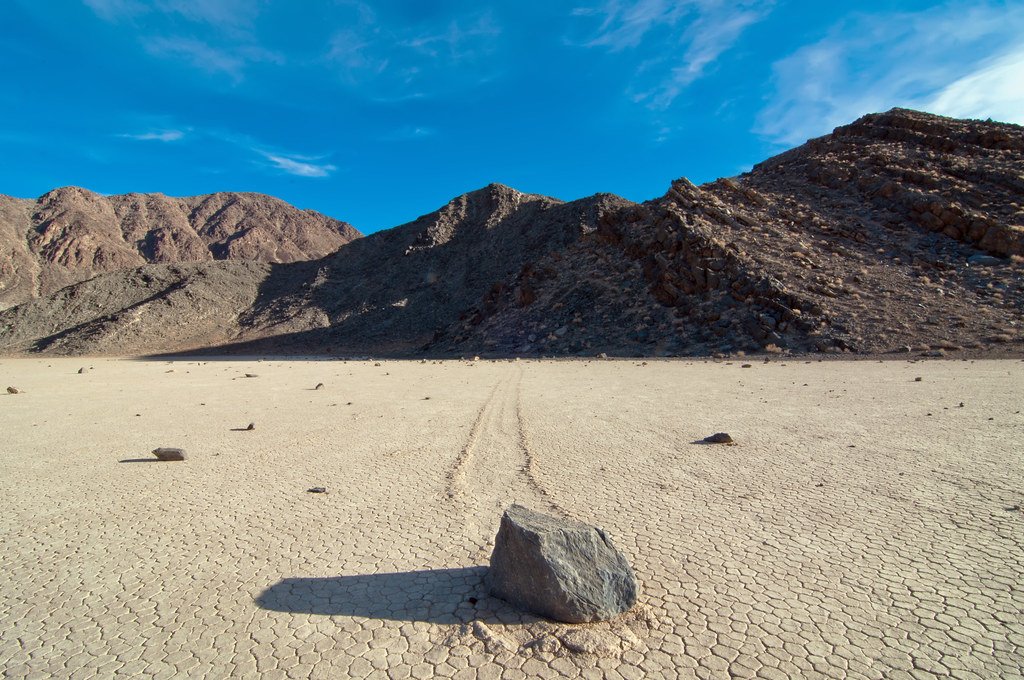
Contrary to popular imagination, the sailing stones don’t race across the desert like runaway boulders in an action movie, but instead move with the stately pace of a slow-motion ballet. During the observed 2013 event, rocks moved at speeds of only a few yards per minute, so slowly that a casual observer might not even notice the movement without careful attention. The largest stones, some weighing several hundred pounds, typically move the shortest distances and at the slowest speeds, while smaller rocks can travel much farther during a single event. A typical movement episode might last several hours, during which time stones can travel anywhere from a few dozen yards to several hundred yards in nearly perfectly straight lines. The trails left behind preserve a record of these journeys for years or even decades, since the hardened mud surface protects the furrows from erosion until the next major flooding event smooths them away.
The Mystery of the Straight-Line Trails
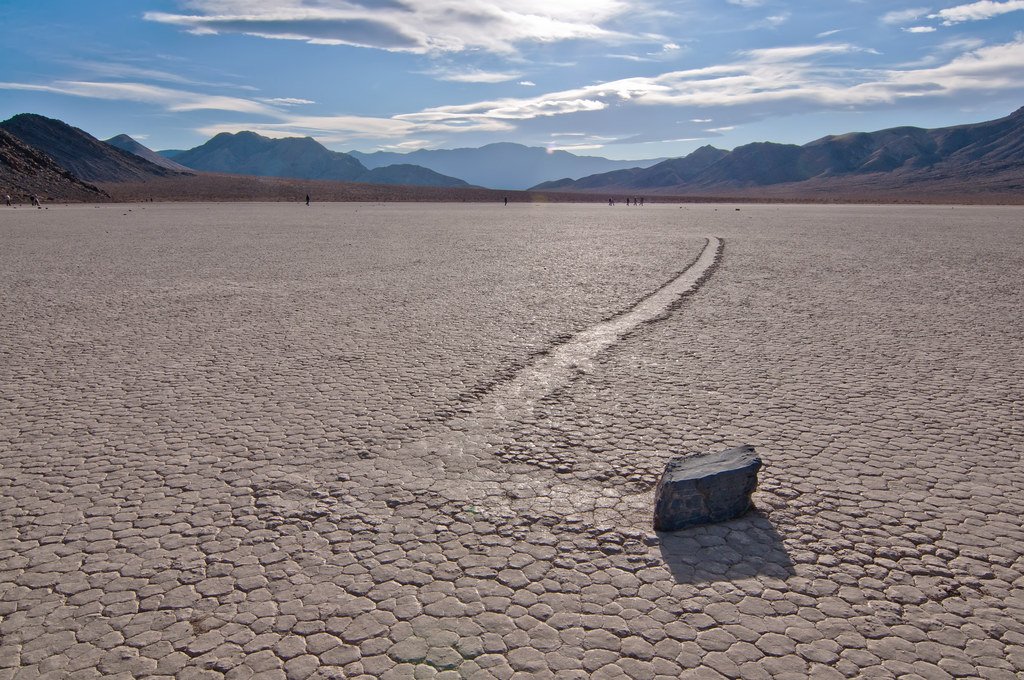
One of the most puzzling aspects of the sailing stones phenomenon is how they manage to travel in such remarkably straight lines across the playa’s surface, creating trails that look almost artificially precise. The answer lies in the physics of ice sheet movement and the incredibly flat terrain of the playa, which together create conditions similar to a massive, natural conveyor belt system. Once an ice sheet begins moving in a particular direction, it tends to maintain that course due to momentum and the consistent wind patterns that drive it across the flat surface. The stones, pushed along by these moving ice panels, have no choice but to follow the same straight-line path as their frozen escorts. Additionally, the perfectly flat nature of the playa means there are no hills, valleys, or other obstacles to deflect the stones from their course, allowing them to maintain their direction for hundreds of yards. The result is the geometric precision that has amazed visitors for generations, creating patterns that seem too orderly to be the work of random natural forces.
Different Types of Rock Movement Patterns
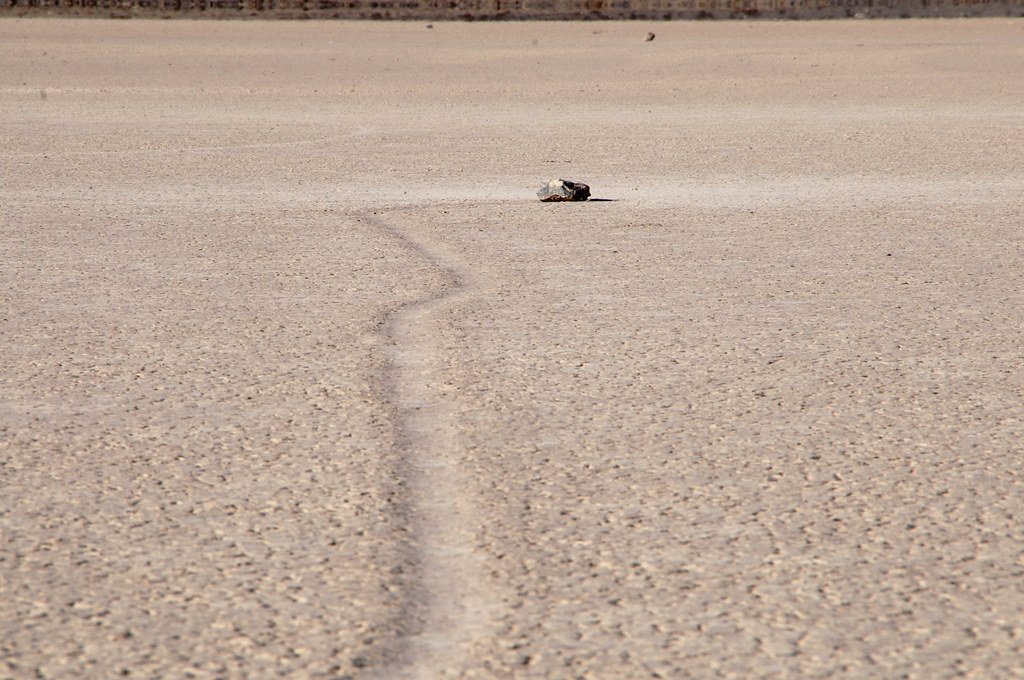
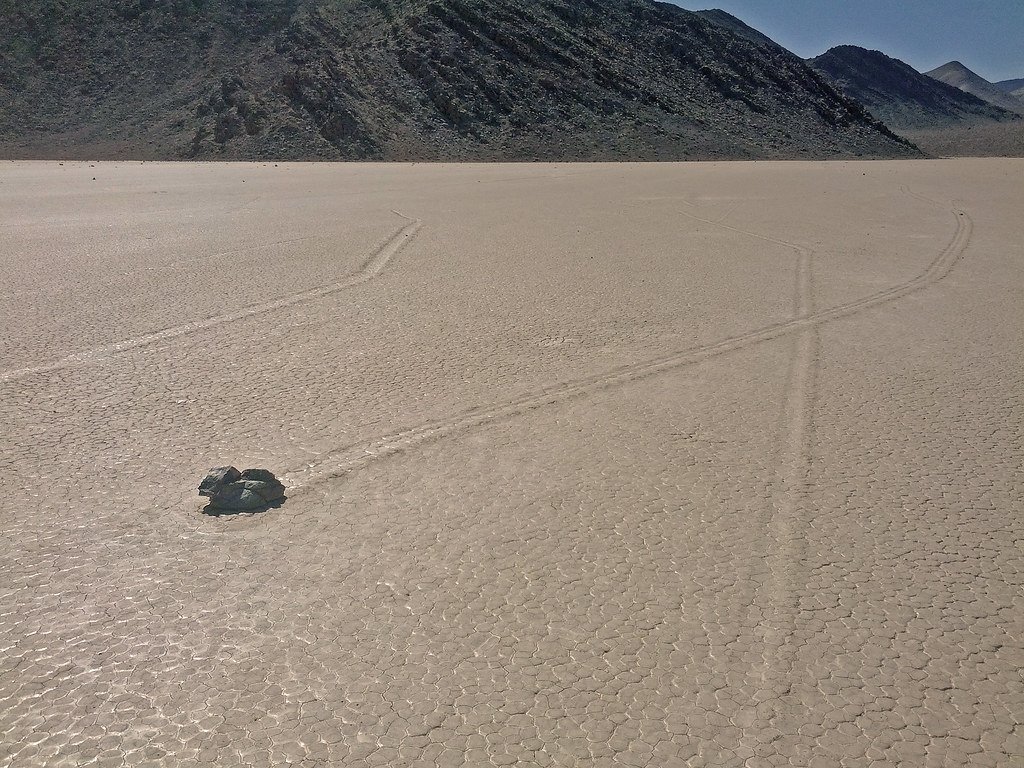
Not all sailing stone trails look the same, and careful observation reveals several distinct types of movement patterns that tell different stories about the conditions during each movement event. Single-stone trails represent the most common pattern, where individual rocks travel alone across the playa in straight lines, leaving behind solitary furrows that can stretch for impressive distances. Parallel trails occur when multiple stones move together during the same event, pushed by the same ice sheet and traveling in the same direction like a convoy of slow-motion vehicles. Some trails show curves or direction changes, indicating that wind patterns shifted during the movement event or that the ice sheet encountered obstacles that altered its course. Occasionally, researchers find intersecting trails where stones traveling during different events crossed paths, creating a complex web of tracks that reveals the playa’s long history of rock movement. The most unusual patterns include loops and zigzags, which occur when ice sheets break apart and reform during a single movement event, causing stones to change direction multiple times during their journey.
The Grandstand: Source of the Sailing Stones
Rising from the southern end of Racetrack Playa like a massive stone island, the Grandstand represents the primary source of new sailing stones that continually replenish the playa’s population of wandering rocks. This dark, imposing rock outcrop consists of ancient volcanic material that resists erosion much better than the surrounding sedimentary formations, creating a natural quarry where fresh boulders regularly break away and tumble onto the playa floor. Freeze-thaw cycles, thermal expansion, and occasional earthquakes cause chunks of rock to split off from the Grandstand’s steep faces, providing a steady supply of new stones ready to begin their mysterious journeys across the desert floor. The size and composition of rocks from the Grandstand vary considerably, ranging from small cobbles that can travel great distances to massive boulders that move only short distances during the most powerful movement events. This natural conveyor belt system ensures that even as old trails fade away and stones reach the far edges of the playa, new participants arrive to continue the ancient dance across Death Valley’s most enigmatic landscape.
Technology That Solved the Mystery

The breakthrough in understanding sailing stones came through the clever application of modern technology, specifically custom-built GPS tracking devices that could survive Death Valley’s brutal conditions while providing precise location data. Researchers designed special weatherproof GPS units powered by lithium batteries that could operate for years in extreme temperatures, transmitting location data every few minutes to track even the smallest movements. High-resolution time-lapse photography played a crucial role too, capturing the subtle formation and movement of ice sheets that previous visitors had missed entirely. Weather monitoring stations recorded the exact temperature, humidity, wind speed, and other conditions that preceded movement events, allowing scientists to identify the precise combination of factors required for stone travel. Underwater cameras and sensors also proved invaluable, revealing how the thin ice sheets interacted with rocks beneath the shallow water in ways that had never been observed before. This technological approach demonstrated how modern instruments could solve mysteries that had persisted for nearly a century, simply by being in the right place at the right time with the right tools.
Other Playa Phenomena Around the World
While Racetrack Playa represents the most famous example of sailing stones, similar phenomena occur in other dried lake beds around the world, each with their own unique characteristics and local explanations. Nevada’s Bonnie Claire Playa exhibits rock movement patterns remarkably similar to those in Death Valley, suggesting that the ice sheet mechanism operates in multiple desert environments across the American Southwest. In some locations, researchers have documented stone movement caused by entirely different mechanisms, including mud flows during flash floods and expansion of clay-rich sediments during wet periods. The Alvord Desert in Oregon shows evidence of rock movement, though the stones there tend to be smaller and the trails less pronounced than those found in Death Valley. These global examples demonstrate that the sailing stone phenomenon represents a broader category of geological processes rather than a unique quirk of Death Valley’s environment. Studying these various locations helps scientists understand how different climate conditions, rock types, and surface materials influence the movement patterns and frequency of stone travel events.
The Human Fascination with Moving Stones
The sailing stones of Death Valley have captured human imagination in ways that few geological phenomena can match, inspiring everything from scientific expeditions to urban legends and artistic interpretations. Part of this fascination stems from the apparent violation of our basic understanding of how heavy objects behave – rocks simply shouldn’t move by themselves across flat ground, yet here they obviously do. The mystery also appeals to our detective instincts, presenting a clear puzzle with visible evidence that begs for explanation and solution. For many visitors, seeing the trails represents a profound moment of connection with natural forces that operate on timescales and under conditions far removed from everyday human experience. The phenomenon has inspired countless photographs, paintings, and written descriptions, as people attempt to capture and share the wonder of this geological mystery. Even now that scientists have solved the puzzle, the sailing stones continue to fascinate visitors who appreciate both the elegant simplicity of the explanation and the incredible rarity of witnessing the phenomenon in action.
Conservation and Protection of Racetrack Playa
As part of Death Valley National Park, Racetrack Playa enjoys federal protection that helps preserve this unique geological laboratory for future generations of scientists and visitors. Park regulations prohibit walking on the playa’s surface during wet conditions, when footprints would remain permanently preserved in the soft mud, potentially interfering with the natural stone movement process. Visitors are also prohibited from moving or disturbing the stones themselves, ensuring that the trails remain authentic records of natural phenomena rather than human interference. The remote location of the playa, accessible only by a rough dirt road that requires high-clearance vehicles, provides natural protection from excessive tourism that might damage the delicate surface. Climate change poses potential long-term threats to the phenomenon, as changing precipitation patterns could alter the frequency and intensity of the rare weather conditions required for stone movement. Park managers work carefully to balance public access and scientific research with the need to protect this irreplaceable natural wonder, recognizing that some mysteries are worth preserving even after they’ve been solved.
Visiting the Racetrack Playa Today
Adventurous travelers can still visit Racetrack Playa to witness the sailing stone trails firsthand, though the journey requires careful planning and appropriate equipment for desert travel. The road to the playa consists of 27 miles of rough, rocky track that can take two hours to navigate even with a high-clearance vehicle, making this one of Death Valley’s most challenging destinations to reach. Visitors should bring plenty of water, extra food, emergency supplies, and ideally travel with at least one other vehicle in case of breakdowns in this remote location. The best time to visit is during cooler months from October through April, when temperatures are more manageable and there’s a slight chance of witnessing the rare conditions that might trigger stone movement. Early morning and late afternoon provide the most dramatic lighting for photography, when the low sun angle emphasizes the subtle depressions of the stone trails against the playa’s flat surface. Park rangers recommend checking current road conditions before attempting the journey, as flash floods can make the access road impassable for days or weeks at a time.
The Lasting Impact on Earth Science
The resolution of the sailing stones mystery has influenced earth science research far beyond Death Valley, demonstrating how rare, episodic events can create persistent geological features that seem to require constant forces to maintain. This understanding has applications in interpreting similar trail-like features found in ancient rock formations, on other planets, and in underwater environments where comparable processes might operate. The research methodology developed for studying the sailing stones – combining patient long-term monitoring with advanced sensor technology – has become a model for investigating other infrequent geological phenomena that resist easy observation. Scientists now recognize that many seemingly mysterious geological features might result from rare combinations of environmental conditions rather than constant, obvious processes. The sailing stones study also highlighted the importance of considering multiple physical processes working together, rather than searching for single explanations for complex natural phenomena.
The mystery that puzzled scientists for eight decades turned out to have an elegantly simple explanation, reminding us that nature’s most spectacular tricks often hide in plain sight, waiting for the right moment and the right tools to reveal their secrets. What started as an impossible puzzle became a testament to the power of patient observation and scientific persistence in understanding our planet’s most extraordinary phenomena.