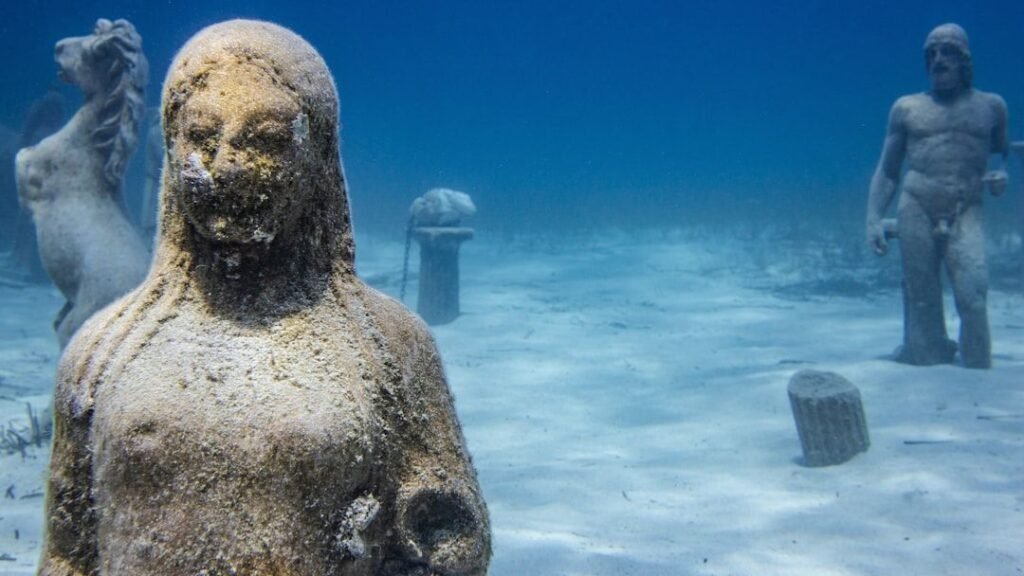

Somewhere beneath the surface of every ocean, sea, and lake on this planet, the past is waiting. Streets that once buzzed with merchants. Temples where thousands prayed. Harbors where ancient ships loaded and unloaded their cargo under a blazing sun. All of it now silent, cold, and draped in silt. It sounds like something out of a fantasy novel, but it isn’t.
Many coastal communities were swallowed up by the sea in the ancient world, their streets, homes, and temples all submerged under relentless tides. Underwater archaeology, a fascinating branch of the discipline, has unlocked secrets from cities long lost to floods, earthquakes, and rising seas. The stories you’re about to read are not myths. They are history written in submerged stone, and they are far more thrilling than anything Atlantis ever promised. Let’s dive in.
Thonis-Heracleion, Egypt: The Sunken Gateway to a Civilization
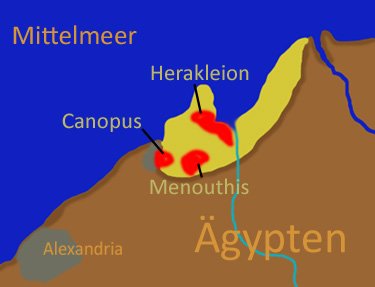
Honestly, if there is one underwater city that deserves to be called the discovery of the century, this might be it. For more than 2,000 years, a legendary Egyptian city lay buried beneath both sand and sea at the mouth of the Nile River. The Greeks named the city Heracleion, after the mythical hero Herakles, and the Egyptians called it Thonis. During the Ptolemaic Dynasty, Thonis-Heracleion was the port of entry for all Greek ships traveling to Egypt and home to the magnificent temple of Amun, where the Ptolemaic pharaohs received their divine authority.
Archaeologist Franck Goddio solved a historic enigma that had puzzled Egyptologists over the years: the archaeological material revealed that Heracleion and Thonis were in fact one and the same city with two names, Heracleion being the name for the Greeks and Thonis for the Egyptians. The finds at the site are simply breathtaking. Countless incredible artifacts have been found, including colossal statues, gold jewelry, Greek weapons, and bronze and ceramic objects. In more recent digs, researchers discovered the remains of a sanctuary dedicated to the Greek goddess Aphrodite, as well as a temple to the god Amun, along with gold jewellery, silver artefacts, ceramics, and bronzes imported from Greece.
Pavlopetri, Greece: The World’s Oldest Planned Underwater City
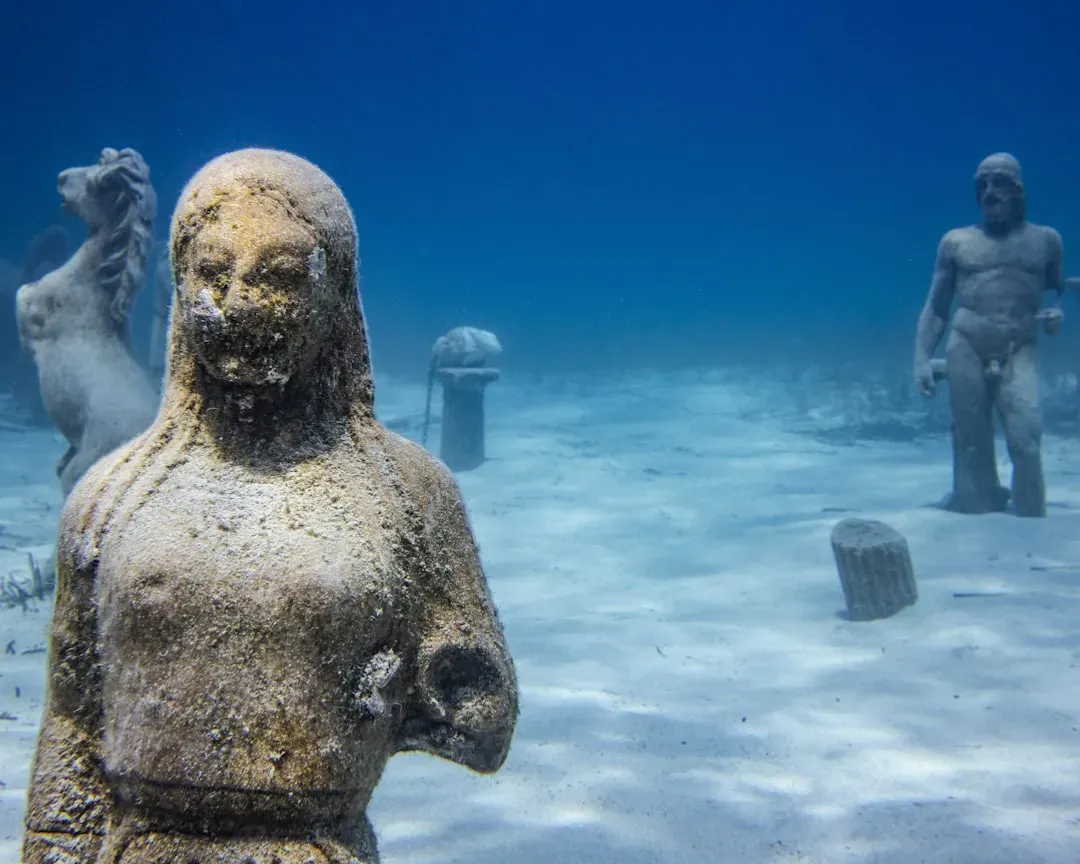
You’d think that the oldest known planned city found beneath the sea would be famous everywhere. Yet somehow, Pavlopetri flies under the radar, and I think that’s a genuine shame. In the clear, coastal waters off the Peloponnese region of southern Greece lie the remains of what some archaeologists believe is the oldest submerged city in the world. The Bronze Age site, called Pavlopetri, was occupied between 2800 and 1200 B.C., centuries before the Classical Greek period. Primitive settlements like Atlit-Yam may date to an earlier period, but Pavlopetri appears to be the oldest planned city found underwater.
Around 5,000 years old, Pavlopetri is one of the oldest known submerged cities, with streets, buildings, and tombs still preserved beneath the sea. The prehistoric city covered 90,000 square metres and featured a complex water management system, with canals and drains, as well as a cemetery. As for how it sank, the science is still debated. Three theories attempt to explain how this happened: one suggests a gradual rise in the sea level, another a sinking of the land, and a third that a combination of earthquake and tsunami caused the city’s disappearance. Think of it as the Greek Pompeii, frozen not in ash but in seawater.
Port Royal, Jamaica: The Wickedest City That the Sea Swallowed
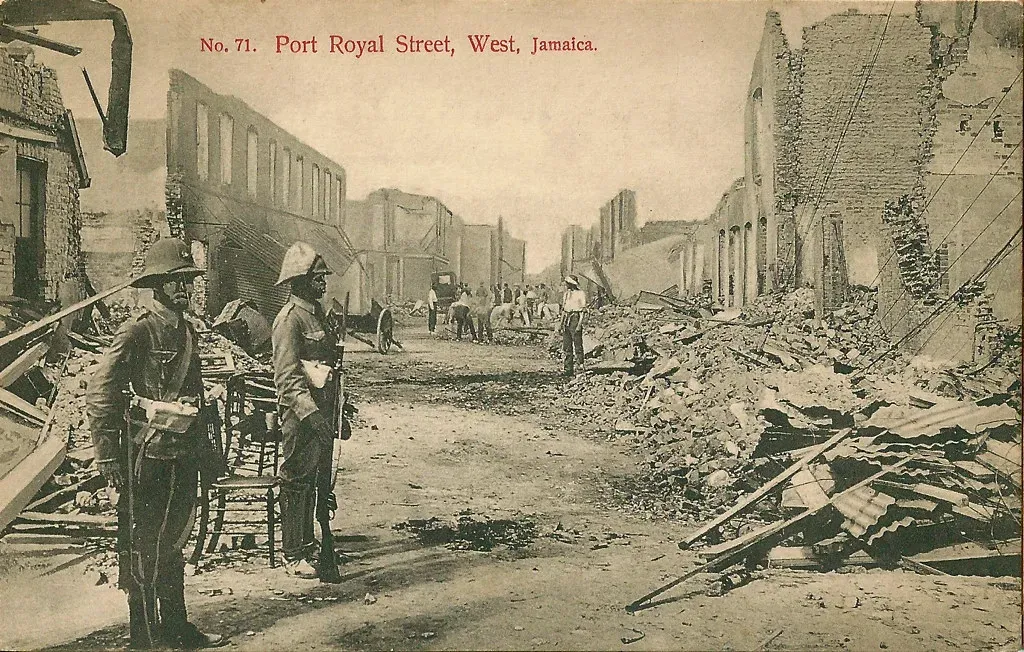
Here’s the thing about Port Royal. Before it sank, it was considered the most sinful, lawless, pirate-infested city in the entire Western Hemisphere. Some historians called it the “Sodom of the New World,” and given what we know about it, that label is not entirely unfair. The city stood out for its wealth and its prominence as a key center of trade and piracy in the Caribbean. In 1692, a devastating earthquake caused two-thirds of the city to sink into the sea. Subsequent fires and hurricanes thwarted any attempts at full recovery.
Excavations have revealed that beyond its many taverns, Port Royal also featured workshops, homes, and warehouses. One eerie detail that should send chills down your spine: a pocket watch uncovered from the seabed in the 1960s confirmed the date and time of the earthquake as 11:43am on 7 June, and many of the city’s mysteries are still shrouded by the sandy seabed. Although Port Royal persisted as a British naval base and secondary port, it never regained its former status as a thriving hub of commerce and piracy. Today, it survives as a small fishing village in Jamaica. Quite a fall from grace, wouldn’t you say?
Baiae, Italy: Rome’s Hedonistic Playground, Now Underwater
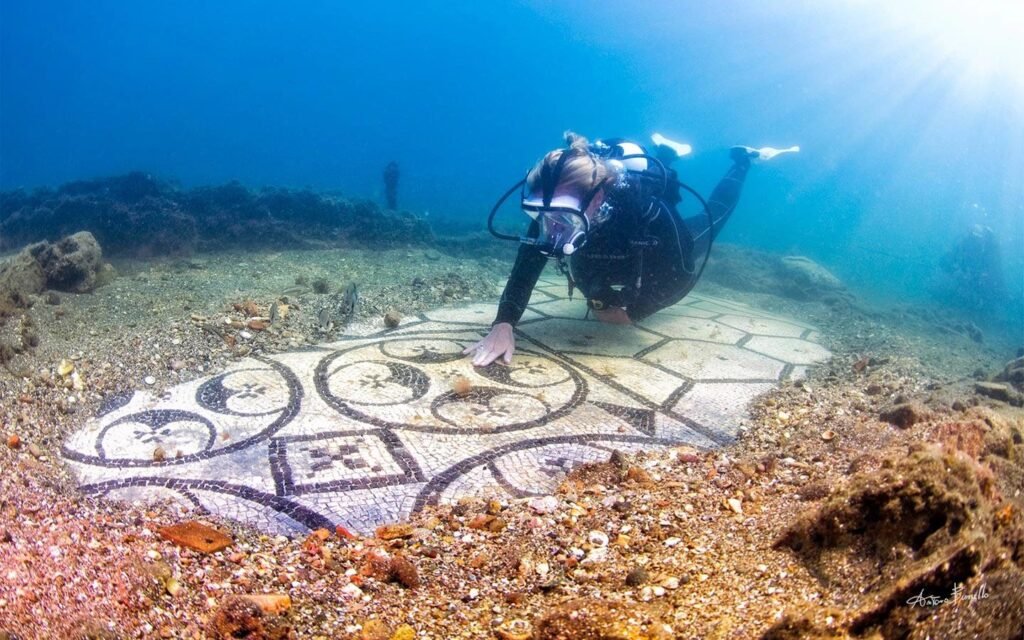
Forget Capri. Forget Pompeii. Among the ancient Roman elite, there was one destination that stood above all others for sheer indulgence, and that was Baiae. Baiae is not far from Mount Vesuvius, and the entire region is known as the Phlegraean Fields, a highly active hydrothermal zone within a collapsed volcanic caldera. Ancient Romans flocked to Baiae for its relaxing thermal baths and constructed lavish villas to host hedonistic parties and conceal illicit love affairs.
Unlike Port Royal, Baiae wasn’t struck down by a devastating earthquake, but was slowly swallowed up by the sea through a geological process called bradyseism, in which the land above a hydrothermal zone periodically rises or subsides. Two thousand years ago, the ornately decorated villas and baths of Baiae were at sea level, but now they’re 20 to 30 feet beneath the Gulf of Pozzuoli. The city has not given up all its secrets, either. In August 2025, archaeologists announced the discovery of a submerged Roman bathhouse, and together these finds show Baiae isn’t just a known site, it’s still yielding new, headline-grade urban discoveries. You can actually dive here yourself and swim through marble-floored halls that once hosted emperors.
Dwarka, India: Where Myth and Archaeology Collide
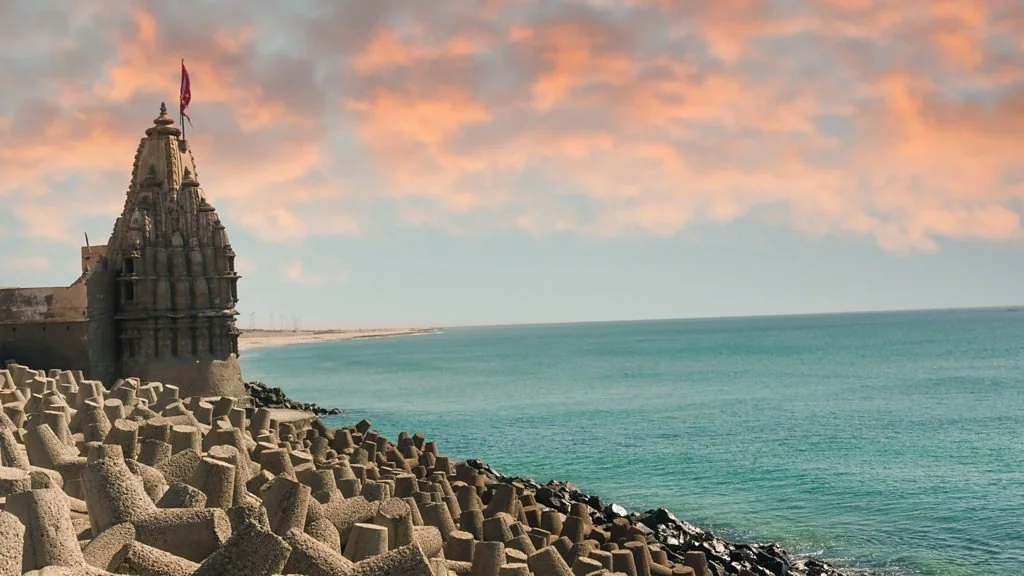
Few cities on this list straddle the line between mythology and verifiable history quite so dramatically as Dwarka. The ancient Indian city of Dwarka is known in Hindu culture to have been the great and beautiful city of Krishna. The Hindu writings say that when Krishna left the Earth to join the spiritual world, the age of Kali began and Dwarka and its inhabitants were submerged by the sea. For centuries, historians assumed this was religious storytelling. Then the divers went in.
Excavations done at two sites on the seaward side of Dwarka brought to light submerged settlements, a large stone-built jetty, and triangular stone anchors with three holes. The settlements are in the form of exterior and interior walls, and fort bastions. The discoveries don’t stop there. Beyond its mythological allure, Dwarka once thrived as a bustling trade hub. Archaeological studies have revealed that this ancient city was not only a center of religion and culture but also a significant gateway for commerce with West Asia. Marine deposits and various artifacts hint at a sophisticated urban network that linked this coastal city to far-flung civilizations. In early 2026, the Archaeological Survey of India announced a renewed program of deeper land and underwater exploration at the site, with upcoming investigations focusing on mapped underwater zones near Bet Dwarka and the Gomti Creek, where structural anomalies and stone features have been observed.
Atlit-Yam, Israel: A Neolithic Village Frozen in Deep Time
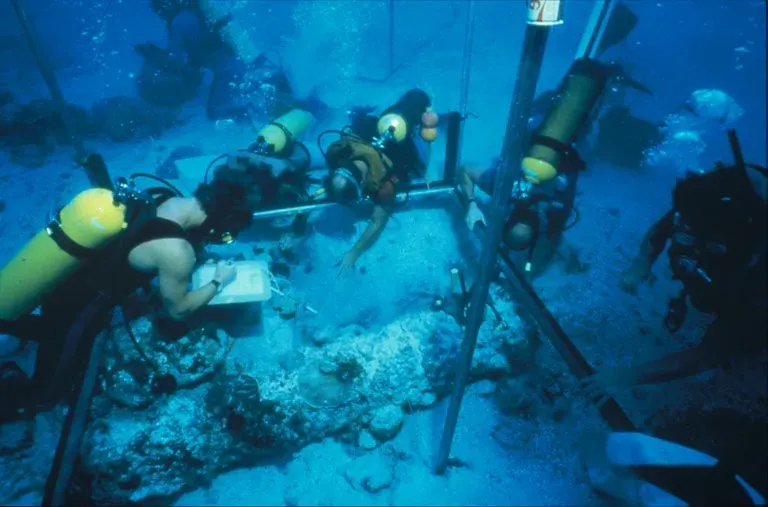
If you want to feel the full weight of deep human history pressing down on you, Atlit-Yam is your place. This isn’t just old. It is almost incomprehensibly old. Discovered in 1984 in the shallow coastal waters near Haifa, Israel, Atlit-Yam is a Neolithic site that was first settled around 6900 B.C., making it by far the oldest known human settlement found underwater. The inhabitants of Atlit-Yam were farmers and fishermen who occupied a fertile stretch of land left behind by the receding Mediterranean Sea.
Archaeologists have recovered thousands of flint artifacts at Atlit-Yam, including sickle blades, arrowheads, and knives. One of the most intriguing discoveries at Atlit-Yam was a circle of large, upright stones that some archaeologists compare to Stonehenge. The stones surround a natural spring and may have served a ceremonial purpose as an open-air sanctuary. It’s hard to say for sure how the village was ultimately lost, but Atlit-Yam was abandoned roughly 600 years after it was first settled, and the encroaching Mediterranean Sea eventually swallowed the village, burying it under 30 feet of water. Standing before something nearly 9,000 years old has a way of making you feel very small.
The Yonaguni Monument, Japan: Nature, or a Lost Civilization?
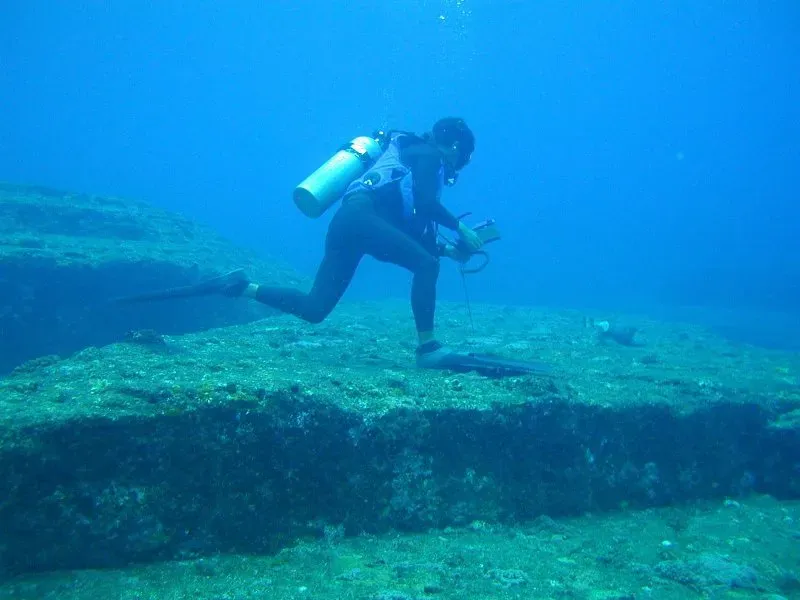
I know it sounds crazy, but this one genuinely doesn’t have a definitive answer yet. Called “Japan’s Atlantis,” the Yonaguni Monument has provoked immense debate since its discovery in the 1980s. Theories of its origin range from a completely natural formation to a man-made structure built by an ancient civilization, but the true identity of the submerged oddity remains unsolved. In 1986, while seeking to observe the sharks, Kihachiro Aratake, a director of the Yonaguni-Cho Tourism Association, noticed some seabed formations resembling architectural structures.
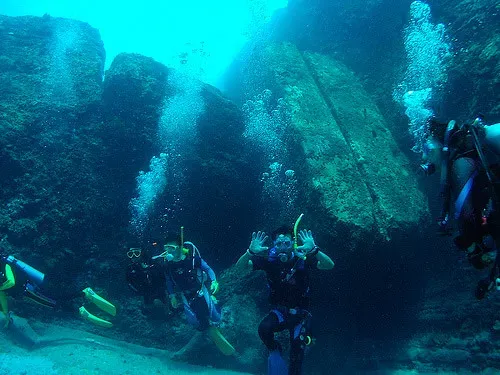
The rectangular monument, which was first detected by a scuba diver, is more than 165 feet long and some 65 feet wide. There are what looks like a couple of pillars, a stone column, a wall that is 33 feet wide, a road, and even a star-shaped platform. The debate is genuinely fascinating. Marine geologist Masaaki Kimura claims that the formations are man-made stepped monoliths, though these claims have been described as pseudoarchaeological by some. Still, the Yonaguni Monument has never been recognized by the Japanese Agency for Cultural Affairs as an important historical artifact, and more research still needs to be done to determine what its true origins are, meaning that to this day, no one can agree on what the Yonaguni Monument actually is.
Cleopatra’s Sunken Palace, Egypt: A Queen’s Royal Realm Under the Sea
Perhaps no underwater discovery carries quite the same dramatic weight as finding the actual palace of Cleopatra, the last pharaoh of ancient Egypt. In Alexandria’s murky eastern harbor, off the coast of Egypt, lies the sunken palace of Cleopatra. Lost for 1,600 years, it was discovered by underwater archaeologist Franck Goddio in 1996. The Egyptian queen’s royal palace was built on the small, ancient submerged island of Antirhodos in the Mediterranean. The island sank, along with the palace, in the fourth century AD as the coastal city of Alexandria was hit by an earthquake and then a tsunami.
The palace was destroyed and scattered under about ten meters of water. Cleopatra’s palace was said to be very opulent and surrounded by sphinxes and goddesses. Some 20,000 artifacts have been discovered in the bay where it once stood, including statues, jewelry, and pottery. Think about that for a moment. Twenty thousand individual objects from one of history’s most legendary rulers, sitting silently on the seafloor for sixteen centuries before anyone thought to look. Dive beneath the waves off Alexandria’s Eastern Harbor and you’ll find Cleopatra’s lost world, including her palace, temple structures, sphinxes, and even remnants of the Lighthouse of Alexandria, one of the Seven Wonders of the Ancient World. That, by any measure, is extraordinary.
Conclusion: The Deep Sea Is History’s Greatest Archive
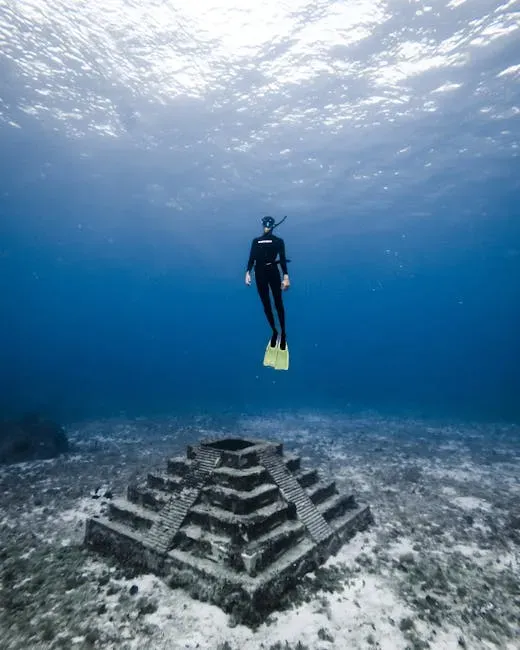
Beneath the calm surfaces of lakes, rivers, and oceans lies a hidden world, the remains of ancient civilizations swallowed by water. These submerged ruins, silent for centuries, are time capsules offering rare glimpses into the past. What these eight cities share is not just their watery fate, but the way they challenge our comfortable assumptions about history. Every time we think we’ve mapped the full picture of human civilization, the ocean reveals another chapter we didn’t know existed.
With the help of AI, robotics, and satellite imaging, researchers can now detect submerged sites even from space. Virtual reality and 3D modeling allow the public to explore these ancient underwater worlds without disturbing them physically. The technology is catching up fast to the mystery. History isn’t just buried underground. It’s hidden beneath the waves, waiting to be rediscovered. The deeper question isn’t how these cities ended up underwater. The real question is how many more are still down there, waiting silently for the rest of us to find them. What do you think is still out there? Share your thoughts in the comments below.