We grow up treating gravity like background software: always running, rarely questioned. Yet the deeper physicists dig into how gravity really works, the stranger it becomes, colliding with quantum rules, warping time, and hinting at hidden parts of the universe. This is not the tidy, apple-falling story most of us learned in school; it is a web of paradoxes and radical ideas that scientists are still struggling to untangle. In what follows, we will walk through eight genuinely surprising facts about gravity that challenge common sense and rewrite how you picture reality. Some of these ideas are well tested, some are still hotly debated, but all of them show that gravity is far weirder – and more wondrous – than its everyday pull on your feet suggests.
1. Gravity Is Not Really a Force in Einstein’s Universe
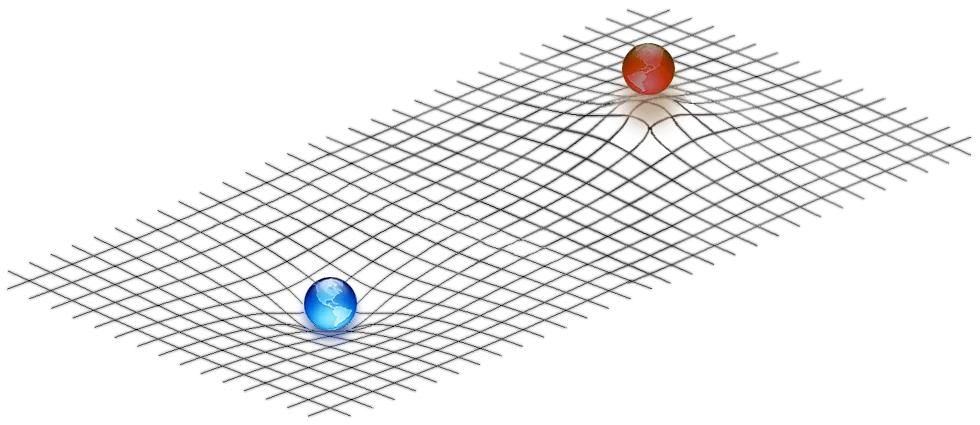
It sounds like a trick question, but in modern physics gravity is no longer treated as a push or a pull in the traditional sense. Isaac Newton’s picture of gravity as a force acting at a distance worked stunningly well for centuries, yet it hid an uncomfortable detail: it seemed to act instantly, across empty space, without any clear carrier. In the early twentieth century, Albert Einstein replaced this with a more mind-bending idea, arguing that mass and energy literally curve the fabric of space and time, and objects simply follow the straightest possible paths in that curved geometry. From that perspective, a planet orbiting a star is more like a marble rolling along a warped rubber sheet than a rock being yanked by an invisible hand. The astonishing part is that this abstract-sounding picture makes concrete predictions – such as how much starlight should bend around the Sun – that have been confirmed again and again.
This shift from “force” to “geometry” means that when you feel your weight pressing into the floor, you are really feeling the floor pushing back as it prevents you from following your natural free-fall path through curved spacetime. Stand on Earth, and spacetime wants your body to fall toward the planet’s center; the solid ground interrupts that motion, and the resulting resistance is what we label as weight. In that sense, astronauts floating in the International Space Station are not weightless because gravity has vanished – they are constantly falling around Earth, following that free path with nothing to stop them. Gravity, in Einstein’s world, is less an external agent and more the stage on which every motion plays out.
2. Gravity Literally Slows Time – Even for You Right Now
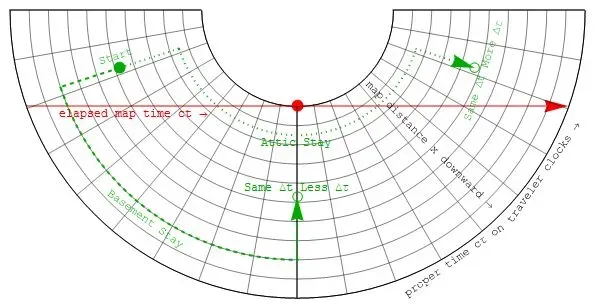
One of the most unsettling predictions of Einstein’s theory is that time itself runs differently depending on how deep you sit in a gravitational field. Closer to a massive object, clocks tick more slowly compared with those farther away; climb a mountain or ride an airplane, and your personal seconds whisper by ever so slightly faster than the ones on the ground. This is not just a mathematical curiosity or a sci-fi plot device, but a measured fact confirmed by experiments using ultra-precise atomic clocks separated by only a few feet in height. The effect is tiny at human scales, yet it becomes dramatic near extreme objects like neutron stars and black holes, where time can be stretched until it almost seems to freeze from an outside perspective. It means that gravity is not just about where things move, but how fast their futures unfold.
The weirdest part is that modern technology quietly depends on this mind-bending twist in time. The satellites that power GPS systems orbit Earth where gravity is slightly weaker, so their onboard clocks run a bit faster than clocks on the ground. Engineers have to correct for both special relativity (because the satellites are moving quickly) and general relativity (because they are higher in the gravitational field) to keep positioning accurate to within meters. Without building relativistic time distortion into everyday navigation, your phone’s map would quickly drift and become useless. Every time your ride-share arrives in front of the right building, it is because someone took seriously the fact that gravity bends not only space, but time itself.
3. Gravity Travels at the Speed of Light, Not Instantly
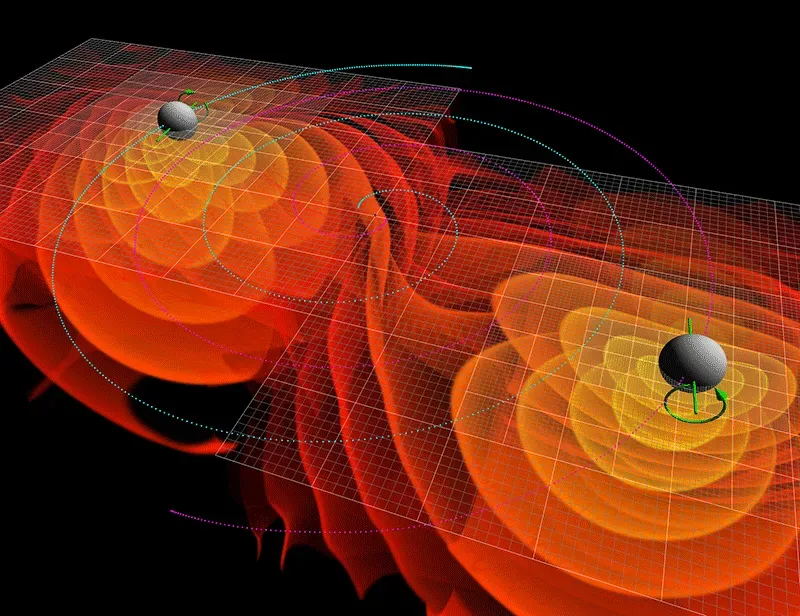
For a long time, it was natural to assume gravity worked like an invisible string: move one object, and everything else feels it right away. That intuition clashes with a basic principle of modern physics, which says that no information or influence can travel faster than light without shredding cause and effect. Einstein’s relativity fixes this by turning changes in gravity into ripples in spacetime that move outward at light speed, much like waves spreading across a pond after a stone is thrown. If the Sun could magically disappear, Earth would not be flung off its orbit immediately; for about eight minutes, we would still orbit the empty point where its gravity was, until the wave of changed spacetime reached us. This finite speed of gravity keeps the universe’s logic intact, ensuring that effects never arrive before their causes.
What was once a theoretical requirement has now been confirmed in one of the most spectacular ways modern science has to offer. In 2015, observatories in the United States detected gravitational waves from the collision of two black holes, and since then multiple such detections have tied the timing of these spacetime ripples to signals of light and radiation from distant cosmic events. Measurements show that gravitational waves race through the cosmos at essentially the same speed as light, just as relativity predicts. The fact that we can now “listen” to the universe through these faint tremors is a testament to how far the understanding of gravity has come, from instant, mysterious action to finite, measurable ripples in the very structure of reality.
4. Gravity Can Be Shockingly Weak – and Yet Impossible to Ignore
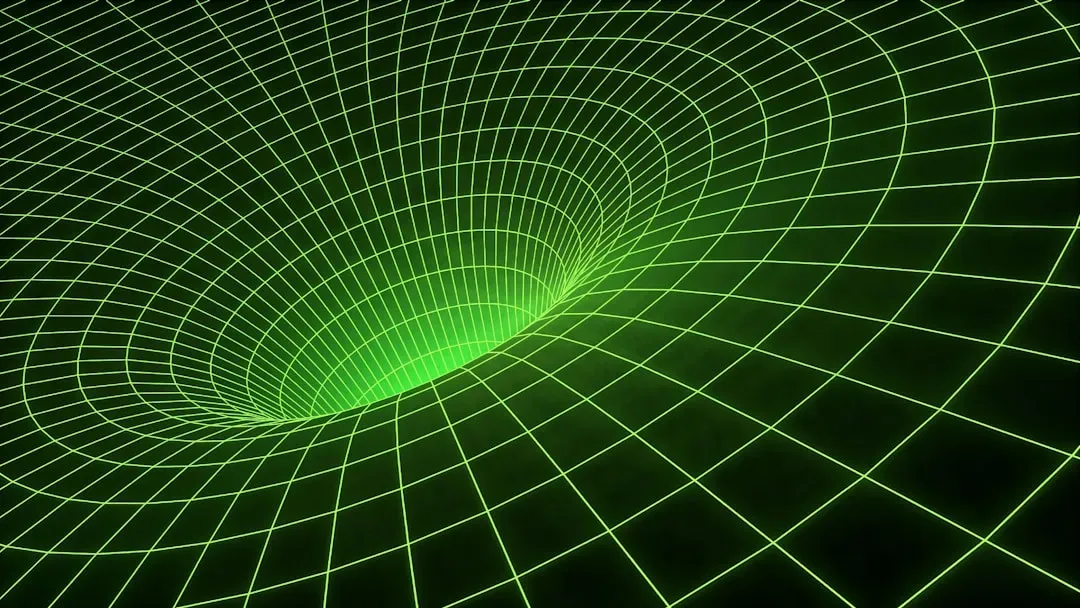
At first glance, gravity seems powerful: it keeps your feet on the ground and anchors entire planets in orbit. But line it up against the other fundamental interactions of nature, and gravity is embarrassingly feeble. A small refrigerator magnet can lift a paperclip against the pull of the entire Earth, meaning the electromagnetic interaction in that tiny magnet is overpowering the gravitational tug of a planet. When physicists compare these forces in their equations, gravity comes out weaker by an almost absurd factor, a chasm so large that it has become one of the nagging puzzles of modern theory. Why should the interaction that shapes galaxies be so timid at the scale of atoms and humans?
One answer is sheer persistence: gravity never turns off, is always attractive, and applies to everything that has mass or energy, however small. Electromagnetic forces can cancel out because positive and negative charges can balance each other, but there is no known negative mass to neutralize gravity in the same way. Over huge distances and across enormous amounts of matter, this gentle, one-directional pull adds up until it dominates the behavior of stars, galaxies, and the cosmic web. The weakness of gravity at small scales has inspired speculative ideas, from extra hidden dimensions where gravity can leak, to new particles that might modify its behavior, but so far experiments have found only its stubborn, consistent gentleness. That contrast – between microscopic weakness and cosmic dominance – is one of gravity’s quietest paradoxes.
5. Black Holes Turn Gravity into a Paradox Machine
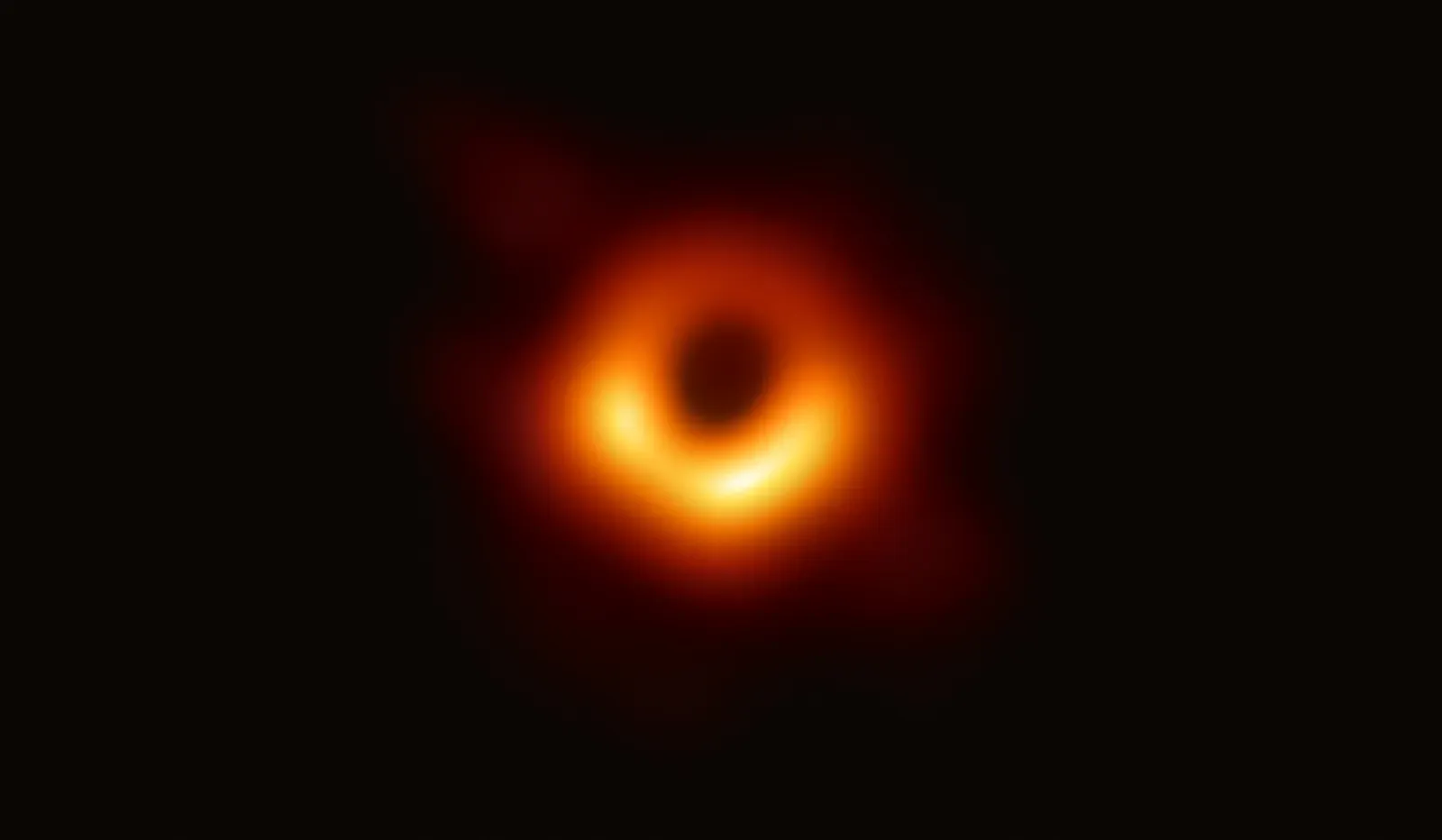
Black holes are where gravity goes to the extremes and the everyday rules of intuition fail. Pack enough mass into a small enough volume and spacetime folds so dramatically that not even light can climb back out, leaving behind a region separated from the rest of the universe by an event horizon. From the outside, you can detect a black hole’s presence through the swirl of hot gas and the dance of nearby stars, but you can never see inside that one-way boundary. Classical general relativity predicts that at the core of a black hole lies a singularity where density becomes infinite and the known laws of physics break down. That kind of infinity is usually a sign that the theory has hit its limit, not that nature literally turns quantities up to impossible values.
Layer quantum mechanics on top of this, and the puzzles multiply. When quantum fields near the horizon are taken into account, black holes are expected to emit a faint glow of radiation and slowly evaporate over unimaginable timescales, raising a disturbing question about whether information that falls in is lost forever. If it is, that would seem to violate one of the central tenets of quantum theory, which insists that information is never destroyed, only transformed. The resulting “information paradox” has become one of the most famous riddles in theoretical physics, sparking ideas that range from holographic encodings on the horizon to exotic quantum structures that replace the classical singularity. In a very real sense, black holes act like laboratories built by nature, forcing our best theories of gravity and quantum physics into a head-on collision.
6. Quantum Gravity: Where Spacetime Itself May Be Pixelated
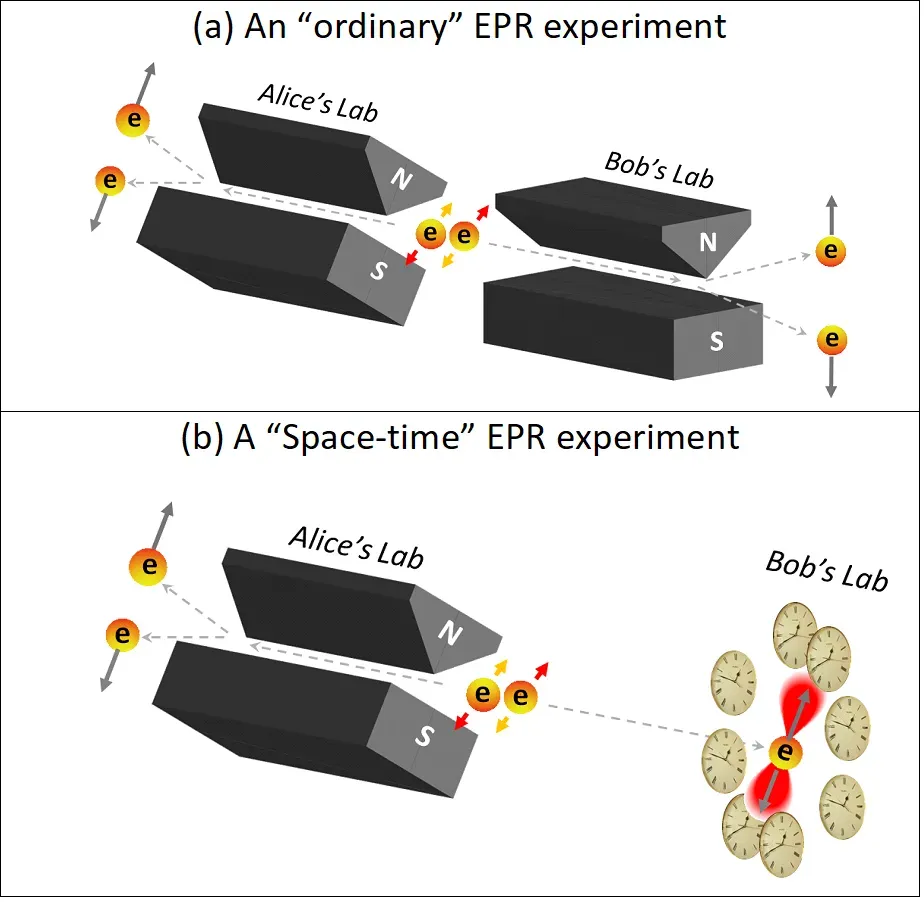
Einstein’s curved spacetime has passed every experimental test so far, yet it does not play nicely with the quantum world that governs particles and fields. Try to apply general relativity at the tiniest scales, and spacetime becomes violently fluctuating in the equations, filled with wild virtual distortions that defy sensible calculation. Many physicists suspect that at unimaginably small distances, far smaller than an atomic nucleus, spacetime is not smooth at all but made of some kind of discrete or quantized structure. One popular approach, loop quantum gravity, imagines space itself woven from tiny loops forming a granular network, while string theory replaces point-like particles with tiny vibrating strings whose vibrations give rise to both matter and gravity. None of these ideas has been definitively confirmed, but each offers a way to tame the infinities that plague attempts to merge gravity and quantum mechanics.
This hunt for a quantum theory of gravity is not just an abstract math game; it underpins how we think about the birth of the universe and the true cores of black holes. Near the Big Bang, densities and energies were so extreme that quantum effects of gravity must have mattered, yet our current equations cannot describe that epoch without crumbling into singularities. A successful quantum gravity theory might explain whether the universe began in a sharp beginning, bounced from a previous phase, or emerged from some deeper, timeless structure. It might also show how information escapes or is preserved in evaporating black holes, resolving paradoxes that have lingered for decades. Until experiments or observations can point clearly toward one framework, gravity remains the last major piece of physics not fully integrated into the quantum revolution.
7. Gravity Has Quietly Rewritten Our Place in the Cosmos
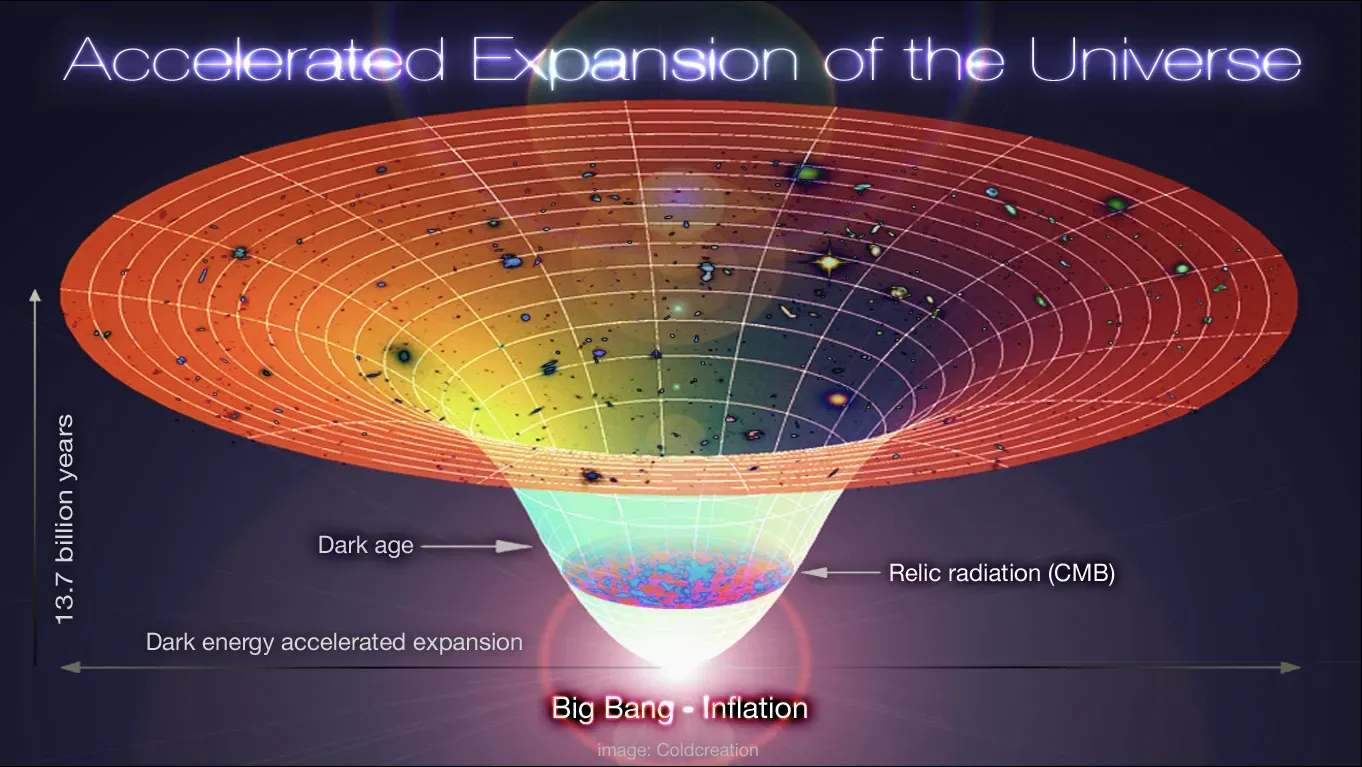
When astronomers carefully measure how galaxies rotate and how clusters of galaxies move, the visible matter alone cannot provide enough gravity to hold them together. The stars whirl too fast, the clusters seem too loosely bound, and the only way to make the numbers balance is to introduce an unseen component now called dark matter. On even larger scales, the universe is not just expanding but speeding up in its expansion, a behavior often described as the action of dark energy acting like a kind of repulsive gravity in the fabric of space. These discoveries mean that the ordinary matter making up stars, planets, and people accounts for only a small fraction of the cosmic inventory. Gravity, the tool we thought would simply let us weigh the universe, has instead revealed that most of what is out there does not interact with light at all.
These findings have forced a reconsideration of nearly every big-picture story we tell about the cosmos. New maps of the universe show vast filaments of galaxies threading through an almost invisible sea of dark matter, all evolving under the competition between gravitational attraction and the accelerating push attributed to dark energy. Some researchers have explored the idea that perhaps our understanding of gravity itself needs to be modified on large scales, rather than adding unseen components, and a variety of alternative gravity theories have been proposed. So far, dark matter and dark energy remain the leading explanations, supported by multiple independent lines of evidence, yet the underlying nature of both remains unknown. Gravity has thus become both the measuring stick and the mystery, revealing a universe far stranger than the bright stars we can see.
8. Why Gravity’s Weirdness Matters for Everyday Curious Minds
It is easy to file all this under “distant cosmic weirdness” and carry on with daily life, but the strangeness of gravity seeps into far more than black holes and the early universe. The same equations that describe time slowing in a gravitational field keep airplanes on the correct course and synchronize global communications. Medical imaging systems and particle accelerators rely on relativistic physics that emerged from the attempt to reconcile gravity with light. When engineers design satellites, spacecraft, or even long bridges, they lean on a refined understanding of gravitational fields, orbital dynamics, and the subtleties of how forces propagate. The invisible curves of spacetime, worked out in chalk on old blackboards, end up guiding hardware, infrastructure, and software that surround us every day.
On a more personal level, grappling with gravity’s paradoxes is a training ground for thinking clearly about complex systems. It forces you to hold multiple ideas in your head at once: that gravity is not really a force yet behaves like one, that time is both universal and malleable, that space can be both continuous and perhaps fundamentally granular. That kind of mental flexibility is increasingly valuable in a world overflowing with data, models, and claims that need careful interpretation. You do not need a telescope or a particle detector to engage with these ideas; it starts with being willing to let your intuition be challenged and updated. And once you have seen how something as familiar as falling becomes a window into warped spacetime, it is hard to look at a dropped object – or your own brief time on this planet – in quite the same way.
Suhail Ahmed is a passionate digital professional and nature enthusiast with over 8 years of experience in content strategy, SEO, web development, and digital operations. Alongside his freelance journey, Suhail actively contributes to nature and wildlife platforms like Discover Wildlife, where he channels his curiosity for the planet into engaging, educational storytelling.
With a strong background in managing digital ecosystems — from ecommerce stores and WordPress websites to social media and automation — Suhail merges technical precision with creative insight. His content reflects a rare balance: SEO-friendly yet deeply human, data-informed yet emotionally resonant.
Driven by a love for discovery and storytelling, Suhail believes in using digital platforms to amplify causes that matter — especially those protecting Earth’s biodiversity and inspiring sustainable living. Whether he’s managing online projects or crafting wildlife content, his goal remains the same: to inform, inspire, and leave a positive digital footprint.