

Every so often, the Earth behaves in ways that make even seasoned scientists stop, stare, and quietly admit: we still do not fully understand what is going on. These are not fantasy tales or internet hoaxes, but carefully documented natural events that seem to bend, twist, or outright ignore the rules we were taught in school. From stones that creep silently across desert floors to lights that flicker in the sky long before an earthquake hits, these phenomena expose the edges of our knowledge. As measurements get sharper and satellites more watchful, the mysteries are not disappearing – they are getting stranger, more complex, and more revealing. The question is no longer whether they are real, but what they are trying to tell us about a planet that is far less “solved” than we like to believe.
The Hidden Clues in Earthquake Lights
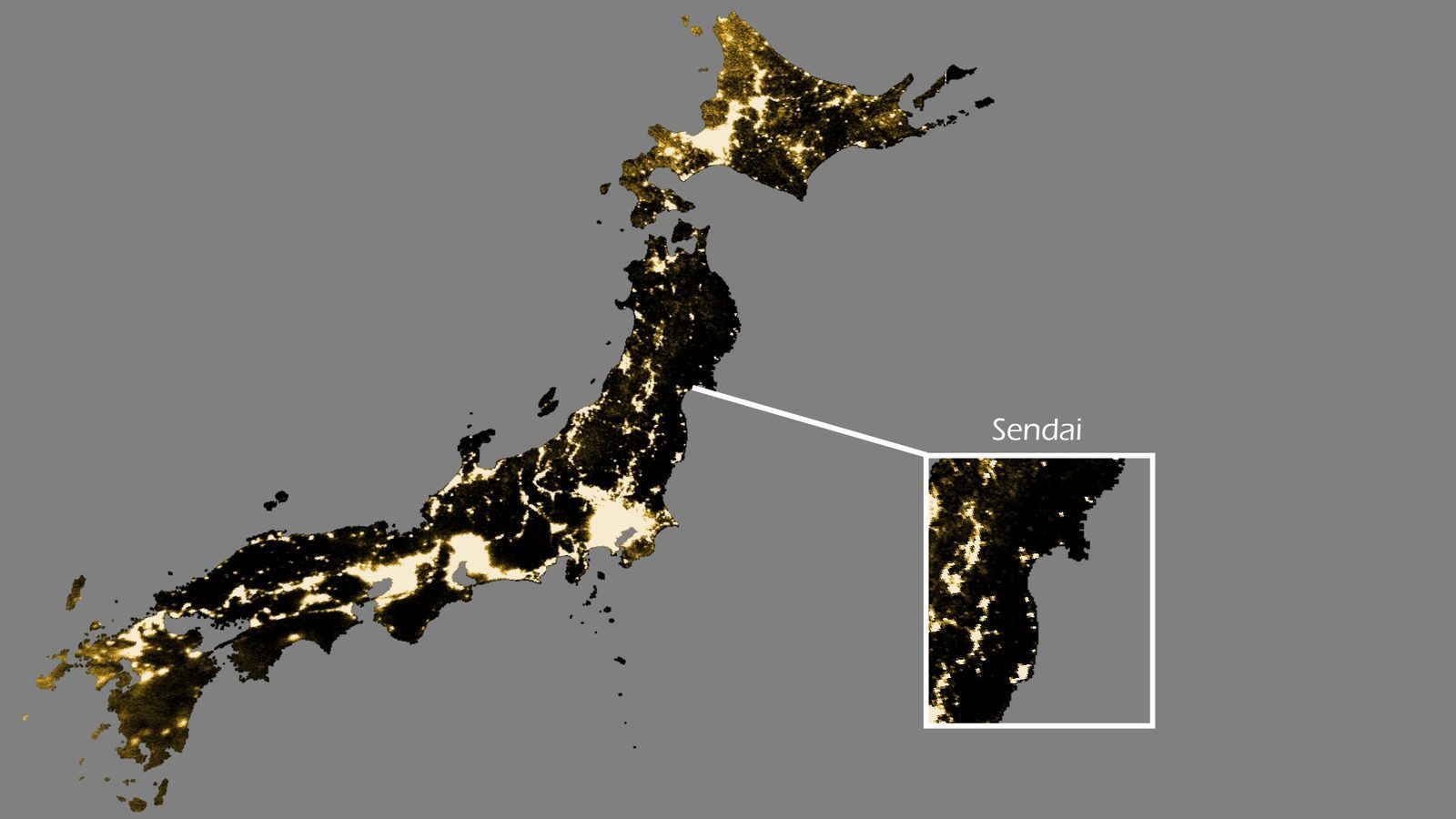
Imagine looking up at the night sky and seeing ghostly blue and green glows rippling over a fault line minutes before the ground begins to shake. Earthquake lights, reported for centuries from Italy to Japan to the Americas, sound like folklore, yet modern videos and instrument readings have forced geophysicists to take them seriously. These lights can look like silent lightning, floating orbs, or glowing curtains, sometimes stretching across entire valleys. What makes them so uncanny is their timing: they often appear right before or during powerful quakes, as if the planet were sending a luminous warning flare.
Leading hypotheses suggest that intense stress in rocks may rip apart atomic bonds and release charged particles that shoot up into the atmosphere, exciting gases and creating a glow. But that story is still incomplete, because not every large quake produces visible lights, and similar rock stress in lab experiments has been tough to scale up to real-world conditions. For seismologists, earthquake lights are like a partially decoded message: clearly significant, but frustratingly inconsistent. If scientists can reliably connect specific light signatures to specific types of tectonic stress, then these ghostly glows could one day become a tool for short-term earthquake forecasting – something that has eluded modern physics for decades.
Singing Dunes and the Physics of a Giant Natural Speaker

Stand on the right sand dune at the right time, and the Earth quite literally starts to sing. In deserts from Morocco to China and the western United States, people have reported dunes that hum, boom, or drone at a low, musical pitch when the sand avalanches down their slopes. It is an eerie sound – like an airplane in the distance or a sustained note from an enormous cello – yet there is no engine, no instrument, just moving grains. The sound can last for many seconds and is so loud in some locations that it can be heard kilometers away.
Laboratory tests have shown that when sand grains of a very specific size and dryness slide together, they can synchronize their motion and vibrate in unison, producing an organized sound wave instead of random noise. But even with that explanation, the phenomenon still pushes at the limits of our intuition, because it requires such a delicate balance of grain size, humidity, slope angle, and avalanche speed. Only a small fraction of dunes on Earth meet these criteria, turning them into natural laboratories for wave physics, friction, and resonance on a landscape scale. For researchers, booming dunes are a reminder that materials we think we understand – like sand – can still surprise us when nature scales them up into planetary-sized experiments.
The “Walking” Stones of Racetrack Playa
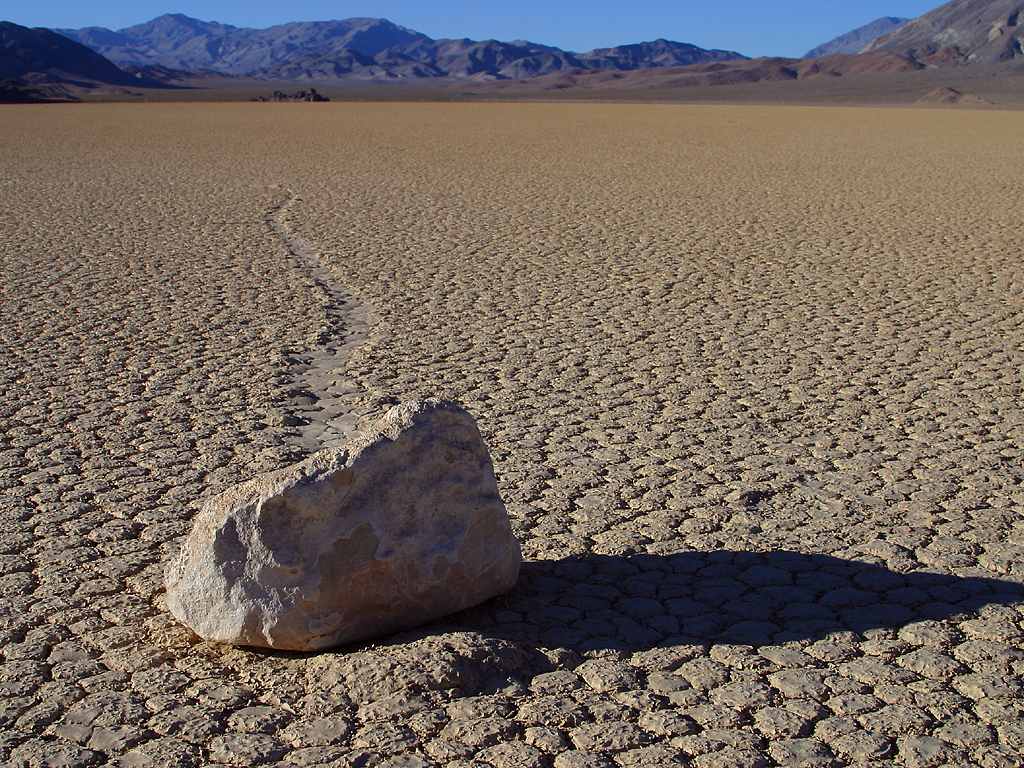
For decades, visitors to Racetrack Playa in California’s Death Valley found something that looked like a prank: heavy stones with long, ruler-straight trails carved into the dry lakebed, as if they had slowly skated across the mud while no one was looking. There were no footprints, no animal tracks, and no obvious slope to push them along. Some rocks had moved tens of meters, yet they appeared to sit on perfectly flat ground. For a long time, the best explanation people could offer was a shrug and a joke about ghosts with a knack for geometry.
In the last few years, researchers installed GPS-tagged rocks and time-lapse cameras and finally caught the stones in the act. Under rare conditions, a thin sheet of water floods the playa overnight and freezes into a fragile ice panel. When the morning sun warms the ice, it fractures into large floating plates that, nudged by light winds, push against the rocks and slide them slowly over the slick mud. The speeds are so low that the motion looks imperceptible from a distance, but over hours it adds up to those long trails. What feels like a violation of Newton’s laws is actually a perfect showcase of them – just operating in a regime of friction, ice dynamics, and wind interaction that almost never happens anywhere else on Earth.
Ball Lightning: The Ghost in the Storm
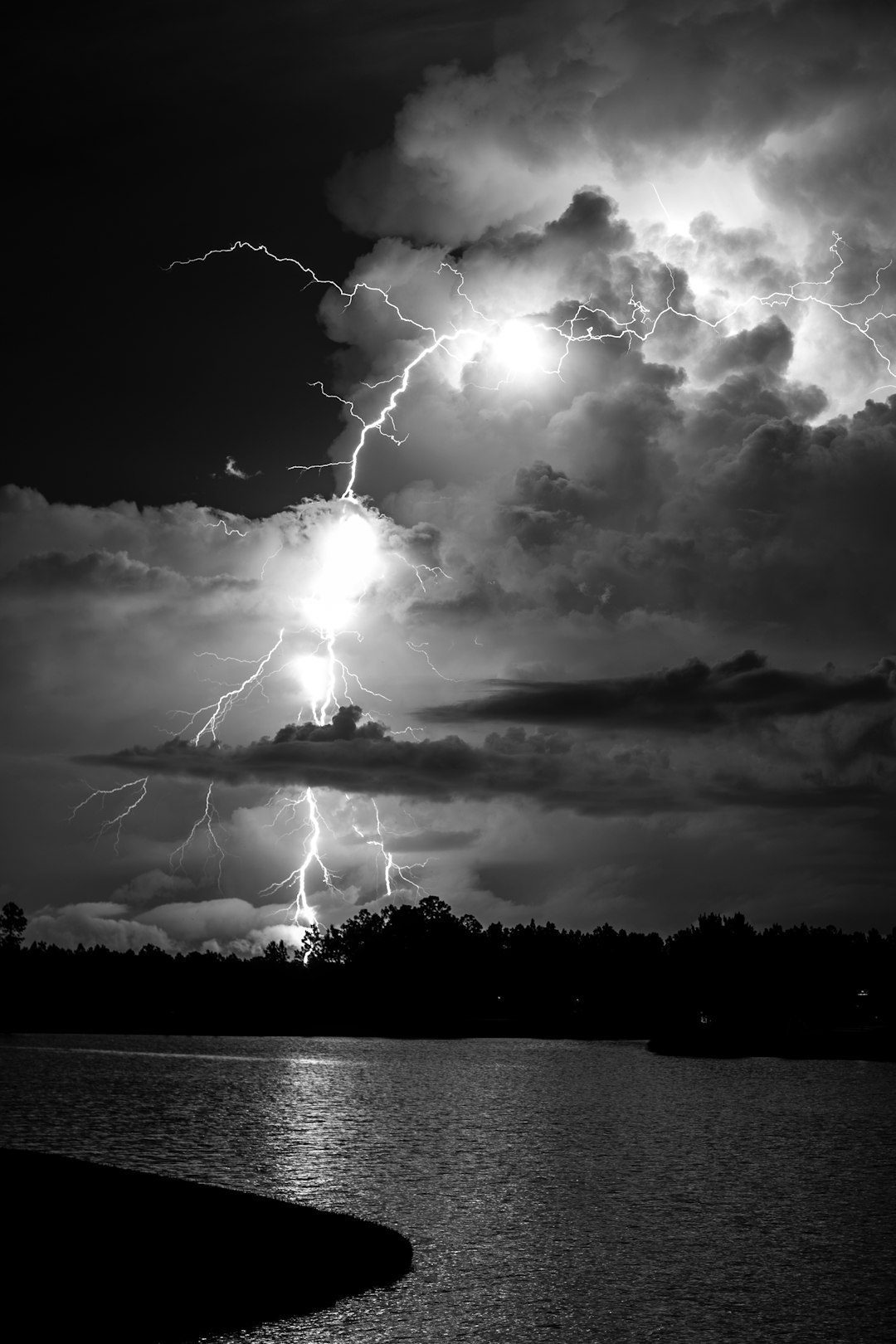
Few natural phenomena have annoyed physicists as much as ball lightning. People across the world have described hovering, glowing orbs – sometimes the size of a grapefruit, sometimes larger – drifting through the air during or after thunderstorms. These spheres have allegedly floated through windows, glided down airplane aisles, or vanished with a sudden pop and a sharp smell. Because they are rare, brief, and unpredictable, good scientific data on them has been incredibly hard to gather.
Only in the last decade have a handful of well-instrumented observations suggested that ball lightning might form when powerful lightning strikes create exotic plasmas, vaporized materials, or complex electromagnetic fields that briefly trap energy in a stable, self-contained structure. The trouble is that several competing models can explain parts of the behavior, but none elegantly explain all of it: the floating motion, the strange colors, the ability to move indoors, and the occasional explosive disappearance. Researchers have tried to simulate ball lightning in laboratories with high-voltage discharges and microwave fields, producing glowing blobs that act a little bit like the real thing, but the match is far from perfect. Until we can combine precise field measurements, high-speed imaging, and atmospheric modeling during a lucky event, ball lightning will remain the storm’s most elusive ghost.
Sprites and Blue Jets: Lightning That Shoots Into Space
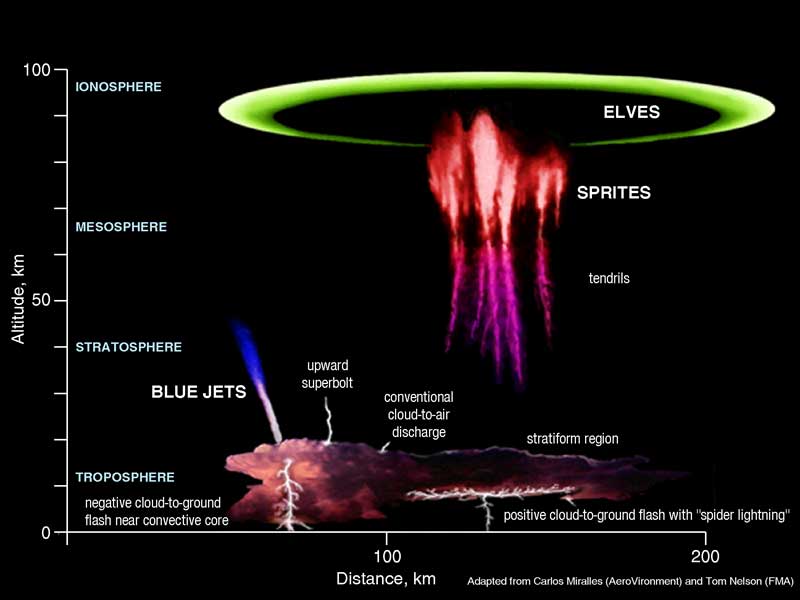
We grow up learning that lightning strikes down from clouds to the ground, but the atmosphere has a wilder secret: lightning that fires upward, toward space. These events, known as sprites, blue jets, and gigantic jets, were dismissed as camera glitches or pilot stories for years. Now, high-speed cameras and satellites have shown they are real, structured, and astonishingly large – towering electrical discharges that can stretch from thundercloud tops up into the thin air of the mesosphere. Sprites often appear as red, jellyfish-like flashes, while blue jets stab upward in narrow beams.
What makes them feel like they are breaking the rules is not that they violate electricity’s basic laws, but that they reveal an electrical conversation between the lower atmosphere and near-space that textbooks barely mentioned until recently. When a powerful lightning strike rearranges charges inside a storm, the resulting imbalance can spark these upward-reaching discharges into layers of the atmosphere that are ordinarily too thin to conduct. This means that major storms are quietly pumping energy and charged particles high above our heads, influencing everything from radio signals to the chemistry of the upper atmosphere. By mapping these ghostly flashes, scientists are discovering that the boundary between weather and space is a lot fuzzier than anyone imagined a generation ago.
The Ocean’s Glow: Bioluminescent Waves and Milky Seas

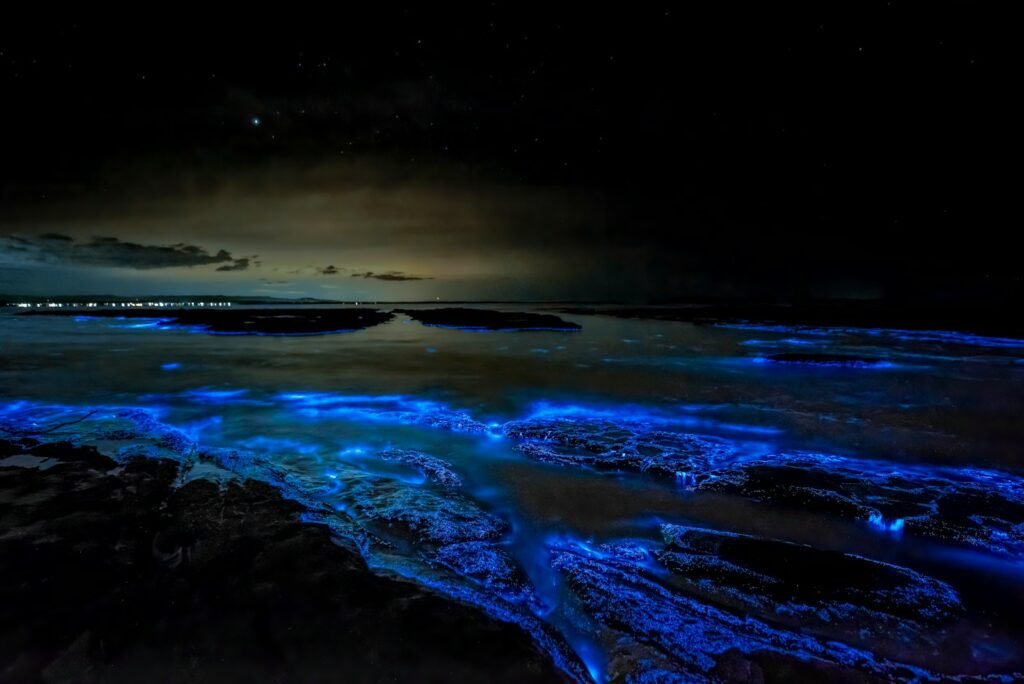
Walk along the right coastline at night, and every step can look like it has been dipped in blue fire. Bioluminescent plankton – usually tiny dinoflagellates – can fill the surf with dazzling flashes when waves break or when swimmers disturb the water. This happens because the organisms use a chemical reaction to produce light, possibly as a defense response to being bumped or attacked. The effect is so dramatic that kayakers sometimes describe feeling like they are paddling through liquid stars, each stroke igniting a new constellation beneath them.
Even more mysterious are “milky seas,” vast regions of the ocean that glow with a continuous, ghostly white or blue light, reportedly stretching over areas larger than some countries. Satellite observations and ship reports suggest these glows can last for hours or even nights, possibly caused by dense blooms of bioluminescent bacteria covering the upper ocean. The scale alone feels like a challenge to everyday physics: how can countless individual microscopic flashes create such an even, planet-scale glow? Understanding these events could reveal new details about marine ecosystems, global carbon cycles, and the hidden lives of microbes that respond to subtle shifts in temperature and nutrients. They also hint that Earth’s surface, even in the darkest corners of the sea, is far brighter and more dynamic than we notice from land.
Why These “Impossible” Phenomena Matter
It is tempting to file all of these events under the label of “weird nature videos” and move on, but that would miss the point. Each phenomenon – earthquake lights, walking stones, ball lightning, sprites, singing dunes, glowing seas – acts like a stress test for our physical theories. Classical physics, as we are taught in school, tends to focus on neat, controlled systems: a falling apple, a swinging pendulum, a clean electric circuit. The real planet is noisy, messy, multi-layered, and full of rare edge cases where many processes collide at once. These edge cases are exactly where our models are forced to prove themselves or be revised.
Historically, some of the biggest scientific breakthroughs have come from paying attention to outliers instead of ignoring them. The unexplained orbit of Mercury helped push Einstein toward general relativity; strange lines in starlight spectra nudged physics toward quantum theory. Today’s “impossible” natural phenomena play a similar role, exposing gaps in our understanding of plasmas, friction, atmospheric electricity, and fluid dynamics at scale. By taking them seriously, researchers are not indulging in fringe curiosity; they are stress-testing the foundations of science in real-world conditions that no laboratory can fully recreate. These mysteries also matter on a human level, because they shape hazard prediction, aviation safety, communications, and our basic sense of how stable – or unstable – our world really is.
The Future Landscape: New Eyes, New Instruments, New Surprises
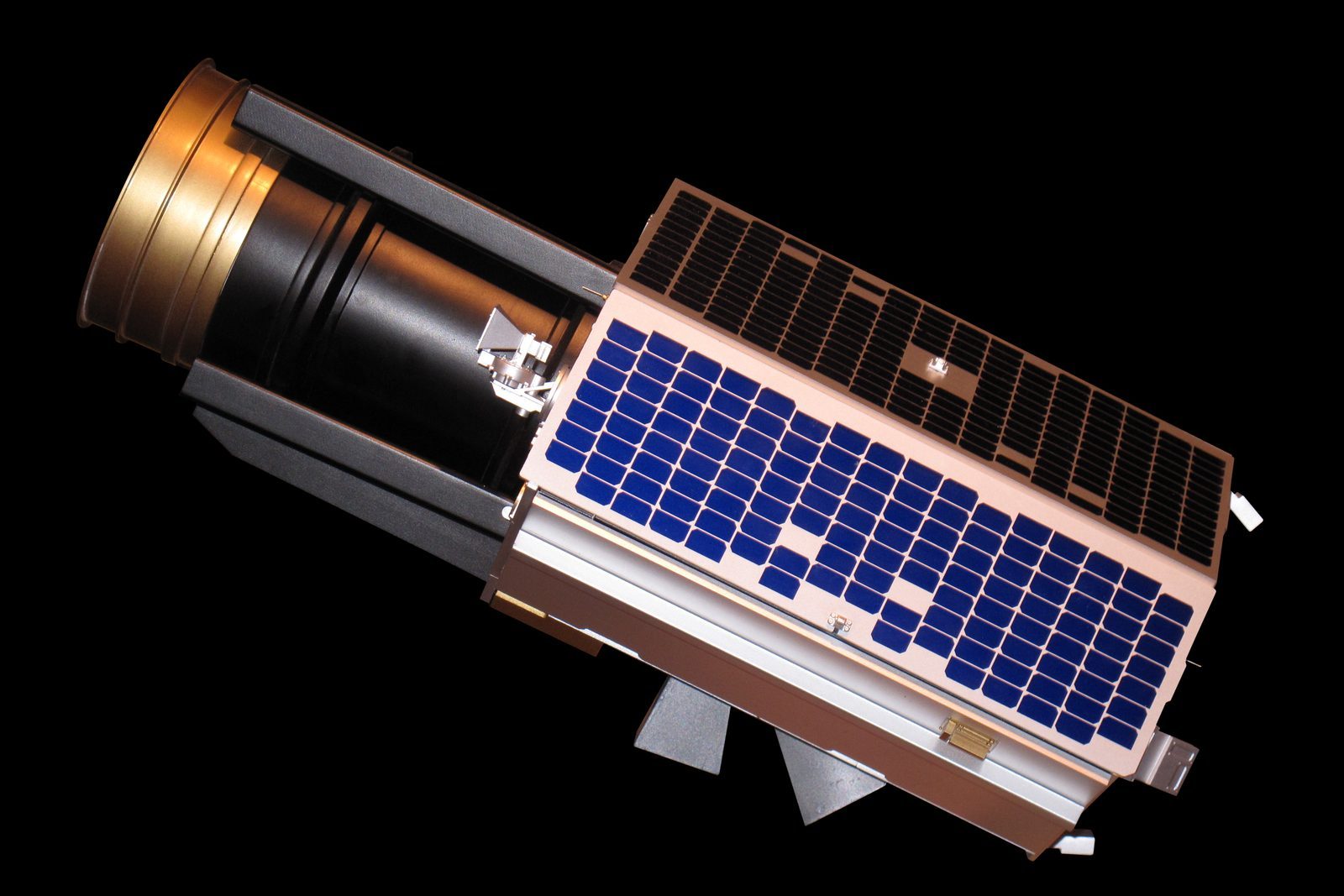
What makes this moment in time especially exciting is that our tools for watching the planet have never been more powerful. Constellations of satellites now peer at thunderstorms, oceans, and deserts in multiple wavelengths, often in near real time. High-speed cameras on aircraft, mountaintops, and research vessels are ready to catch fast, transient events like sprites or potential ball lightning. Sensitive magnetometers and electric-field meters can log tiny fluctuations around faults and storms, building up data sets that would have been impossible a few decades ago. It feels a bit like switching from a blurry black-and-white television to an ultra-sharp, full-color display.
Researchers are also turning to machine learning and advanced pattern-recognition algorithms to spot subtle signals that human eyes might miss. For example, algorithms can sift through years of satellite imagery to identify faint, repetitive glows over the ocean that might be unreported milky seas, or correlate rare atmospheric flashes with specific storm structures. Future advances in lab technology may allow physicists to recreate more faithful versions of ball lightning or dune acoustics under controlled conditions, closing the loop between field observations and theory. Still, there is a good chance that every time we solve one of these puzzles, the better data will reveal new layers of complexity hiding underneath. The future landscape of Earth science may be less about declaring mysteries “solved” and more about embracing an ever-richer description of how wild our home planet really is.
How You Can Stay Curious and Support the Science
While most of us will never install high-speed cameras on thunderstorm-chasing aircraft or place GPS tags on desert rocks, we are not locked out of this story. Careful eyewitness accounts, smartphone videos, and simple observations still matter, especially for rare events that scientists cannot easily stage on demand. If you happen to see an unusual glow in the sky before a quake, an oddly singing sand slope, or waves that shine with their own light, documenting what you see – time, location, weather, and behavior – can be surprisingly valuable. Responsible reporting to local scientific bodies or citizen-science platforms can help distinguish genuine phenomena from optical illusions or hoaxes.
Beyond that, supporting research-focused institutions, science journalism, and public data projects helps keep these questions on the agenda. Many of the instruments that catch “impossible” events were funded because people agreed that curiosity-driven science is worth the investment, even when practical payoffs are not obvious at first. You can also nurture your own curiosity by following reputable science outlets, attending public lectures, and resisting the urge to accept the first simple explanation for a complex event. The Earth is constantly performing experiments we do not fully understand yet; the least we can do is keep watching, asking questions, and staying open to surprise.
Suhail Ahmed is a passionate digital professional and nature enthusiast with over 8 years of experience in content strategy, SEO, web development, and digital operations. Alongside his freelance journey, Suhail actively contributes to nature and wildlife platforms like Discover Wildlife, where he channels his curiosity for the planet into engaging, educational storytelling.
With a strong background in managing digital ecosystems — from ecommerce stores and WordPress websites to social media and automation — Suhail merges technical precision with creative insight. His content reflects a rare balance: SEO-friendly yet deeply human, data-informed yet emotionally resonant.
Driven by a love for discovery and storytelling, Suhail believes in using digital platforms to amplify causes that matter — especially those protecting Earth’s biodiversity and inspiring sustainable living. Whether he’s managing online projects or crafting wildlife content, his goal remains the same: to inform, inspire, and leave a positive digital footprint.


