
Open a laptop, flick on a lamp, or tap your phone, and you’re already living in a quantum-powered world, even if the physics underneath it still sounds like controlled madness. Quantum mechanics is not just a quirky theory about tiny particles; it is a radical rewrite of what reality is allowed to do, and it routinely breaks the rules our everyday intuition depends on. Over the last century, physicists have pushed this strangeness from blackboard arguments into hard technology, from lasers to quantum computers and ultra-precise timekeeping. What has emerged is a picture of nature where probability, information, and even cause-and-effect play by unfamiliar rules. These seven quantum facts do not just bend your mind for fun – they quietly shape the devices you use and the future we’re racing into.
1. A Single Particle Can Be in Many Places at Once
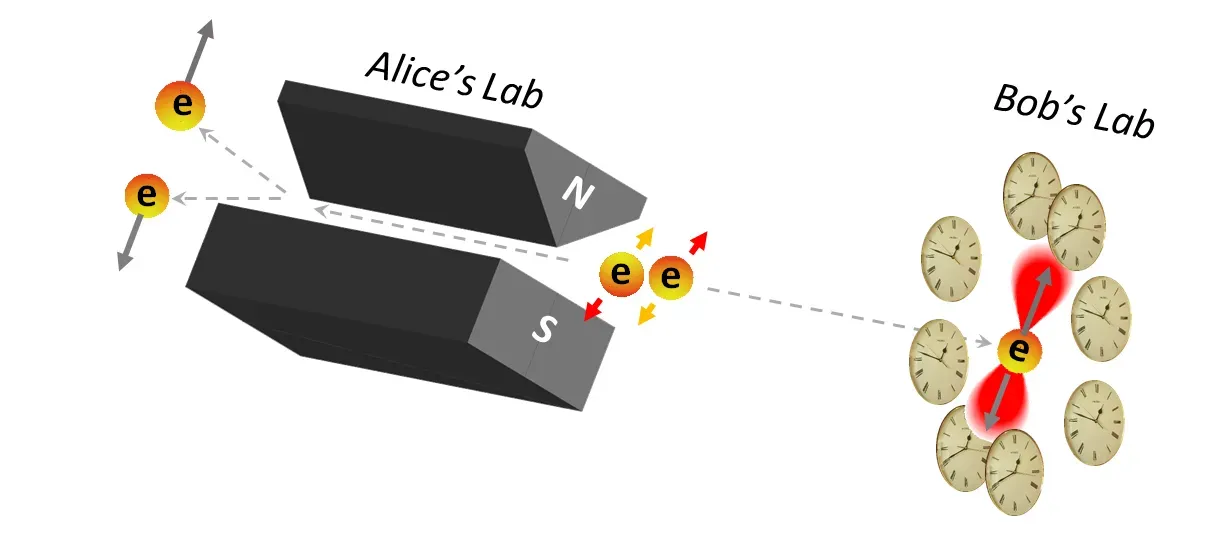
It sounds like science fiction, but one of the most basic predictions of quantum mechanics is that a single particle does not have to choose one location – it can exist in a spread-out cloud of possibilities. This is called superposition, and it shows up most famously in the double-slit experiment, where a lone electron sent toward two narrow openings behaves as if it has gone through both slits simultaneously. When many electrons are fired one by one, the impact pattern builds up into an interference pattern, the kind you get from overlapping waves, not classical bullets. The really unsettling part is that this pattern appears even if you send the electrons so slowly that only one is in flight at a time.
The instant you try to measure which slit the electron used, the wave-like pattern disappears and you get a pattern consistent with ordinary particles picking a single path. The act of measurement forces the electron to “decide” on a definite history, as if reality itself waits until you look before settling on an answer. This is not a trick of faulty equipment; the effect has been demonstrated with electrons, atoms, and even large molecules made of dozens or hundreds of atoms. Everyday objects do not show this split-personality behavior because their quantum states get scrambled almost instantly by interactions with the environment, but at small scales and under careful control, being “in more than one place at once” is a real, measurable phenomenon.
2. Quantum Entanglement Links Particles Across Vast Distances
Imagine flipping two coins on opposite sides of the world and discovering that every time one lands on heads, the other instantly lands on tails, in perfect step, no matter when you look. Quantum entanglement is even stranger than that analogy, because the “heads” and “tails” of quantum particles are not fixed until they are measured. When two particles are entangled, their properties become so tightly correlated that describing one on its own no longer makes sense; they form a single joint system, even when separated by enormous distances. Experiments have entangled photons and other particles over tens and hundreds of kilometers, including between ground stations and orbiting satellites.
Albert Einstein famously complained that entanglement seemed to imply a spooky kind of action at a distance, where one measurement instantly affects another far away. But repeated tests of so‑called Bell inequalities have shown that the quantum correlations cannot be explained by any model where the particles carried pre-agreed instructions and then simply revealed them on demand. At the same time, entanglement does not let you send usable information faster than light, so relativity’s speed limit stays safe. Instead, it forces us to accept that reality at the quantum level is more holistic than our classical picture suggests: two things can really behave as parts of a single entity, even while being physically far apart.
3. Quantum Randomness Is Truly Unpredictable
We are used to calling things “random” when we just do not know all the details – a dice roll, a roulette spin, the time your train will actually arrive. In classical physics, the idea is that if you had perfect information and perfect computing power, you could predict all of these with certainty, because the underlying laws are deterministic. Quantum mechanics rips up that safety net and says there are events that have no hidden clockwork behind them, only genuine probabilities. When you measure the spin of an electron or the polarization of a photon prepared in a balanced superposition, the result is fundamentally unpredictable, even in principle.
This intrinsic randomness is not just philosophical; it is being weaponized in technology. Quantum random number generators already on the market use single photons or other quantum processes to produce bit streams that cannot be anticipated by any attacker, because there simply is no deeper pattern to learn. Physicists have even built “device-independent” schemes where the very violation of Bell inequalities is used to certify that the randomness is not being faked by flawed or malicious hardware. In a world where digital security often hinges on the quality of randomness, the universe’s own built-in dice may turn out to be one of our most valuable natural resources.
4. Empty Space Boils with Invisible Quantum Activity
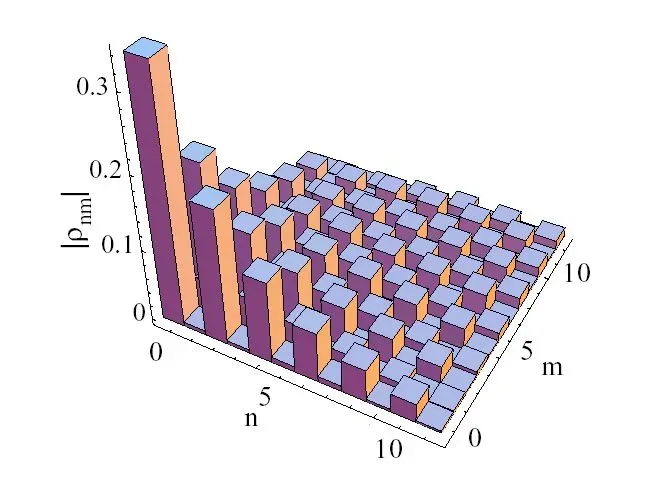
Classically, a perfect vacuum is exactly nothing: no particles, no fields, just emptiness. Quantum field theory replaces that picture with a more unsettling one, where even the lowest-energy state of a field is not perfectly quiet. Because of the uncertainty principle, fields cannot sit at precisely zero energy and zero fluctuation; instead, they are subject to constant jitter, producing short‑lived particle–antiparticle pairs that pop into existence and then annihilate each other. These virtual particles cannot be directly observed in the same way as ordinary particles, but their effects can be measured.
One striking example is the Casimir effect, where two uncharged, closely spaced metal plates placed in a vacuum feel a tiny but real force pushing them together, arising from how quantum fluctuations are restricted between them compared with outside. Another is the Lamb shift, a small but measurable shift in the energy levels of electrons in hydrogen that appears only when quantum vacuum effects are taken into account. These corrections are so precise that they have been tested to many decimal places, making quantum “nothingness” one of the best‑verified somethings in all of physics. The vacuum, far from being a blank stage, is more like an endlessly restless sea whose ripples subtly alter the behavior of matter and light.
5. Quantum Measurement Blurs the Line Between Observer and System
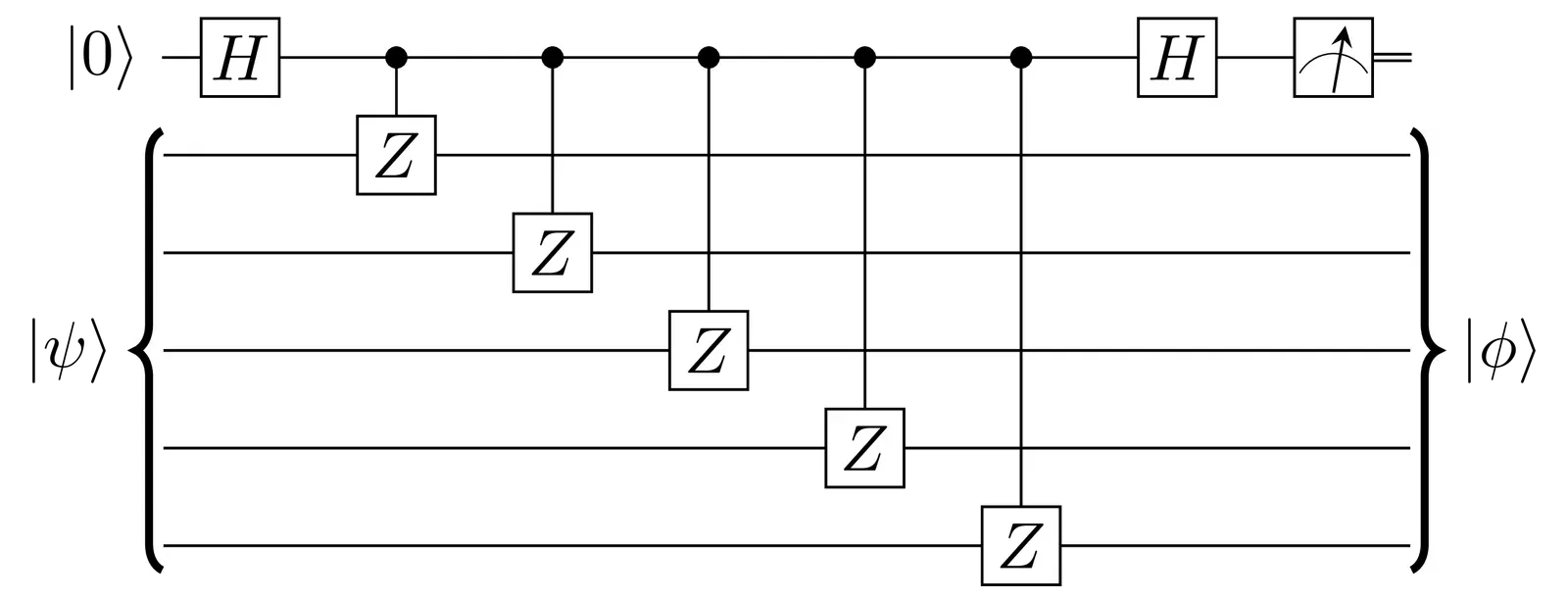
In everyday life, measuring something seems straightforward: a thermometer reads the temperature without changing the weather, and a bathroom scale reports your weight without rewriting your biology. In quantum mechanics, that picture breaks down, because measuring a system is itself a physical interaction strong enough to disturb what you are trying to observe. The famous uncertainty principle is partly a reflection of this: position and momentum cannot both be sharply defined, because any attempt to pin one down destroys precise information about the other. At small scales, you cannot be a passive spectator; your very act of looking leaves fingerprints.
This is why quantum mechanics talks about wavefunctions that “collapse” upon measurement, jumping from a spread‑out superposition to a specific outcome. Different interpretations disagree about whether this collapse is a real physical event, an update of our knowledge, or an illusion that disappears in a more complete theory, but the practical consequence is the same: you get probabilities, not certainties, until an interaction strong enough to count as a measurement happens. In modern labs, researchers exploit this by using carefully timed, weak probes that extract partial information while preserving some quantum coherence, a delicate dance that lies behind technologies like quantum error correction and certain kinds of quantum sensors. The boundary between observer and observed, which felt so solid in classical physics, turns out to be negotiable and context‑dependent.
6. Tunneling Lets Particles Cross Barriers They Should Not Survive
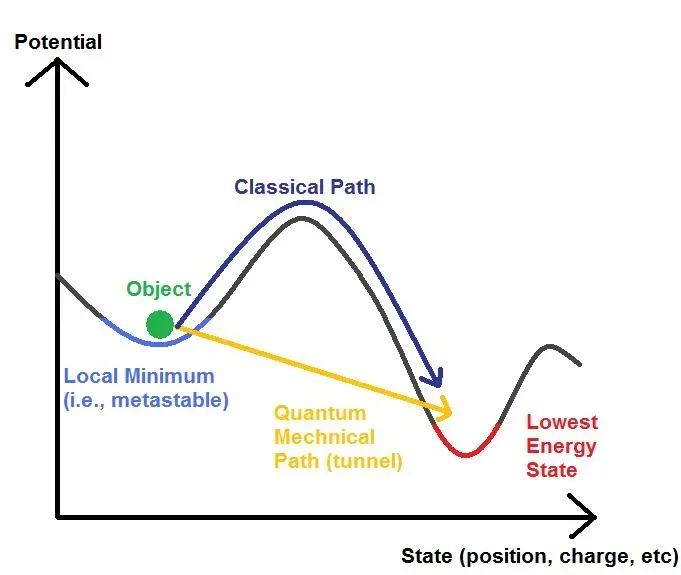
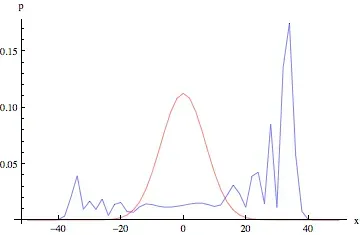
Imagine rolling a ball toward a hill that is taller than the energy you gave the ball; in classical physics, it will roll up a bit, slow down, and then roll back to you every time. At the quantum scale, particles behave like waves, and those waves do not abruptly end at a barrier; they leak a little into and through it. Quantum tunneling is the phenomenon where, thanks to this leakage, there is a nonzero chance that a particle on one side of a barrier will suddenly be found on the other side, even if it does not have enough energy to climb over in the classical sense. The barrier does not vanish; the particle simply exploits the probabilistic nature of its wavefunction.
Far from being a laboratory curiosity, tunneling underpins technologies and natural processes we rely on. Scanning tunneling microscopes use the effect to image individual atoms on surfaces, by measuring the tiny tunneling current between a sharp tip and a sample brought incredibly close together. In stars, including our Sun, tunneling allows protons in the core to fuse at temperatures and pressures where classical estimates say they should almost never get close enough, keeping starlight flowing over billions of years. In modern electronics, engineers must constantly contend with unwanted tunneling currents that leak through insulators as components shrink, a reminder that at nanometer scales, particles refuse to respect the clean walls we think we have built.
7. Quantum Information Is Reshaping How We Think About Reality
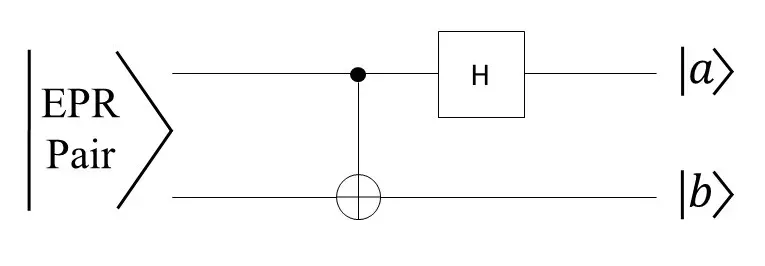
Over the last few decades, physicists have quietly started to treat quantum mechanics less as a theory about particles and waves, and more as a theory about information and how it can be stored, transformed, and transmitted. In this view, superposition becomes a way for a qubit to encode multiple possible values at once, and entanglement becomes a resource that lets you do tasks like teleporting unknown quantum states or performing certain computations more efficiently than any classical machine. Quantum computers built from superconducting circuits, trapped ions, or other platforms have already demonstrated small-scale algorithms and simulations that would be painfully slow to mimic exactly on ordinary hardware, even if they are still far from breaking everyday encryption.
This information-centric perspective has spilled into some of the deepest questions in theoretical physics, including black hole evaporation and the structure of space-time itself. Debates over how information escapes from or is preserved in black holes have forced researchers to sharpen their understanding of what quantum states really are and how they can be scrambled yet not destroyed. There are bold ideas on the table where the geometry of space-time emerges from patterns of entanglement, as if reality were a vast, error-correcting code woven from quantum bits. Even if some of these proposals end up being wrong or incomplete, they mark a decisive shift: the weirdness of quantum mechanics is no longer something to be swept under the rug, but a tool for building both new technologies and new ways of thinking about existence.
Why These Quantum Oddities Matter Far Beyond the Lab

It is tempting to relegate quantum strangeness to the world of thought experiments and exotic machinery, but that sells it short. Everyday technologies – lasers in barcode scanners, LEDs in traffic lights, the transistors in your phone – owe their operation to quantum rules governing electrons in solids and photons in optical cavities. Global positioning systems depend on atomic clocks whose precision is set by quantized energy levels, and proposed quantum networks could eventually secure communications in ways that eavesdroppers cannot silently compromise, because intercepting quantum states unavoidably leaves traces. The line from baffling lab result to practical tool is rarely straight, but history shows that once we learn to harness a quantum effect, it tends to stick around.
At a deeper level, these seven facts collectively force a kind of intellectual humility. Our classical intuitions evolved for throwing spears and dodging predators, not for judging whether entangled photons violate a mathematical inequality or whether information can be smeared across multiple locations at once. Quantum mechanics confronts us with a world where certainty gives way to probability, locality gives way to nonlocal correlations, and emptiness hides restless fields. In return, it offers predictive power so accurate that it borders on eerie and technologies that are starting to bend the limits of what we thought computation, sensing, and communication could do. The challenge is not just to accept that reality is weirder than it looks, but to get comfortable building our future on that weirdness.
How You Can Lean Into the Quantum Weirdness
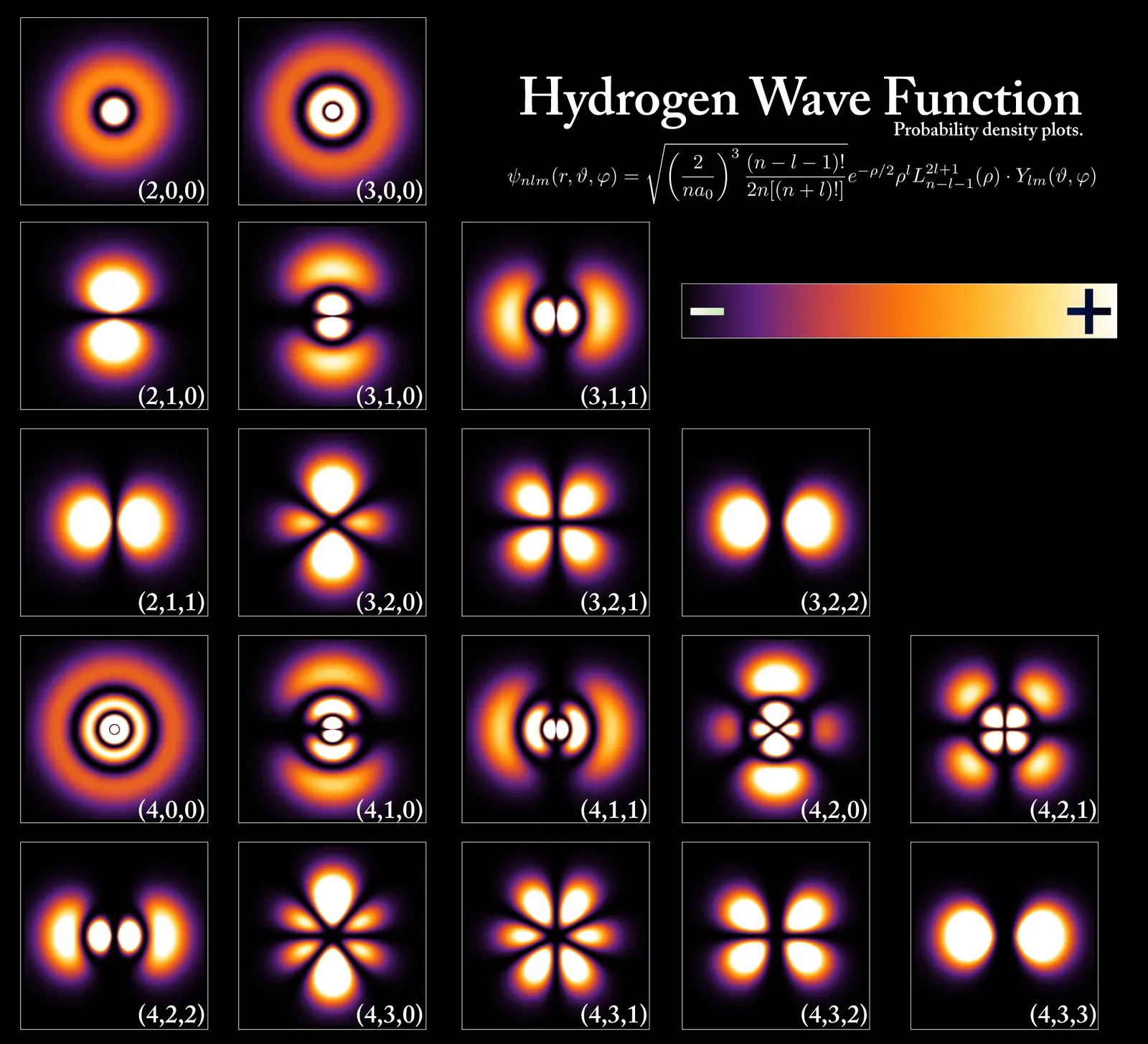
You do not need a PhD or access to a dilution refrigerator to start engaging with quantum ideas in a real way. Popular-level books, podcasts, and online lectures by working physicists can give you a feel for superposition, entanglement, and quantum information without drowning you in equations, and many universities and science museums now host outreach events specifically about quantum technologies. There are browser-based simulations and free coding platforms where you can design and run simple quantum algorithms on cloud-accessible devices, letting you experiment with qubits the way hobbyists once tinkered with early personal computers. If you prefer something more hands-on, kits and classroom experiments built around polarized light or basic interference patterns can make the abstractions more tangible.
Staying curious about quantum mechanics is not just a nerdy side hobby; it is a way to be an informed citizen in a world where policy decisions will increasingly touch on quantum-secure communications, advanced sensing, and high-stakes computation. Ask better questions when you hear hype about quantum breakthroughs, and look for concrete details: what physical platform is being used, what specific problem is being addressed, what are the real limitations. Support science education efforts in your community, encourage kids (and adults) to treat not understanding something as an invitation rather than an embarrassment, and allow yourself to sit with a bit of mystery. After all, if reality is willing to be this strange and still work, the least we can do is keep asking how far the rabbit hole goes.
Suhail Ahmed is a passionate digital professional and nature enthusiast with over 8 years of experience in content strategy, SEO, web development, and digital operations. Alongside his freelance journey, Suhail actively contributes to nature and wildlife platforms like Discover Wildlife, where he channels his curiosity for the planet into engaging, educational storytelling.
With a strong background in managing digital ecosystems — from ecommerce stores and WordPress websites to social media and automation — Suhail merges technical precision with creative insight. His content reflects a rare balance: SEO-friendly yet deeply human, data-informed yet emotionally resonant.
Driven by a love for discovery and storytelling, Suhail believes in using digital platforms to amplify causes that matter — especially those protecting Earth’s biodiversity and inspiring sustainable living. Whether he’s managing online projects or crafting wildlife content, his goal remains the same: to inform, inspire, and leave a positive digital footprint.