

Quantum physics is the one branch of science where the more you understand, the less certain you feel about reality. It’s not that the math is wrong. In fact, the equations work with staggering precision. The trouble is what those equations seem to be saying about the nature of the universe, and it turns out that nature, at its most fundamental level, refuses to behave in ways that feel reasonable to us.
These aren’t just puzzles waiting for a clever solution. Several of the strangest ideas in quantum mechanics have been tested experimentally, and in many cases, reality keeps choosing the weird answer. The seven paradoxes below have occupied physicists for decades, and some remain genuinely unresolved, not because we haven’t looked hard enough, but because the universe itself seems to be running on rules our human-scale intuitions were simply never built to grasp.
1. Schrödinger’s Cat: Alive, Dead, and Both at Once
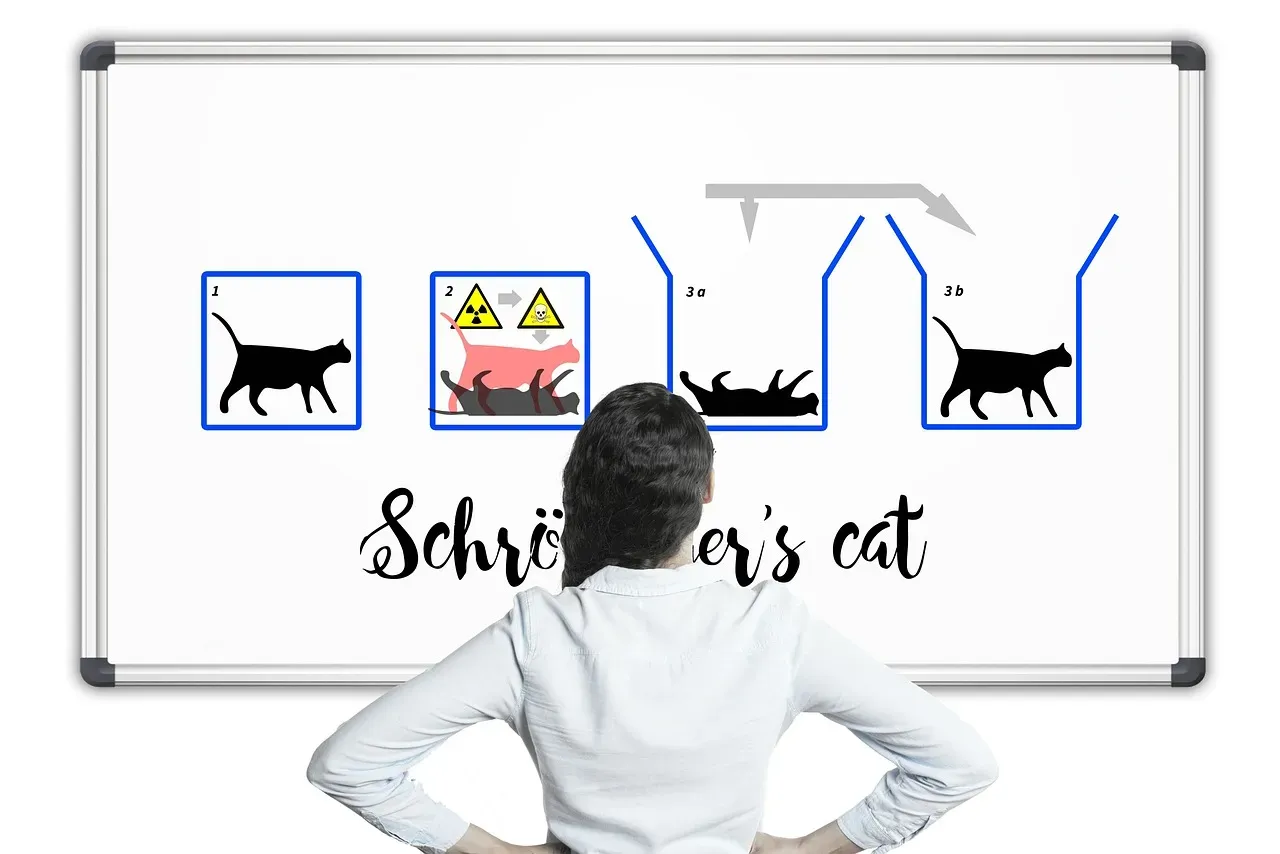
This thought experiment was devised by physicist Erwin Schrödinger in 1935, in a discussion with Albert Einstein, to illustrate what Schrödinger saw as the problems of Niels Bohr and Werner Heisenberg’s philosophical views on quantum mechanics. In Schrödinger’s original formulation, a cat, a flask of poison, and a radioactive source are placed in a sealed box. If an internal radiation monitor such as a Geiger counter detects radioactivity from a single atom decaying, the flask is shattered, releasing the poison, which kills the cat. If no decaying atom triggers the monitor, the cat remains alive. The problem is what quantum mechanics says must be true while the box stays closed.
The paradox arises because if the atom is in a superposition of decayed and undecayed states, the entire linked system, including the cat, must also be in a superposition. According to this quantum logic, until an external observer opens the box, the cat’s wave function must be a combination of the “alive” state and the “dead” state. Contrary to popular belief, Schrödinger did not actually believe the cat was both alive and dead. He created the experiment to demonstrate a flaw in the Copenhagen Interpretation of quantum mechanics. The cruel irony is that his attempted critique of the theory ended up becoming one of its most iconic illustrations. The question of why a measurement collapses a quantum object from a superposition of states to a single definite state has not yet been fully answered by quantum physics, and this remains known as the “measurement problem.”
2. The EPR Paradox and Spooky Action at a Distance
The Einstein–Podolsky–Rosen paradox is a thought experiment proposed by physicists Albert Einstein, Boris Podolsky, and Nathan Rosen, which argues that the description of physical reality provided by quantum mechanics is incomplete. In a 1935 paper titled “Can Quantum-Mechanical Description of Physical Reality be Considered Complete?”, they argued for the existence of “elements of reality” that were not part of quantum theory, and speculated that it should be possible to construct a theory containing these hidden variables. Einstein found the alternative deeply uncomfortable: that two particles could somehow influence each other instantly across any distance.
In the case of the EPR paradox, quantum entanglement appears to allow for the physical impossibility of information being transmitted faster than the speed of light, violating special relativity. After the publication of Bell’s paper, a variety of experiments to test Bell inequalities were carried out, notably by the group of Alain Aspect in the 1980s, and all experiments conducted to date have found behavior in line with the predictions of quantum mechanics. The present view of the situation is that quantum mechanics flatly contradicts Einstein’s philosophical postulate that any acceptable physical theory must fulfill “local realism.” In other words, the universe is genuinely strange in exactly the way Einstein refused to believe it could be.
3. The Measurement Problem: Reality Created by Looking
One of the oddest tenets of quantum theory is that a particle can be in two places at once, yet we only ever see it here or there. Textbooks state that the act of observing the particle “collapses” it, such that it appears at random in only one of its two locations. Physicists, however, quarrel over why that would happen, if indeed it does. The moment you try to look closely at what “observation” actually means, the concept begins to dissolve into something genuinely philosophical.
In the Copenhagen interpretation, measurement causes the wave function to collapse, and we cannot talk of properties, such as a particle’s position, before collapse. Some physicists view the Copenhagen interpretation as an argument that properties are not real until measured. Given the attributes of certain anti-realistic quantum theories, work by physicists implies that there is no single outcome of a given measurement that’s objectively true for all observers. So if a detector clicked for Alice’s friend inside the lab, then it’s an objective fact for her, but not so for Alice, who is outside the lab modeling the entire lab using quantum theory. The results of measurements depend on the perspective of the observer. That isn’t a metaphor, it’s what the math actually predicts.
4. The Quantum Zeno Effect: A Watched Particle Never Changes

The quantum Zeno effect carries a simple yet shocking proposition: if you observe a quantum system frequently enough, you can “freeze” its evolution. An unstable particle that would normally decay never decays, as long as you keep watching it. In 1977, George Sudarshan and Baidyanath Misra from the University of Texas published a paper on Zeno’s paradox in quantum theory. The authors considered an unstable radioactive particle with some probability of decaying, then used quantum theory to calculate that if the particle is continuously observed, it should never decay. That result feels utterly backwards from everything classical intuition suggests.
In quantum mechanics, each measurement causes the wave function to collapse into an eigenstate of the measurement operator. Between two measurements, the system evolves into a superposition of states, a synthesis of possible realities. As the time interval between measurements shrinks, the probability of transitioning to a different state decreases dramatically. The quantum Zeno effect has been demonstrated in various real-world systems, such as trapped ions, cold atoms, and quantum dots, where frequent measurements can indeed inhibit the evolution of a quantum system. Potential applications of the quantum Zeno effect include enhancing quantum computing stability, improving precision in atomic clocks, and aiding in quantum error correction. Watching, it turns out, is not a passive act in the quantum world.
5. Quantum Tunneling: Passing Through Walls That Should Be Impenetrable
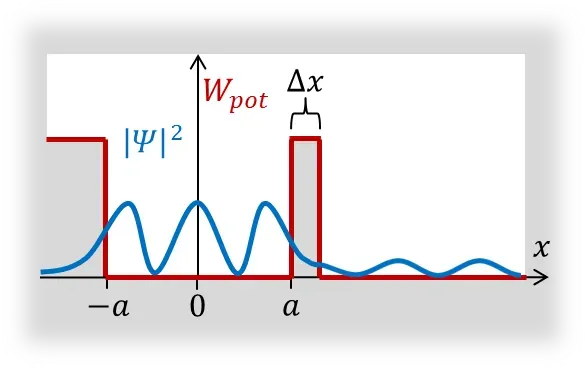
Tunneling is a quantum mechanical phenomenon when a particle is able to penetrate through a potential energy barrier that is higher in energy than the particle’s kinetic energy. This remarkable property of microscopic particles plays important roles in explaining several physical phenomena, including radioactive decay. Think of it this way: in the classical world, if you roll a ball toward a hill and it doesn’t have enough energy to reach the top, it rolls back. In the quantum world, the ball sometimes appears on the other side anyway.
One of the most direct consequences of the uncertainty principle is quantum tunneling. In classical physics, if an electron doesn’t have enough energy to pass through a barrier, it simply cannot do so. But in quantum mechanics, due to uncertainty, there’s a small probability that the electron can tunnel through the barrier, even if it doesn’t have enough energy to overcome it directly. This behavior enables processes like nuclear fusion in stars, where particles combine despite repelling each other. The principle of tunneling also led to the development of the Scanning Tunneling Microscope, which had a profound impact on chemical, biological, and material science research. A paradox that once seemed purely theoretical is now the foundation of technologies used in laboratories every day.
6. The Black Hole Information Paradox: Does the Universe Forget?
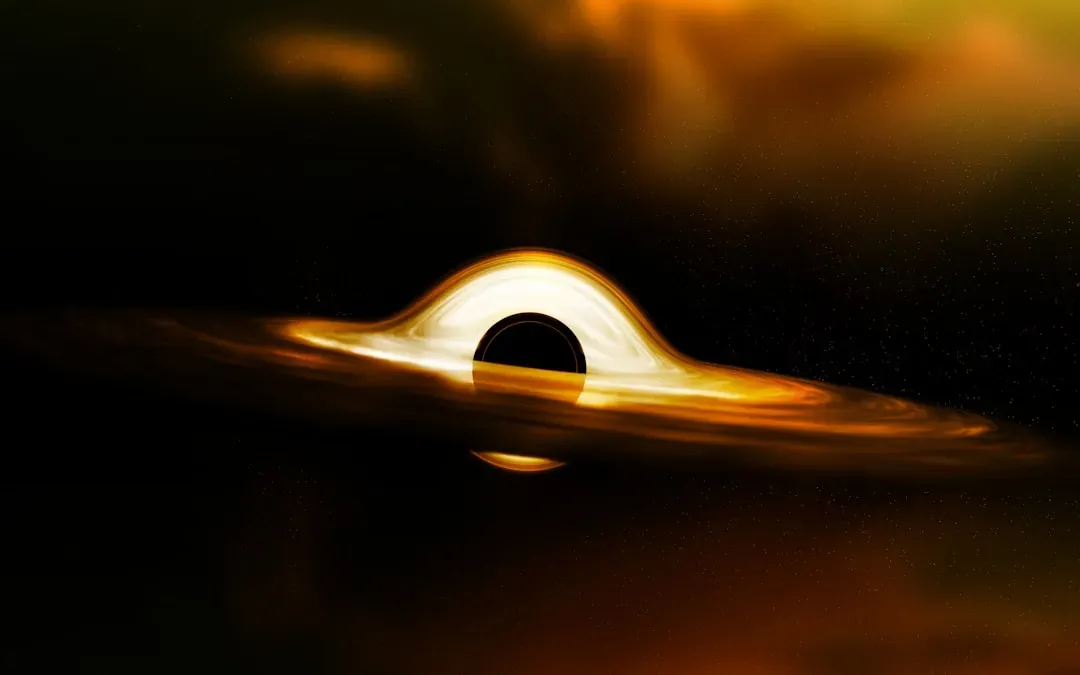
The black hole information paradox points out that information associated with a particle that falls into a black hole is not conserved when the theoretical Hawking radiation causes the black hole to evaporate. This matters enormously, because quantum mechanics has a foundational rule: information cannot simply vanish. The Hawking radiation spectrum shows that the black hole evaporation process follows an equilibrium blackbody spectrum, which means that information seems to be permanently lost in the black hole evaporation process, and the information of the initial state cannot be recovered by observing the radiation.
Black hole formation and evaporation appears to be an irreversible process, which seems to defy the laws of quantum mechanics. Hawking and most other theorists at the time accepted that conclusion, though Page was perturbed because irreversibility would violate the fundamental symmetry of time. In a landmark series of calculations, physicists have proved that black holes can shed information, which seems impossible by definition, and the work appears to resolve a paradox that Stephen Hawking first described five decades ago. Yet even now, the precise physical mechanism by which that information escapes remains deeply contested, and no fully satisfying picture has yet emerged.
7. The Heisenberg Uncertainty Principle: The Universe’s Hard Limit on Knowledge
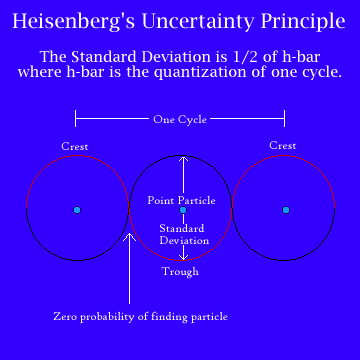
The Heisenberg Uncertainty Principle states that there is a limit to the precision with which certain pairs of physical properties, such as position and momentum, can be simultaneously known. The more accurately one property is measured, the less accurately the other property can be known. This is not a limitation of your measuring instrument or your technique. It is baked into the structure of reality itself. The Heisenberg Uncertainty Principle, proposed by German physicist Werner Heisenberg in 1927, states that certain pairs of physical properties, like a particle’s position and its momentum, cannot both be precisely known at the same time. The more accurately we know a particle’s position, the less accurately we can know its momentum, and vice versa.
The uncertainty principle is more than a measurement challenge; it suggests that particles don’t have definite properties until we measure them. This idea has profound implications for how we understand reality itself. In a way, the act of measurement brings particles into a specific state, influencing their properties in ways that seem almost paradoxical from a classical perspective. The uncertainty principle forms part of the foundation for quantum cryptography, which promises secure data transmission. Since measuring a quantum state disturbs it, any eavesdropper trying to intercept a quantum key would introduce detectable errors, alerting the sender and receiver to the intrusion. A paradox born from pure theory has quietly become the guardian of digital secrets in the modern age.
Conclusion

What’s remarkable about these seven paradoxes isn’t just that they’re strange. It’s that they remain strange even after decades of rigorous experimental testing. In physics as in all of science, contradictions and paradoxes are generally assumed to be artifacts of error and incompleteness. When, as in fields such as quantum physics and relativity theory, existing assumptions about reality have been shown to break down, this has usually been dealt with by changing our understanding of reality to a new one which remains self-consistent in the presence of new evidence.
That process of revision is still very much underway. While multiple physical paradoxes have accepted resolutions, others defy resolution and may indicate flaws in theory. The honest answer to many of these puzzles is that we simply don’t know yet, and the honest physicist will tell you that with something close to excitement rather than discomfort.
Perhaps the deepest takeaway from all of these paradoxes is that the universe doesn’t owe us intuitive answers. It operates by rules that were already in place long before humans arrived to ask questions about them. Our job, for now, is to keep asking, keep measuring, and stay genuinely open to the possibility that reality is far stranger than we are currently equipped to fully understand.