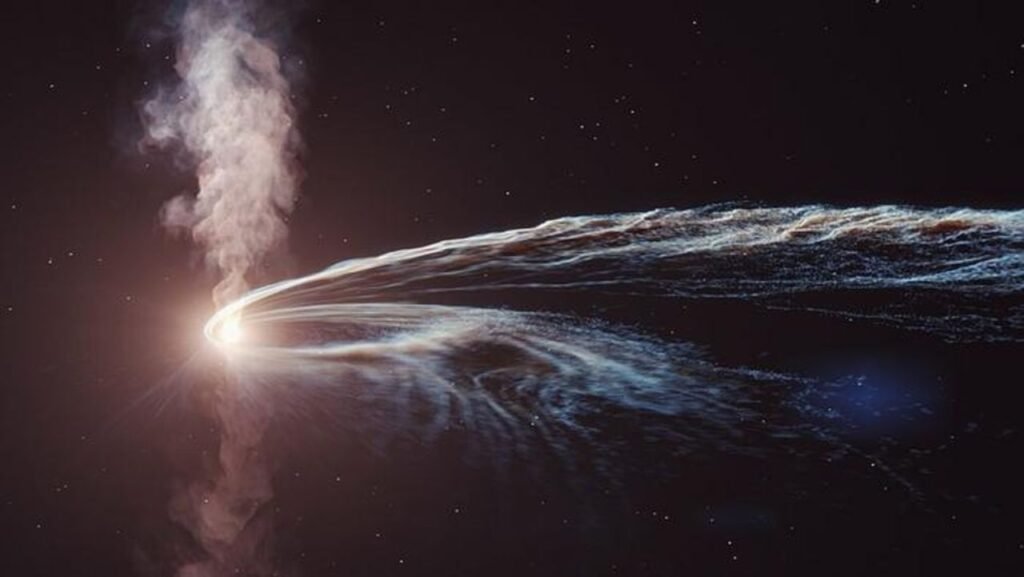

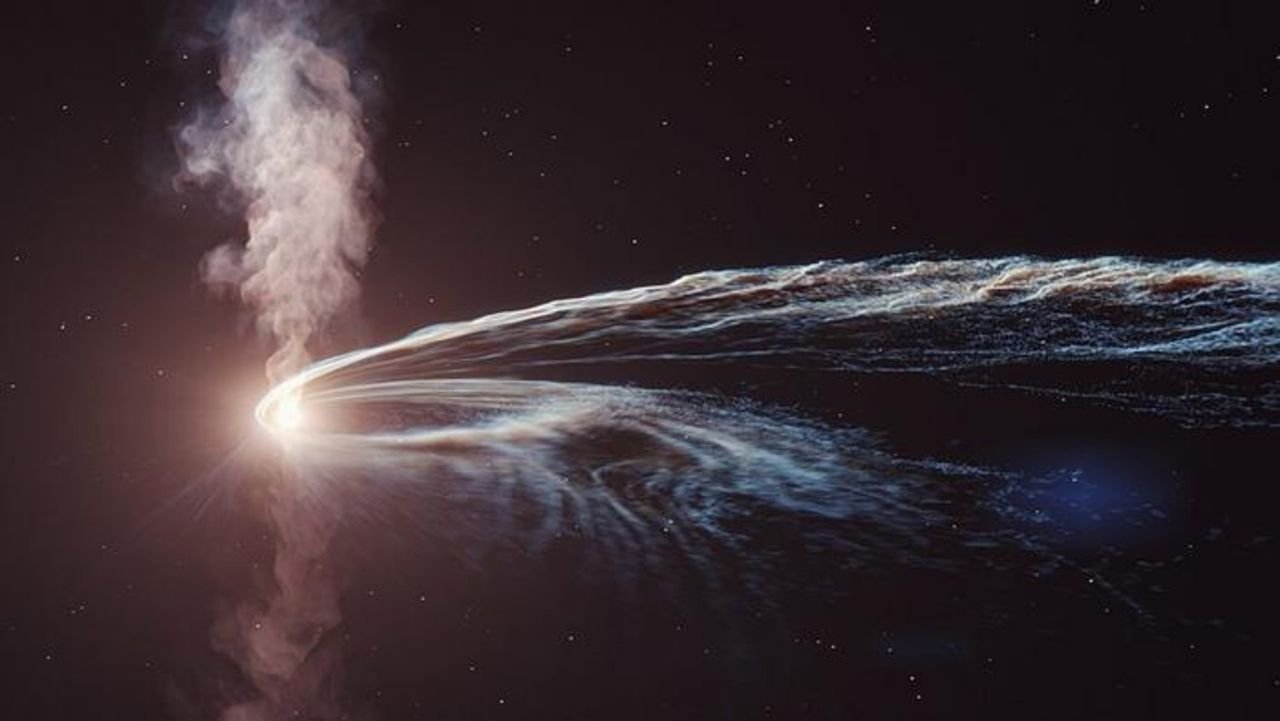
A Star Shredded, a Monster Awakens (Image Credits: Cdn.mos.cms.futurecdn.net)
A supermassive black hole in a serene galaxy 665 million light-years distant ripped apart a star and propelled a particle jet that vastly outpowers the Death Star’s legendary laser.[1][2]
A Star Shredded, a Monster Awakens
Picture the raw fury of tidal forces at work. One side of an unlucky star felt the black hole’s gravitational pull far stronger than the other, stretching and tearing the stellar body into oblivion.
This tidal disruption event, cataloged as AT2018hyz, occurred in 2018 within an otherwise unremarkable galaxy. Astronomers first spotted signs of the catastrophe that year, but the true spectacle emerged later.
Fragments of the doomed star spiraled into the black hole’s accretion disk. Magnetic fields channeled much of the material outward, forming a narrow jet of charged particles racing at nearly light speed.[1]
Relativistic jets like this appear in only about 1 percent of tidal disruptions. Most produce slower, spherical outflows far less energetic.
Energy Output Defies Comprehension
The jet’s power staggers the mind. Researchers peg its total energy at 5 x 10^55 ergs – orders of magnitude beyond ordinary cosmic events.
| Phenomenon | Peak Energy (ergs) |
|---|---|
| Sun’s solar maximum | 1033 |
| Typical TDE outflow | 2 x 1050 |
| AT2018hyz jet | 5 x 1055 |
Lead researcher Yvette Cendes, a radio astronomer at the University of Oregon, dubbed it “Jetty McJetface” after the internet-famous naming contest. She compared its might to Star Wars fiction: between a trillion and 100 trillion times the Death Star’s destructive yield.[1]
Any planets caught in its path faced annihilation. “Planets are going to be destroyed for the first few light-years,” Cendes stated. “I’m just not sure how far out from the jet this would be the case.”[1]
Brightening Years After the Feast
Initial observations in 2018 revealed no hint of this escalation. A quiet phase followed, likely as shredded stellar debris slowly formed the accretion disk.
Since 2022, radio emissions have surged, powered by synchrotron radiation from the jet’s particles. The beam has broadened and begun aligning more directly with Earth, boosting its apparent luminosity by 50 times over the original detection.[1]
- Jet decelerates, causing relativistic beaming effects.
- Energy climbs steadily toward a 2027 peak.
- Post-peak decline expected, but total output remains immense.
- Cendes cautioned on precise figures: “I am hesitant to give a final energy estimate – there are too many things that it will depend on that will become clear once we actually see the peak.”
Lessons from a Rare Relic
This enduring jet challenges models of black hole feeding. Years after the star’s demise, AT2018hyz continues to astonish with its vigor.
The findings appeared February 5 in The Astrophysical Journal. Cendes eyes future hunts with the Square Kilometer Array, which promises sensitive radio surveys to uncover similar rarities.
These events reveal how black holes sculpt their surroundings, blasting away gas and stars while regulating galaxy growth.
Key Takeaways
- AT2018hyz marks one of the brightest, longest-lasting TDE jets observed.
- Its power highlights magnetic fields’ role in jet formation.
- Upcoming telescopes may reveal more such cosmic powerhouses.
This jet reminds us of the universe’s violent underbelly. What implications do you see for our understanding of black holes? Share your thoughts in the comments.