

Imagine waking up in a world where you can feel electricity, see the Earth’s magnetic field, or hear with your skin. For humans, that sounds like science fiction. For many animals, that’s just an ordinary Tuesday. We share the planet with creatures that move through reality in ways we can’t directly experience, like living in the same room but in different dimensions.
I still remember the first time I read that sharks can detect the faint electrical field of a heartbeat from meters away. It felt almost unfair, like some animals got secret cheat codes to the universe. In this article, we’ll look at six species whose senses go so far beyond ours that even with science, we’re still mostly guessing what their world really feels like.
Sharks: Masters of Electroreception

Picture trying to find someone in the ocean with your eyes closed, in the dark, during a storm. That’s basically what a shark can do, except it cheats with a superpower: electroreception. Sharks have tiny jelly-filled pores on their snouts called the ampullae of Lorenzini that let them detect the faint electrical fields produced by the muscles and nerves of other animals. Every heartbeat, every muscle twitch, sends out a tiny signal, and sharks can pick it up even when visibility is terrible.
Humans have nothing like this. We can sense electric shocks, sure, but we can’t passively “feel” electricity at a distance the way sharks do. In murky water where sight and smell become unreliable, this sense is like having a built-in metal detector tuned to life itself. It’s so sensitive that scientists have had to carefully shield experiments to avoid interference from things like power cables or even the Earth’s own electric noise. When a shark zeroes in on a hidden fish under the sand, it’s not a lucky guess. It’s a different kind of vision – one made of electricity instead of light.
Bats: Seeing the Night with Sound
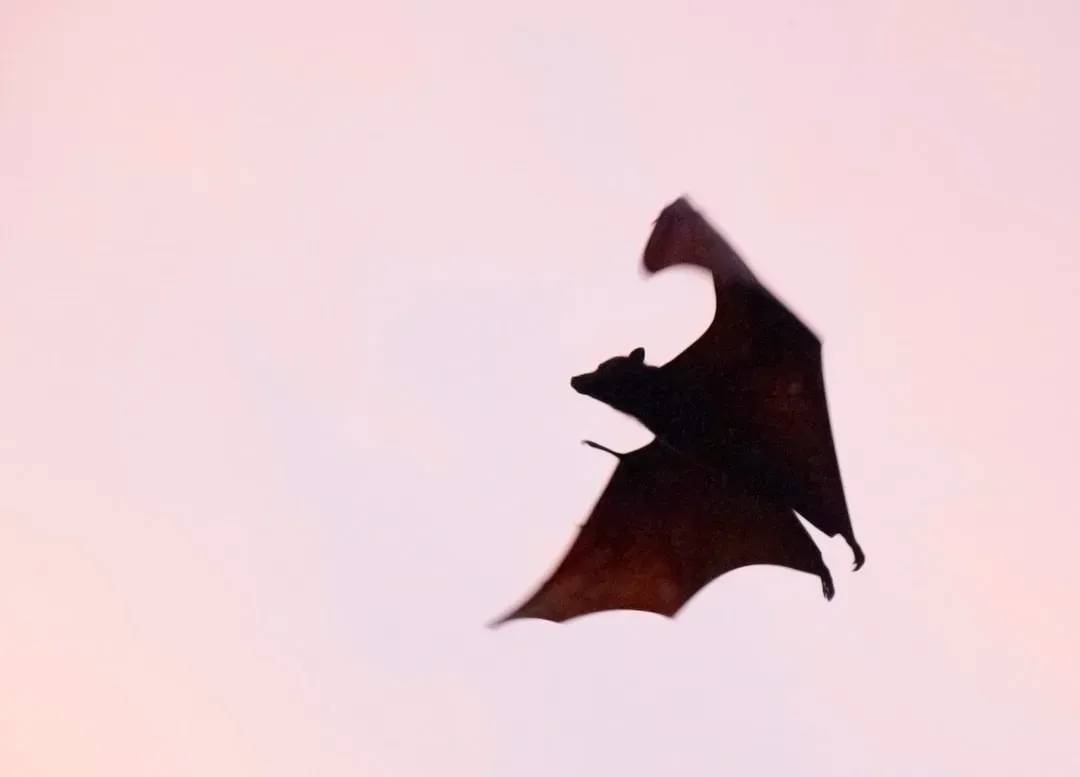
If sharks “see” electricity, bats “see” with sound. In the dark, many bat species navigate and hunt using echolocation: they emit high-pitched calls and read the echoes that bounce back from objects around them. To us, their calls are often too high to hear at all, but to a bat, every echo paints a detailed 3D map of the world, including the position, distance, and even texture of flying insects. It’s like living inside a constantly updating acoustic blueprint.
We try to imagine echolocation, but we always end up thinking of it as sharper hearing, which doesn’t really do it justice. Bats are not just hearing louder or better; they’re turning time delays and frequency shifts into spatial images. Their brains process these echoes incredibly fast, allowing them to dodge branches and catch insects in midair with a precision that would embarrass a drone. Humans can learn some basic click-based echolocation, and blind individuals sometimes use tongue-clicks to sense walls and doorways, but that’s like comparing a stick-figure sketch to a full-color photograph. Bats live in a sound-based reality we can only vaguely approximate.
Pit Vipers: Infrared Vision in the Dark

Now imagine being able to see heat. Not through a camera or gadget, but with your own body. Pit vipers, like rattlesnakes, have special heat-sensing organs called pit organs on their faces, between the eye and nostril. These organs can detect the infrared radiation given off by warm-blooded animals, allowing the snake to “see” a heat image of its surroundings, especially prey like rodents. Even in total darkness, a mouse glows like a lantern in the snake’s sensory world.
For us, infrared is something we associate with thermal cameras, night-vision gear, or action movies. For a pit viper, it’s part of daily reality. Research suggests their brains actually combine this heat information with normal vision, almost like layering a thermal filter over what their eyes see. So when a pit viper strikes at a moving target in the dark with eerie accuracy, it’s not guessing – it’s tracking a warm silhouette we can’t detect with our own senses. To humans, darkness is a barrier; to these snakes, it’s just a slight change in the user interface.
Mantis Shrimp: Supervision Beyond the Rainbow
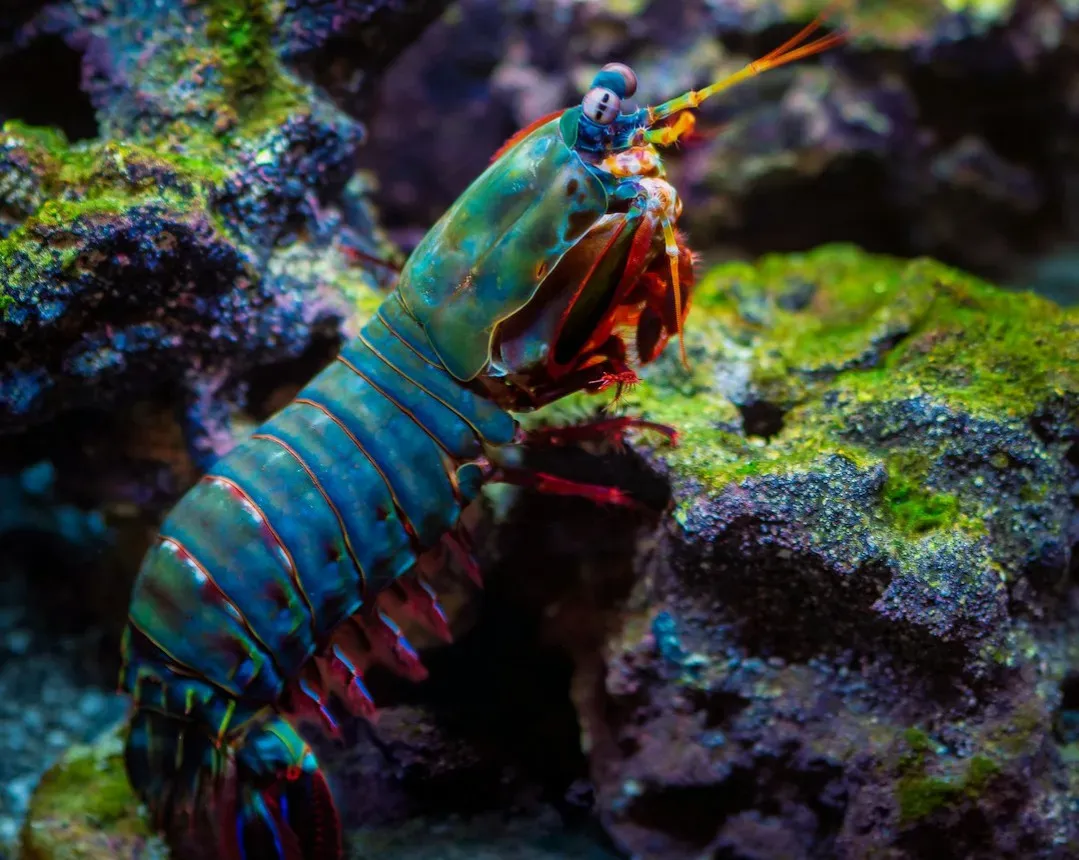
Mantis shrimp are small marine crustaceans with a sense of sight so over-the-top that it almost sounds like fiction. Human eyes rely on three types of color receptors. Many mantis shrimp species have a dozen or more, which means they’re sensitive to a much wider range of wavelengths, including parts of the ultraviolet spectrum that we never see. Their eyes are also divided into independent sections and can move each eye separately, giving them a level of visual complexity that is still being studied.
It’s tempting to say they “see more colors,” but that probably undersells what’s really going on. Some researchers think mantis shrimp might not be seeing a smoother gradient of colors, but instead using those extra receptors to very quickly recognize specific visual signals, like patterns on other mantis shrimp or subtle changes in the environment. They can also detect polarized light – light waves that vibrate in specific directions – which we don’t perceive at all without tools. To a mantis shrimp, the ocean likely glitters with hidden patterns and signals that are completely invisible to us, like a secret code painted across the water.
Homing Pigeons: Reading the Earth’s Magnetic Map

For centuries, people used homing pigeons to carry messages across great distances, long before GPS or smartphones existed. These birds are remarkably good at finding their way back home from places they have never flown before. One major clue to how they do it lies in their ability to sense the Earth’s magnetic field, turning it into a sort of invisible map they can follow. They combine this magnetic sense with vision, smell, and memory, but the magnetic piece is what truly lifts them into the realm of the uncanny.
We know the Earth’s magnetic field exists; we build compasses and navigation systems around it. But feeling it directly the way pigeons likely do is beyond us. Some studies suggest they might have magnetically sensitive cells in their tissues, while other research points to effects on specific proteins in the eye. The truth is, we still do not fully understand the exact mechanism. What we do know is that pigeons can orient themselves even when visual landmarks are unfamiliar or hidden, hinting that their sense of direction taps into a layer of reality that, for humans, remains abstract and invisible.
Elephants: Low-Frequency Vibrations Through the Ground

Elephants are famous for their size and memory, but their senses are just as fascinating. In addition to excellent hearing and a powerful sense of smell, elephants can detect low-frequency sounds and ground vibrations that travel over long distances. They communicate using rumbles so deep that many fall below the range of human hearing. These vibrations can move through the ground, and elephants pick them up through sensitive structures in their feet and trunk.
It’s a bit like having a built-in earthquake sensor that can also read messages. When a distant herd calls out or a storm rumbles far away, those vibrations can give elephants early warnings or social information long before anything is visible. Scientists have observed elephants reacting to distant thunder, approaching herds, or disturbances that humans nearby barely notice. While we depend mostly on air-borne sound and vision, elephants live in a sensory world layered with silent rumbles and subtle tremors, connecting them to events miles away in a way we can’t directly experience.
Conclusion: A Planet of Hidden Worlds

Once you start looking at senses beyond our own, you realize how narrow our slice of reality really is. Sharks feel electricity, bats sculpt the night from echoes, and pit vipers see heat where we see nothing. Mantis shrimp swim through a riot of colors and polarized patterns, pigeons trace invisible magnetic highways, and elephants listen to the ground itself. It’s not that humans are “worse” or “better” than these animals; we just evolved a different toolkit tuned to our particular survival needs.
To me, that’s both humbling and a little thrilling. Every time we learn more about animal senses, we get a reminder that the world is richer than what fits into our eyes, ears, and skin. There are signals buzzing, glowing, vibrating, and flowing around us all the time that we’ll never directly feel without technology. Maybe the strangest truth is this: our idea of “the real world” is just what our senses happen to pick up. Knowing that, how many other hidden worlds might still be out there, waiting just beyond our perception – what do you think we’re still missing?