
Think quantum mechanics is just some abstract theory for physicists in white lab coats? Think again. The strange, unpredictable world of atoms and subatomic particles is working behind the scenes in your life right now. Every time you check your phone, navigate with GPS, or scroll through photos on your screen, you’re benefiting from principles that would have seemed like pure science fiction a century ago.
Here’s the thing: quantum mechanics doesn’t just exist in laboratories or university textbooks. It’s the invisible force powering the technology you use every day, and it’s quietly shaping your reality in ways you’d never expect. Let’s dive into five surprising ways this bizarre branch of physics touches your life.
Your Smartphone Relies on Quantum Tunneling to Function
You probably take your smartphone for granted, tapping away without a second thought about how billions of tiny transistors inside it manage to process information at lightning speed. Your smartphone contains billions of transistors, each operating based on the quantum mechanical properties of semiconductor materials. These microscopic switches control the flow of electricity through silicon chips, and they couldn’t work without a quantum phenomenon called tunneling.
Here’s where it gets weird. Quantum tunneling is a quantum mechanical phenomenon in which an object such as an electron or atom passes through a potential energy barrier that, according to classical mechanics, should not be passable. Imagine you’re trying to roll a ball over a hill, but you don’t give it enough energy. In our everyday world, the ball would just roll back down. In the quantum world, though, that ball could magically appear on the other side of the hill without ever climbing over it. That’s tunneling.
Flash memory chips found in USB drives use quantum tunneling to erase their memory cells. Every time you save a photo, delete an app, or store a document on your phone, electrons are tunneling through barriers that would be impossible to cross in the classical physics world. Without this quantum trick, your phone would be nothing more than an expensive paperweight.
GPS Navigation Depends on Atomic Clocks and Quantum Precision
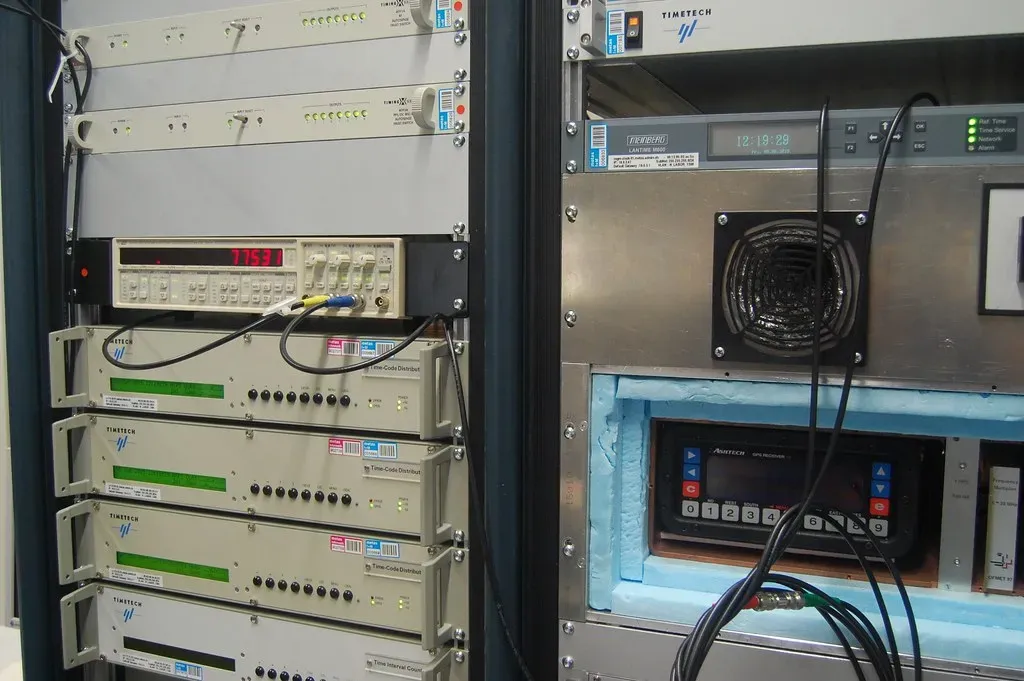
When you ask your GPS to guide you to the nearest coffee shop, you’re tapping into one of the most precise timekeeping systems ever created. Atomic clocks are integral to global positioning systems, including those found in our mobile phones. These clocks don’t rely on gears or quartz crystals. Instead, they measure time using the vibrations of atoms, specifically the energy transitions of electrons jumping between quantum states.
Atomic clocks are calibrated against the microwave frequency required to move an electron in an atom or ion from a lower quantum energy state to a higher one. Using this technology, time can be measured within a margin of error of only 1 second in up to 100 million years. That kind of accuracy isn’t just impressive. It’s essential. Even a tiny timing error of just one nanosecond translates to roughly 30 centimeters of positional error when multiplied by the speed of light.
There’s more to the story. A GPS satellite clock will gain about 38 microseconds per day over a clock at rest at mean sea level. This happens because of relativistic effects predicted by Einstein’s theories. If these effects were not properly taken into account, a navigational fix based on the GPS constellation would be false after only 2 minutes, and errors in global positions would continue to accumulate at a rate of about 10 kilometers each day! Quantum mechanics keeps your navigation accurate to within meters, guiding you safely through unfamiliar streets.
Photosynthesis Uses Quantum Superposition to Power Life on Earth

This one might sound crazy, but plants are way more sophisticated than they appear. When a leaf captures sunlight and converts it into chemical energy, it’s not just a simple chemical reaction. Photosynthesis happens at close to 100% efficiency, and recently, solutions based on quantum mechanics have demonstrated how plants can achieve photosynthesis with high conversion efficiency. That near-perfect efficiency has puzzled scientists for decades.
Researchers discovered something remarkable. Plants are employing the basic principles of quantum mechanics to transfer energy from chromophore to chromophore until it reaches the so-called reaction center where photosynthesis, as it is classically defined, takes place. In simpler terms, when light hits a plant, it creates tiny packets of energy called excitons. These excitons don’t just hop randomly from one molecule to another like a ball bouncing down stairs. Instead, they exploit quantum superposition, essentially exploring multiple pathways simultaneously to find the most efficient route.
Experiments show electron absorption and transfer with an efficiency of above 99%, which cannot be explained by classical mechanical models. So every time you admire the greenery in a park or eat a salad, you’re witnessing quantum mechanics at work. Plants have been using this quantum trick for billions of years, long before humans even understood what quantum mechanics was. Nature figured it out first.
Quantum Tunneling Powers the Sun and Keeps You Alive

Let’s talk about the sun. Every second, our star produces an enormous amount of energy through nuclear fusion, where hydrogen atoms combine to form helium. This process is what lights up the sky, warms the planet, and makes life possible. There’s just one problem: for fusion to happen, hydrogen nuclei need to overcome an incredibly strong repulsive force. They’re both positively charged, and like charges repel each other.
The sun’s energy comes from nuclear fusion – hydrogen atoms combining to form helium – a process only possible because of quantum tunneling. This quantum mechanical effect allows particles to pass through energy barriers that would be impossible in classical physics. Without quantum tunneling, the sun couldn’t produce the energy that sustains life on Earth. In classical physics, the temperatures and pressures at the core of the sun shouldn’t be enough to force these particles together.
Quantum tunneling changes the game. Particles acting like waves, undergo quantum tunneling and pass through the repulsive electric field barrier. Rather than needing to physically overcome the barrier with brute force, the hydrogen nuclei essentially slip through it like ghosts passing through walls. This allows fusion to occur at lower energies than classical physics would predict. Without this quantum phenomenon, the sun would be a cold, dark rock floating in space, and you wouldn’t be here to read this.
MRI Scans Depend on Quantum Spin to See Inside Your Body

If you’ve ever had an MRI scan, you’ve experienced quantum mechanics firsthand. MRI is a technique for visualizing tissues that takes use of the physical phenomenon of nuclear magnetic resonance, which is the union of quantum mechanics with classical electrodynamics. The machines use powerful magnets to interact with hydrogen atoms in your body, specifically targeting the quantum property called spin.
Particles that make up the atomic nuclei (protons and neutrons) have the intrinsic quantum mechanical property of spin. In nuclear physics the total angular momentum that the nucleus has is called nuclear spin. When you lie inside an MRI machine, the magnetic field causes these spinning nuclei to align in specific directions. Radio waves then nudge them out of alignment, and as they snap back into place, they emit signals that the machine detects and converts into detailed images of your organs, bones, and tissues.
The technique of hyperpolarization boosts the effective magnetization of the nuclear spins by factor of 10,000 to 100,000, thereby significantly increasing the sensitivity of MRI. Researchers are now working on quantum-enhanced MRI techniques that could make scans even more sensitive, potentially detecting diseases like cancer at much earlier stages. Without quantum mechanics, doctors wouldn’t have this powerful window into the human body, and countless medical diagnoses would be impossible.
Conclusion

Quantum mechanics isn’t some esoteric theory reserved for scientists in ivory towers. It’s the hidden engine driving your smartphone, guiding your GPS, powering the plants that feed you, fueling the sun that warms you, and enabling the medical scans that save lives. From the smallest atoms to the vast scale of our solar system, quantum effects shape the world in profound and surprising ways.
The next time you use your phone or glance at the sun, remember: you’re interacting with one of the strangest, most fascinating branches of science ever discovered. What do you think about it? Did any of these quantum connections surprise you?
Hi, I’m Andrew, and I come from India. Experienced content specialist with a passion for writing. My forte includes health and wellness, Travel, Animals, and Nature. A nature nomad, I am obsessed with mountains and love high-altitude trekking. I have been on several Himalayan treks in India including the Everest Base Camp in Nepal, a profound experience.