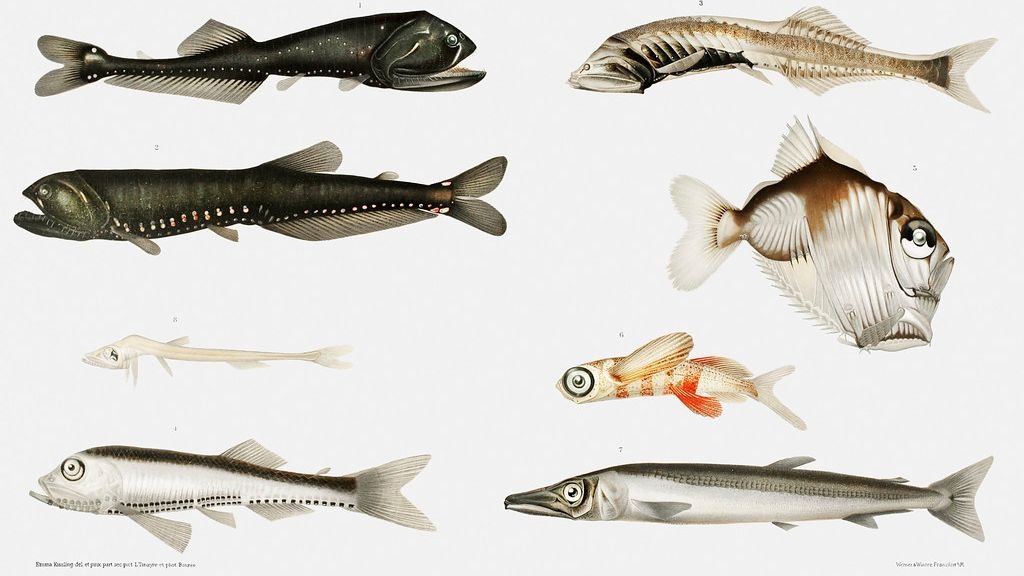

You’ve probably gazed up at a starry sky and wondered if something truly alien is out there. But honestly, you might be looking in the wrong direction. Beneath the surface of our oceans, past the point where sunlight gives up and turns back, an entirely different world exists – one packed with creatures so bizarre, so unsettling, and so impossibly strange that science fiction writers have been borrowing from them for decades.
The deep sea is home to weird and wonderful creatures that, over millions of years, have evolved specific traits to survive the extreme conditions of their habitat, resulting in some truly alien-looking animals. The deeper you go, the more surreal the life gets. These are five of the most jaw-dropping examples. Let’s dive in.
1. The Anglerfish: A Living Nightmare with a Glowing Lure
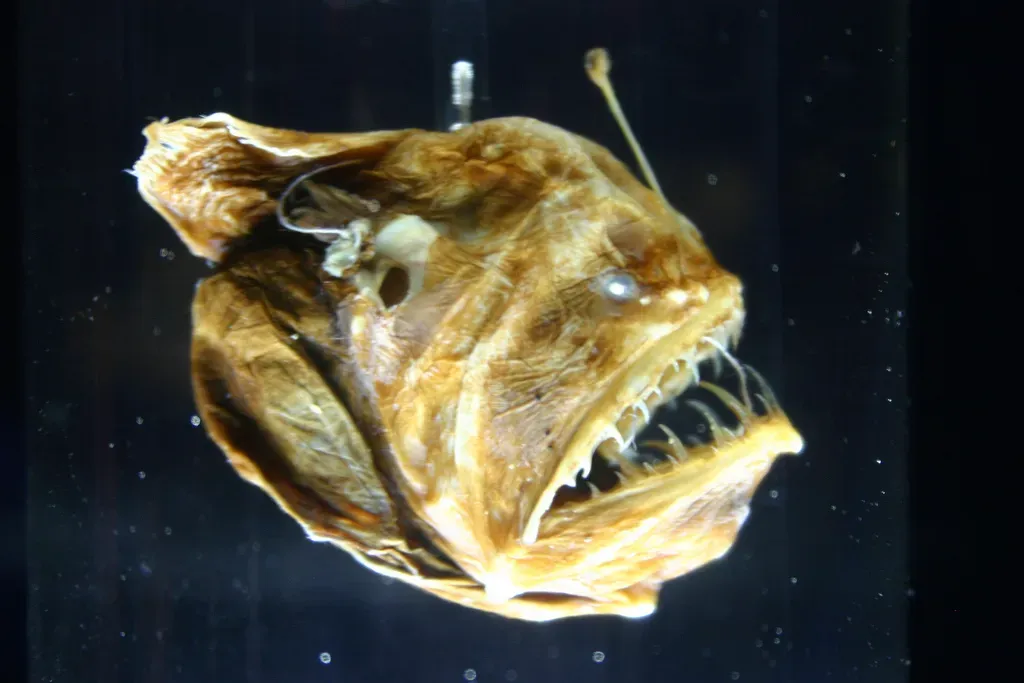
Looking at an anglerfish, you might have a hard time telling if it’s an actual fish or an extraterrestrial creature. Besides the bioluminescent lure at the top of its head, which it uses to attract prey, the anglerfish is characterized by distorted jawlines with sharp, needle-like teeth. It’s the kind of face that belongs in a horror film, not a science textbook. Yet here it is, thriving in the absolute darkness of the deep ocean.
Anglerfish are deep-sea predators known for their glowing bioluminescent lure, which they use to attract unsuspecting prey in the pitch-black waters of the ocean’s abyss. Their otherworldly traits extend to their reproductive habits, as males permanently fuse to females, becoming little more than a living appendage. I think that last part might be the strangest biological fact you’ll read all year. There are over 200 species of deep-sea anglerfish in a variety of shapes and sizes, from the recognisable toothy jaws of the black seadevil to the bottom-dwelling sea toad called coffinfish.
2. The Barreleye Fish: The Creature with a See-Through Head
![2. The Barreleye Fish: The Creature with a See-Through Head ([https://archive.oceanexplorer.noaa.gov/explorations/24skq-ak-seamounts/gallery/gallery.html#Exploring Pelagic Biodiversity of the Gulf of Alaska and the Impact of Its Seamounts], Public domain)](https://nvmwebsites-budwg5g9avh3epea.z03.azurefd.net/dws/ac0cc58f29e58e34beebc900d05e77df.webp)
Exploring Pelagic Biodiversity of the Gulf of Alaska and the Impact of Its Seamounts], Public domain)
The barreleye fish is a bizarre and fascinating deep-sea creature characterized by its dome-shaped, transparent head. Its tubular eyes usually point upward, allowing it to spot prey silhouetted against the faint light from above. If the need arises, the eyes can rotate forward. When you compare these features with the barreleye fish’s relatively smaller body, you have the perfect alien-like marine creature. It’s like nature built a submarine periscope into a fish’s skull.
Discovered in 1939, when it was pulled from its habitat 762 meters below the surface, the fish has a transparent head. Within its transparent head, you will see two sensitive barrel-shaped eyes, which are constantly pointed upwards, allowing the fish to see the silhouettes of its prey. Scientists believe this clear head allows the fish to collect just a bit of light to hunt fish. Here’s the thing – the discovery that barreleye fish have transparent heads was made relatively recently, as usually the head is damaged even before reaching the surface. For years, scientists were looking at broken specimens and missing the whole picture.
3. The Dumbo Octopus: Adorably Alien from the Abyss
![3. The Dumbo Octopus: Adorably Alien from the Abyss ([1], Public domain)](https://nvmwebsites-budwg5g9avh3epea.z03.azurefd.net/dws/f2adfcac801f595018a2b04b333044e0.webp)
Scientifically known as Grimpoteuthis, the Dumbo octopus is an alien-like deep-sea creature. It has two prominent ear-like fins which extend from the mantle above each eye. The marine animal got the name “Dumbo” from a Disney character with the same name and similar appearance. Dumbo octopuses feed on worms, bivalves, crustaceans, and copepods.
They are the deepest-living octopuses known to researchers, with some specimens observed at hadal depths. Interestingly, Dumbo octopuses do not have ink sacs, as is the case with regular octopuses. Since they mainly inhabit deep seas, Dumbo octopuses don’t have to evade predators using ink clouds. The biggest Dumbo octopus ever recorded was 5 feet 10 inches long – which is, let’s be real, far larger than you’d ever want to encounter in the dark. Still, scientists who have come across them describe their demeanor as surprisingly gentle.
4. The Antarctic Strawberry Feather Star: A 20-Armed Horror Beauty
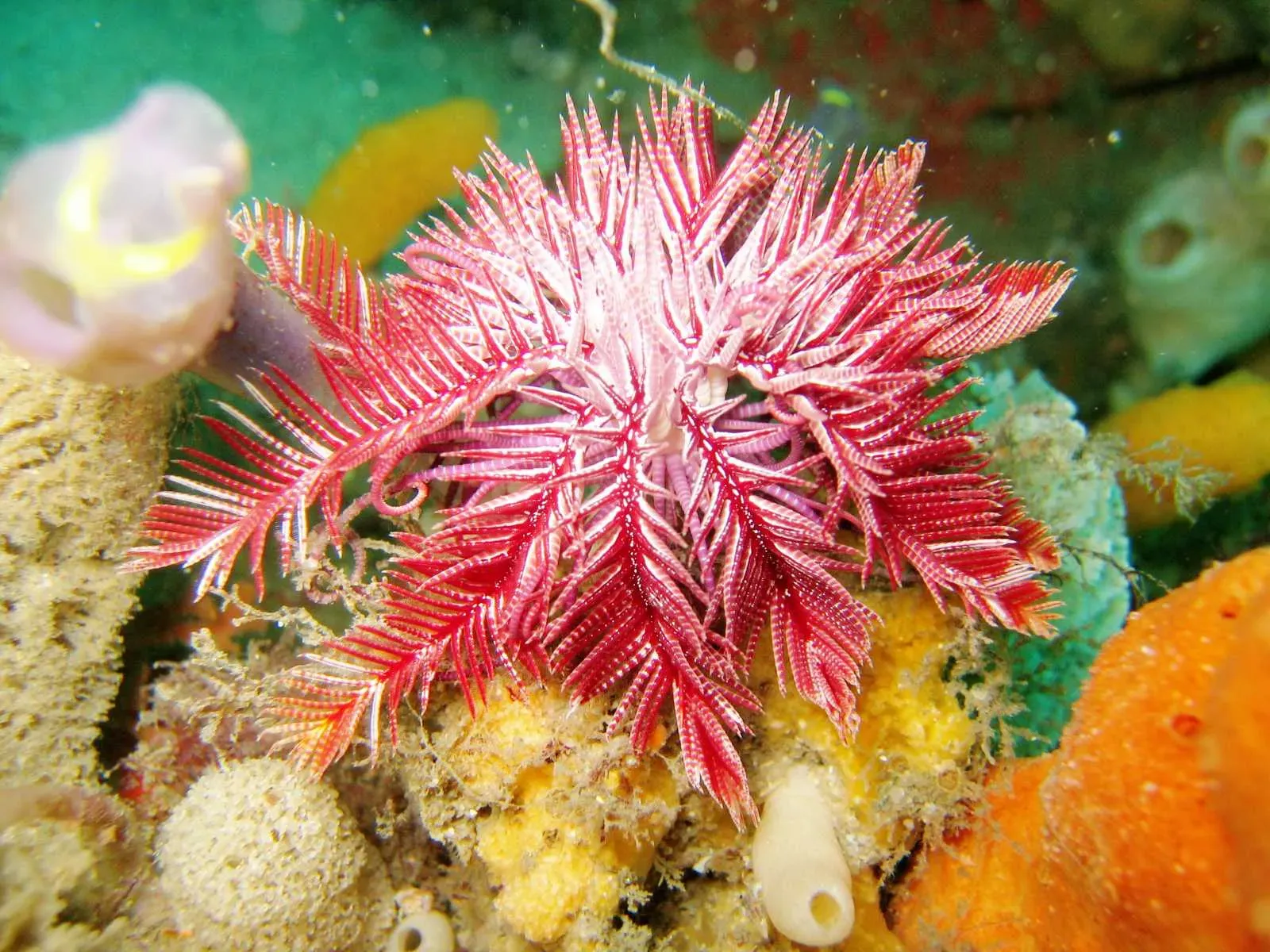
Researchers have discovered an otherworldly, 20-tentacled creature lurking in the freezing depths of the Antarctic Ocean. Resembling an alien or a Lovecraftian horror, the Antarctic strawberry feather star (Promachocrinus fragarius) is one of four new species of crinoids that scientists found at the bottom of the ocean. It’s the kind of creature you’d expect to see swimming past a spaceship window, not floating through Earth’s southern seas.
The Antarctic strawberry feather star gets its name from the strawberry-like nub on its body, from which stringlike appendages called cirri protrude to anchor the animal to the seafloor. When feather stars take flight, they spread their arms wide and paddle with rhythmic pulses, dancing through the water and capturing plankton with thousands of tiny, mucousy filaments along their arms. At least eight species of the strange creatures live in the waters surrounding the southernmost continent, at depths ranging from about 330 to 3,300 feet. It sounds almost graceful – until you see those arms.
5. The “E.T. Sponge”: The Deep-Sea Creature That Named Itself After a Movie
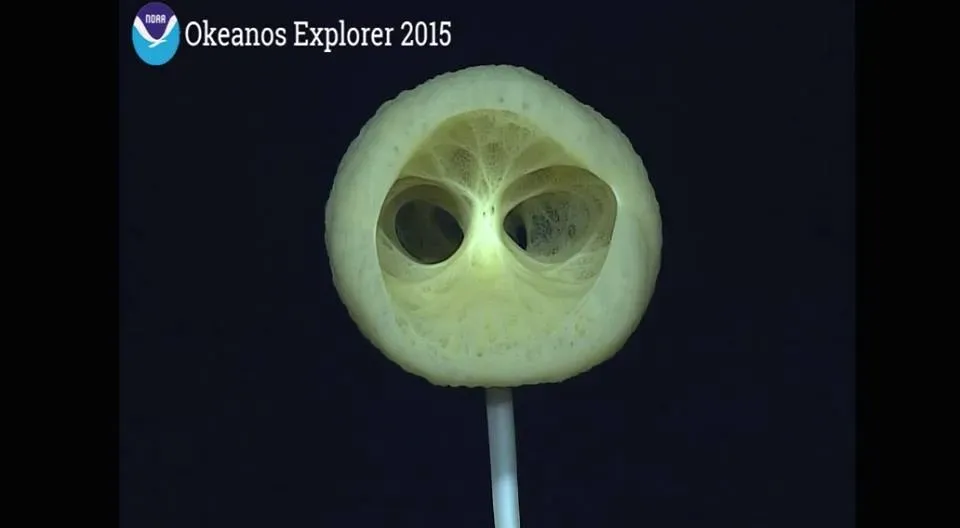
On July 9, 2020, the National Oceanic and Atmospheric Administration Office of Exploration and Research announced that a deep-sea team had discovered a new type of sponge that resembles the iconic alien. This alien-like creature was found growing on a section of the Pacific seafloor that dates back as far as 145 million years. Known as the “Forest of the Weird,” this extraordinary seascape lies more than 7,800 feet below the ocean’s surface, where strange organisms appear to grow directly from the rocky seabed.
In 2020, scientists scientifically named these creatures Advhena magnifica, meaning “magnificent alien.” One of these unusual creatures is now known as the “E.T. sponge,” thanks to its tall stalk and two large openings that resemble E.T.’s eyes. The sponge represents a new species and genus of glass sponge, a group of animals that attach themselves to hard surfaces and feed on tiny bacteria and plankton. Honestly, the name fits so perfectly it’s almost unsettling. A creature floating in the pitch-black deep, staring up at you with what looks like movie eyes, feeding silently in a place humans have barely visited.
Conclusion: The Aliens Were Here All Along
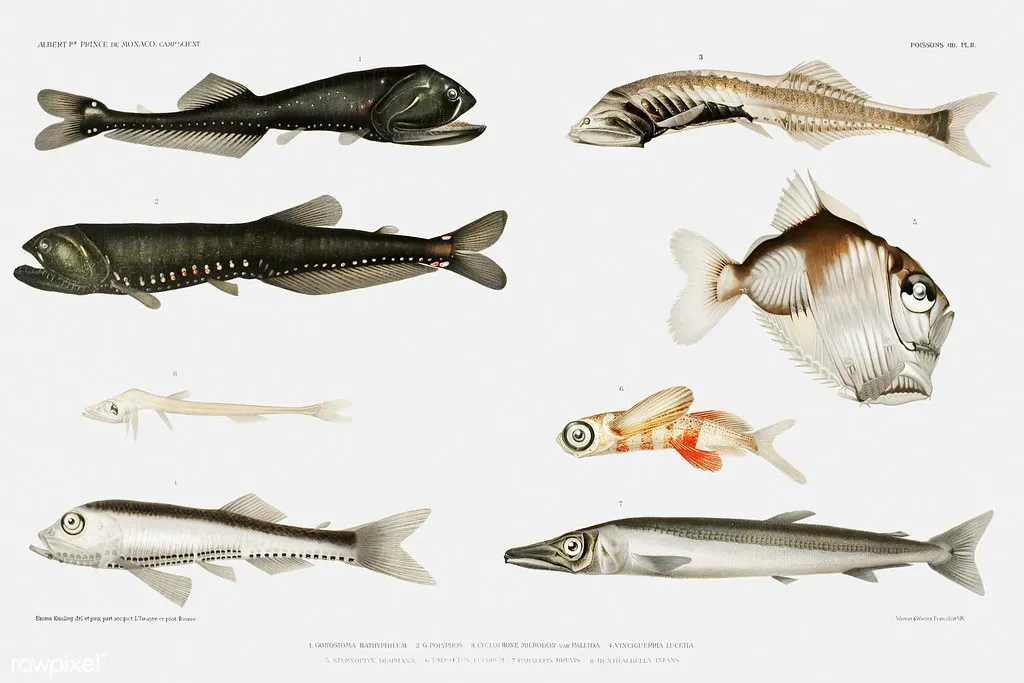
You don’t need to look to the stars to find life that seems to defy everything you understand about biology. Scientists define the deep sea as encompassing all ocean waters below 656 feet (200 meters). In these regions, sunlight filtering through the water from above begins to dwindle, giving way to a realm of complete darkness, frigid temperatures, and crushing pressure. Within that hostile darkness, evolution has been doing its most creative, most outrageous work for millions of years.
With only 5% of the ocean explored, it remains one of the most mysterious places on Earth. Every expedition that ventures deeper tends to return with something new – something that rewrites what we thought was possible. These findings suggest that life can thrive in conditions once deemed uninhabitable, drawing parallels to extreme environments on distant planets.
The next time someone asks you where you’d go to find alien life, you might just point toward the ocean floor. The creatures down there have been waiting, evolving, and surviving in total darkness long before anyone thought to look. What do you think – are these deep-sea creatures stranger than anything science fiction has dreamed up? Tell us in the comments.