
Most people assume prehistoric art is just crude stick figures scratched by simple minds. The deeper archaeologists dig, though, the more that assumption falls apart.
Scattered across five continents are cave paintings depicting perfectly rendered astronomical events, human-animal hybrids with more narrative complexity than a modern comic strip, and art created by beings who, according to the textbooks, weren’t even supposed to be capable of symbolic thought yet. Some of these images are tens of thousands of years older than the “first art” timeline taught in school. Here’s what the actual dating science and archaeological record reveal.
#1 – The “Martian Gods” of the Sahara
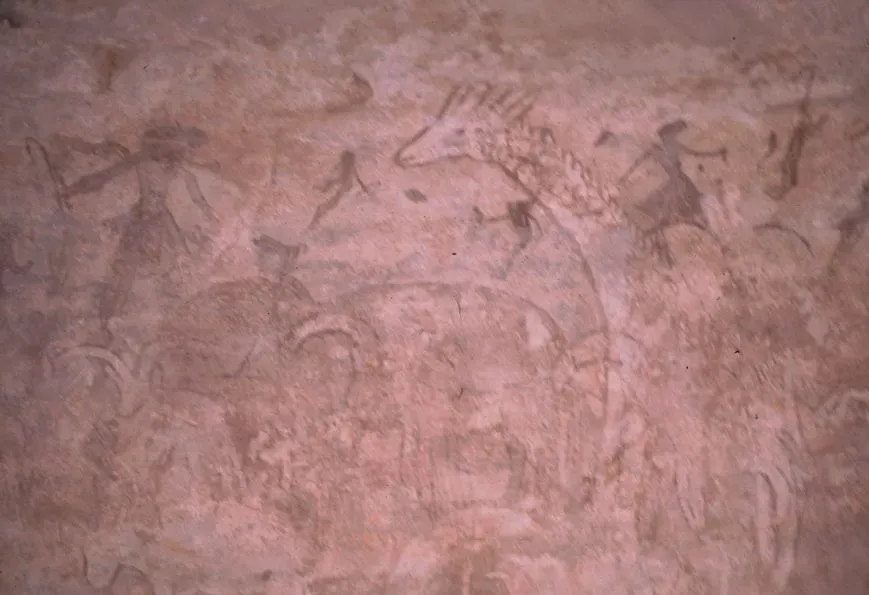
Deep in the Algerian desert sits a gallery of towering humanoid figures that even the archaeologist who found them couldn’t resist nicknaming after aliens.
The discoverer of the paintings, French archaeologist Henri Lhote, baptized one of them “the great Martian god” back in 1933. The figure isn’t small either – it’s part of a collection of prehistoric paintings with gigantic human images, one of which stretches more than six meters high. These belong to what researchers now call the Round Head Period, and the figures are strange by any standard: rock paintings dating back about 8,000 years depicting anthropomorphic beings with round heads, a feature so distinctive it gave its name to the entire cultural period.
What makes the imagery genuinely eerie isn’t just the bulbous heads. The paintings portray human forms with disproportionately enlarged, often featureless circular heads, elongated or amorphous bodies, and many figures appear to float, swim, or hover in empty space rather than standing grounded on a landscape. Mainstream researchers tie this to shamanic trance states, not visitors from space – but that hasn’t stopped the theory from spreading for decades. But that’s nothing compared to what we found about #2.
#2 – Italy’s Carved “Astronaut”
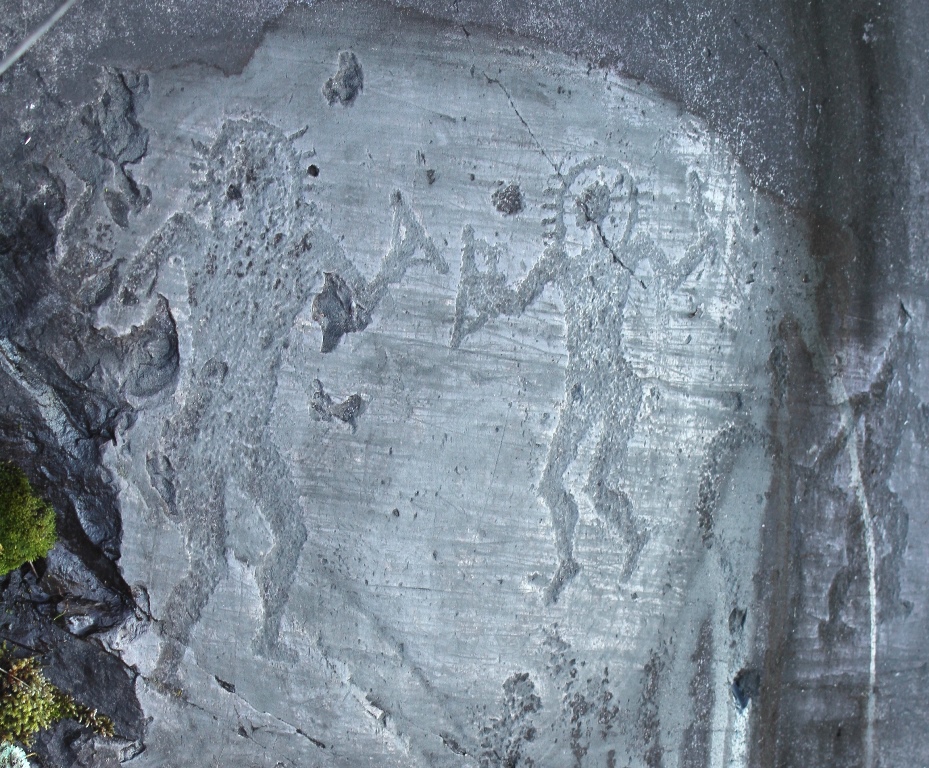
Tucked into the Camonica Valley in northern Italy is a petroglyph that ancient astronaut theorists have been pointing to for half a century.
The figure – sometimes called the “Anvoia” or simply “the astronaut of Val Camonica” – features a rounded, helmet-like head and antenna-like projections that, from a certain angle, do look uncannily like a spacesuit. It’s part of one of the largest collections of prehistoric rock art in the world, with tens of thousands of individual carvings spanning thousands of years of use by different cultures moving through the valley. The carving predates any concept of spaceflight by millennia, yet its silhouette keeps getting compared to modern EVA suits.
Archaeologists who specialize in Alpine rock art classify the figure as a stylized human shape from a later prehistoric period, likely representing a warrior, deity, or ritual dancer wearing a headdress rather than anything extraterrestrial. The “helmet” is almost certainly a stylized crown or ceremonial mask, a common motif across Iron Age European carvings. Still, the resemblance is close enough that the site has become a pilgrimage spot for fringe theorists – and a headache for archaeologists trying to explain simple artistic convention. But #3 involves an entire supernova explosion caught in stone.
#3 – The Star That Shouldn’t Have Been Recorded
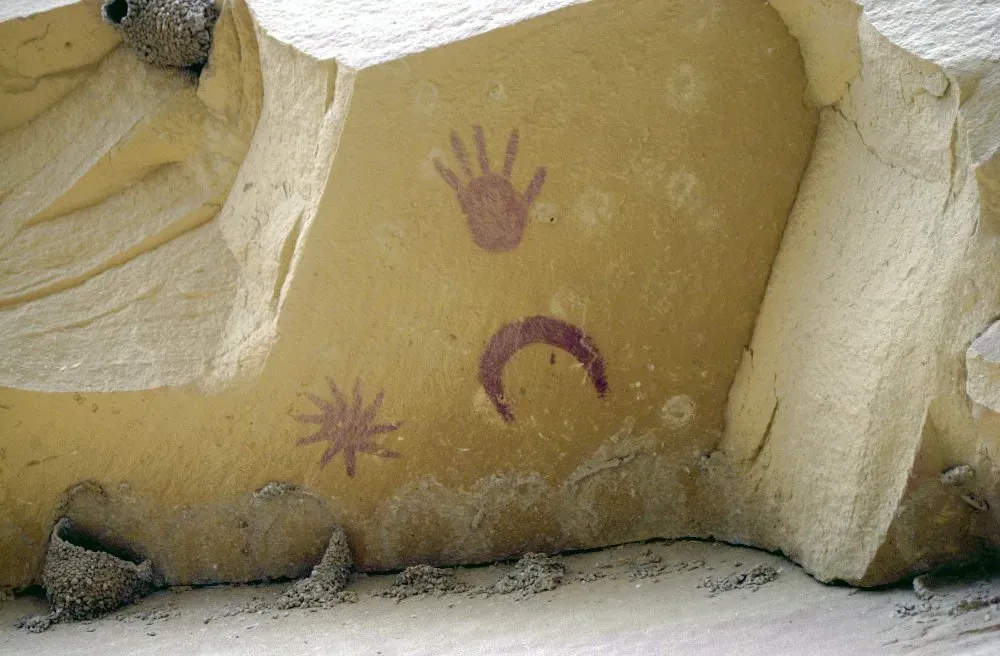
In New Mexico’s Chaco Canyon, ancient sky-watchers may have done something modern astronomers only confirmed centuries later: they recorded the birth of the Crab Nebula in real time.
A pictograph associated with the Ancestral Puebloan culture found in Chaco Canyon may depict a supernova first observed on July 4, 1054 A.D., the remnant of which is known today as the Crab Nebula. That supernova wasn’t subtle – it reached a maximum brightness about ten times that of Venus, remained visible by day for 23 days, and stayed visible by night for 653 days. The panel itself is deceptively simple: it contains just three symbols – a large star, a crescent moon, and a hand print.
What makes this genuinely startling is the astronomical precision. The orientation of the star to the right of the crescent corresponds to the pre-dawn appearance of the supernova and the moon on July 5, 1054, directly across the canyon. Skeptics point out that a star-and-crescent pairing is a common motif worldwide, so the “supernova theory” remains debated among archaeoastronomers. But if it’s accurate, a civilization with no telescopes captured a one-time cosmic event with better positional accuracy than most amateur sky charts today. #4 takes us underground to a scene involving a dying man, a disemboweled bison, and a bird that scientists still can’t explain.
Fast Facts
- Supernova first observed: July 4, 1054 A.D.
- Peak brightness: roughly 10 times that of Venus
- Visible in daylight for 23 straight days
- Visible at night for 653 days total
- Panel contains just three symbols: star, crescent moon, hand print
#4 – The Dying Man of Lascaux’s Shaft
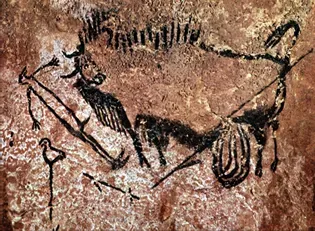
Buried in a deep pit inside France’s Lascaux cave is one of the most argued-over images in all of prehistoric art: a man with a bird’s head, seemingly dead or in trance, beside a wounded bison.
Unlike the confident, naturalistic animals painted throughout the rest of Lascaux, this figure is crude, almost sketch-like – a stick-man beside an erect bird-topped staff, with a rhinoceros walking away in the background. The drawing dates to between roughly 14,000 and 21,000 years ago, making it one of the oldest depictions of a human-animal hybrid figure in Western European art. The scene sits in a hard-to-reach shaft, suggesting it wasn’t meant for casual viewing – it may have been reserved for initiates only.
Interpretations range from a shamanic vision of death and rebirth to a literal hunting accident memorialized in paint. What nobody disputes is the composition’s ambition: it’s not a single animal outline, it’s a multi-figure narrative with implied motion, cause, and consequence – the kind of storytelling structure you’d expect from a much later, more “developed” culture. Most textbooks call cave art simple decoration. This scene argues otherwise. But #5 is even stranger – a panel of tied-up figures that some researchers think depicts an actual execution.
#5 – Sicily’s Bound Figures of Addaura
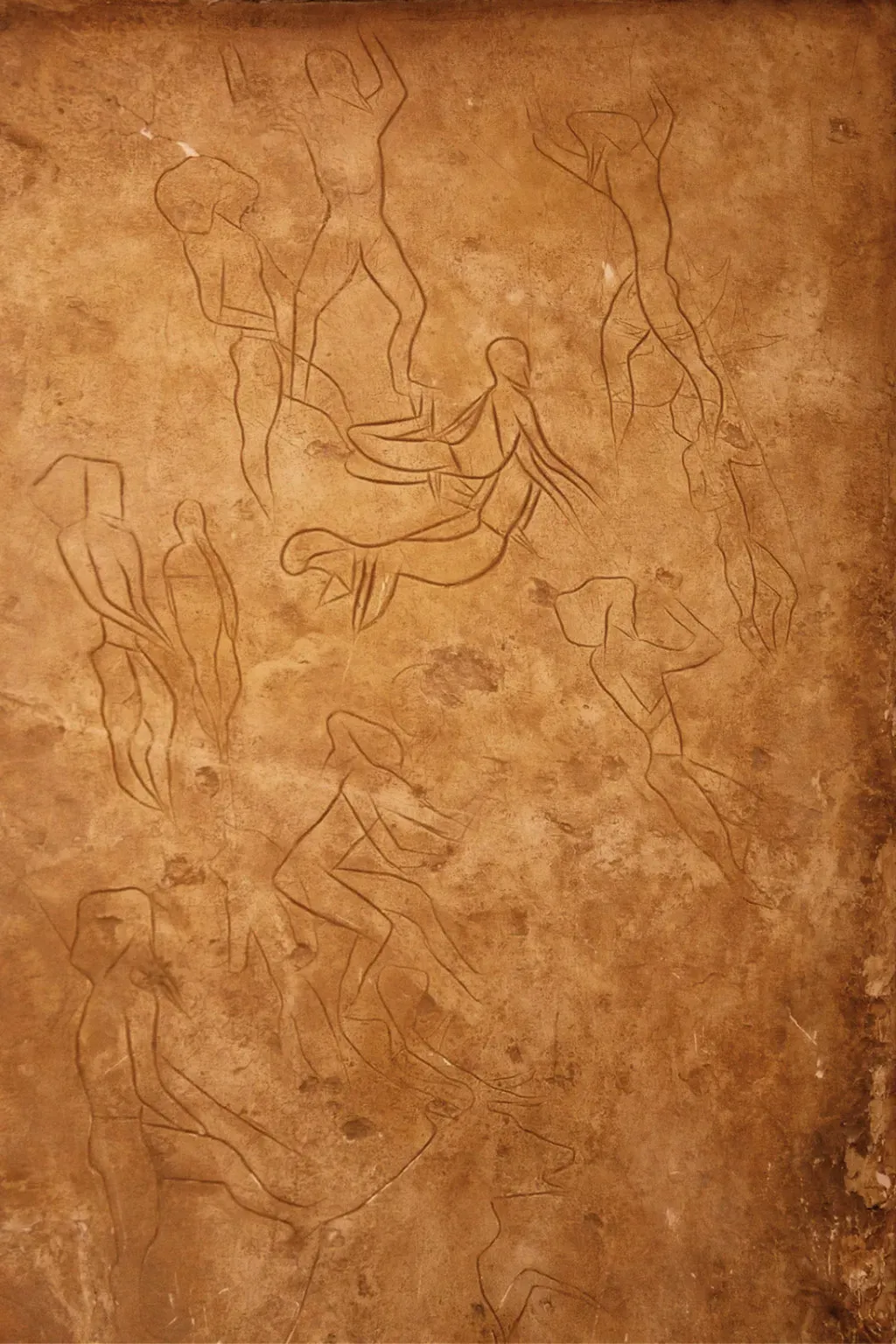
On the slopes of Mount Pellegrino in Sicily, Upper Paleolithic engravers carved a scene so unsettling that archaeologists still argue about whether it depicts a dance, a sport, or a ritual killing.
The Addaura engravings show a group of human figures surrounding two central individuals who appear bent backward, limbs contorted, with lines some researchers interpret as ropes or restraints. Early theories proposed a fertility rite or an athletic contest gone wrong. Others have suggested something far darker: a ritualized human sacrifice, with the surrounding figures acting as witnesses or participants. The central figures’ extreme, almost impossible body positions are what keep this panel controversial decades after its discovery.
No consensus has ever been reached, and that ambiguity is exactly what makes the site so compelling to keep studying. Unlike animal hunting scenes, which have fairly intuitive explanations, a circle of human figures around two bound, contorted bodies doesn’t slot neatly into any obvious “daily life” category. It suggests early humans were already using art to record complex, symbolic – possibly disturbing – social events, not just meals on the hoof. But #6 shows a rock art panel some archaeologists call the oldest true “storyboard” in North America.
#6 – Texas’s Cosmic Storyboard
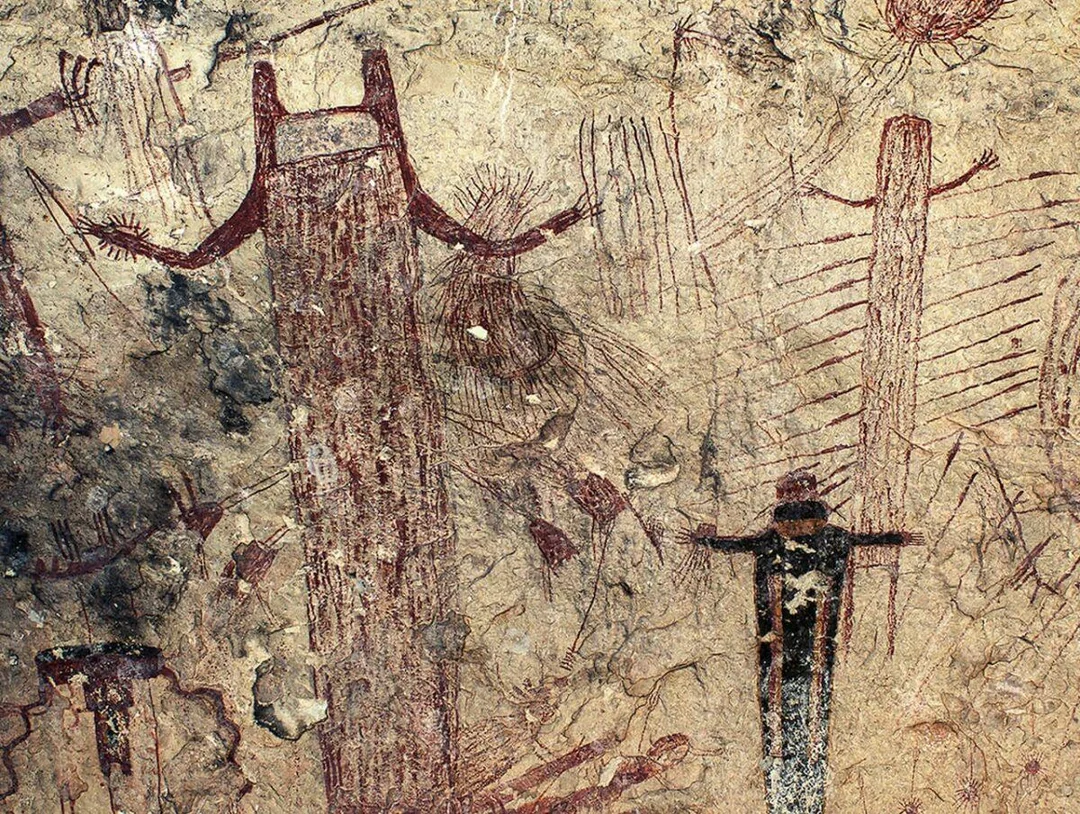
In the limestone canyons along the lower Pecos River in Texas sits a mural so densely layered with symbolism that one archaeologist spent decades just learning to “read” it.
The White Shaman mural stretches across a rock shelter wall and combines dozens of interlocking figures – deer, antlered serpents, spear-throwers, and elongated humanlike forms – into what researcher Carolyn Boyd has argued is a single, coherent origin narrative rather than a random accumulation of images. That’s a bold claim, because most rock art sites are treated as a patchwork of unrelated additions made over centuries. If Boyd’s interpretation holds, this panel would be one of the oldest sustained pictorial narratives ever identified in the Americas, painted by hunter-gatherers with no written language.
Comparisons have been drawn between the mural’s imagery and origin stories still told by Indigenous communities in the region today, suggesting a startling continuity of belief systems across thousands of years. That’s the part that unsettles archaeologists most: not that ancient people made art, but that the ideas behind the art may have survived, largely intact, for far longer than most oral traditions are assumed to last. But #7 is about a technique so advanced, some researchers initially assumed it had to be a hoax.
#7 – The “Too Advanced” Animals of Chauvet
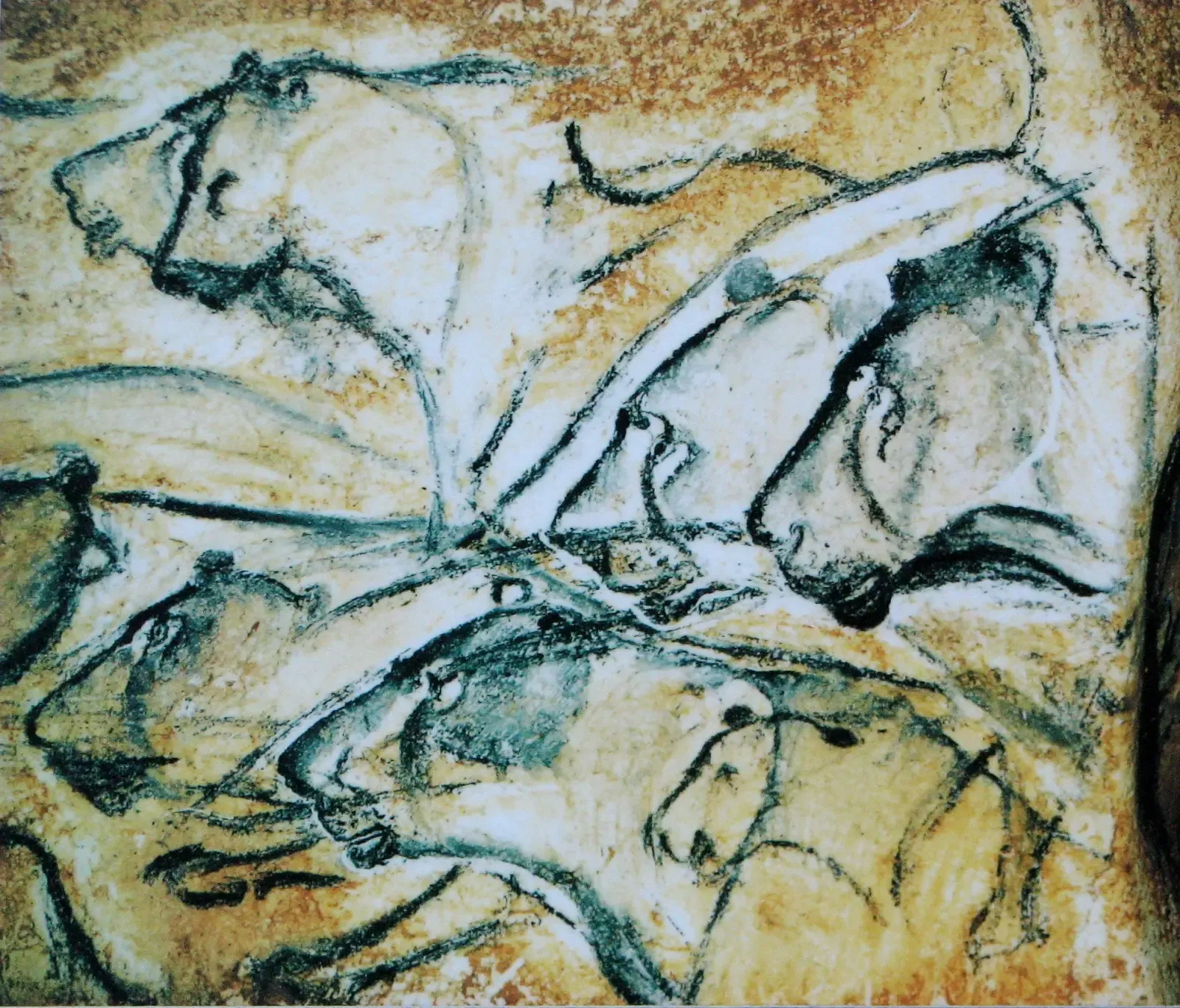
When France’s Chauvet Cave was discovered in 1994, the artistic sophistication of its paintings was so far beyond expectations that some specialists publicly doubted its age.
The panels show lions, rhinoceroses, and horses rendered with shading, implied movement, and layered perspective – techniques art historians associate with far later periods, not supposedly “early” Ice Age humans. Animals are drawn overlapping to suggest depth and even motion, as if the artist understood foreshortening centuries before it became a formalized technique in Renaissance Europe. This wasn’t primitive scratching – it was intentional, controlled draftsmanship.
Uranium-series and radiocarbon dating eventually confirmed the cave’s extreme age, silencing most of the skeptics, but the unease never fully went away. If artistic skill this refined existed this early, it undercuts the old assumption that human creativity evolved in a slow, steady climb from crude to complex. Chauvet suggests something closer to sudden, full-blown mastery – talented individuals working within an already-established artistic tradition, not fumbling toward one. But #8 shows the exact same style turning up somewhere it has no business being.
Worth Knowing
- Discovered on December 18, 1994, by three amateur speleologists exploring the Ardèche gorge
- Contains 435 recorded animal figures across its chambers
- Radiocarbon dating places most of the artwork between roughly 30,000 and 36,000 years old
- Evidence shows two separate periods of human use, separated by thousands of years
- Named a UNESCO World Heritage Site in 2014
#8 – Romania’s Impossible Twin of Chauvet
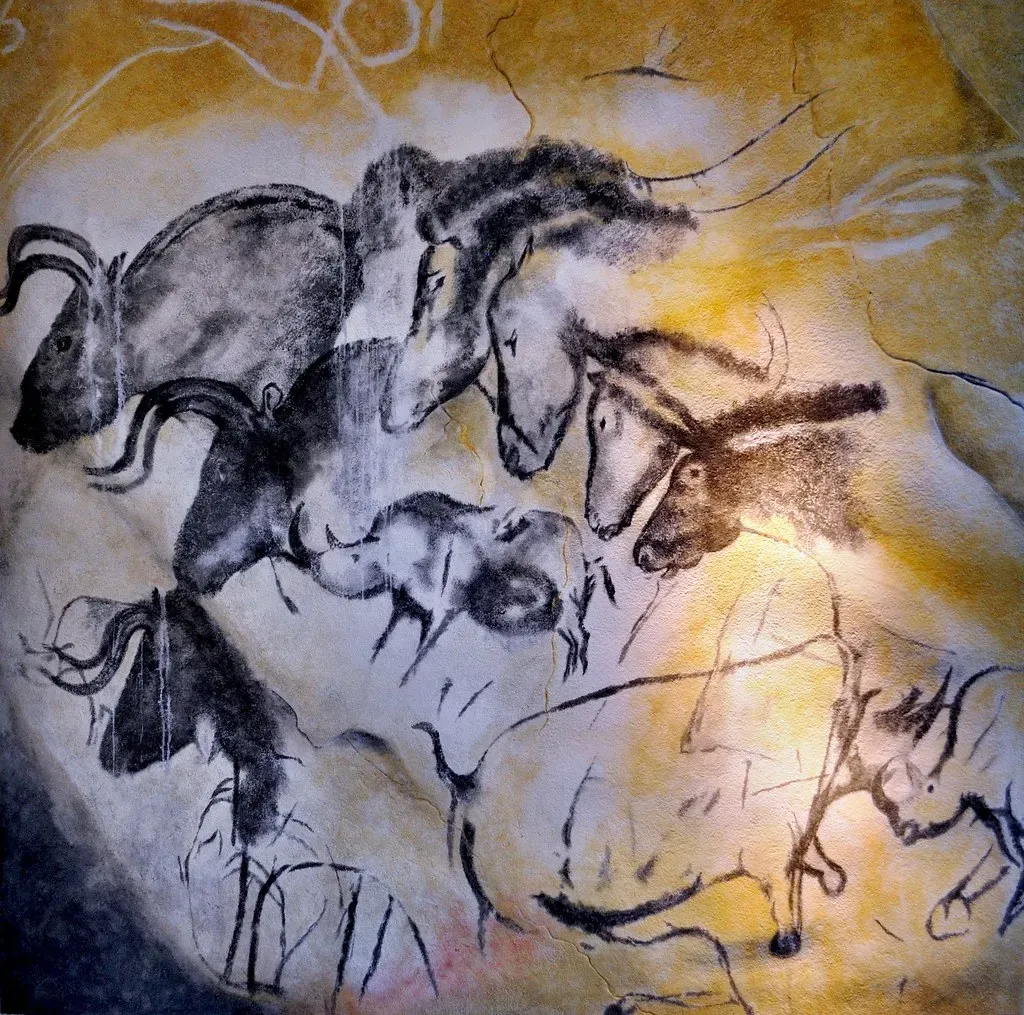
Thousands of kilometers from France, inside a Romanian cave system, researchers found paintings so stylistically similar to Chauvet’s animals that some initially assumed a mistake had been made.
Coliboaia Cave, discovered in the Carpathian Mountains, contains painted bears, rhinoceroses, and felines rendered in a manner strikingly close to the French masterpieces – despite being separated from Chauvet by an enormous geographic distance and, at the time of discovery, no known cultural link. Dating placed the Romanian paintings in a similar Ice Age timeframe, raising an uncomfortable question for archaeologists: was this coincidence, parallel invention, or evidence of shared artistic traditions moving across an entire continent long before anyone assumed ideas – let alone people – traveled that far.
The implication is bigger than one cave: it suggests a network of connected human populations sharing artistic knowledge across thousands of kilometers during the last Ice Age, something previously considered implausible for such small, scattered hunter-gatherer bands. It’s forced a slow rethink of just how isolated Ice Age Europe’s human populations actually were. But #9 involves a drawing that may represent the oldest confirmed use of a very specific, very deliberate art material.
#9 – Australia’s Charcoal Secret
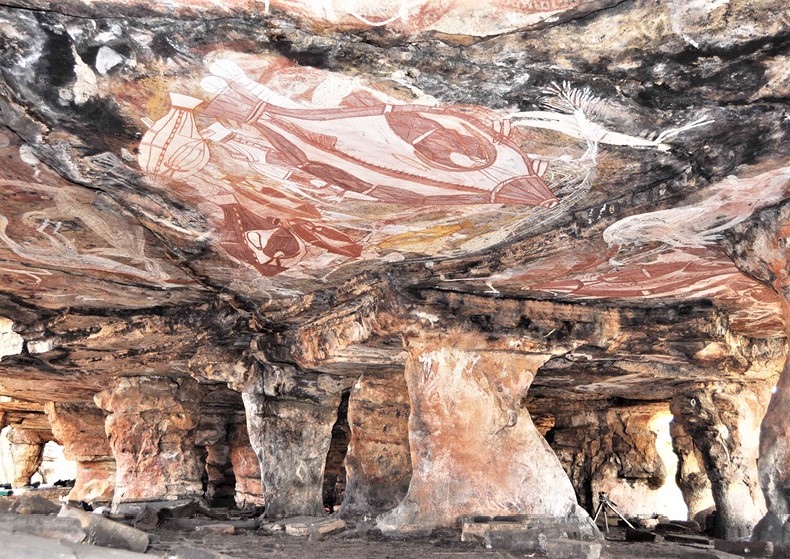
In a rock shelter called Nawarla Gabarnmang in Australia’s Arnhem Land, archaeologists uncovered a charcoal drawing that pushed back the known use of that specific pigment technique by an enormous margin.
Unlike ochre paintings, which are common across ancient rock art sites worldwide, charcoal drawings are rarer and harder to date reliably – except that the material itself can be directly radiocarbon dated, unlike mineral pigments. That direct dating capability is exactly what made this discovery so significant: researchers were able to confirm an extremely old age for the drawing with a level of scientific certainty that mineral-pigment paintings elsewhere simply can’t offer. The find effectively rewrote assumptions about how early Australia’s first inhabitants were experimenting with different artistic materials and methods.
What’s striking is the deliberateness of the choice. Charcoal isn’t as durable or vivid as ochre, so its use suggests either a specific stylistic preference or a particular ritual purpose tied to the material itself – fire-derived pigment for fire-related ceremonies, perhaps. Either way, it’s a reminder that “ancient” doesn’t mean “simple.” These artists were already making conscious material choices tens of thousands of years ago. But #10 shows figures dressed more elaborately than most of what came after them for millennia.
#10 – Australia’s Over-Dressed Mystery People
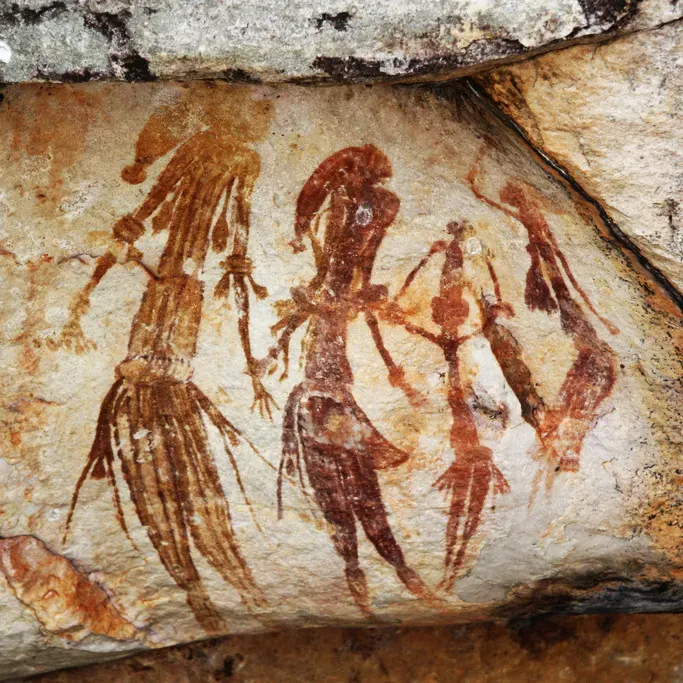
Across the Kimberley region of Western Australia, ancient artists painted human figures so elaborately decorated that they look almost out of place next to the region’s later, simpler rock art traditions.
Gwion Gwion art – formerly commonly known as “Bradshaw paintings” – is a sophisticated tradition of Kimberley rock art displaying distinctive spindly human stick figures ornamented with accessories such as bags, headdresses, and tassels, and carrying spears and boomerangs. The detail is extraordinary for their age: the figures are depicted in graceful display or hunting poses, beautifully painted, adorned with tassels, hair ornaments, and even clothing.
The oldest confirmed examples are jaw-droppingly old – one tassel Gwion Gwion figure has been dated at over 17,000 years old, determined by dating a fossilised mud wasp nest built over the painting, and some researchers argue the true age could run even higher. What makes this genuinely puzzling is the style itself: the earliest tassel figure style appeared fully developed, seemingly out of the blue, with no other styles discovered underneath it, indicating it was probably the first of the line. A fully mature art style with no obvious “rough draft” phase is exactly the kind of anomaly that keeps rock art researchers up at night. But #11 predates all of this by tens of thousands of years, using nothing but a rock and a red crayon.
#11 – The World’s Oldest “Doodle”
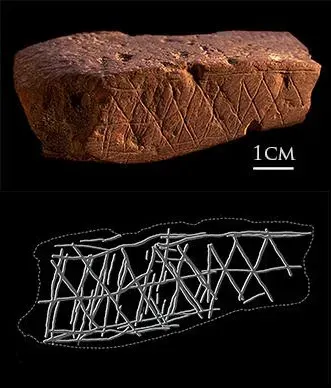
Long before cave paintings of animals or human figures existed anywhere on Earth, someone in a South African cave sat down and scratched a deliberate, abstract pattern that looks remarkably like a modern hashtag.
Lines drawn on a stone with an ochre crayon 73,000 years ago are considered the earliest symbolic art ever found, according to archaeologists excavating the famed Blombos Cave in South Africa. This wasn’t an accident or a tool-sharpening mark – microscopic and chemical analyses confirm that red ochre pigment was intentionally applied to the flake with a crayon-like tool. The drawing predates the previous oldest known abstract art by tens of thousands of years, pushing the known record back by at least 30,000 years.
What makes this so disruptive to the standard timeline is the sheer gap it exposes. Until recently, experts thought that unambiguous symbols first appeared when Homo sapiens entered Europe about 40,000 years ago, yet here was clear evidence of deliberate symbolic drawing more than 30,000 years before that migration even happened. A tiny crosshatched flake, barely bigger than a coin, forced an entire field to push its “dawn of symbolic thought” timeline back by tens of millennia. But #12 goes even further, suggesting full narrative storytelling existed before that.
#12 – The Oldest Story Ever Painted
On the Indonesian island of Sulawesi, a cave wall holds what researchers now consider the oldest known piece of storytelling art in human history – and it’s not simple stick figures, it’s a scene with characters, action, and implied plot.
The panel most likely shows three small human-bird hybrids surrounding a massive wild pig, which they were probably hunting. The underlying artwork was painted at least 51,200 years ago, making it the oldest known reliably dated cave art image in the world – and the earliest narrative art found anywhere. That’s a full narrative composition, not a single animal outline, dated to over 51,000 years ago.
What makes this genuinely mind-bending is what it implies about early human minds. The image portrays a group of part-human, part-animal figures hunting large mammals with spears or ropes, and this figurative depiction may be the oldest evidence for our ability to imagine the existence of supernatural beings. The painting suggests there was no gradual evolution of Palaeolithic art from simple to complex, since all the major components of a highly advanced artistic culture were already present at Sulawesi tens of thousands of years ago, including figurative art, scenes, and therianthropes. There was no slow crawl toward complexity – full storytelling apparently arrived essentially fully formed. But #13 might be the most disruptive discovery of all, because of who actually painted it.
Quick Compare: How Old Is Old?
- Blombos Cave crosshatch doodle (South Africa): about 73,000 years old
- Iberian red discs and hand stencils (Spain, likely Neanderthal-made): about 64,000 years old
- Sulawesi hunting narrative (Indonesia): at least 51,200 years old
- Chauvet Cave animal panels (France): roughly 30,000 to 36,000 years old
- Lascaux shaft scene (France): roughly 14,000 to 21,000 years old
#13 – The Art That Predates Us
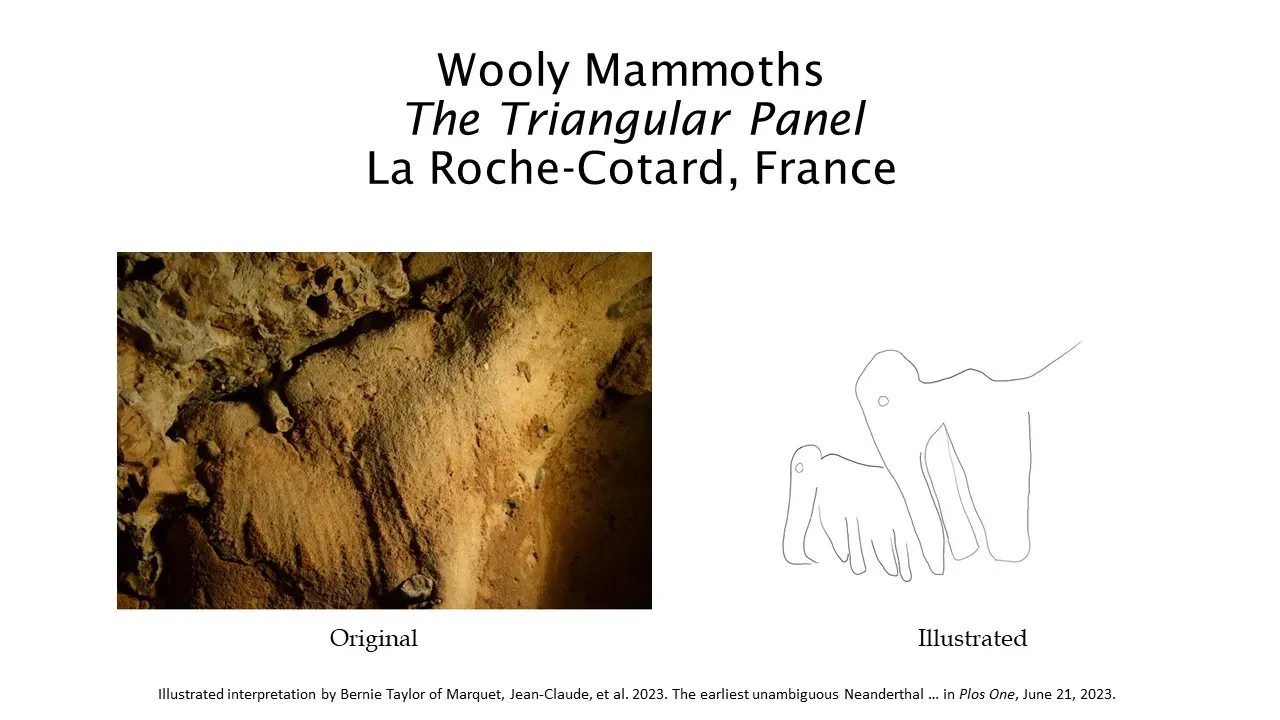
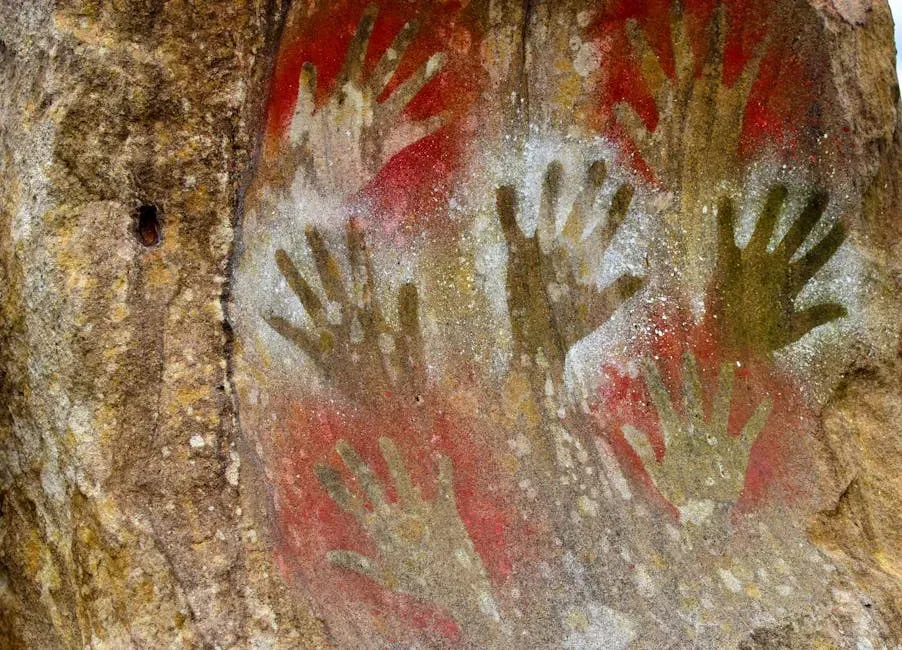
The single most unsettling entry on this list isn’t about what’s depicted – it’s about who could have possibly made it, because the artists in question may not have even been human.
Red pigment markings and disk shapes found deep inside Spanish cave systems, including La Pasiega, Maltravieso, and Ardales, have been dated using uranium-thorium methods to more than 64,000 years old – a timeframe that predates the arrival of Homo sapiens in Europe by tens of thousands of years. That leaves only one other candidate capable of making them: Neanderthals, a species long dismissed in popular imagination as incapable of symbolic art. If the dating holds up, it means our closest evolutionary relatives were painting caves before modern humans ever set foot on the continent.
This single finding forced a wholesale reconsideration of Neanderthal cognitive capacity, upending decades of assumptions that symbolic thought was a uniquely Homo sapiens trait. It means “cave art” isn’t really a human story at all – it’s a story about intelligence and creativity existing in more than one branch of the human family tree, arguably as far back as our own species’ earliest paintings, and possibly further.
This is an incredibly exciting discovery which suggests Neanderthals were much more sophisticated than is popularly believed.
Chris Standish, archaeologist, University of Southampton
The Bottom Line
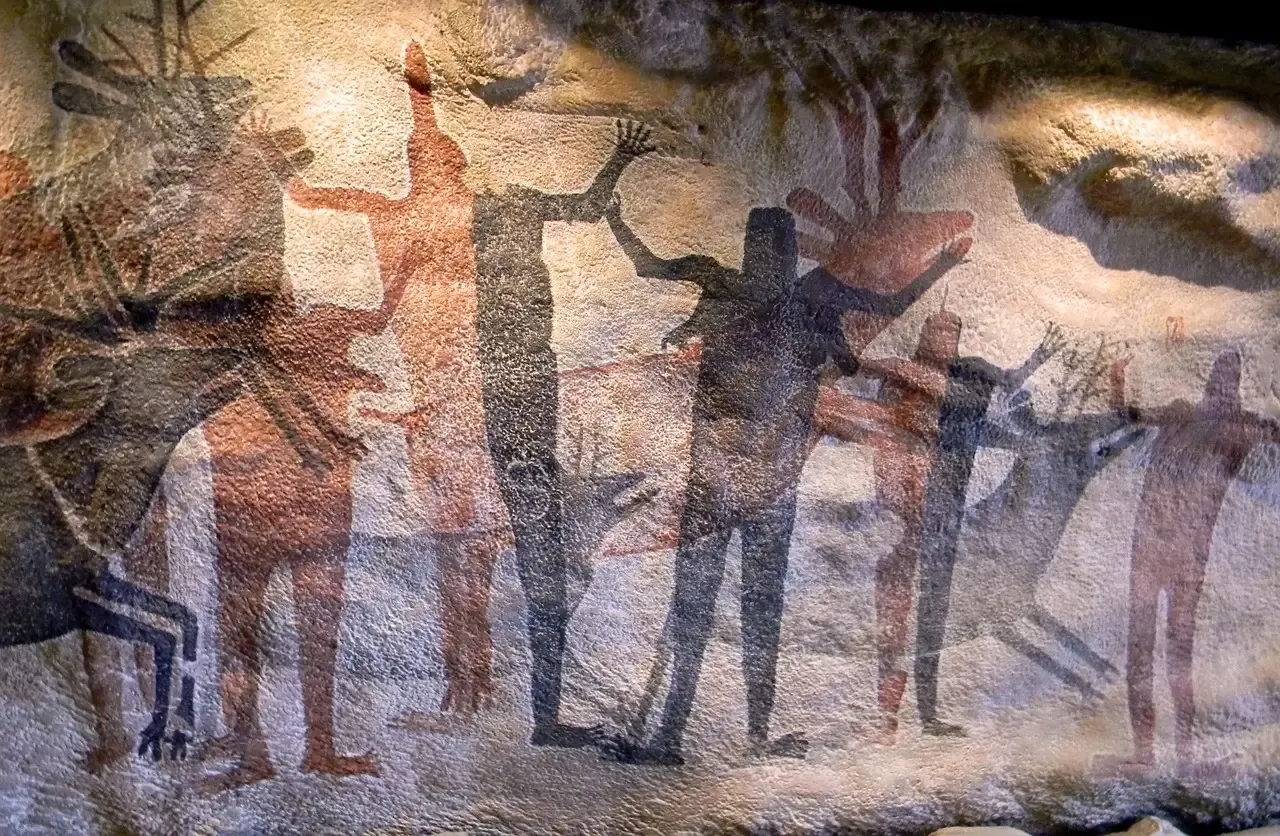
Here’s the uncomfortable truth: prehistoric people were never as “primitive” as pop culture likes to pretend.
From a 73,000-year-old crosshatched doodle in South Africa to narrative hunting scenes over 51,000 years old in Indonesia to art that may have been painted by Neanderthals before modern humans even reached Europe, the evidence keeps pointing the same direction – symbolic thought, storytelling, and even astronomical observation arrived far earlier, and far more suddenly, than the old textbooks claimed.
The “steady climb from simple to complex” theory of human creativity is looking shakier every year. My honest take? We’re not watching a slow dawn of intelligence. We’re watching flashes of it that were there all along, waiting for someone to find the cave. Which one of these caught you most off guard? Drop your pick in the comments.