
You’ve probably heard people say quantum physics is weird. That’s an understatement. Over the past century or so, physicists have stumbled across discoveries so bizarre, so profoundly counterintuitive, that they’ve forced us to completely reconsider what we mean by “reality.” These aren’t just abstract equations scribbled on blackboards. These are findings that challenge everything we thought we knew about how the universe operates at its most fundamental level.
The classical world you interact with every day operates according to rules that make sense. Drop a ball, it falls. Push an object, it moves. Yet venture into the quantum realm, and those rules dissolve into something far stranger. Particles exist in multiple states at once. Information seems to travel faster than light. The very act of looking at something changes what it is. It sounds like science fiction, honestly. Yet these phenomena have been confirmed again and again through rigorous experimentation.
What follows are ten moments when quantum discoveries shook the scientific community to its core. These aren’t just interesting anecdotes. They represent fundamental shifts in how we understand existence itself. Let’s dive in.
When Light Refused to Choose Between Wave and Particle
Light exists as both a particle and a wave, a concept that defies all common sense. Think about that for a moment. How can something be two completely different things simultaneously?
Wave-particle duality is the concept in quantum mechanics that fundamental entities of the universe, like photons and electrons, exhibit particle or wave properties according to the experimental circumstances. During the 19th and early 20th centuries, light was found to behave as a wave, then later was discovered to have a particle-like behavior. This discovery fundamentally challenged the neat categories physicists had constructed. It’s like discovering that your car is also somehow a bicycle, depending on how you look at it.
The implications go deeper than you might initially grasp. This duality cannot be simultaneously observed. Seeing light in the form of particles instantly obscures its wave-like nature, and vice versa. Reality itself seems to depend on what you’re measuring and how. That’s not just strange. That’s revolutionary.
The Double-Slit Experiment Revealed Reality’s Observer Problem
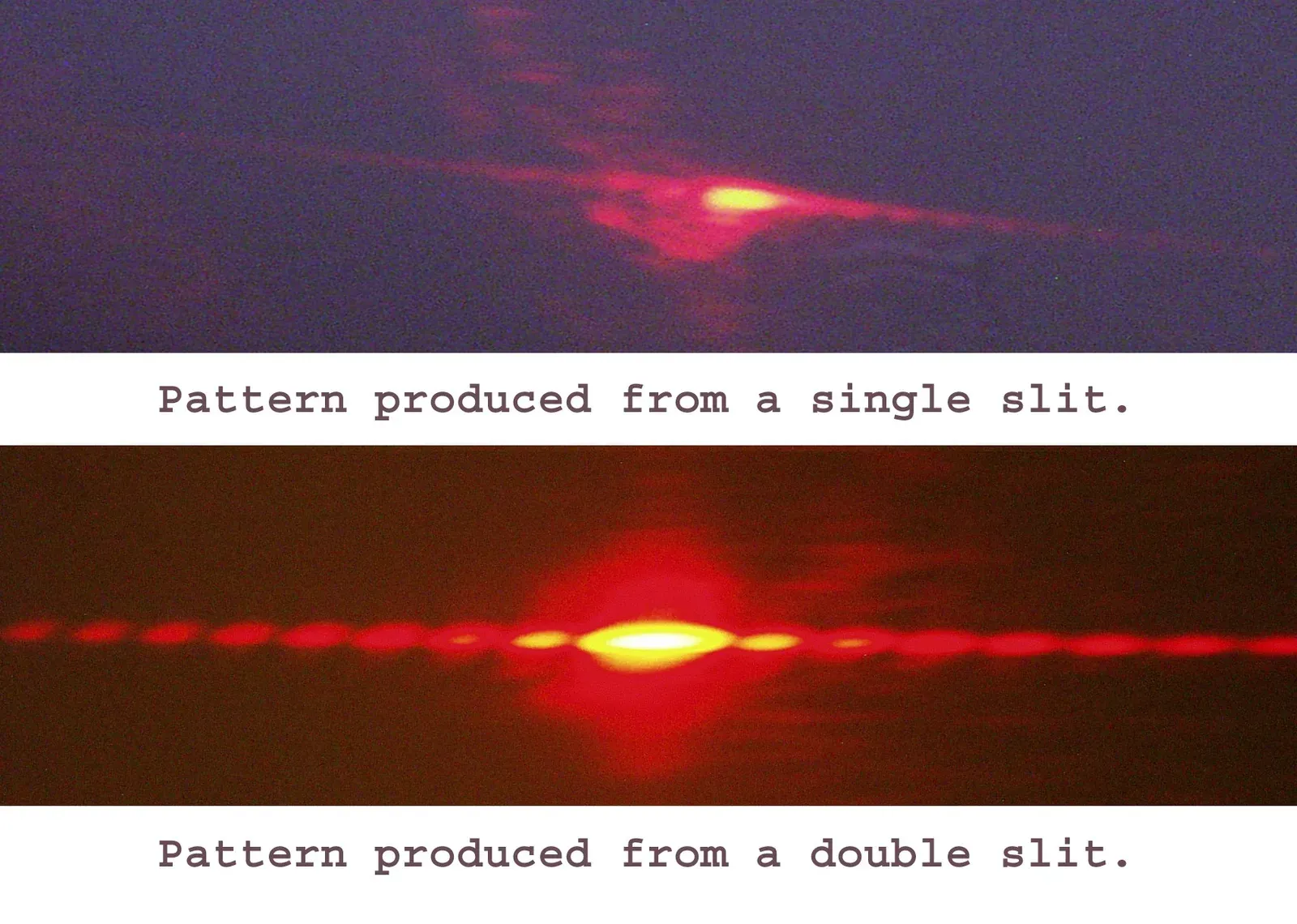
Here’s where things get truly unsettling. The double-slit experiment has become a classic for its clarity in expressing the central puzzles of quantum mechanics. When you shoot particles through two slits, they create an interference pattern on a screen behind them, just like waves would.
The mind-bending part? When scientists sent light particles through the slits one by one, the interference pattern still showed up. Each individual photon somehow “knew” where to land to eventually form a wave pattern. It’s as if the particles were interfering with themselves, passing through both slits at once.
Then comes the real kicker. When scientists placed detectors at each slit to determine which slit each photon was passing through, the interference pattern disappeared. The very act of observing the photons collapses those many realities into one. You change reality simply by looking at it. Let that sink in.
Einstein’s “Spooky Action” Connected Particles Across Space
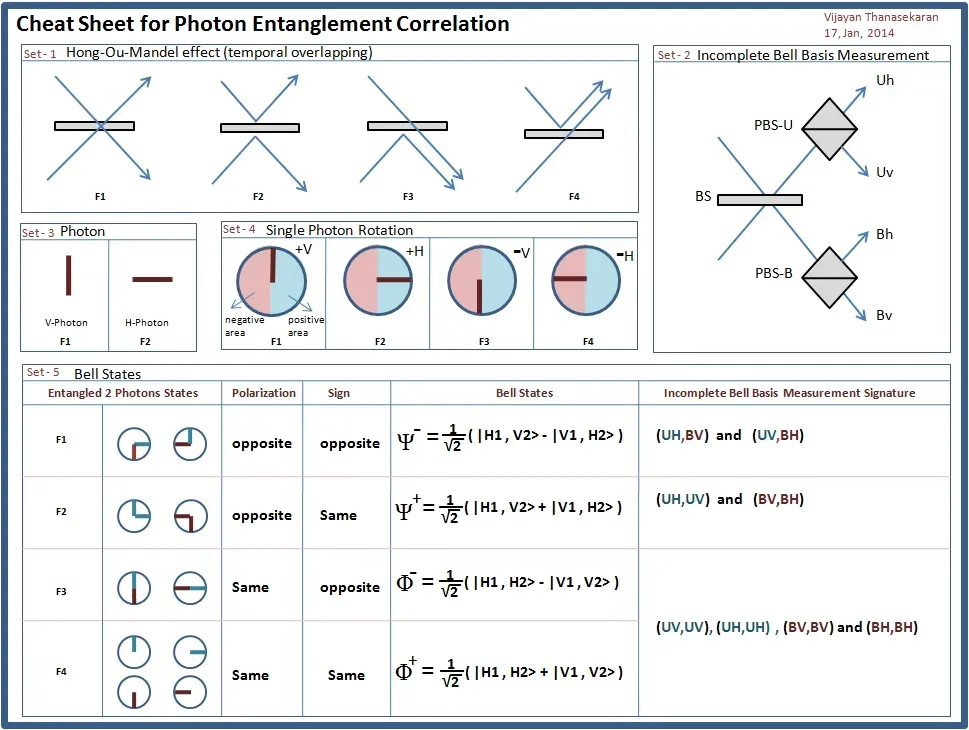
Einstein later disparaged quantum mechanics for seemingly exhibiting “spukhafte Fernwirkung” or “spooky action at a distance”, and you can understand his frustration. Quantum entanglement suggests that two particles can remain connected regardless of the distance between them.
Measurements of physical properties such as position, momentum, spin, and polarization performed on entangled particles can be found to be perfectly correlated. For example, if a pair of entangled particles is generated such that their total spin is known to be zero, and one particle is found to have clockwise spin on a first axis, then the spin of the other particle, measured on the same axis, is found to be anticlockwise.
What disturbed Einstein so much was the instantaneous nature of this connection. Measure one particle here, and its partner light-years away immediately “knows” and responds accordingly. Einstein and others considered such behavior impossible, as it violated the local realism view of causality and argued that the accepted formulation of quantum mechanics must therefore be incomplete. Later, the counterintuitive predictions of quantum mechanics were verified in tests where polarization or spin of entangled particles were measured at separate locations, statistically violating Bell’s inequality. Einstein was wrong, quantum mechanics was right.
Schrödinger’s Cat Exposed the Measurement Paradox
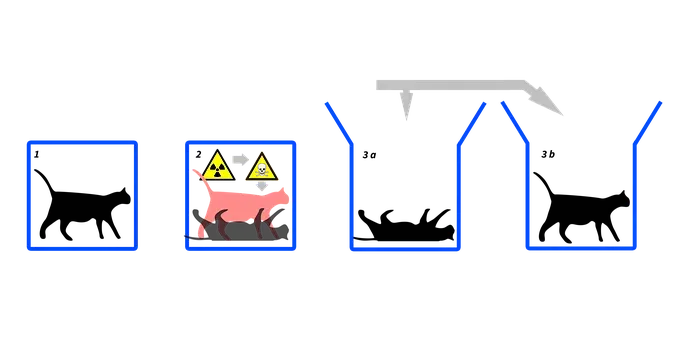
Erwin Schrödinger wasn’t trying to celebrate quantum mechanics when he devised his famous cat thought experiment. He was trying to expose what he saw as its absurdity. This thought experiment was devised by physicist Erwin Schrödinger in 1935 in a discussion with Albert Einstein to illustrate what Schrödinger saw as the problems of Niels Bohr and Werner Heisenberg’s philosophical views on quantum mechanics.
The setup is deceptively simple. A cat, a flask of poison, and a radioactive source are placed in a sealed box. If an internal radiation monitor such as a Geiger counter detects radioactivity, the flask is shattered, releasing the poison, which kills the cat. Since radioactive decay is a quantum process, the cat theoretically exists in a superposition of both alive and dead until someone opens the box.
The experiment poses the question, when does a quantum system stop existing as a superposition of states and become one or the other? This “measurement problem” remains one of quantum mechanics’ most profound puzzles. We still don’t have a fully satisfactory answer.
Particles Revealed They Tunnel Through Impossible Barriers
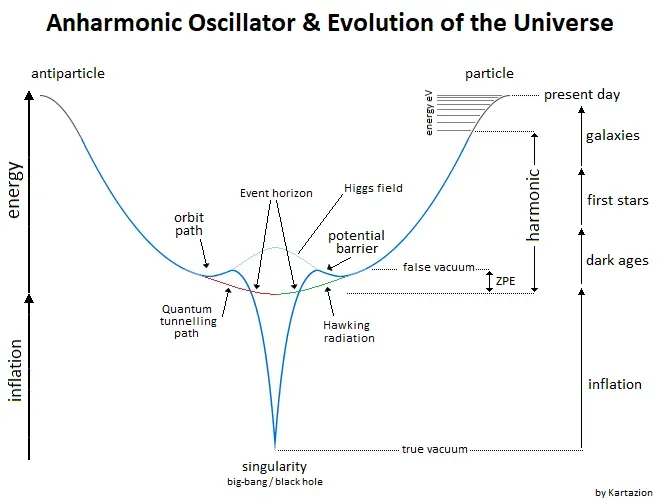
Classical physics says that if you don’t have enough energy to climb over a hill, you simply can’t get to the other side. Quantum physics laughs at this limitation. Quantum tunneling allows particles to pass through barriers they shouldn’t be able to penetrate.
Think of it like throwing a ball at a wall and occasionally having it appear on the other side without breaking through. That’s essentially what particles do at the quantum level. They don’t have enough energy to overcome the barrier in the classical sense, yet they somehow end up on the other side anyway.
This isn’t just theoretical weirdness. Quantum tunneling is why your electronics work, why the sun produces energy through nuclear fusion, and why certain chemical reactions proceed at all. Without it, stars wouldn’t shine and life as we know it couldn’t exist. Reality at the quantum level simply doesn’t respect the boundaries we think should be absolute.
Heisenberg’s Uncertainty Demolished Determinism Forever
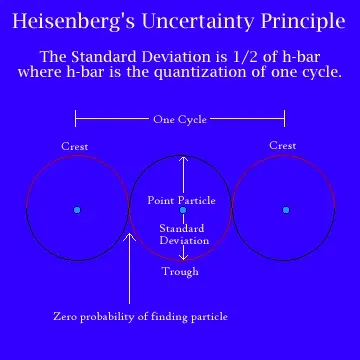
Werner Heisenberg discovered something that destroyed centuries of scientific certainty. Heisenberg’s uncertainty principle says that an object does not have an exact position and velocity at the same time. This deals a fatal blow to the Newtonian clockwork universe.
The implications are staggering. The idea of a deterministic universe was that if we could know the exact position and velocity of every atom in the universe, then the entire history of the universe could be calculated. Heisenberg’s principle demolishes that idea, because nothing in the universe has an exact position and an exact velocity. The future is not determined.
It’s not that we lack precise enough instruments. Nature simply does not know how the future will unfold. Uncertainty is built into the fabric of reality itself. The universe isn’t a machine following predetermined paths. It’s fundamentally probabilistic, which means the future is genuinely open.
Superposition Made Everything Everywhere All at Once
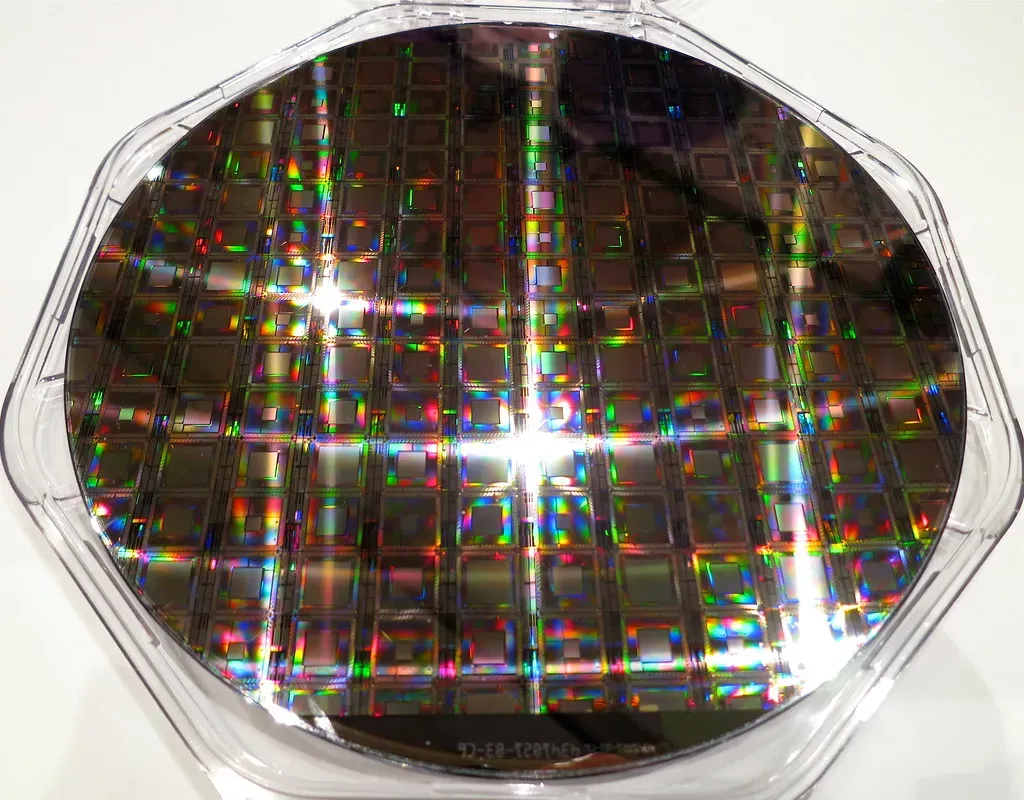
Quantum superposition states that particles exist in all possible states simultaneously until measured. A quantum coin isn’t heads or tails before you look at it. It’s genuinely both, weighted by probability, until observation forces it into one state.
This isn’t a failure of knowledge on our part. The particle genuinely doesn’t have a definite state until measured. It exists as a cloud of possibilities, all real, all present. Only when you interact with it does this cloud of potential collapse into a single actuality.
Scientists have now demonstrated superposition with increasingly large objects, not just individual particles. The boundary between the quantum world and our everyday experience keeps getting pushed upward. Where does quantum weirdness end and classical reality begin? We’re still searching for that answer, and it might not exist at all.
Wave Functions Collapsed Reality From Many to One

The wave function is quantum mechanics’ mathematical description of all possible states a system can occupy. It evolves smoothly and predictably according to Schrödinger’s equation, spreading out over time like ripples in a pond. Then you measure something, and everything changes.
Wave function collapse is the process by which all those possibilities suddenly snap into one concrete outcome. The measurement of a quantum object in a superposition of states collapsing down the object to a definite single state is very well predicted by the mathematics of quantum physics. Therefore, the measurement problem is more a problem of philosophical interpretation and incomplete scientific explanation, than a problem of the theory being incorrect.
Yet nobody fully understands why or how collapse happens. What counts as a measurement? Does it require consciousness? Does the universe split into multiple branches? Different interpretations of quantum mechanics give wildly different answers, and we still don’t know which, if any, is correct. The mathematics works perfectly. We just don’t know what it means.
Recent Experiments Proved Einstein Wrong at Atomic Precision
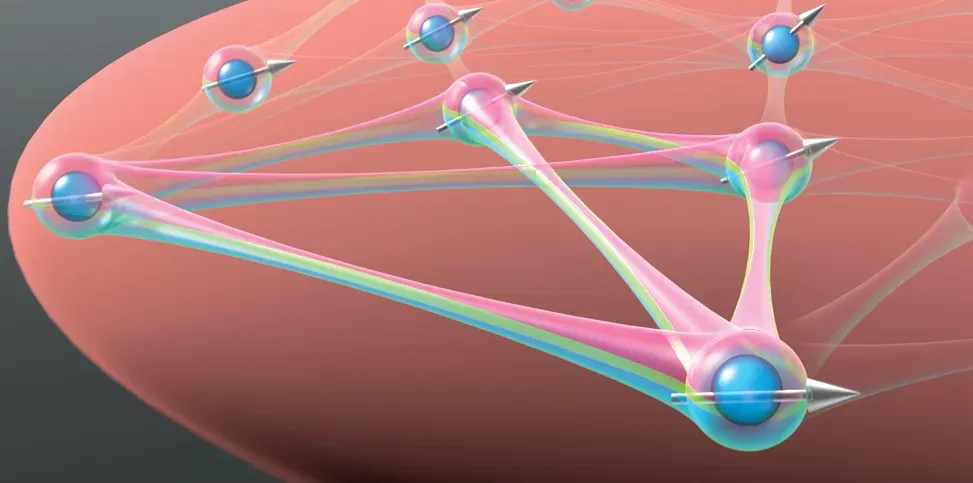
In 2025, physicists achieved something remarkable. MIT physicists performed the most idealized version of the double-slit experiment to date. Their version strips down the experiment to its quantum essentials. They used individual atoms as slits and demonstrated with unprecedented precision that quantum theory’s predictions hold.
The researchers confirmed the predictions of quantum theory: The more information was obtained about the path of light, the lower the visibility of the interference pattern was. They demonstrated what Einstein got wrong. Even stripped to its bare essentials, quantum mechanics refuses to bend to classical intuition.
This wasn’t just confirming old knowledge. It was settling a nearly century-old debate between Einstein and Bohr with atomic-level precision. The universe really does work the strange way quantum mechanics predicts, even when you eliminate every possible complication. There’s no hidden classical reality underneath.
Entanglement Extended to the Heaviest Known Particles
For a long time, entanglement was demonstrated with tiny particles like photons and electrons. Then scientists pushed further. The CMS collaboration examined the spin entanglement of a top quark and a top antiquark that are simultaneously produced at a very high speed with respect to each other. The two particles are therefore far apart before decaying, their distance is larger than what can be covered by information transferred at the speed of light.
The results were clear. The measurement shows that there is indeed spooky action at a distance between the heaviest known particles. Entanglement isn’t limited to delicate laboratory conditions with the smallest particles. It operates even with massive quarks moving at tremendous speeds, separated by distances that should prevent any connection.
This discovery extends quantum weirdness to regimes physicists once thought might be immune. The quantum realm isn’t separate from our world. It underlies everything, even the most massive and energetic processes in nature.
Conclusion: Reality Will Never Be the Same
Quantum physics hasn’t just added new facts to our knowledge. It’s fundamentally altered what we mean when we talk about reality. The universe at its deepest level doesn’t work anything like our everyday experience suggests. Particles aren’t little balls following definite paths. They’re clouds of possibility that only crystallize into definite states when observed.
Objects can be connected across vast distances with no physical link between them. The act of measurement doesn’t just reveal pre-existing properties but actually creates them. The future isn’t predetermined but genuinely open. These aren’t philosophical speculations. They’re confirmed experimental facts that have been tested and retested for a century.
We’ve come a long way from thinking reality was a clockwork mechanism ticking along according to fixed laws. Quantum physics has shown us a universe far stranger and more wonderful than we ever imagined. The nature of reality itself has been rewritten, and we’re still coming to terms with what that means. What do you think about living in a quantum universe? Does it change how you see the world around you?
Jan loves Wildlife and Animals and is one of the founders of Animals Around The Globe. He holds an MSc in Finance & Economics and is a passionate PADI Open Water Diver. His favorite animals are Mountain Gorillas, Tigers, and Great White Sharks. He lived in South Africa, Germany, the USA, Ireland, Italy, China, and Australia. Before AATG, Jan worked for Google, Axel Springer, BMW and others.