
Time should march forward in a clean, orderly line, and space should simply be the stage on which the universe unfolds. Yet the deeper physicists push into the quantum and cosmic extremes, the less these old intuitions seem to hold. From particles that appear to influence the past to black holes that erase information, the universe keeps serving up puzzles that feel less like tidy equations and more like riddles from a trickster god. These paradoxes are not just abstract brainteasers; they expose cracks in our best theories, from Einstein’s relativity to quantum mechanics. As researchers build bigger telescopes, smash particles at higher energies, and simulate strange universes inside supercomputers, they are forced to ask a disarmingly simple question: do we actually understand what time and space are at all?
The Arrow of Time: Why Does Time Only Move One Way?

Open a physics textbook and most of the fundamental equations work just as well backward as forward in time, like a movie that looks the same if you hit rewind. But in real life, eggs do not uncrack, smoke does not flow back into the match, and we grow older rather than younger. This tension between reversible laws and irreversible experience is wrapped up in what physicists call the arrow of time, and it is tied closely to entropy, a measure of disorder. The paradox is that the universe seems to have started in a remarkably low-entropy, highly ordered state, for reasons no one can fully explain yet. If everything was once so improbably tidy, why did it begin that way, and what, if anything, fixed the direction of “past” and “future”?
Cosmologists trying to tackle this puzzle have turned their attention to the very early universe, to fractions of a second after the Big Bang. Some argue that inflation, a brief period of explosive expansion, might help explain the special initial conditions, but even that simply pushes the mystery back a step. Others speculate that time’s arrow may emerge from how observers like us are embedded in the universe, not from the underlying laws themselves. The unsettling possibility is that our sense of time flowing may be a kind of large-scale illusion produced by statistics, not a fundamental feature of reality. For a quantity that rules every second of our lives, time turns out to be suspiciously hard to pin down.
The Twin Paradox: When High-Speed Travel Warps Aging
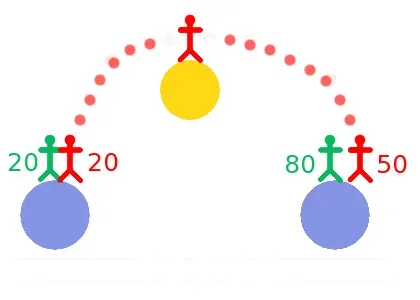
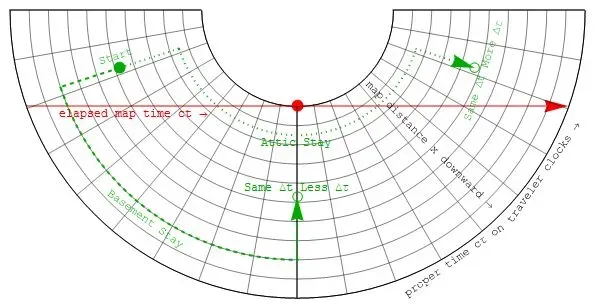
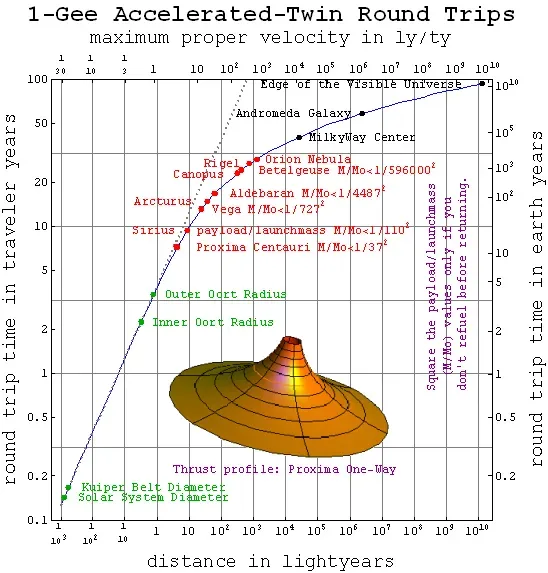
Imagine a pair of twins: one stays on Earth, the other blasts off on a near–light speed journey to a distant star and back. According to Einstein’s special relativity, the traveling twin will age more slowly than the one who remained at home, and when they reunite, they will disagree about how much time has passed. At first glance, this seems paradoxical, because from the traveler’s point of view, it is Earth that is moving; so whose clock should really run slower? The resolution lies in the fact that the traveling twin undergoes acceleration and deceleration, breaking the symmetry and putting the two experiences on unequal footing. Still, the visceral unease remains: how can two people, who once shared the same childhood, literally live through different amounts of time?
This is not just a thought experiment; versions of the twin paradox have been tested using ultra-precise atomic clocks on airplanes and satellites. Clocks flown around the world, or orbiting Earth on GPS satellites, really do tick at slightly different rates compared with clocks on the ground. Engineers must correct for these relativistic effects every day, or navigation systems would drift by miles. The fact that something as personal as aging is subtly malleable, stretched or squeezed by speed and gravity, forces us to accept that time is not a universal backdrop but a flexible dimension, tightly woven into space itself. Under extreme conditions, your “now” and mine may part ways in very literal, measurable ways.
The Black Hole Information Paradox: Does the Universe Lose Its Memory?
Black holes are often described as cosmic traps from which nothing, not even light, can escape. In the 1970s, Stephen Hawking showed that black holes are not completely black but slowly radiate energy, and over unimaginable stretches of time, they can evaporate away. His calculations implied that this radiation is purely thermal, carrying no details about what originally fell in. That leads to a disturbing conclusion: information about the matter that formed or entered a black hole appears to be destroyed, in direct conflict with a core principle of quantum mechanics that says information is never truly lost. The universe, in other words, might have a shredder, and that is not supposed to be allowed.
This black hole information paradox has become one of the central battlegrounds in modern theoretical physics. Ideas like holography suggest that the information might be encoded on the two-dimensional surface of the black hole’s event horizon rather than inside it, a radical reimagining of how spacetime works. Others propose that subtle quantum correlations, or “entanglement,” could hide the missing data in ways Hawking’s original calculation overlooked. More exotic solutions flirt with the idea of “firewalls” at the edge of a black hole, which would incinerate anything falling in and upend general relativity. Each attempt to fix the paradox forces physicists to rethink either gravity, quantum theory, or the nature of space itself – none of which are easy sacrifices.
Quantum Entanglement: Spooky Links Across Space and Time
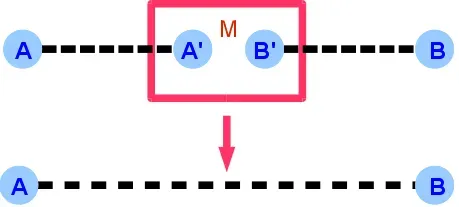
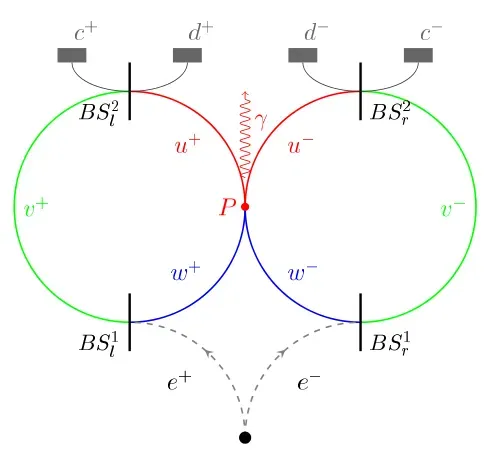
Quantum entanglement binds particles together so tightly that measuring one seems to instantly affect the other, even if they are separated by vast distances. Experiments have repeatedly confirmed this eerie connection, showing that entangled particles share linked properties in ways that cannot be explained by hidden signals traveling at or below the speed of light. To many researchers, this looks like nature thumbing its nose at the classical idea of locality, the notion that influences must move continuously through space. Some interpretations of quantum mechanics treat entanglement as evidence that the wave function, a mathematical object describing possible outcomes, is more real than space itself. The paradox is simple to state and hard to swallow: either information moves faster than light, or our everyday idea of separateness in space is deeply flawed.
Recent “loophole-free” tests of entanglement have closed many of the experimental escape hatches skeptics once relied on. Photons, atoms, and even small groups of molecules have been entangled and manipulated in laboratories worldwide, pushing this once-philosophical oddity into the realm of practical technology. Quantum computers and quantum communication systems are poised to exploit entanglement to perform calculations and secure data in ways that classical systems cannot match. Yet no experiment has fully resolved what entanglement means for our understanding of time: when does the correlation “happen,” and does that question even make sense? In a universe where two particles can seem to share a single, nonlocal existence, the old division between here and there, now and then, looks more like a convenient story than a strict rule.
The Grandfather Paradox: Can Time Travel Rewrite Reality?
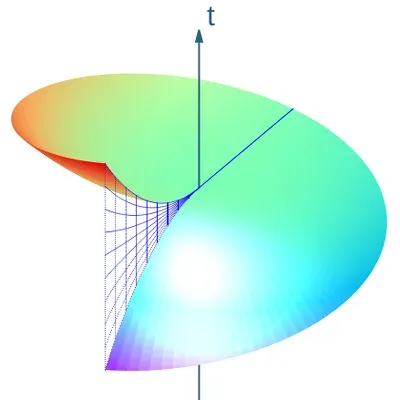
The grandfather paradox is the classic sci-fi nightmare: you build a time machine, travel into the past, and prevent your own grandparent from having children. If you succeed, you erase the very conditions that allowed you to exist and travel back in time in the first place. This logical knot exposes the headaches that come with the idea of traveling backward along the timeline. In general relativity, certain mathematical solutions, such as wormholes or rotating universes, seem to permit closed timelike curves – paths that loop back into their own past. The question is whether the real universe ever allows such loops, or whether some still-unknown rule slams the door on paradoxical time travel.
Physicists have explored several ways out of the dilemma. One proposal suggests that the universe enforces consistency: any action taken by a time traveler must be absorbed into history in a way that avoids contradictions, perhaps by improbable coincidences steering events away from logical disaster. Another idea borrows from quantum mechanics and the notion of many worlds, arguing that changing the past simply shunts you into a different branch of reality rather than altering your own history. These are clever, if unsettling, escapes that trade one kind of weirdness for another. For now, time travel to the past remains firmly in the realm of theory and fiction, but the paradox it raises continues to guide deep questions about causality itself.
The Cosmological Horizon: Edges of the Observable, Not the Universe
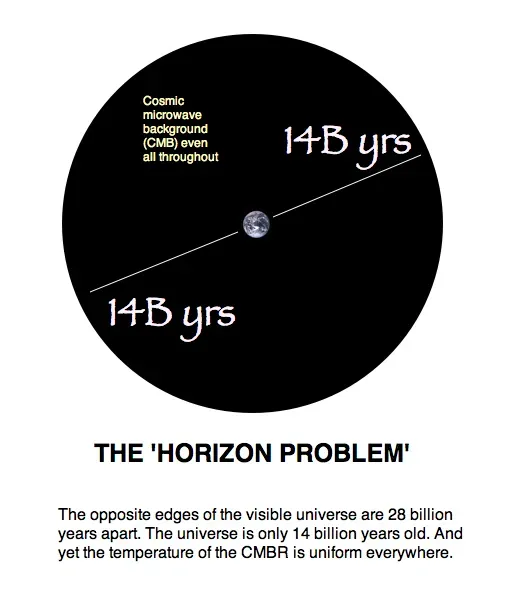
When cosmologists speak about the “observable universe,” they are drawing a boundary not around all that exists, but around all that light has had time to reach us since the Big Bang. Beyond that cosmological horizon, regions of space may stretch on indefinitely, filled with galaxies we will never see. The paradox here is more psychological than mathematical: we often picture the observable universe as the universe, even though our best models strongly suggest that we inhabit only a tiny patch of a much larger, perhaps infinite, structure. As space expands, some distant galaxies are actually receding from us faster than light due to the stretching of spacetime itself, putting them forever out of reach. It is like being in a boat on a foggy ocean where the visible circle of water tricks you into underestimating the vastness around you.
This horizon is not just a curiosity; it shapes how we interpret cosmic data. When telescopes measure the afterglow of the Big Bang, the cosmic microwave background, they are effectively staring at a spherical shell marking the limit of what can be observed. Beyond that shell, conditions could be subtly different – or wildly so – without any direct way for us to test those ideas. Some versions of inflationary theory even suggest that our observable universe is just one bubble in a frothy multiverse. The paradox, then, is that cosmology aspires to describe the universe as a whole, while the fundamental limits of light and time guarantee that we will always see only part of the picture.
Why These Paradoxes Matter: Cracks in the Foundations
It might be tempting to treat time and space paradoxes as pure philosophy, the mental equivalent of optical illusions with no real-world stakes. But history suggests otherwise: past “paradoxes” in physics often pointed straight at the next revolution. The clash between Newtonian mechanics and electromagnetism, for example, eventually led to special relativity. Later tensions between relativity and the quantum world birthed entirely new fields. Today’s puzzles about information loss, nonlocality, and time’s arrow are similarly acting as stress tests on our most successful theories.
Compared with traditional problems in physics – calculating orbits, predicting chemical reactions – these paradoxes live closer to the foundations. They force scientists to question assumptions that were once taken for granted, such as absolute time, fixed dimensionality, or the independence of distant events. Solving them could unlock a unified theory that reconciles gravity with quantum mechanics, a long-sought “theory of everything” that would finally describe spacetime and matter under a single framework. Beyond pure curiosity, these advances may ripple outward into technology, as quantum theory already has with semiconductors and lasers. The discomfort we feel wrestling with these paradoxes is not a bug in science; it is often the first sign that we are brushing up against deeper truths.
The Future Landscape: Simulated Universes, Quantum Networks, and New Telescopes
Looking ahead, the strangest thing about these paradoxes may be how practical they are becoming. Quantum entanglement, once a philosophical oddity, is already being woven into early quantum networks and encryption schemes that treat nonlocal correlations as resources rather than nuisances. New generations of telescopes, from space-based observatories to gigantic ground-based mirrors, are poised to probe black holes and cosmic horizons with unprecedented detail. As they do, they will test ideas about information, spacetime geometry, and the evolution of the universe that were once purely theoretical. The line between thought experiment and experiment is steadily shrinking.
At the same time, physicists are turning to advanced simulations and machine-learning tools to explore exotic spacetimes and quantum systems. Supercomputers can now model colliding black holes, quantum fields, and alternative cosmologies in ways that were impossible a decade ago. Some researchers are even entertaining bold ideas that our universe could itself be a kind of simulation, a provocative attempt to reframe long-standing paradoxes about information and fine-tuning. None of these approaches are guaranteed to succeed, and each raises fresh conceptual challenges along the way. But together they sketch a future in which our picture of time and space may be as unrecognizable to us as Einstein’s relativity would have been to an ancient sky-watcher.
How Readers Can Engage: Staying Curious in a Strange Universe

You do not need a particle accelerator in your backyard to participate in this unfolding story about time and space. One simple step is to follow ongoing missions and experiments – from gravitational-wave observatories to quantum technology demos – that regularly share data, visualizations, and explanations for the public. Many of these projects maintain open archives or citizen-science platforms where non-specialists can help classify galaxies, spot gravitational lensing events, or sift through signals. Supporting science journalism and educational initiatives also matters, because it keeps complex ideas accessible rather than locked away in paywalled journals. Curiosity, in that sense, becomes a kind of civic duty.
On a more personal level, grappling with these paradoxes can reshape how you think about everyday life. Reading books on cosmology and quantum theory, attending public lectures, or joining local astronomy clubs can turn abstract headlines into something you can debate over coffee. Even small acts – like protecting dark skies from light pollution so telescopes can see more clearly, or backing policies that fund basic research – feed back into the grand project of understanding time and space. The universe is under no obligation to make sense to us, yet we keep asking questions anyway. That stubborn insistence on understanding may be humanity’s most powerful response to a cosmos that, at its deepest levels, still refuses to give up all its secrets.
Suhail Ahmed is a passionate digital professional and nature enthusiast with over 8 years of experience in content strategy, SEO, web development, and digital operations. Alongside his freelance journey, Suhail actively contributes to nature and wildlife platforms like Discover Wildlife, where he channels his curiosity for the planet into engaging, educational storytelling.
With a strong background in managing digital ecosystems — from ecommerce stores and WordPress websites to social media and automation — Suhail merges technical precision with creative insight. His content reflects a rare balance: SEO-friendly yet deeply human, data-informed yet emotionally resonant.
Driven by a love for discovery and storytelling, Suhail believes in using digital platforms to amplify causes that matter — especially those protecting Earth’s biodiversity and inspiring sustainable living. Whether he’s managing online projects or crafting wildlife content, his goal remains the same: to inform, inspire, and leave a positive digital footprint.