

Grab almost anything around you right now – a paperclip, a sticky note, the screen you’re reading this on – and it probably feels boringly familiar. But hidden under that ordinary surface, a lot of these materials are quietly breaking the rules of common sense. They’re bending light, trapping heat, flipping magnets, and even helping doctors see inside your body without a single cut.
Once you start to notice this, your home, your office, even your kitchen turns into a low‑key science museum. That plastic wrap on your leftovers? It’s part chemistry lab, part force field. The pencil in your drawer? A blueprint for advanced batteries and space tech. Let’s pull back the curtain on ten of these “nothing special” materials that are secretly doing some seriously wild science.
1. Graphite: The Pencil Lead That Behaves Like A Space-Age Material

It’s easy to think of graphite as the boring gray stuff inside a cheap pencil, but scientifically it’s more like a superhero in disguise. At the microscopic level, graphite is made of flat sheets of carbon atoms arranged in perfect hexagons, stacked loosely like a deck of ultra‑thin cards. These layers slide over each other effortlessly, which is why it leaves a mark on paper so smoothly and why it’s a stellar lubricant, even in extreme temperatures where oils would fail.
Strip that structure down to a single layer and you get graphene, one of the most hyped materials in modern science: it conducts electricity better than copper, is incredibly tough yet flexible, and is almost transparent. While you won’t peel graphene off your pencil at home, that same layered structure means graphite shows up in lithium‑ion batteries, nuclear reactors, and high‑temperature industrial equipment. Next time you scribble a note, you’re basically writing with a budget version of the same family of materials researchers are betting on for future electronics and advanced energy storage.
2. Sticky Notes: The Failed Glue That Became A Reusable Memory Device

The little neon squares stuck to your monitor look like the opposite of high tech, but their adhesive chemistry is surprisingly clever. The glue on a sticky note is made of tiny polymer spheres that act like millions of microscopic suction cups. Each one makes a weak bond with the surface, but together they create enough grip to hold the paper in place – while still being easy to peel off without ripping or leaving gunk behind.
That “just right” level of stickiness has turned these notes into more than office clutter. The same principle – lots of small, reversible interactions instead of one strong, permanent one – is used in removable medical patches, temporary surface coatings, and some kinds of reusable labels. In labs, scientists use similar pressure‑sensitive adhesives when they need things that can be precisely repositioned without damaging delicate surfaces. It’s a reminder that sometimes the most useful materials come not from getting something perfect, but from dialing in a balance between holding on and letting go.
3. Aluminum Foil: Kitchen Wrap With Serious Physics Chops
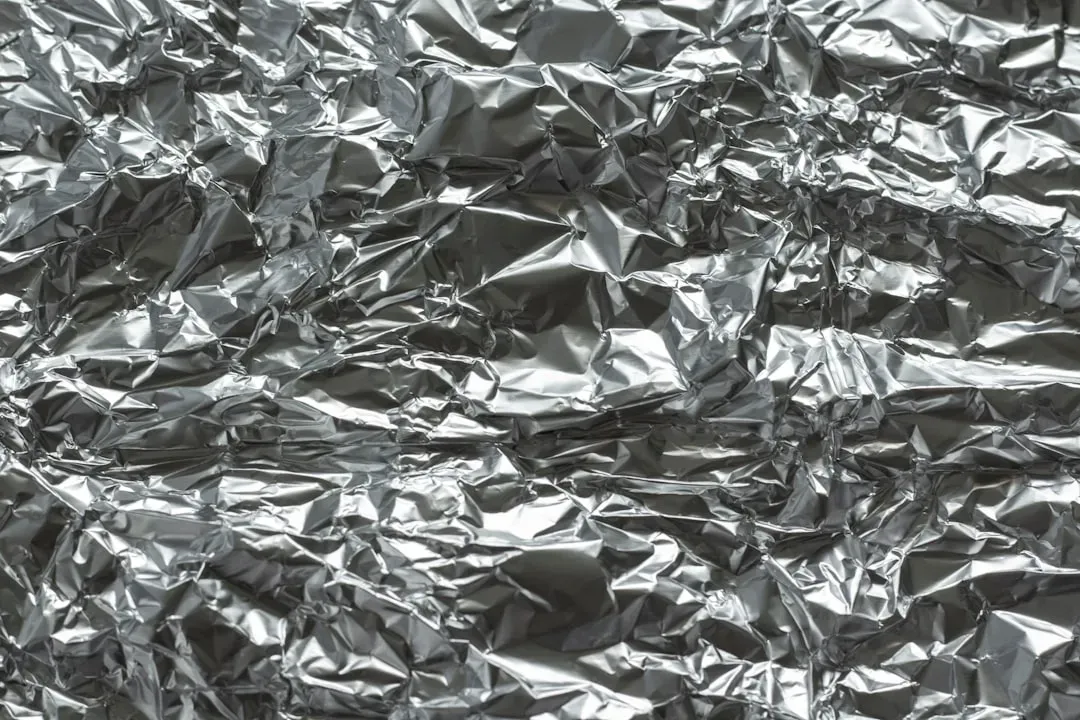
Most of us think of aluminum foil as a way to keep last night’s pizza from dying in the fridge, but physically it’s doing far more than that. Aluminum is a highly reflective metal, bouncing back a large portion of radiant heat and light that hits it. That’s why one side of the foil can feel almost cool while the other faces a hot oven, and why survival blankets made of ultra‑thin aluminum-coated films can help someone keep body heat in cold conditions without being thick or heavy.
On top of that, a whisper‑thin layer of aluminum oxide forms instantly on its surface when exposed to air, acting like an invisible protective shell. This makes aluminum foil corrosion‑resistant enough to handle acidic foods and high humidity without dissolving or rusting. The same physics principles show up in spacecraft insulation, where layered aluminum films help protect instruments from brutal temperature swings in orbit. So when you casually crumple foil over a baking tray, you’re using the same family of tricks that keeps satellites safe in the vacuum of space.
4. Glass: The Solid That’s Not Really Playing By Solid Rules

Windows, phone screens, glasses on your face – the material feels so common it’s almost invisible, but glass is quietly weird. Unlike metals or crystals, the atoms in most glass are arranged in a disordered way, more like a frozen liquid than a perfectly ordered solid. That odd atomic chaos gives glass some of its strange properties: it can be transparent, rigid, chemically durable, and yet made from something as simple as melted sand mixed with a few additives.
With tiny changes to its recipe and processing, glass can gain abilities that seem almost magical. Tempered glass is heat‑treated so internal stresses make it stronger and cause it to crumble into blunt chunks instead of dangerous shards. Borosilicate glass handles sudden temperature changes, which is why it’s used in lab beakers and oven-safe dishes. Modern smartphone glass is carefully engineered so it resists scratches and cracks, balancing hardness and flexibility at a level your grandparents’ windows could never dream of. The same ingredient – sand – can become anything from a wine glass to a fiber optic cable carrying internet data across oceans.
5. Table Salt: Simple Crystals With Electric And Chemical Secrets

That little shaker on your dinner table might be the most underrated science object in your kitchen. Sodium chloride forms tidy cubic crystals where positively charged sodium ions and negatively charged chloride ions lock into a neat, repeating pattern. Dissolve those crystals in water and they split apart into mobile ions, which is exactly what your nerves and muscles rely on to fire electrical signals throughout your body.
Salt’s ability to split into charged particles also makes it a quiet workhorse in industry. Salty solutions carry electric current better than pure water, which is why saltwater behaves differently in everything from corrosion to electrolysis processes. Pressurized molten salt mixtures are used in some experimental nuclear and solar thermal systems to store and transfer heat safely at temperatures that would destroy organic fluids. So while you’re sprinkling it on fries, the same familiar compound is being used to move electricity, shift heat, and drive chemical reactions at extreme scales.
6. Rubber Bands: Everyday Elasticity With Molecular Acrobatics
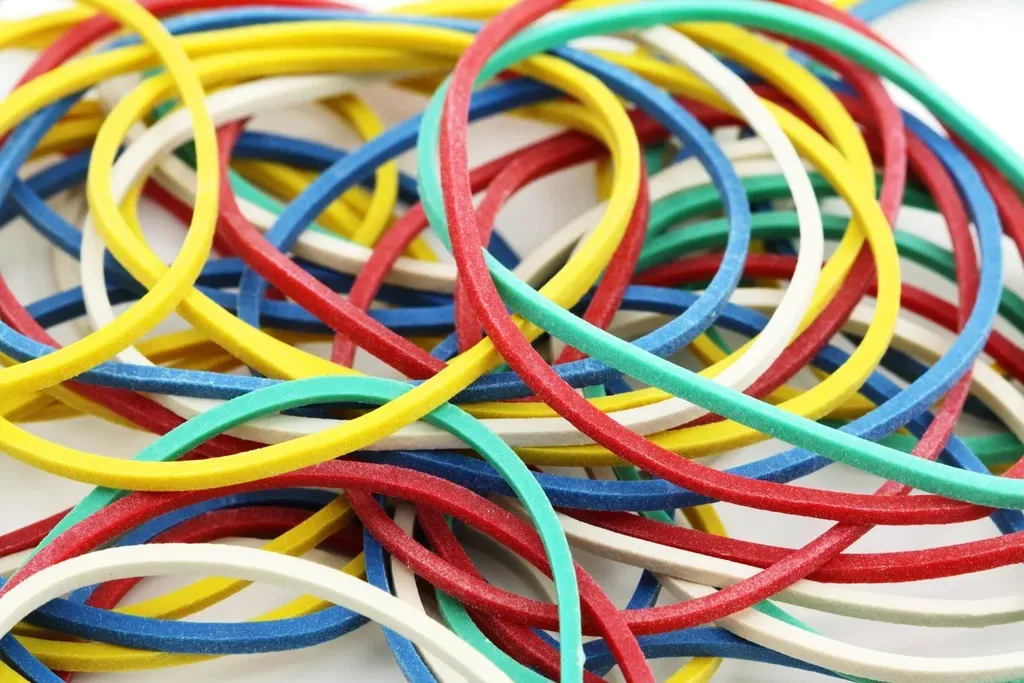
Stretch a rubber band and it feels like the simplest thing in the world, but at the molecular level it’s a chaotic party. Rubber is made of long, spaghetti‑like polymer chains twisted and tangled together. When you pull on a rubber band, you force those random coils to line up, like straightening out a pile of curled ribbons. Let go, and they snap back into their messy state, dragging the material with them – that’s elasticity, powered by entropy and atomic motion rather than metal springs.
What’s even stranger is that when you stretch rubber quickly, it actually gets a bit warmer. Those polymer chains lose some of their internal wiggle room and convert that microscopic motion into heat. This behavior shows up in everything from car tires gripping the road to the soles of your running shoes absorbing impact. The simple loop sitting in your desk drawer is linked to the same physics used in vibration dampers, medical devices, and shock absorbers that quietly keep bridges, machines, and even skyscrapers stable.
7. Plastic Wrap: Clingy Film With Gas-Blocking Skills
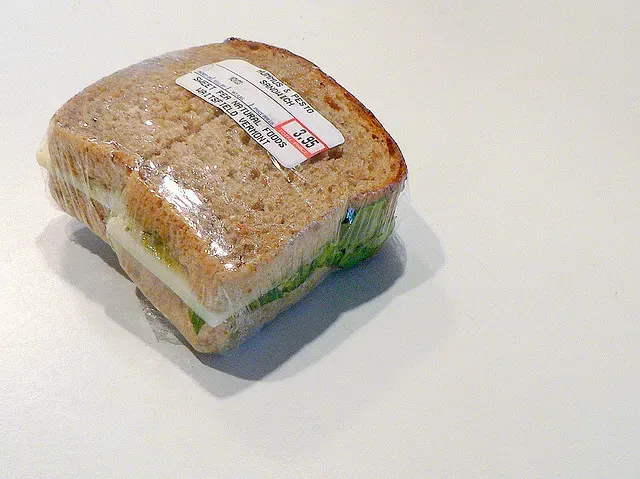
Plastic wrap may look like flimsy, transparent nothingness, but chemically it’s a fine‑tuned barrier. Many common wraps are made from polymers whose long chains pack tightly together, leaving very little space for gas molecules like oxygen or carbon dioxide to slip through. That’s one reason covering food can slow down how quickly it dries out, oxidizes, or picks up odors from the rest of your fridge.
By changing the polymer recipe and thickness, manufacturers tweak how much moisture or gas plastic films let through, which is a big deal for food safety and shelf life. In industrial and medical settings, related barrier films are used to protect sensitive electronics from humidity or to keep sterile instruments sealed from microbes until the moment they’re needed. It’s a strange thought, but that clingy sheet you’re wrestling over a bowl of leftovers is built on the same science as some lifesaving packaging in hospitals and high‑tech labs.
8. Cotton T-Shirts: Cozy Fabric With Micro-Engineered Fibers

The softness of a cotton T‑shirt feels about as low‑tech as it gets, but zoom in and the fibers are mini engineering projects. Each cotton fiber is a twisted ribbon of almost pure cellulose, a natural polymer that plants build from repeating sugar units. The way these ribbons twist, flatten, and bundle together creates tiny channels that can soak up and move moisture, which is why cotton feels breathable and can absorb a surprising amount of sweat before it feels soaked.
Textile scientists study these structures to spin cotton and cotton blends that behave in very specific ways – dry faster, wick moisture in one direction, or hold dyes more permanently. Some modern fabrics mimic cotton’s natural micro‑channels using synthetic fibers shaped or textured at the microscopic level, combining comfort with quick drying or stretch. So when you pull on your favorite worn‑in shirt, you’re wearing centuries of trial‑and‑error fabric science that’s still inspiring new materials for sportswear, medical dressings, and even flexible sensors woven into clothing.
9. Ceramic Coffee Mugs: Fragile Shells With Heat-Handling Power

That comforting ceramic mug in your hand seems simple: it holds coffee, it breaks when you drop it, end of story. But ceramic materials sit in a fascinating sweet spot between glass and crystal. Their atoms are often locked into ordered structures that make them stiff and heat‑resistant, while carefully controlled firing in a kiln strengthens them and removes internal stresses. That’s why a mug can handle boiling liquid without cracking, even though a sudden hard knock on the counter can still shatter it.
This combination of heat tolerance and rigidity is why ceramics show up in places that would destroy metals or plastics. Advanced ceramics are used in jet engines, where temperatures are so high that even high‑grade alloys struggle, and in some automotive brakes that need to survive intense friction without warping. In medicine, certain ceramic materials are biocompatible enough to be used in bone replacements and dental implants. The cup on your desk is a distant cousin of the materials keeping planes flying and replacing worn‑out joints inside the human body.
10. LED Bulbs: Everyday Lighting With Quantum-Level Tricks

Flip a switch and an LED bulb just lights up – nothing dramatic to see – but the way it works is quietly radical. Inside is a semiconductor material where electrons fall from a higher energy level to a lower one when current flows, and in the process they release energy as light. By adjusting the composition and structure of that semiconductor, manufacturers can tune the color and efficiency of the light, turning electricity into photons with far less wasted heat than old‑school incandescent filaments.
The same basic light‑emitting physics shows up in phone screens, traffic lights, and some medical devices that use specific wavelengths of light to treat skin conditions or help imaging systems see blood vessels more clearly. White LED bulbs often combine blue or ultraviolet LEDs with special phosphor coatings that convert part of that light into a broad spectrum closer to daylight. So the plain bulb screwing into your ceiling fixture rests on quantum‑scale behavior that connects your living room directly to the cutting edge of optoelectronics.
Once you start seeing the science behind everyday stuff, it’s hard to unsee it. A pencil, a mug, a rubber band – these things stop being background noise and start looking like the visible tip of a massive iceberg of chemistry, physics, and engineering beneath the surface. The wildest part is that many of the same principles driving futuristic technologies – quantum behavior, atomic structure, thermal management – are already sitting on your desk or in your kitchen drawer.
You don’t need a lab coat or a particle accelerator to bump into serious science; you’re literally holding it every day. The more you pay attention to what materials around you can really do, the more the world stops feeling ordinary and starts feeling like a quiet miracle of design and discovery. What’s the most “boring” object near you right now that might be hiding its own secret superpower?