Imagine a place where sunlight never reaches, pressure could crush a submarine, and life has twisted itself into shapes that look more like science fiction than biology. That’s the deep sea. It’s Earth’s largest habitat, and yet we’ve explored only a tiny slice of it. What we have seen, though, is wild enough to make you question whether you’re still on this planet.
Some of these animals glow like living neon signs. Others have transparent bodies, huge teeth, or balloon-like heads that look digitally edited. I still remember the first time I saw footage of a certain deep-sea creature and genuinely wondered if someone was pranking me. Let’s dive into ten of the most otherworldly beings living right now on our own planet, far beneath the waves.
Anglerfish: The Living Lantern of the Abyss
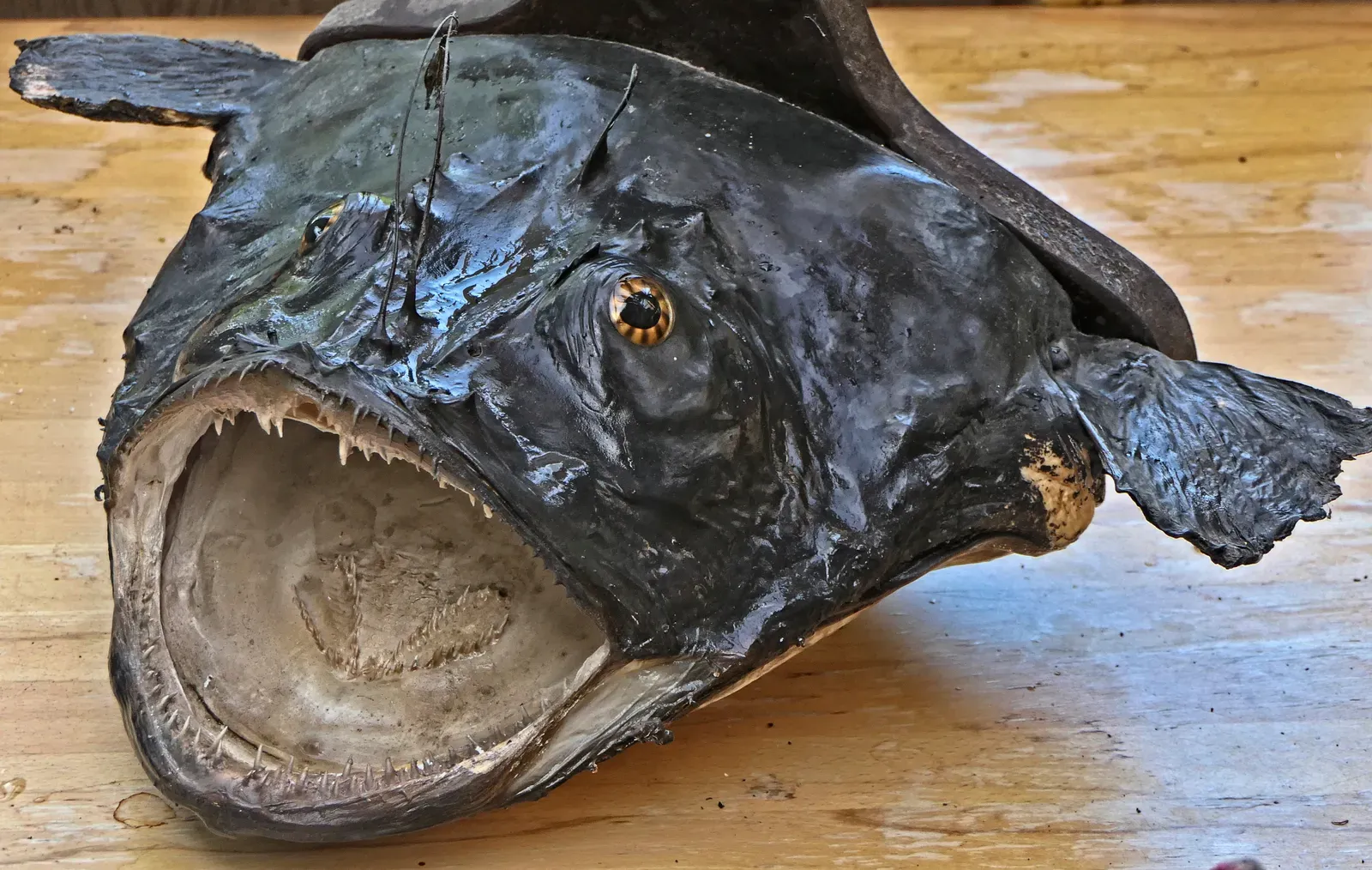
At first glance, the anglerfish looks like a monster straight out of a horror movie: huge teeth, a gaping mouth, and a glowing lure dangling in front of its face like a fishing rod light. That glowing orb is actually a piece of modified dorsal spine filled with bioluminescent bacteria, which the anglerfish uses to lure prey in the total darkness of the deep. In an environment where nearly everything is pitch black, having your own built‑in flashlight is like cheating.
What really feels alien, though, is their love life. Many deep-sea anglerfish species have extreme sexual dimorphism: the females are large and terrifying, and the males are tiny, almost parasitic. When a male finds a female, he bites and fuses to her body, eventually sharing her bloodstream and losing most of his organs. It’s bizarre, but in a place where encounters are rare, permanently attaching to your partner is a brutal but effective strategy.
Gulper Eel: The Balloon-Headed Nightmarescape
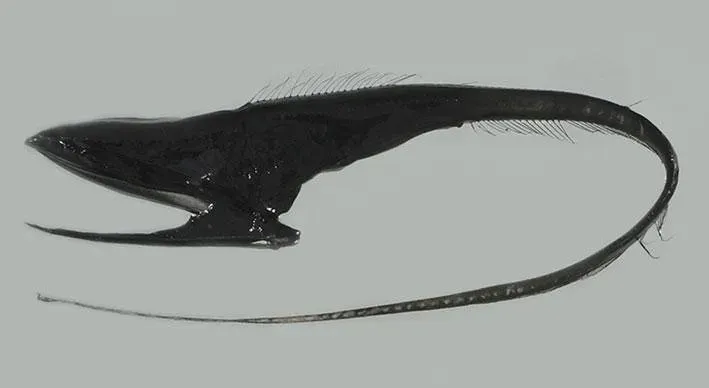
The gulper eel (also called the pelican eel) looks like an experimental creature design that never should’ve left the sketchbook. Its head is enormous compared to its long, whiplike tail, and its mouth can open into a huge balloon shape that’s many times bigger than its body. Instead of sharp teeth, it has small ones, because the real trick is swallowing prey whole, like a net closing. This weird anatomy helps it gulp down almost anything it can fit inside, which is incredibly useful when food is scarce.
As if that weren’t strange enough, gulper eels have a glowing, bioluminescent tail tip that can flash and pulse. Scientists think it might work like a glow-stick lure, pulling curious animals close enough to be swallowed. Watching video of one inflating its head feels like watching a glitch in reality, as if someone took a normal eel and put it through a cartoon filter. It’s one of those creatures that makes you realize just how flexible evolution can be when the rules of light and space change.
Dumbo Octopus: The Deep Sea’s Gentle Alien
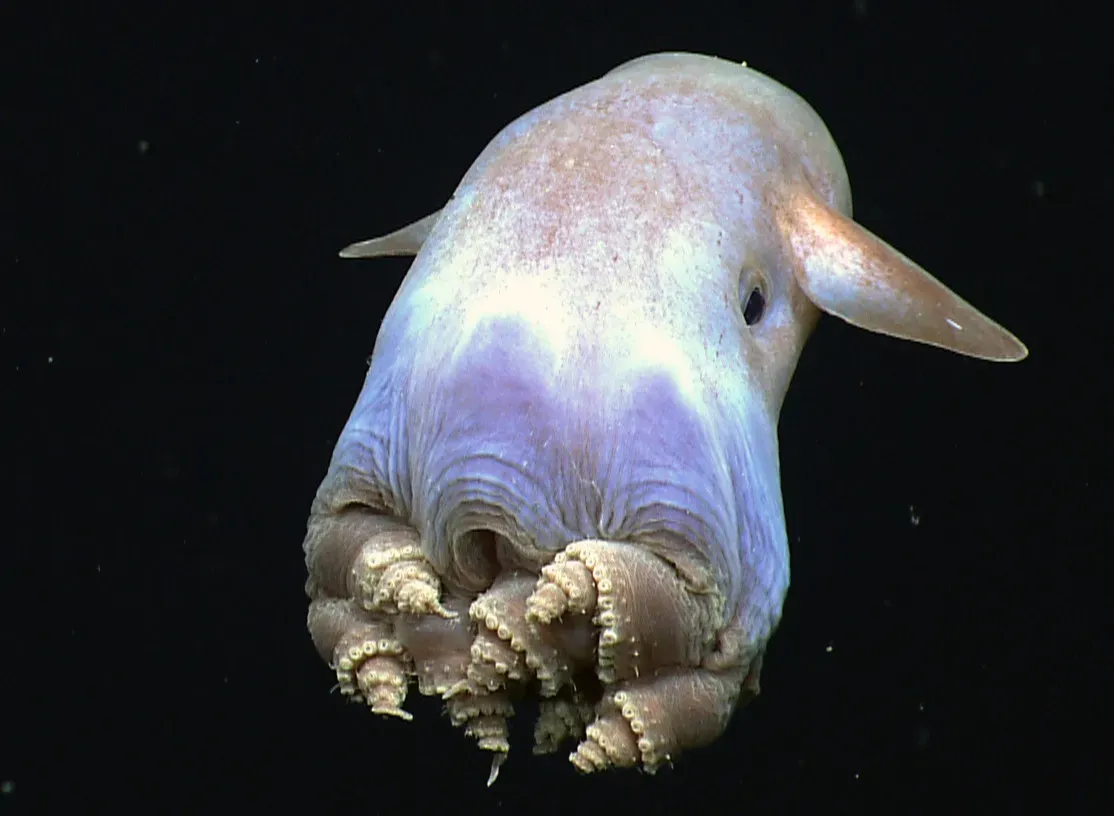
If most deep-sea creatures look like nightmares, the dumbo octopus is the exception that looks weirdly adorable. It gets its name from the two ear‑like fins on its head that resemble the cartoon elephant’s ears, and it flaps them gently as it swims. Unlike many shallow-water octopuses that crawl and squeeze into crevices, dumbo octopuses drift through the water column, hovering like tiny ghosts. Their rounded bodies and calm, floating motion feel almost peaceful compared to their toothy neighbors.
They live thousands of meters below the surface, where pressure is intense and temperatures are close to freezing. Down there, they feed mostly on worms, crustaceans, and other small invertebrates on or just above the seafloor. One of the strangest things about them is how little drama there is: they don’t have ink sacs, because there’s no point clouding water no one can see in. Instead, their alien charm comes from how soft and delicate they seem in such a brutal environment, like a gentle visitor in a hostile world.
Vampire Squid: The Cloaked Creature of Eternal Night
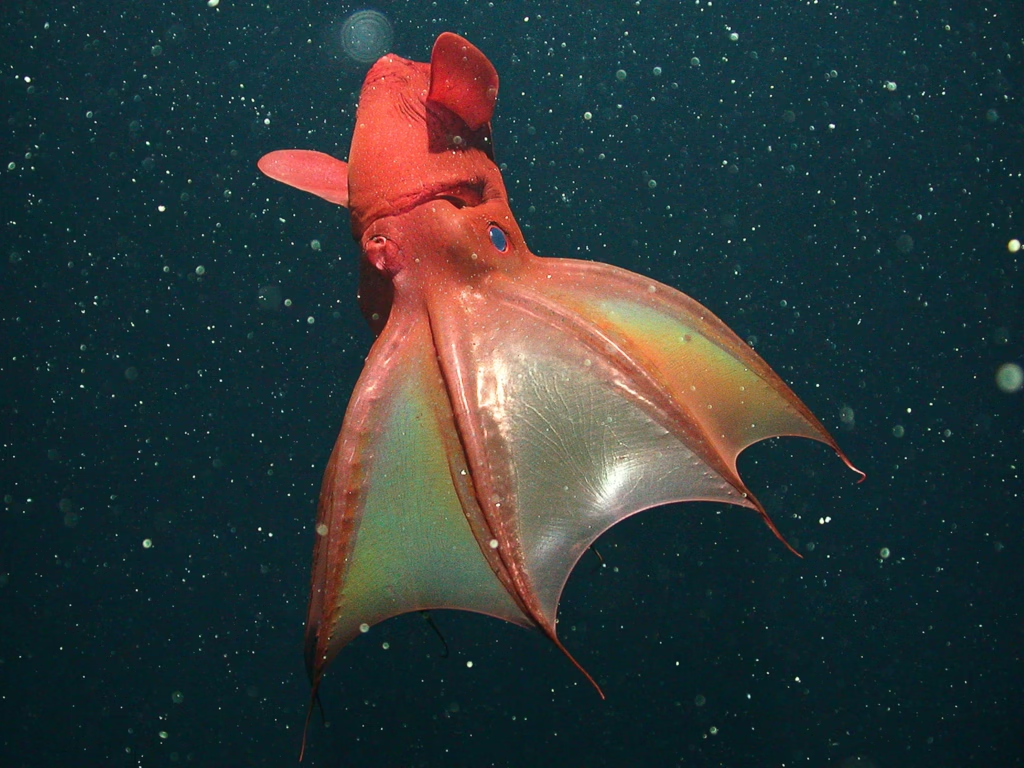
The vampire squid sounds like something a sci‑fi writer invented during a late-night brainstorming session. It lives in deep, oxygen‑poor waters and has webbing between its arms that forms a sort of cloak. When threatened, it can invert that cloak over itself, turning into a spiky, inside‑out umbrella that looks disturbingly dramatic. Its scientific name literally means “vampire squid from hell,” which tells you how unsettling it looks up close.
Despite the name, it doesn’t suck blood; it’s actually kind of a gentle scavenger. It feeds on “marine snow,” the constant drizzle of tiny dead bits and organic particles falling from above. Instead of jetting around like other squids, it uses very little energy, drifting in the water with its red eyes and softly glowing body. It can produce bioluminescent clouds of blue light, almost like underwater fireworks, to distract predators. The combination of cloak, glow, and eerie calm makes it look less like an animal and more like a character from a dark fantasy story.
Goblin Shark: The Deep Sea’s Living Fossil
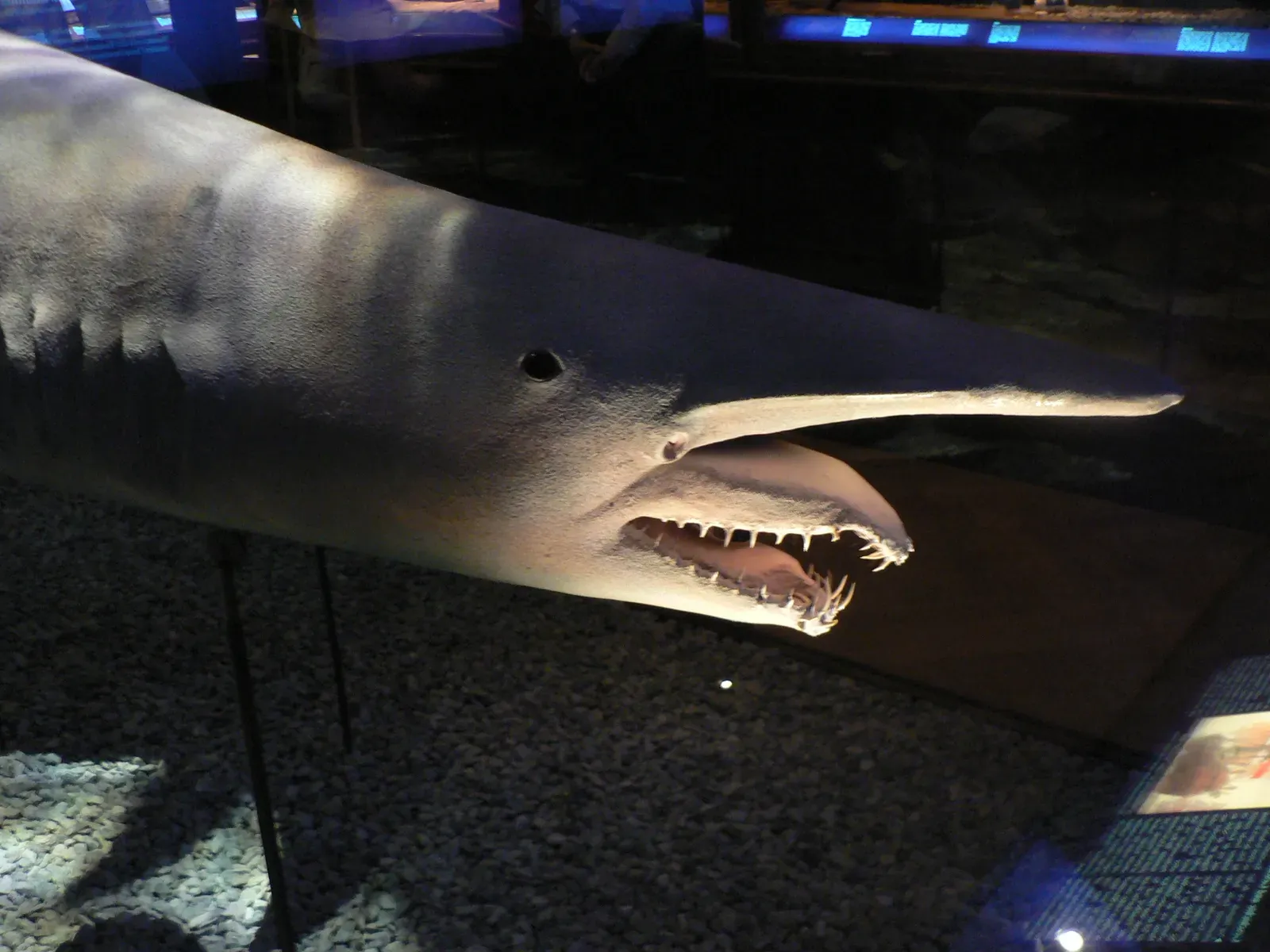
The goblin shark is the kind of creature that makes people say, “That cannot be real.” It has a long, flattened snout, nail‑like teeth, and a jaw that can suddenly shoot forward in a rapid, slingshot move. When it attacks, the whole lower part of its face juts out in a way that looks mechanical, almost like a movie monster animatronic. High‑speed footage of this jaw extension is both mesmerizing and mildly disturbing.
This shark is sometimes called a living fossil because it belongs to a very old lineage that has changed surprisingly little over millions of years. It spends its life in deep waters, far below where humans swim, and most of what we know comes from rare captures or occasional deep‑sea footage. Its pale, almost pinkish skin and soft, rubbery body add to the unreal appearance. Standing next to one in a lab, people often say it looks like it came from a different timeline, not just a different depth.
Barreleye Fish: The Transparent-Headed Enigma
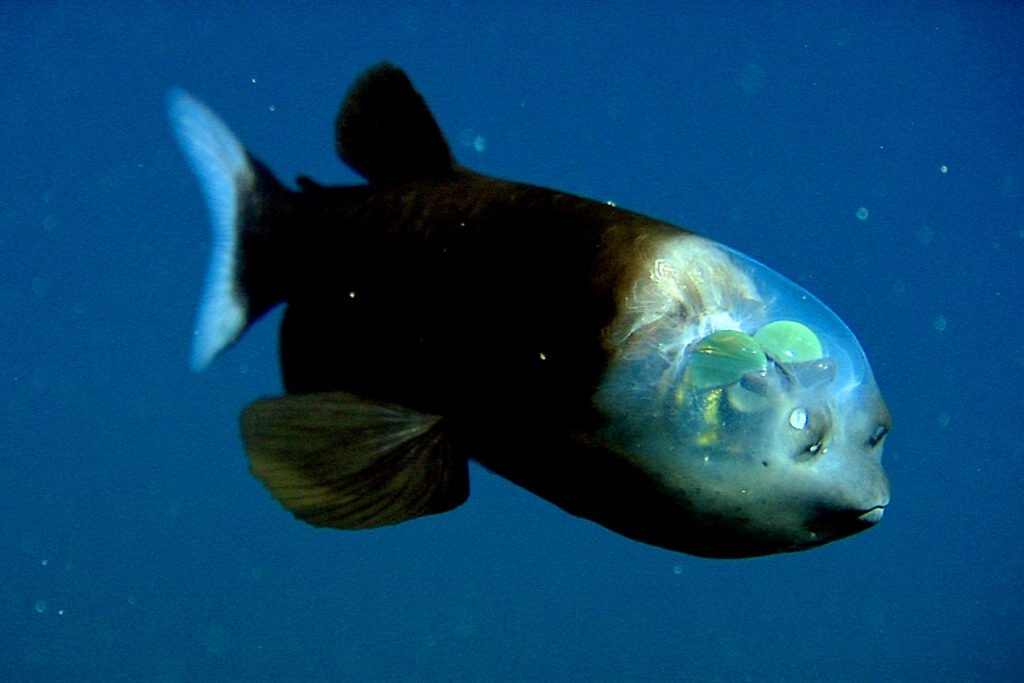
The barreleye fish might be one of the most unsettling animals ever discovered, simply because it breaks a rule we take for granted: heads are not supposed to be see‑through. This fish has a transparent, dome‑shaped head, and inside that dome are two green, barrel‑shaped eyes that can swivel around. For a long time, scientists misinterpreted those eyes as weird nostrils because they’re so unlike anything we see in surface fish. Only later did deep‑sea footage reveal the see‑through skull and rotating gaze.
Those tubular eyes are incredibly sensitive, built to gather what little light exists in the deep sea, probably to spot faint silhouettes above. The fish often hovers almost motionless, conserving energy, and can angle its eyes upward to watch for prey. When it needs to feed, it can shift its gaze forward, like adjusting a pair of binoculars. The whole setup looks less like an animal and more like some kind of floating surveillance device. It’s one of those creatures that makes you realize evolution can treat anatomy like experimental hardware.
Frilled Shark: The Serpentine Relic From the Deep
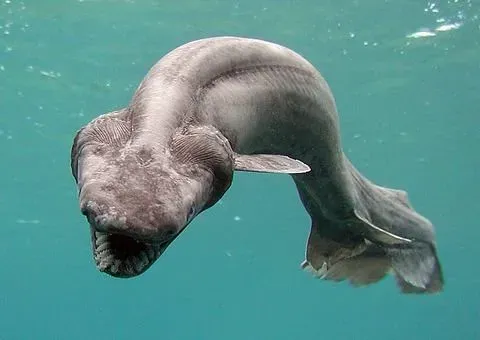
The frilled shark looks like a sea serpent from old sailor stories that somehow slipped into modern times. Its body is long and eel‑like, and its mouth is filled with rows of backward‑pointing, needle‑sharp teeth that seem designed to trap anything unfortunate enough to slide in. The gill slits are frilly and edged, giving it the “frilled” name, and adding an almost gothic flair to its appearance. It doesn’t have the typical sleek, muscular shark shape most of us imagine from documentaries.
This species lives deep down, often beyond the reach of regular fishing nets, and sightings are rare. When one does surface or get filmed, it moves with a slow, writhing motion that looks more like a snake than a shark. Its ancient lineage and primitive features make scientists think it has stayed more or less similar for a very long time. Seeing one is like time‑traveling back into a darker, stranger version of Earth’s oceans. If any animal could pass as a myth come to life, this one is on the shortlist.
Giant Isopod: The Deep Sea’s Armored Tank Bug
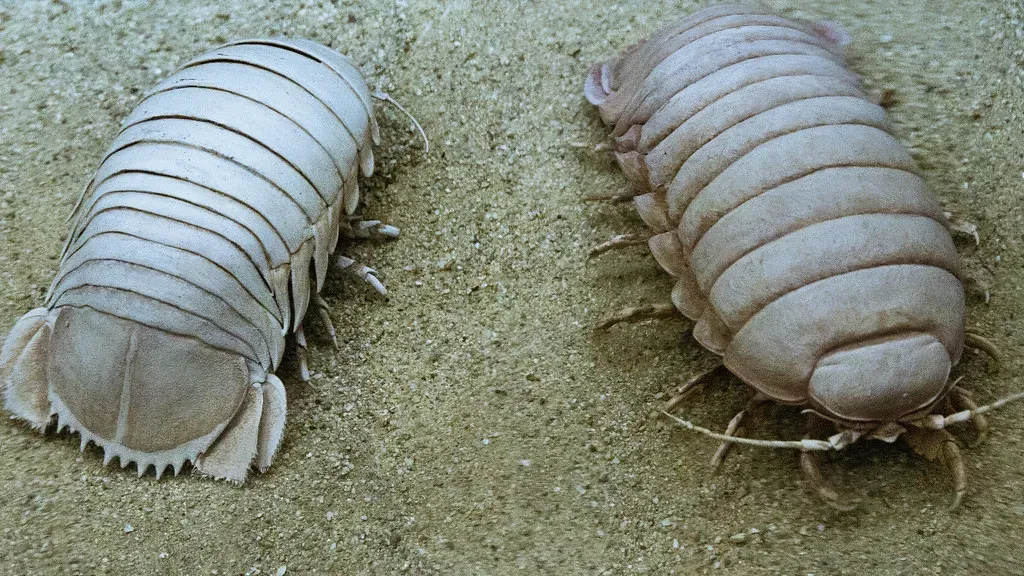
The giant isopod looks like someone hit the “zoom in” button on a common pill bug or roly‑poly and then dropped it at the bottom of the ocean. It’s an armored crustacean with a segmented shell, many legs, and a pale, almost ghostly color. The unsettling part is the size: some species grow longer than a house cat, which feels deeply wrong if you’ve ever flicked a tiny version off your porch. It crawls slowly over the deep seafloor like a little tank searching for leftovers.
These scavengers feed mainly on dead animals that sink down from above, including fish, squid, and even whale carcasses. Food is unpredictable in the deep, so they’ve adapted to survive long stretches without eating; in captivity, some have gone months without a meal. Their slow movements and tough armor make them look strangely confident in a world full of sharp‑toothed predators. They don’t have the eerie glow or bizarre anatomy of some deep‑sea neighbors, but the scale alone makes them feel alien. It’s like seeing a backyard insect promoted to boss level.
Fangtooth: The Tiny Terror With Oversized Fangs
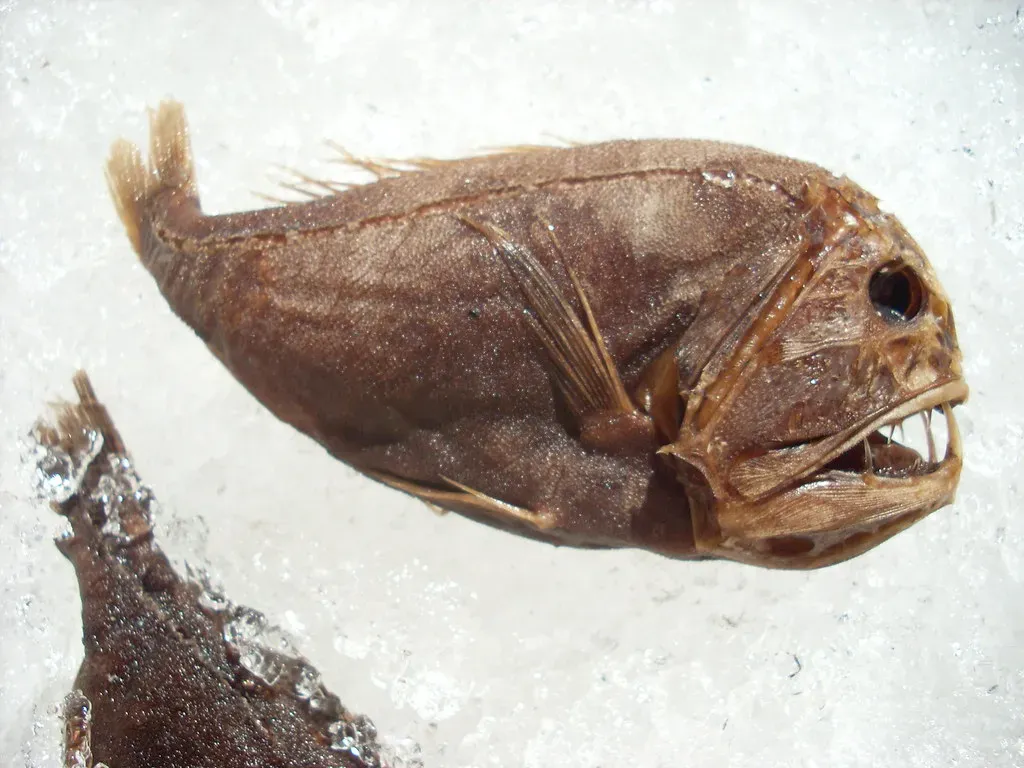
The fangtooth fish is proof that small does not mean harmless. It’s only about the size of a human hand, yet it has some of the largest teeth relative to body size of any fish in the ocean. Those teeth are so long they would pierce its own brain if the fish’s skull weren’t specially adapted with pockets to hold them. Its eyes are small, its head is large, and its body is dark and rough, giving it the vibe of a deep‑sea bouncer that’s seen things no one should see.
Despite the intimidating look, fangtooths are actually not brutal super‑predators; they’re just very well armed for catching anything that swims in range. In the deep sea, meals don’t show up often, so you need to be ready when they do. They rely on touch and movement more than sight, lunging blindly into the dark. The combination of oversized teeth, dark armor‑like skin, and compact size feels almost comical and terrifying at the same time. It’s like someone put a set of shark jaws on a small, grumpy potato.
Sea Angel: The Ghostly Butterfly of the Deep
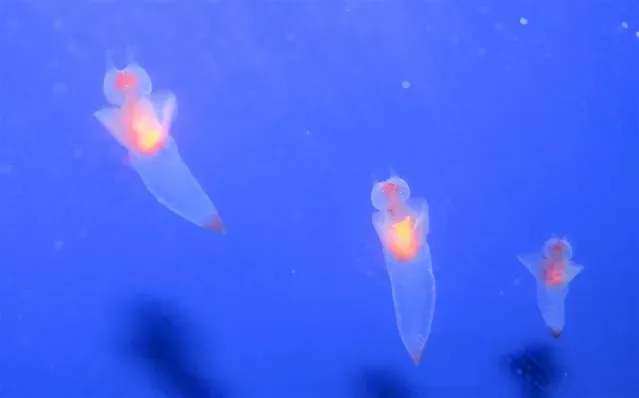
The sea angel is the kind of creature that makes you forget you’re looking at a snail. It’s actually a type of pelagic sea slug, but it doesn’t have a visible shell; instead, it has a transparent, gelatinous body with two winglike flaps that it uses to “fly” through the water. Watching one swim is strangely calming, like seeing a tiny, glowing ghost butterfly drifting in slow motion. Compared to the teeth and spikes of other deep‑sea residents, its softness feels unreal.
But behind the delicate appearance, sea angels can be surprisingly fierce, at least toward their prey. Some species hunt related sea snails, using specialized feeding structures that appear when it’s time to attack. They live in cold and deep waters, sometimes rising closer to the surface at night and sinking again by day. Their pale, often faintly glowing bodies make them look like they fell out of a dream and just kept sinking. If aliens ever sent a peaceful messenger to Earth’s oceans, you could easily imagine it looking like this.
A Stranger World Beneath Our Feet
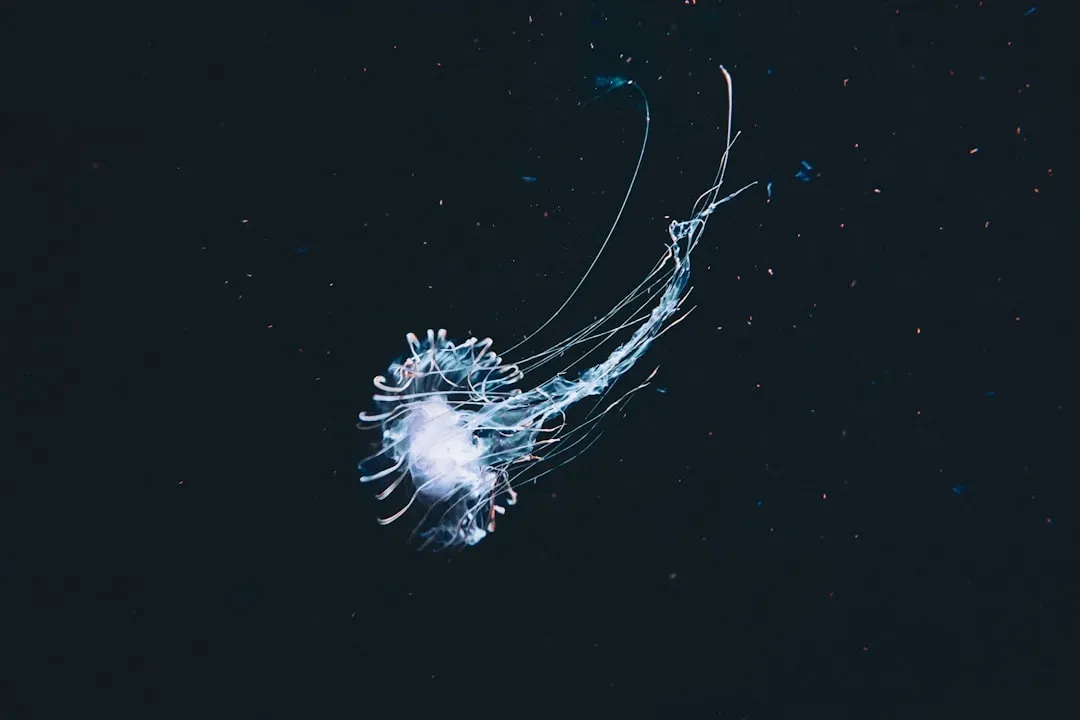
The more you look at the deep sea, the more it feels like we’ve been living next to an alien world without really noticing. These creatures – with their glowing lures, transparent heads, balloon mouths, and parasitic romances – aren’t just curiosities; they’re survival experiments in one of the harshest environments on Earth. Every strange feature has a job: to find food, to avoid being eaten, or to reproduce in a place where encounters are rare and darkness is total. What looks monstrous or magical to us is just practical engineering in another realm.
What sticks with me is how tiny our “normal” really is. Most of the planet is ocean, and most of that ocean is deep, dark, and still wildly unexplored. Somewhere down there, beyond the reach of our cameras and subs, there are almost certainly creatures even stranger than the ones we’ve already met. The next time you look at a calm blue sea, remember that it’s not a flat surface but a window into a black, pressurized universe full of living oddities. Which of these deep‑sea aliens would you have guessed actually lives on Earth?