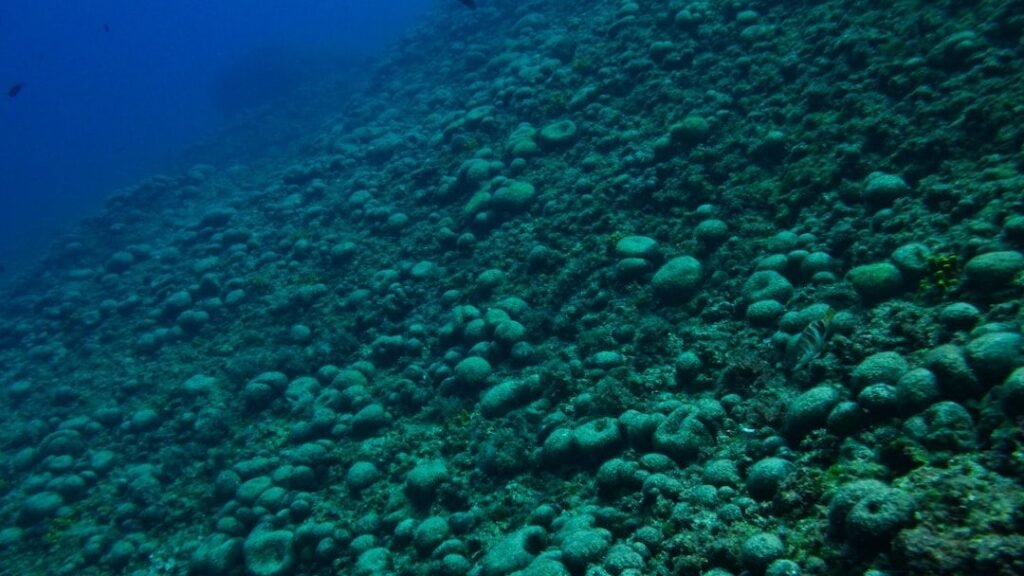
Hundreds of miles from the nearest sunlight, in waters so cold and pressurized they would crush a submarine, life still finds a way to glow, grasp, and devour. The deep sea was once dismissed as a barren void, but over the past few decades, robotic submersibles and deep-diving cameras have revealed a world stranger than science fiction. Out here, transparency is armor, teeth are longer than fingers, and light itself becomes a trap. Scientists are realizing that understanding these bizarre creatures is not just about cataloging oddities; it reshapes what we think life can endure and how Earth’s largest habitat really works. In the pitch-black depths, every flash, fin, and fanged jaw is a clue to a hidden ecosystem we’re only beginning to understand.
The Vampire Squid: A Living Relic of the Deep
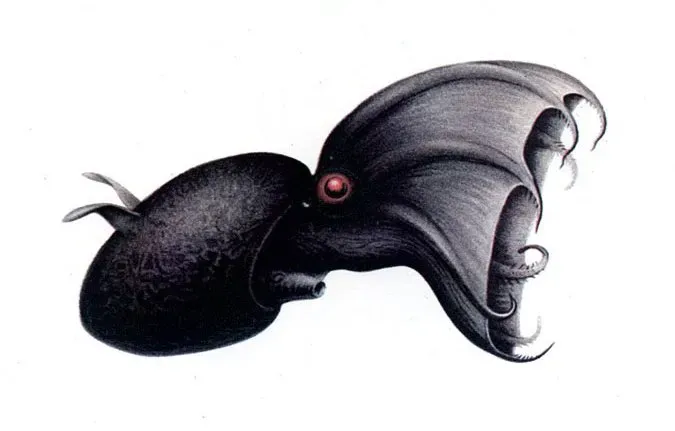
The vampire squid sounds like something dreamed up for a horror film, but in reality it is a small, soft-bodied survivor that lives in some of the lowest-oxygen waters on Earth. Rather than slurping blood, it drifts slowly through the dark, gathering falling organic debris – so-called “marine snow” – with delicate, filament-like arms. Its skin can appear black or deep red, and when threatened, it turns its cloak-like webbing inside out, revealing rows of rubbery-looking spines that make it appear larger and more menacing. The animal’s eyes are enormous, proportionally among the largest in the animal kingdom, tuned to detect the faintest glimmers of bioluminescent light around it. To me, it feels less like a monster and more like a ghost from Earth’s ancient oceans, quietly persisting where few others can.
Scientifically, the vampire squid sits alone in its own order, a reminder that evolution sometimes preserves entire lineages in stable, hidden habitats. It thrives in oxygen minimum zones where many other animals would suffocate, thanks to specialized blood pigments and slow metabolism. Instead of fast, violent predation, it has evolved a low-energy, scavenging lifestyle that perfectly fits the deep sea’s scarcity. Its blue bioluminescent spots and glowing arm tips likely confuse predators in the darkness, creating disorienting flashes rather than clear targets. If you imagine a world built entirely on recycling the ocean’s leftovers, the vampire squid is one of its quiet custodians.
The Anglerfish: Hunters With a Built-In Fishing Rod
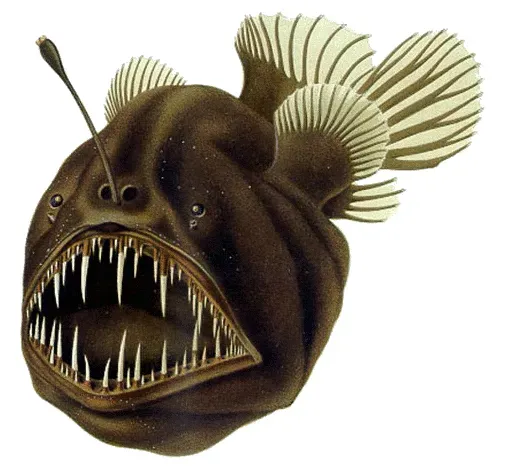
Few deep-sea residents are as instantly recognizable – or as unsettling – as the anglerfish, with its gaping jaw and glowing lure. The now-iconic image of a lantern-like bulb dangling above a mouthful of needle teeth is not exaggerated; it is a clever adaptation to life where light never naturally penetrates. The fleshy “fishing rod,” called an illicium, is tipped with a bioluminescent organ that hosts light-producing bacteria. In the endless night, small animals drawn to that glimmer of “food” end up inches from a predator that can snap its jaws shut faster than the eye could follow, if eyes could see down there at all. When I first watched submersible footage of an anglerfish, the eerie stillness around its lure felt almost theatrical – like the calm center of a trap.
Their biology only gets stranger with sex. In some anglerfish species, males are tiny, free-swimming creatures that devote their lives to finding a much larger female in the dark. Once they do, they bite and literally fuse into her body, eventually sharing her circulatory system and becoming little more than a living sperm reservoir. This extreme strategy likely evolved because encounters between individuals are so rare in the deep sea that mating opportunities cannot be wasted. Anglerfish remind us that in extreme environments, evolution is willing to trade independence for certainty. It is a love story, in a twisted way, written by the physics of darkness and distance.
Barreleye Fish: Transparent Heads and Rotating Eyes
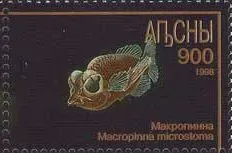
The barreleye fish looks like a hoax the first time you see it: a small fish with a transparent, bubble-like head and two vivid green tubes for eyes pointing straight upward. For years, scientists only knew its silhouette from damaged net-caught specimens and had no idea what the intact animal really looked like. Modern deep-sea cameras finally revealed the whole picture: inside that transparent dome, the eyes can actually rotate, scanning both above and in front of the fish. In a place where food is patchy and scarce, the ability to track faint outlines of prey against the weak glow of the surface is a serious advantage. It is as if the animal carries a periscope built into its skull.
The transparent shield likely protects its sensitive eyes from stinging cells on the tentacles of siphonophores and other gelatinous prey. At the same time, it allows light to pass through unhindered, preserving every photon of information about the world above. The green pigments in the eyes act like natural filters, tuning out background bioluminescence and enhancing specific wavelengths from prey. When I picture this fish hovering calmly in midwater, eyes swiveling inside a glassy helmet, it feels like something between a spy drone and an alien spacecraft. Yet it is simply another example of deep-sea life optimizing every possible scrap of light.
The Gulper Eel: A Jaw Like a Parachute
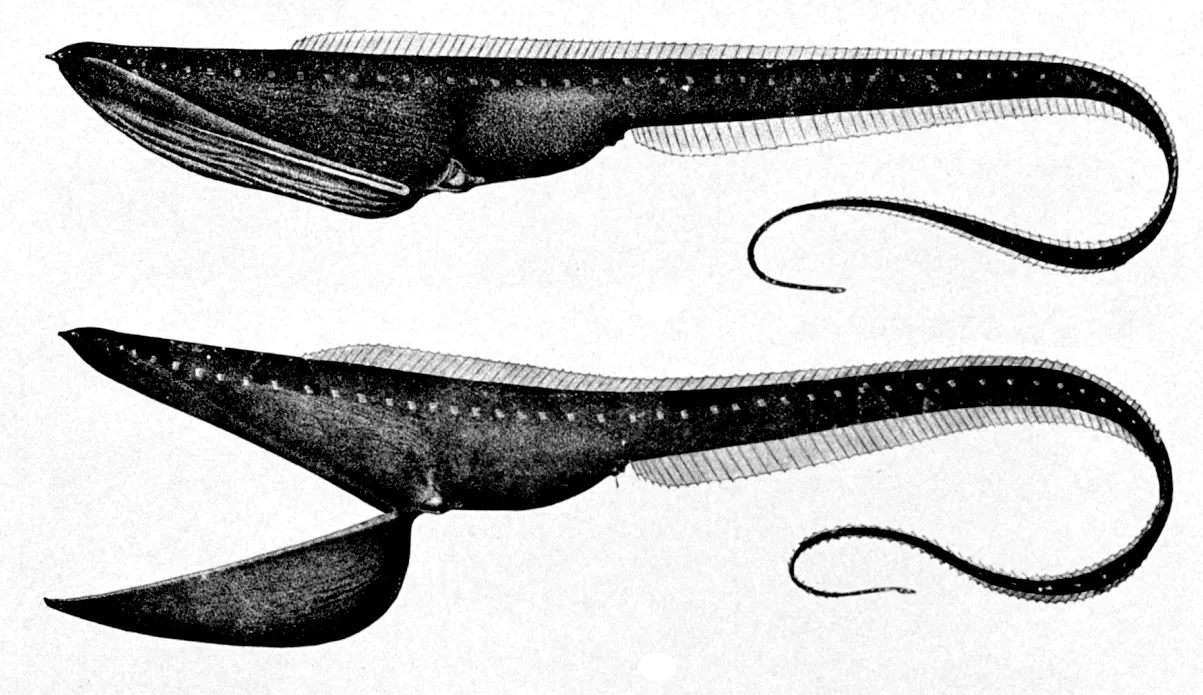
The gulper eel, sometimes called the pelican eel, turns the usual idea of a fish upside down. Its body is thin and whip-like, but its head expands into an enormous, hinged mouth that can open wider than the rest of its body. Unlike classic predators that chase specific prey, the gulper eel is built to engulf almost anything unfortunate enough to drift close, from small fish to swarms of shrimp. Its lower jaw stretches like a dark parachute, ballooning out to trap passing food in the water column. The effect is so surreal that it feels more like a scene from a dream than from real ocean footage.
Rather than powerful teeth, gulper eels rely on elastic tissues and a roomy stomach that can store large, infrequent meals. Many individuals have a bioluminescent, pinkish tail tip that may serve as a lure, wiggling like a tiny worm in the dark to draw curious prey. Energetically, this makes sense: in the deep sea, chasing prey wastes precious energy, so creating a slow-motion trap is safer. Their unusual shape also hints at how evolution stretches the definition of “fish” when traditional body plans no longer pay off. Whenever a submersible camera spots a gulper eel inflating its mouth, it feels like watching a black hole open in the water.
The Yeti Crab: Furry Arms in Hydrothermal Darkness
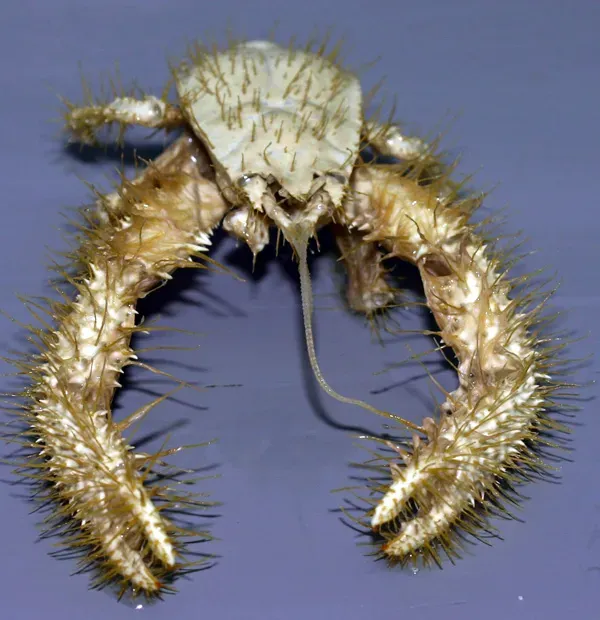
Far from the open water, deep-sea life crowds around hydrothermal vents – cracks in the seafloor where superheated, mineral-rich fluids gush out like underwater geysers. Among the strangest residents are yeti crabs, pale crustaceans with hairy-looking claws that resemble oversized mittens. Those silky bristles are coated with bacteria, which the crab appears to “farm” by waving its arms in the vent’s chemical-laced waters. Instead of sunlight, these tiny ecosystems run on chemical energy, and the bacteria can turn those chemicals into food in a process called chemosynthesis. In a sense, the yeti crab is both farmer and harvester in a field of invisible crops.
These crabs live in tight clusters near vents, sometimes piled on top of one another, packed into narrow bands where temperatures and chemicals are just right. Their ghostly white color reflects a world where camouflage from light is no longer relevant and pigment is an unnecessary luxury. To me, they feel like the deep sea’s equivalent of frontier homesteaders, eking out a living in an environment usually described as “hellish.” Studying yeti crabs and other vent species has transformed our ideas about where life can exist, even beyond Earth. If life can thrive on toxic, boiling vents without sunlight, the icy moons of Jupiter or Saturn start to look less barren.
The Snailfish: Champions of Crushing Pressure
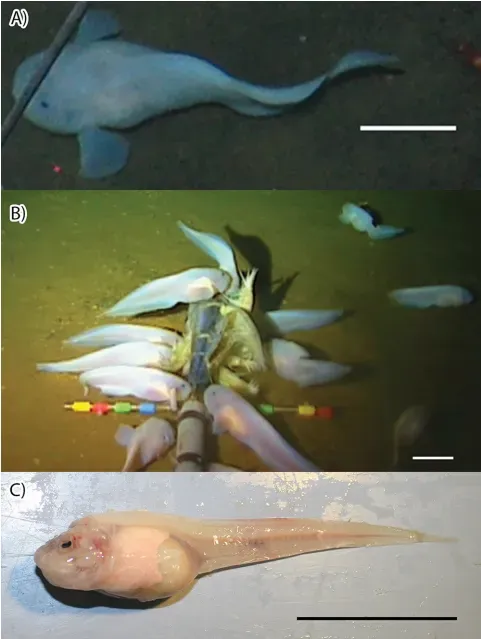
In the deepest trenches of the ocean, where pressures are hundreds of times greater than at the surface, you might expect only microbes and perhaps a few hardy worms. Instead, researchers have filmed ghostly, tadpole-like snailfish drifting calmly through the gloom at depths that would instantly destroy most submarines. Their bodies are soft and gelatinous, with minimal bone and no swim bladder, so there is nothing inside to be crushed by the enormous pressure. Specialized molecules help stabilize their proteins and cell membranes, allowing normal biology to continue under extreme stress. Watching them on camera, casually picking at scraps across the seafloor, feels almost unsettling – like seeing a bird fly on another planet.
Snailfish are often surprisingly abundant in these trenches, suggesting they are not just surviving but thriving where others cannot follow. Their translucent bodies and simple, flexible shapes are the opposite of armored, muscular surface fish. Scientists have even found that some trench species carry unique adaptations in their DNA related to pressure tolerance, hinting at a long evolutionary history in these depths. As our deep-diving technology improves, we keep pushing the record for the deepest-living fish slightly lower, and snailfish keep meeting us there. They quietly rewrite what we thought were the hard limits of animal life.
The Dragonfish: Bioluminescent Weapons and Invisible Light
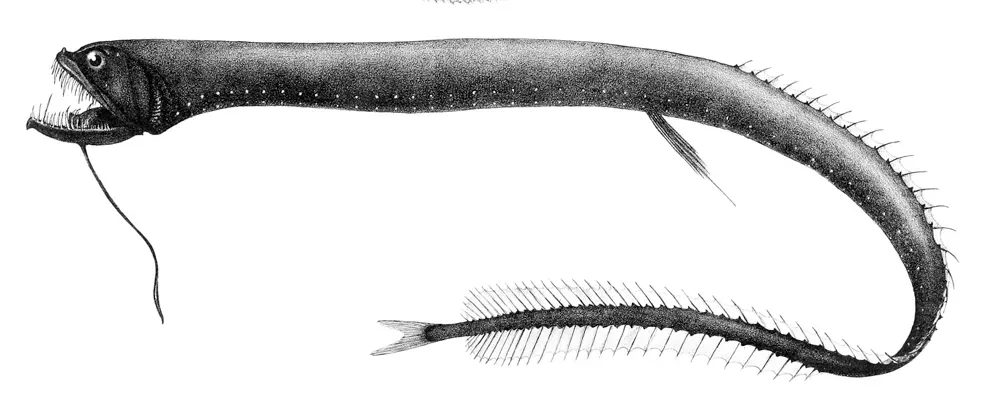
Dragonfish combine the menace of myth with the stealth of a spy plane. Many species have elongated bodies, fearsome fangs, and light-producing organs scattered across their heads and flanks. Unlike many other bioluminescent creatures that emit bluish light, some dragonfish can both produce and see red or infrared-like light that most deep-sea animals cannot detect. This gives them a private flashlight system, letting them illuminate prey without revealing themselves to others nearby. In the endless night, this kind of invisible spotlight is a decisive predatory edge.
They also use glowing spots along their bodies as lures and possible communication signals, turning their own flanks into coded message boards. The combination of extreme sensitivity to dim light and specialized pigments in their eyes places dragonfish among the optical specialists of the deep. To me, their toolkit feels almost unfair – like a submarine equipped with night vision in a world of blind targets. Understanding how dragonfish manage this biochemistry helps researchers think more broadly about light detection and signaling in low-energy environments. It even sparks ideas for new imaging technologies that might mimic these invisible wavelengths.
The Deep-Sea Hatchetfish: Mirrors in the Midnight Zone
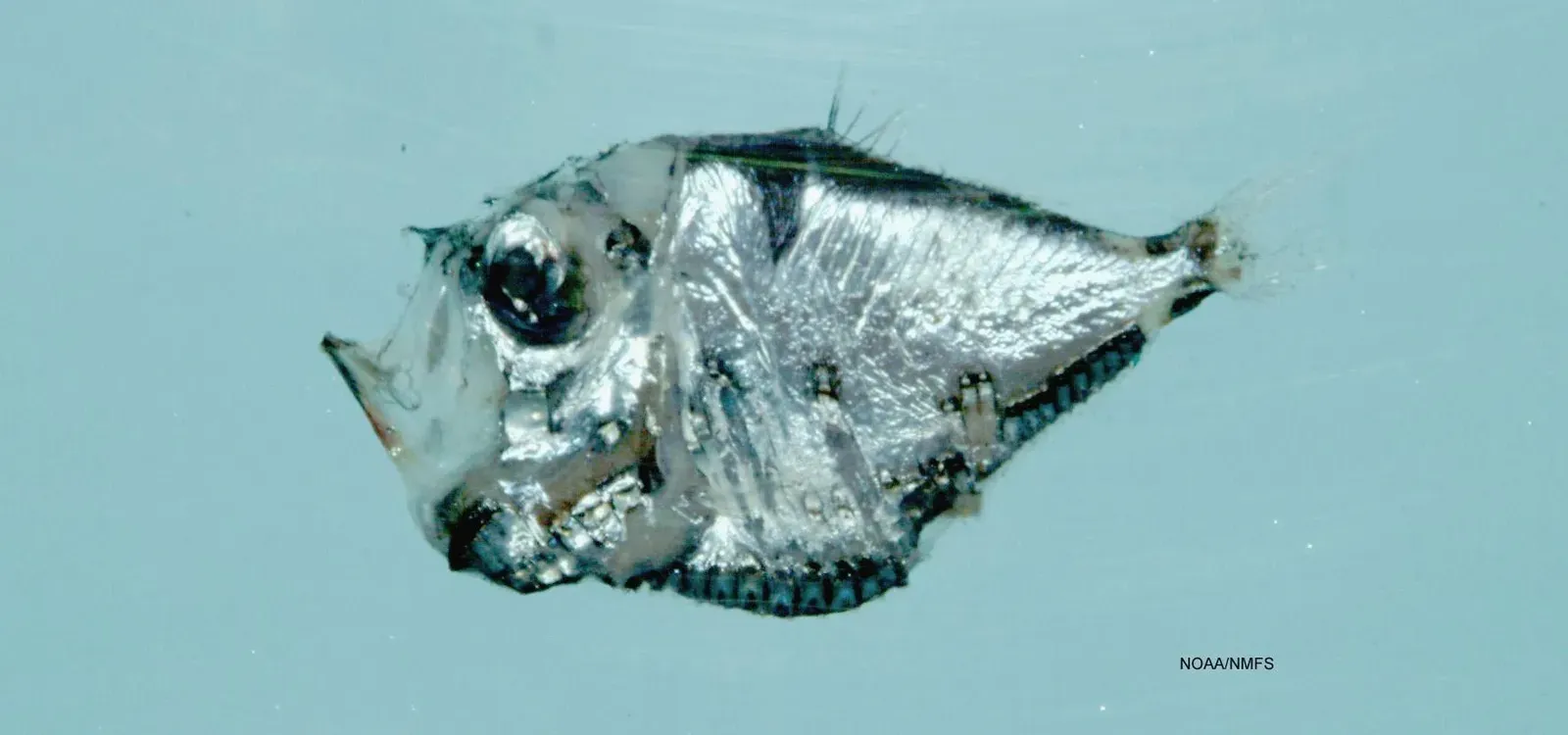
The deep-sea hatchetfish is small enough to fit in your hand, yet its shimmering, metallic body hides one of the cleverest camouflage tricks in the ocean. Its flanks are lined with tiny, precisely arranged light organs that can match the faint glow filtering down from the surface. Predators looking up from below see not a silhouette but a seamless continuation of the dim background light, a strategy known as counterillumination. In the deep midwater world where shadows can be lethal, erasing your own outline is a matter of life or death. The fish’s laterally compressed, hatchet-shaped body helps reduce its profile even further.
These animals fine-tune their bioluminescence in real time, adjusting intensity and pattern as the light environment changes with depth or time of day above. That level of precision suggests a sophisticated feedback system between their eyes and light organs. What strikes me is how this strategy in the deep sea echoes technology on land, like stealth aircraft designed to evade radar or infrared detection. Evolution got there first, crafting living cloaking devices out of soft tissue and bacteria. The hatchetfish shows that in the dark ocean, sometimes the most powerful weapon is simply not being seen at all.
Why These Creatures Matter Far Beyond the Deep
It is tempting to see these bizarre animals as mere curiosities, like nature’s oddities locked away in an inaccessible museum. But the deep sea is not a side show; it covers the vast majority of Earth’s habitable volume and plays a central role in climate regulation and nutrient cycles. Many of these creatures are key links in the “biological pump,” the slow, planet-scale conveyor belt that moves carbon from the surface to the deep ocean. Vertical migrators feed near the surface at night and then descend during the day, carrying carbon in their bodies and waste to depths where it can be stored for centuries. If you care about climate stability, these hidden commuters suddenly matter a great deal.
Compared with traditional oceanography that focused on surface waters and coastal fisheries, modern deep-sea biology is overturning the notion that the deep is mostly empty and static. Instead, it appears dynamic, interconnected, and surprisingly responsive to changes in temperature, oxygen, and food supply. Disturbances from above – like warming waters or shifting currents – can ripple down the water column to the very habitats where gulper eels drift and snailfish forage. That means our decisions about fossil fuels, fishing, and pollution are not just affecting coral reefs and shorelines; they are reshaping a world we barely understand. In that sense, every glowing lure and transparent head is an early warning signal, if we choose to listen.
The Future of Deep-Sea Exploration and Its Risks
Right now, new generations of autonomous underwater vehicles and remotely operated robots are giving us sharper, longer, and more frequent glimpses into the deep. High-resolution cameras, low-light sensors, and compact DNA sequencers are revealing both new species and hidden diversity within groups we thought we already knew. In the coming years, we are likely to discover many more bizarre residents of the abyss, from microscopic symbionts living on yeti crab hairs to large animals adapted to newly found vents and seeps. This technological leap is exciting, but it also arrives at the same moment as rising interest in deep-sea mining and industrial activity on the seafloor. The risk is that we may damage habitats before we even know what lives there.
Mining proposals for metal-rich nodules and crusts in international waters have sparked intense debate among scientists and policymakers. Disturbing sediment, creating noise, and altering chemical conditions could impact the very creatures that help maintain deep-ocean processes. Because these animals often grow slowly and live long lives, recovery from disturbance may take decades or centuries, if it happens at all. The future of deep-sea exploration will hinge on whether we treat this realm as a living library to be studied and protected, or as a resource bank to be exploited quickly. The choices we make in the next few years will likely shape what kind of deep-sea life is left for future explorers to marvel at.
How You Can Help Protect the Dark Ocean
It might feel like the deep sea is so remote that nothing you do on land could possibly matter, but the connection is uncomfortably direct. Carbon emissions, plastic pollution, and overfishing all send ripples down into the depths where vampire squid drift and dragonfish hunt. Supporting policies that cut greenhouse gases, reduce single-use plastics, and create large marine protected areas helps stabilize the very systems that sustain deep-sea ecosystems. You can also back organizations that fund deep-ocean research, from university labs to nonprofit expeditions, ensuring that we keep learning before we keep taking. Even staying informed and talking about the deep sea with friends and family helps shift it from an invisible backdrop to a shared responsibility.
On a more personal level, small choices accumulate: eating seafood from well-managed sources, voting for leaders who prioritize ocean science, and resisting the lure of quick, extractive “solutions” to resource shortages. The deep ocean will never be as visible as a coral reef or a sandy beach, but it underpins both. The are not asking for rescue; they simply need space and time to continue the quiet work they have done for millions of years. The real question is whether we can learn to value what we cannot easily see or touch. In a world lit mostly from above, will we remember to care for the life that glows, unseen, far below?
Suhail Ahmed is a passionate digital professional and nature enthusiast with over 8 years of experience in content strategy, SEO, web development, and digital operations. Alongside his freelance journey, Suhail actively contributes to nature and wildlife platforms like Discover Wildlife, where he channels his curiosity for the planet into engaging, educational storytelling.
With a strong background in managing digital ecosystems — from ecommerce stores and WordPress websites to social media and automation — Suhail merges technical precision with creative insight. His content reflects a rare balance: SEO-friendly yet deeply human, data-informed yet emotionally resonant.
Driven by a love for discovery and storytelling, Suhail believes in using digital platforms to amplify causes that matter — especially those protecting Earth’s biodiversity and inspiring sustainable living. Whether he’s managing online projects or crafting wildlife content, his goal remains the same: to inform, inspire, and leave a positive digital footprint.