You think you know what strange looks like? Think again. The ocean’s deep zones, those pitch-black layers of crushing pressure and near-freezing cold that begin just a few hundred meters below the surface, are home to life forms so alien in design that even seasoned marine biologists occasionally stop and stare. We know remarkably little about the deep ocean. In fact, we know more about the surface of the moon than we do about the ocean floor.
That should give you pause. Right here on our own planet, beneath waves we’ve sailed for thousands of years, an entire universe of bizarre biology is playing out in complete darkness. By accelerating how species are documented and named, scientists can better understand and potentially protect the countless forms of life still hidden in Earth’s vast and mysterious oceans. Every single expedition turns up something that rewrites what we thought we knew. So buckle up, because what you’re about to read is weirder than any science fiction. Let’s dive in.
1. The Goblin Shark: The Living Fossil With a Slingshot Jaw
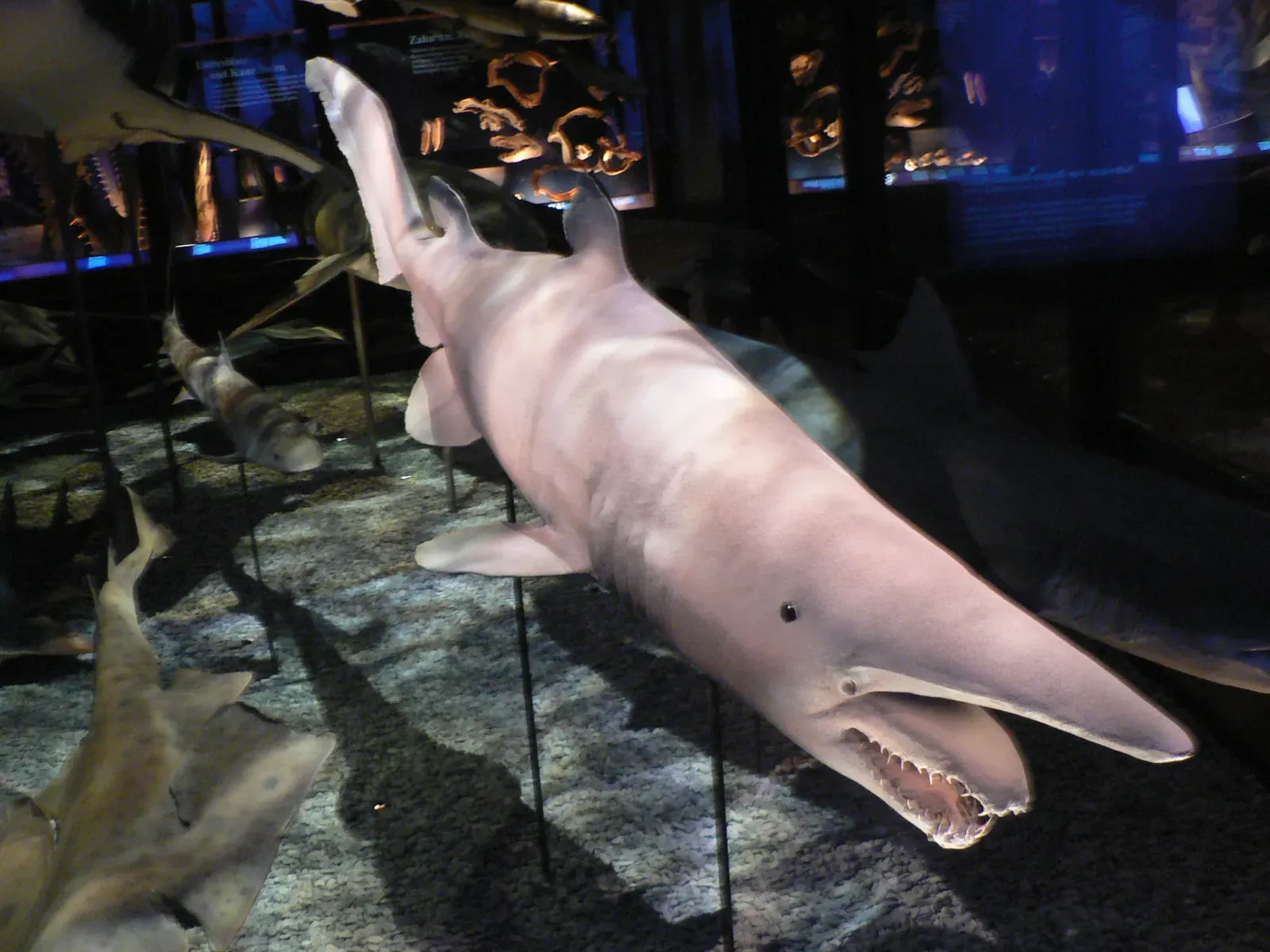
If you’ve ever imagined what a shark from the age of dinosaurs might look like, you’re probably already picturing the goblin shark. It is the only living member of the Mitsukurinidae family, whose lineage is some 125 million years old. That’s not a typo. This creature has been lurking in the deep while the world above changed beyond recognition, and it has barely evolved.
Once their sensitive snout or eyes helps them find a potential meal, the goblin shark slowly closes the distance until it can use its secret weapon: its jaws. Lined with rows of thin and pointed teeth perfect for gripping the soft bodies of prey like squids and rat-tail fishes, goblin sharks have the terrifying ability to literally sling their entire jawbone forward. Ligaments attached to the joint of their jawbone are held with constant tension in normal circumstances, acting like rubber bands that catapult the whole jaw forward at a speed unmatched by any other animals on Earth.
Very few live goblin sharks have been observed in the wild, and most of what is known about these mysterious sharks comes from individuals that have been caught accidentally as bycatch in deepwater trawling nets, longlines, or deep-set gill nets. Honestly, that’s probably for the best. There is still so much we don’t know about how they reproduce. Scientists have yet to capture or study a pregnant female.
2. The Siphonophore: One Creature or Thousands?
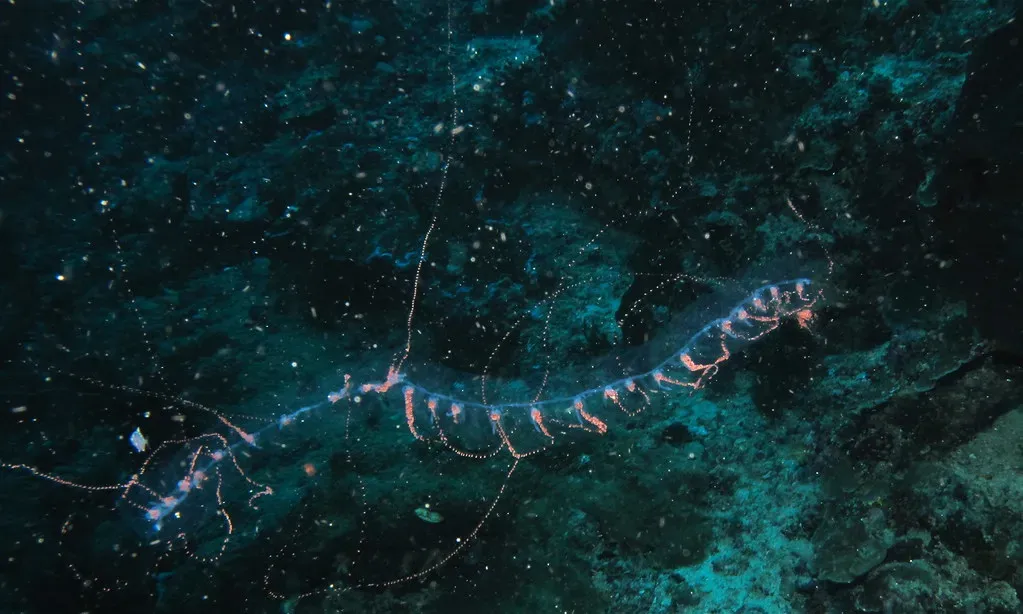
Here’s the thing about siphonophores: they challenge your basic understanding of what an “individual” even is. A siphonophore is a colony of genetically identical polyps, or zooids, that acts like one organism. Each zooid performs a function essential to the survival of the whole colony, such as catching prey, digesting food, or reproducing. Think of it like a city where every resident has one specific job, and the city itself is technically alive as a single unit.
Siphonophores can grow to extraordinary lengths, with the largest colony on record measuring 154 feet long and 49 feet in diameter. That makes them potentially the longest living organisms on the planet. Many of the animals come in peachy-pink hues because red light doesn’t travel far in the dark ocean’s depths, providing the perfect camouflage. Scientists continue to study exactly how these thousands of individual zooids coordinate themselves, almost like a nervous system that spans a creature the length of a blue whale.
3. The Vampire Squid: Neither Squid Nor Vampire, Yet Terrifyingly Fascinating
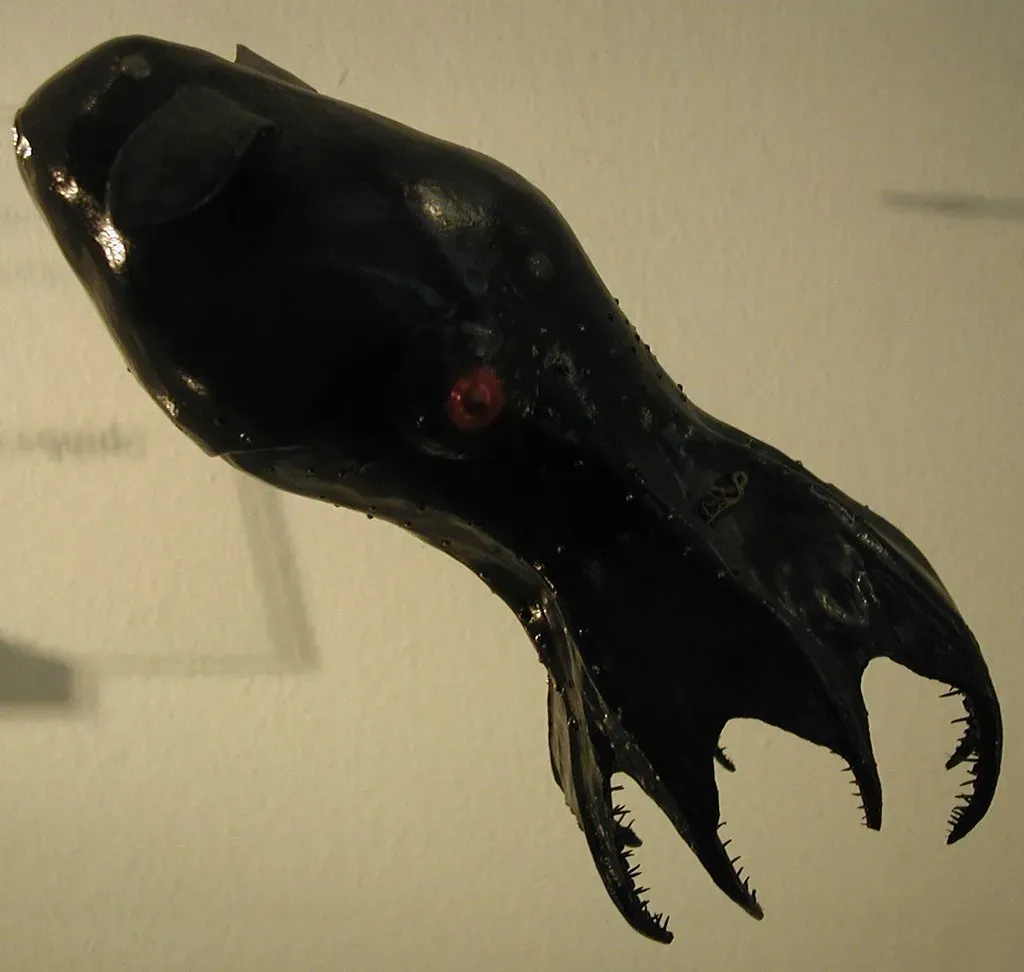
The name alone sounds like a fever dream. The vampire squid possesses characteristics of both squid and octopi, and occupies its own order in taxonomy. Its scientific classification is entirely unique. While it does not suck blood like its mythical namesake, the vampire squid is a “living relic” that evolved from an ancestor of the octopus, and its lineage goes back 165 million years in the fossil record. Let that sink in. This thing predates the extinction of the dinosaurs.
Oxygen is scarce this far down, and vampire squid inhabit what is called the oxygen minimum zone. One result of this is that there is not enough oxygen for aerobic metabolism to occur in many organisms. The vampire squid, however, is able to survive in an oxygen saturation value as low as 3% and breathe normally, something no other cephalopod can do. Instead of ink for defense, a sticky cloud of bioluminescent mucus is expelled from the arm tips. Glowing slime as a defense mechanism. I think the deep sea has officially out-weirded everything.
4. The Anglerfish: Evolution’s Most Disturbing Love Story
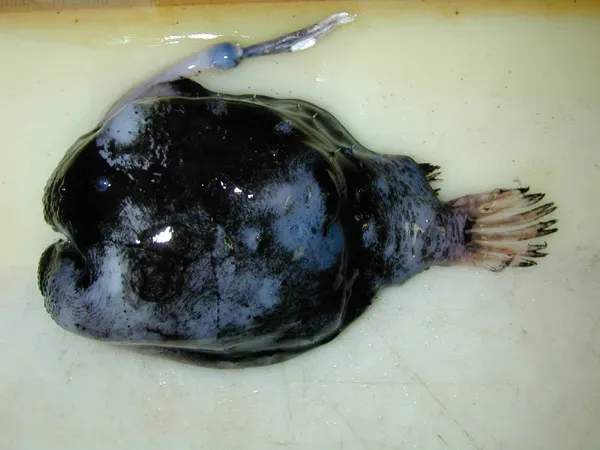
You’ve probably seen a picture of an anglerfish, but the reality is far stranger than any illustration. With over 200 species found worldwide, anglerfish are perhaps best known for their iconic “lure,” found only on the females. This specialized, bioluminescent apparatus protruding from the female’s head resembles a fishing pole with a glowing light at its tip. This clever lure attracts unsuspecting small animals in the pitch-black depths of the sea while the rest of the anglerfish remains hidden in the darkness.
Some species show sexual parasitism, where a tiny male fuses permanently to a female’s body to reproduce, an extreme adaptation to the scarcity of mates in the deep sea. The male literally dissolves into the female, merging circulatory systems, and exists essentially as a permanent sperm donor. These ancient creatures are thought to have diversified genetically in a short evolutionary period in the early to mid-Cretaceous, around 130 to 100 million years ago. For a species that old, you’d think we’d have figured them all out by now. We haven’t.
5. The Barreleye Fish: The Creature With the Transparent Head
![5. The Barreleye Fish: The Creature With the Transparent Head ([https://archive.oceanexplorer.noaa.gov/explorations/24skq-ak-seamounts/gallery/gallery.html#Exploring Pelagic Biodiversity of the Gulf of Alaska and the Impact of Its Seamounts], Public domain)](https://nvmwebsites-budwg5g9avh3epea.z03.azurefd.net/dws/ac0cc58f29e58e34beebc900d05e77df.webp)
Exploring Pelagic Biodiversity of the Gulf of Alaska and the Impact of Its Seamounts], Public domain)
Deep in the ocean’s twilight zone swims the barreleye fish, one of the strangest creatures ever seen. Its head is transparent, revealing its glowing green eyes moving freely inside a clear dome. If you haven’t seen footage of this, stop right now and look it up. It genuinely looks like something designed on a computer.
These eyes can rotate, allowing the fish to look both upward and straight ahead. Their eyes also have bright green lenses protected behind a transparent forehead, which gives the fish a futuristic appearance, almost like a sci-fi submarine. The yellow pigment in their eyes helps them distinguish between the faint bioluminescent light produced by living organisms and sunlight. This makes it easier to spot the siphonophores and zooplankton that they eat. The transparent dome may also protect those delicate eyes from the stinging cells of jellyfish. It’s an almost comically elegant solution to a very dark problem.
6. The Gulper Eel: All Mouth, No Rules
![6. The Gulper Eel: All Mouth, No Rules ([1], CC BY 3.0)](https://nvmwebsites-budwg5g9avh3epea.z03.azurefd.net/dws/5e14cad9110ac3571a055ccafd36eb92.webp)
If the ocean were designing a creature purely for shock value, it might produce the gulper eel. The gulper eel, also known as the pelican eel, is essentially a massive mouth attached to a long, ribbon-like tail. Its jaws hinge open to an almost comical degree, allowing it to swallow prey far larger than its own body in a single gulp. At the tip of its tail, a glowing pink organ pulses with bioluminescent light, luring curious prey closer before the eel snaps forward in a lightning-fast strike.
The gulper eel inhabits depths of 1,600 to 9,800 feet in deep tropical and temperate oceans worldwide. Its black, whip-like body stretches up to six feet long, tapering to a glowing tail tip used as a lure. Despite its fearsome appearance, the gulper eel feeds primarily on small crustaceans and cephalopods, using its expandable stomach to maximize feeding opportunities. The bioluminescent tail tip is a detail that feels almost theatrical, a glowing invitation to a very bad dinner.
7. The Giant Isopod: Deep-Sea Gigantism at Its Most Unsettling
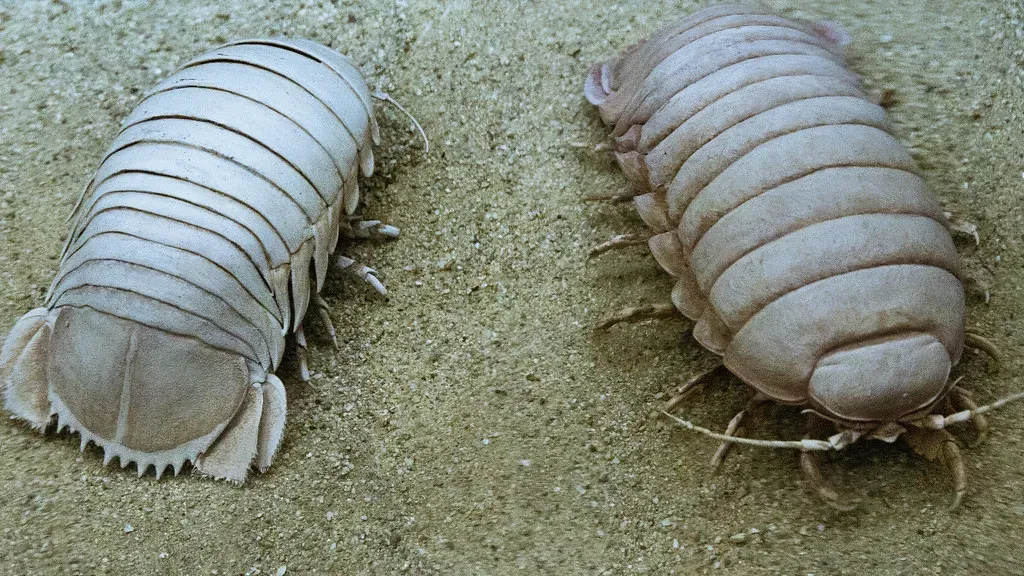
Picture a common pill bug, the little grey thing that rolls up in your garden. Now imagine it the size of a football, or larger. Giant isopods roam the seafloor, scavenging food that falls from above, such as fish carcasses. They can also swim short distances using their fan-like tails. Giant isopods are an example of deep-sea gigantism, which is an evolutionary pattern in which deep-dwelling creatures grow much larger than their relatives in other habitats.
Scientists can’t fully explain why deep-sea gigantism occurs. Theories include slower metabolisms in cold water, reduced predation pressure, and the need for larger bodies to handle extreme pressure. However, the exact mechanisms behind this phenomenon remain one of oceanography’s most puzzling questions. These creatures live deep in the ocean, at least 500 metres deep. Not much is known about these arthropods, but it is thought they are not as fearsome as they look, scavenging on whatever they can find. Terrifying? Maybe. Misunderstood? Absolutely.
8. The Colossal Squid: Bigger, Heavier, and More Mysterious Than You Think
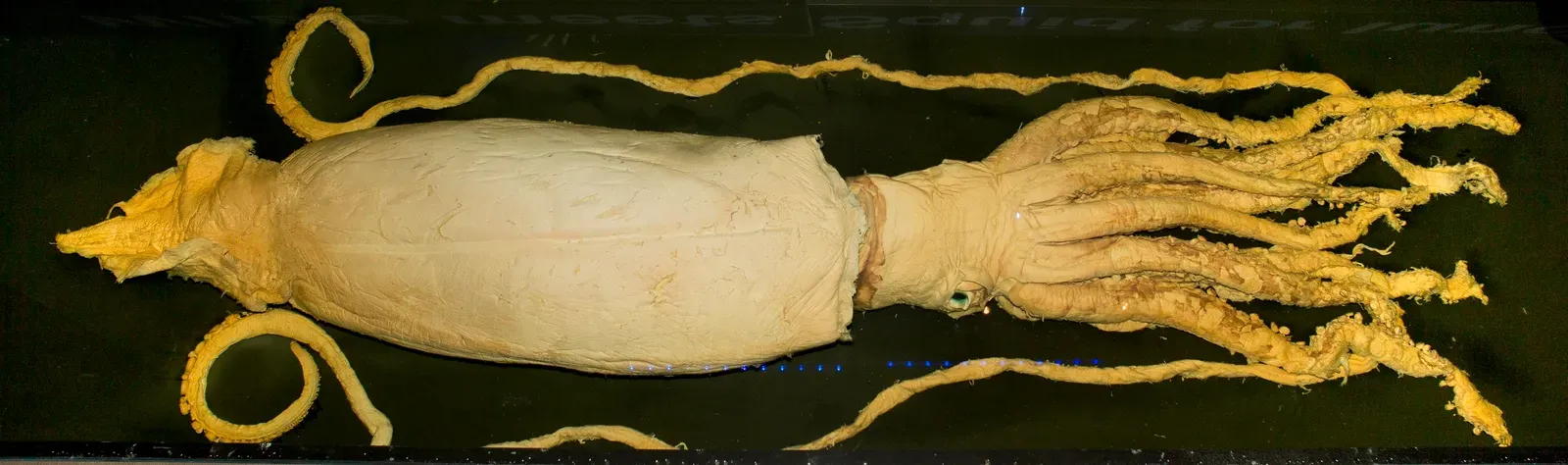
While legends of giant squids have haunted sailors for centuries, the colossal squid is the real-life leviathan that lurks in the Southern Ocean’s abyss. It’s larger, heavier, and more elusive than its giant squid cousin, with eyes the size of dinner plates, the largest in the animal kingdom. We’re not talking about a minor size upgrade here. This thing is built on a completely different scale.
Only a handful of specimens have ever been recovered, most from fishing nets or washed ashore. Its behavior, life cycle, and role in the oceanic ecosystem are largely speculative. Some scientists believe it engages in titanic battles with sperm whales, whose bodies often bear the squid’s circular scars. Other exciting finds in recent expeditions include the first confirmed footage of a juvenile colossal squid. Scientists filmed a live juvenile for the very first time in 2025, a jaw-dropping moment that only confirmed how little we actually know about its adults.
9. The Sea Pig: The Deep Ocean’s Unexpected Herd Animal
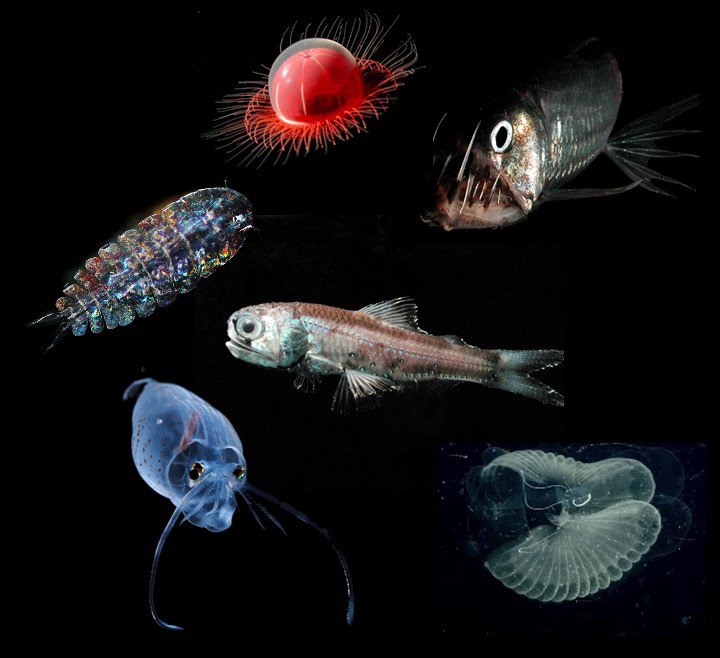
The name alone raises eyebrows. Despite its name, the sea pig is actually a type of sea cucumber. Its squishy, pinkish body and its habit of rooting through the mud are why it earned such a fitting nickname. It is a relatively small sea creature, measuring between 1.5 and 6 inches long. Sea pigs have tube-like “legs” on their undersides that help them move across the ocean floor.
The rosy sea cucumbers sometimes gather in huge herds to feast on the sunken carcasses of large animals, like whales. Imagine stumbling across thousands of these pale, lumpy creatures marching across the seafloor in the dark, drawn to the scent of a whale carcass the way a crowd is drawn to a food festival. This sea pig can be seen gently drifting more than 9,000 feet underwater. Having that much water pressing down from overhead is like having dozens of elephants stacked on top of your head at sea level. Sea pigs survive the intense pressure partly thanks to their flexible body.
10. The Bigfin Squid: The Ghost of the Deep You’ve Almost Certainly Never Heard Of
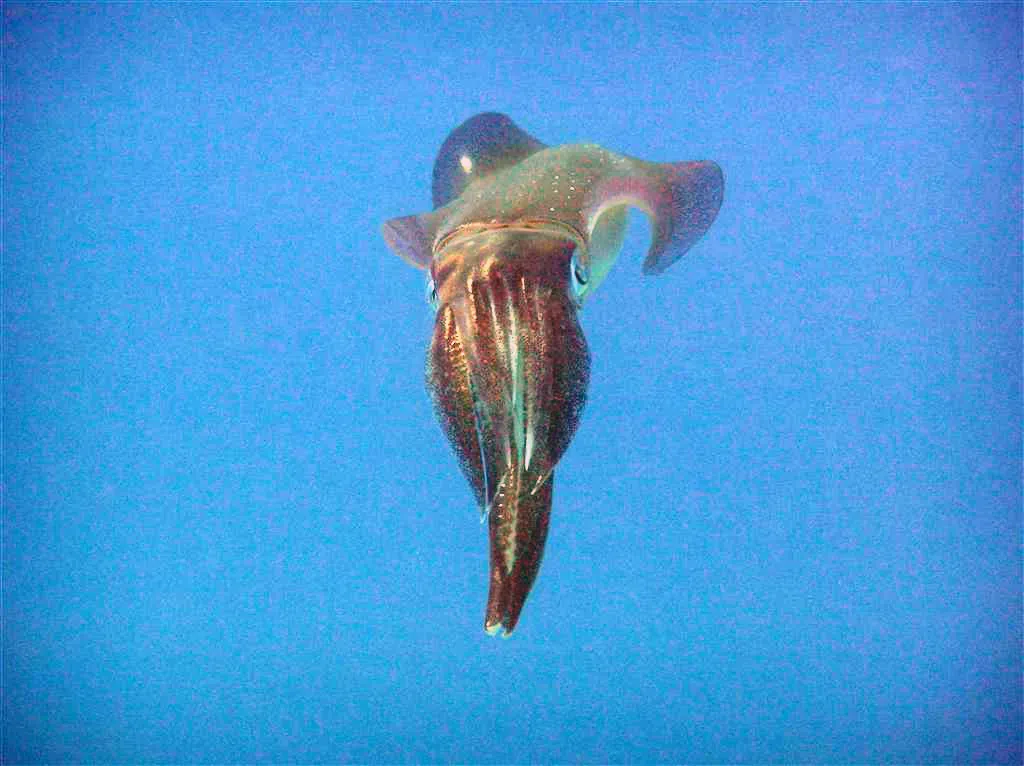
Of all the creatures on this list, the bigfin squid might be the one that haunts you the most. The bigfin squid holds the record as the deepest squid ever recorded, yet it’s been sighted fewer than a dozen times in history. Its most unnerving feature is its elbowed arms and tentacles, which dangle downward at a 90-degree angle and can stretch up to 20 times the length of its body, trailing behind it like long, ghostly wires. It uses these elongated limbs to snare prey and glides through the darkness on large, elegant fins.
Think about that for a moment. A creature with limbs stretching to potentially 20 times its body length, hovering silently in the deep dark, barely ever seen by human eyes. Discovering multiple candidate new species in such a short exploration window is not unusual in deep-sea research, precisely because these ecosystems remain so poorly sampled. The bigfin squid is a perfect symbol of everything the deep sea still holds: vast, mostly uncharted, and full of forms of life that defy our imagination even when we’re looking directly at them.
Conclusion: The Deep Sea Is Still the Final Frontier
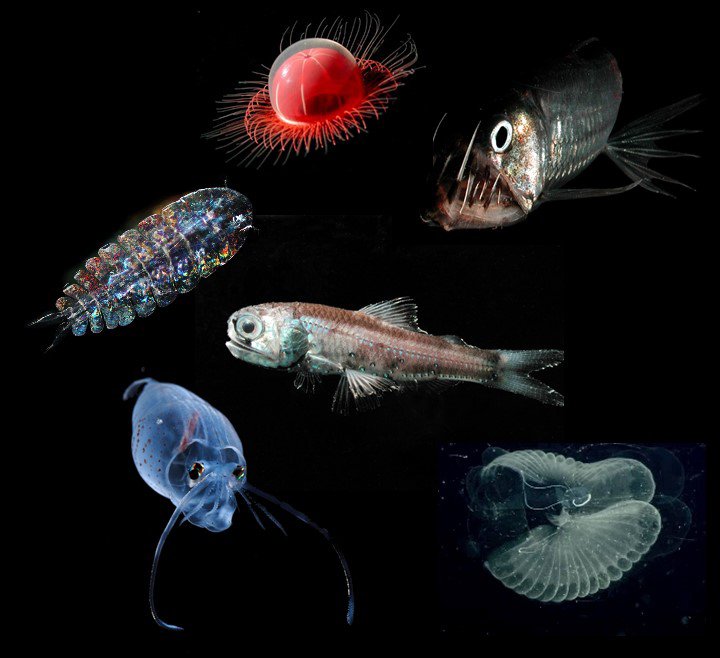
It’s easy to assume that in 2026, with all the satellites, AI tools, and scientific resources at our disposal, we must have a pretty solid grip on the natural world. The deep sea proves that assumption spectacularly wrong. The findings from ongoing expeditions reveal previously unknown branches of life and push the boundaries of how deep these creatures are known to live.
Deep-sea canyons are biodiversity hotspots and play key roles in ecosystem functioning, yet we still know very little about them. Every new expedition, every ROV dive, every specimen hauled up from the dark reminds us that the ocean is not just deep in meters. It’s deep in secrets. The creatures above are not anomalies. They’re hints. Hints that the deep sea is running a biology we’ve barely started to decode.
The most humbling part? Scientists estimate we have explored only a tiny fraction of the ocean floor. Most of these creatures may die, evolve, or disappear before we ever properly study them. So the real question isn’t what lives down there. It’s this: what are we missing? What would you guess is still hiding in the dark, waiting to be found?